

Posts Tagged ‘camera-trap’
Forty Tigers…!
India’s amazing big cats
About 20 years ago when I began wildlife photography, I dreamed of going to India to photograph tigers. The rich biodiversity found on the sub-continent is without equal and boasts the largest population of the big striped cat in the world.
My first tiger in India; one of four cubs around ‘Telia Lake’ in Tadoba-Anhari-2013…!

Tiger cubs sparring in Telia Lake, Tadoba-Anhari..a once in a lifetime shot…!
The first photographic book in my library on wildlife is titled ‘Wild India’ by the renowned British photographer, Gerald Cubitt and published by New Holland in London. He traveled all over India capturing most of the wild animals on film including the majestic tiger. The urge to go after this big cat burned in me for many years.

‘Telia lake’ cub up-close on my third morning in Tadoba…!
In late-2009, I photographed an Indochinese male tiger (though the lens) in Thailand from a blind which is a very difficult feat to accomplish. These carnivores are so smart and extremely wary, and tough to see in the wild let alone photograph. I also camera-trapped many tigers in several protected areas situated around the Kingdom.

Tiger cub near the road in Tadoba…!
Tadoba-Andhari Tiger Reserve – Maharashtra State – Count: 11 tigers…!

Tiger cub hunting chital at Telia Lake…she was hesitant and missed the deer…!
But the desire to visit India burned in me until I finally made my first trip in April-2013 to Tadoba-Andhari Tiger Reserve and National Park. I was with my good buddy Luke Stokes who is an up and coming photographer in his own right, and he lives in Thailand like me. We made the flight from Bangkok to Hyderabad, and then the 9-hour taxi ride to the park. I was finally in the ‘Land of the Tiger’…!
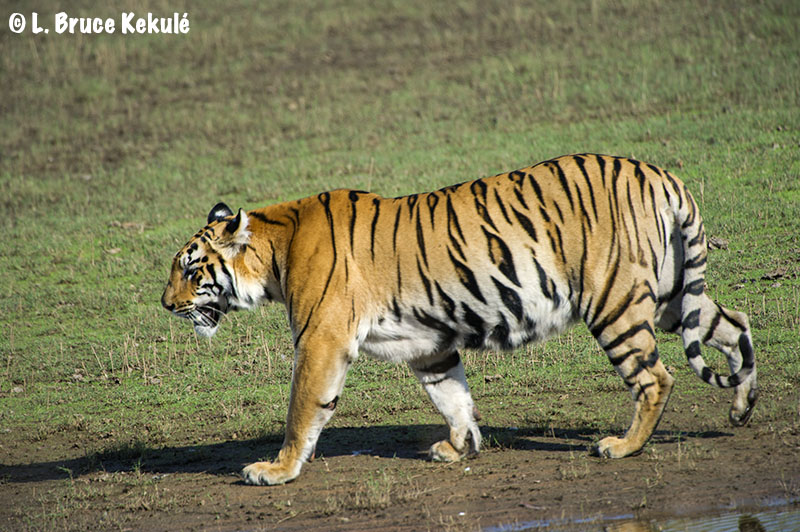
Old ‘Wagdoh’ (Scarface) at Telia Lake…he still is the dominant male in this area…!
At the time, Tadoba was one of the top reserves for tiger sightings in India with four tiger cub sisters growing up around Telia Lake. On our second morning, I managed to get a once in a lifetime shot of two sisters sparring in the water. I was certainly off to a good start.
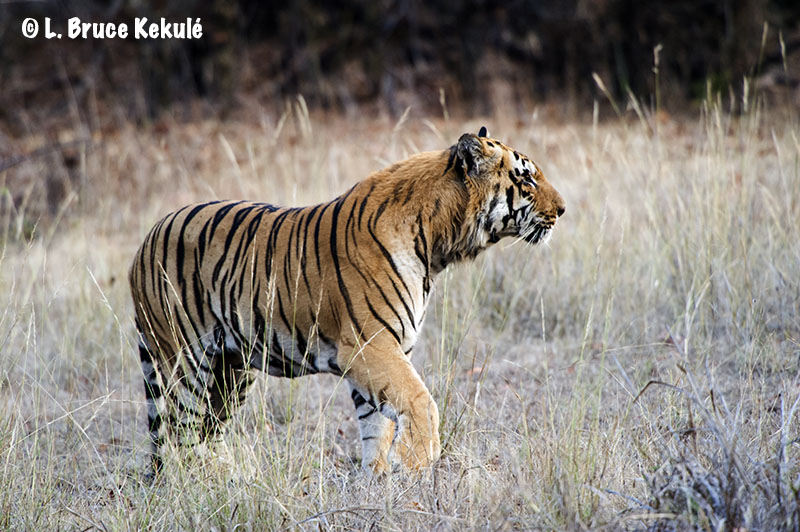
‘Wagdoh’ on the third morning by the road…!

‘Wagdoh’ at the lake the next day,,,!
The next morning, we bumped into the dominant male and father of the four sisters; old Wagdoh (Scarface) out on the road, and a day later, photographed him at the lake. We also got the other two sisters around the lake during the week. Then, we got a breeding pair over in Tadoba National Park as they went about their natural business.

A breeding pair over in Tadoba National Park…!
On our next to the last day in the park, one of the sisters (the jumping tiger facing me) made an appearance near the road to say goodbye, and I got some wonderful close-up shots of her.

Tiger cub by the side of the road saying goodbye…she is the same tiger facing me in the sparring shot…!
Then in early-2015, I made a second trip to Tadoba and managed to get three tigers including Maya T12, Choti Tara T17 and finally, ‘Gabbar’ or ‘Leopard Face’ T42 that had been injured in a fight with another male tiger.

‘Maya’ or T12, is a mature tigress in Tadoba, 2015…!
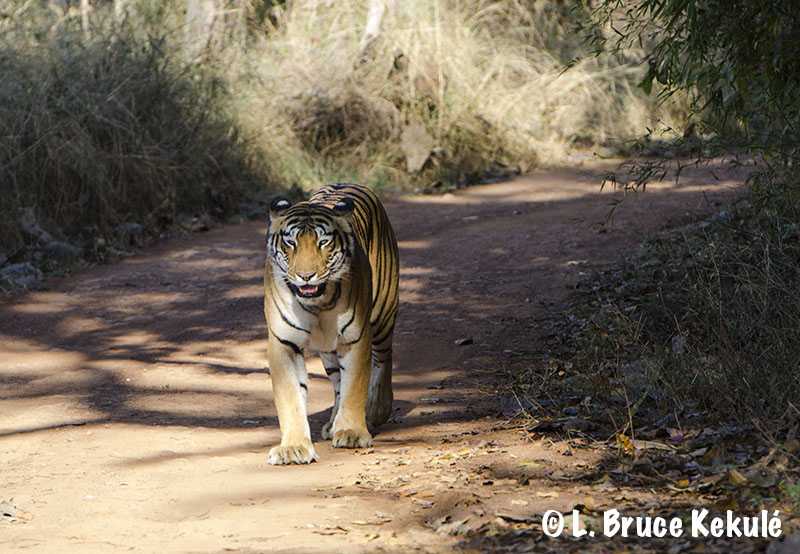
‘Choti Tara’ or T17, another mature tigress on the road in Tadoba National Park…!

‘Gabbar’ or ‘Leopard Face’ or T42 with a radio collar cooling off in a pond in Tadoba National Park…he was badly injured fighting with another male…!
Ranthambore Tiger Reserve – Rajasthan State – Count: 6 tigers…!
In November-2014, I visited Ranthambore that is India’s most famous tiger reserve. On the third morning of my 7-day safari, I managed to photograph the very infamous dominant male tiger named ‘Ustad’ or T-24, and then later that day got another male named Zalim or T-25, and one of his cubs (he was looking after two cubs at that time).

The infamous ‘Ustad’….I caught him in Zone 1 on my third day…!
Then the next day, I got Ustad’s son ‘Sultan’ or T-72 two days in a row. Finally, I snapped ‘Krishna’ or T-19, an equally legendary tigress. Shortly after that, ‘Ustad’ was thrown in a zoo (jail) on trumped-up charges of killing a forest guard. It became a world-class scandal. Poor ‘Ustad’ was out and never to be photographed in the wild again..!
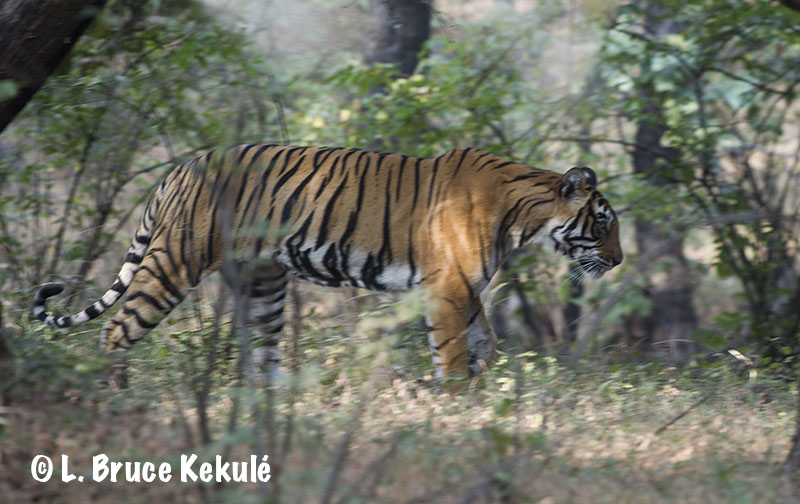
‘Zalim’ out hunting…he had left his two cabs in the bush…!

‘Zalim’s’ cub in thick bush. This was the only shot I got of this young tiger…!
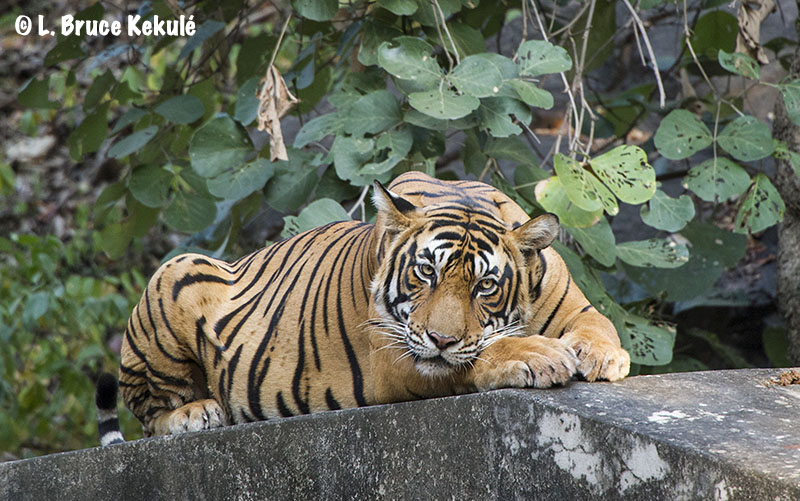
‘Sultan’ looking bored in Zone 6…one of my favorite tiger shots….! A huge crowd of hundreds of Indian tourist had should up behind me…!

‘Sultan’, son of ‘Ustad’ the next morning, also in Zone 6…!
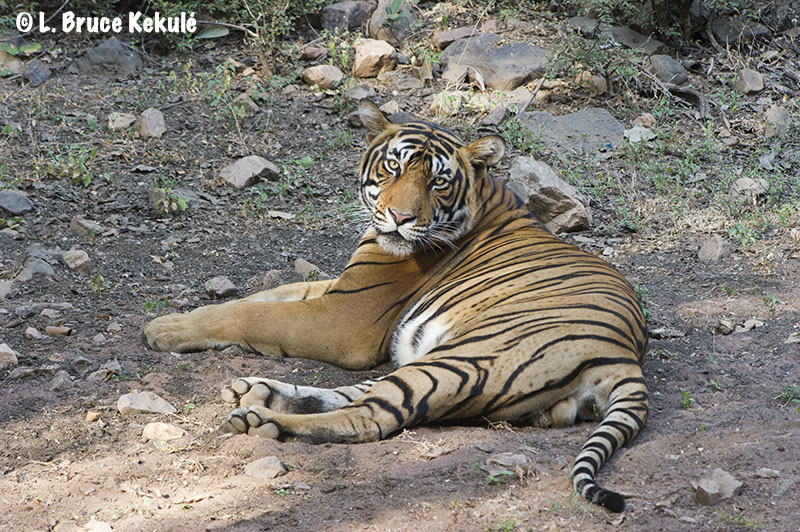
‘Sultan’ saying goodbye in Zone 6…!

‘Krishna’, a tigress near the Ranthambore Lake…!
Bandhavgarh Tiger Reserve – Madhya Pradesh State – Count: 7 tigers…!
When I made my first trip to Bandhavgarh in November-2014, I was not lucky and did not see any tigers over a four-day visit except for some pug-marks. But in early-2015, I made a second trip to the park and on the finale day of my 4-day safari, got a sub-adult male in the morning and then in the afternoon, photographed ‘Dotty’, a very famous tigress in Zone 2.

A sub-adult male tiger in Zone 2 in 2015…a lucky encounter after 4 days of no sightings….!

A tigress named ‘Dotty’ in the afternoon on day four…another lucky shot…!
In early March of this year (2017), I made my third visit and caught a sub-adult male in Zone 3 on the very first afternoon. The next morning, I bumped into ‘Spotty’ (sister of ‘Dotty’) and two of her cubs (8-9 months old) in Zone 1. On my next to the last safari, I bumped into ‘Solo’ in Zone 2, a mature female at distance for a nice tiger habitat shot as she sat in the morning sun looking for prey.

A sub-adult male on my first day in late afternoon on March 2017 in Zone 3….!

On my second day, we bumped into ‘Spotty’ (sister of ‘Dotty’) and her two cubs in Zone 2…!

‘Spotty’s’ cub on the road in Zone 2…!
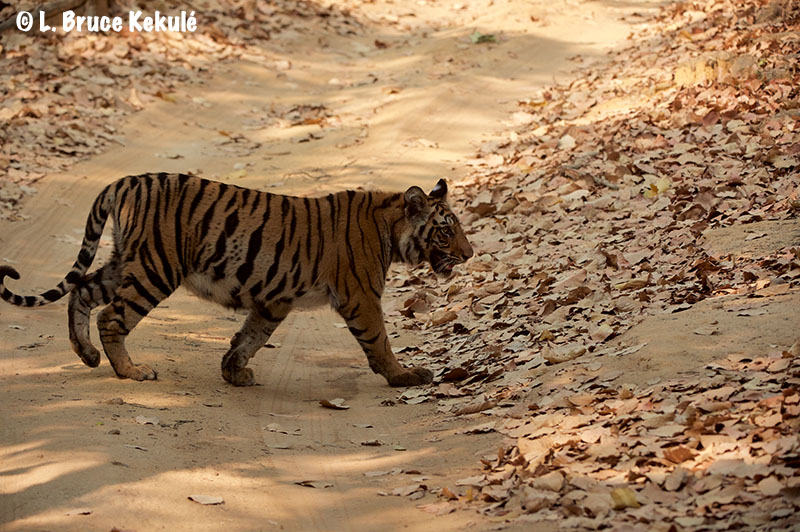
‘Spotty’s’ other cub following her sibling and mother….!

A tigress named ‘Solo’ out in the morning sun waiting on prey….!
Kanha Tiger Reserve – Madhya Pradesh State – Count: 1 tiger…!
In early-2015, I visited Kanha Tiger Reserve. Sightings were down at that time but I finally was able to catch the ‘Budbudi’ female tiger one morning as she walked, roared and scent marked looking for a mate. She came real close to our jeep and crossed in front of us, and then posed on the other side.

‘Budbudi’ female tiger marking territory in Kanha…!
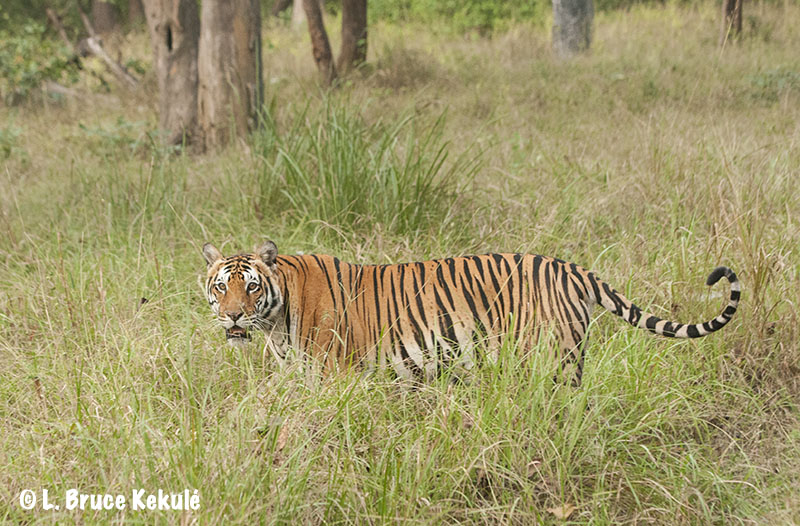
‘Budbudi’ female on the other side of my jeep…!
Pench Tiger Reserve – Madhya Pradesh State – Count: 8 tigers…!
In early-2015, I also traveled to Pench and on the very first morning, got the ‘Patdev’ female tigress and photographed her again in the afternoon. The next morning, I got a sub-adult male. On the third morning, I managed to get some great close-up shots of the very famous ‘Collarwali’, a female tigress with seven litters and 26 cubs to her name.
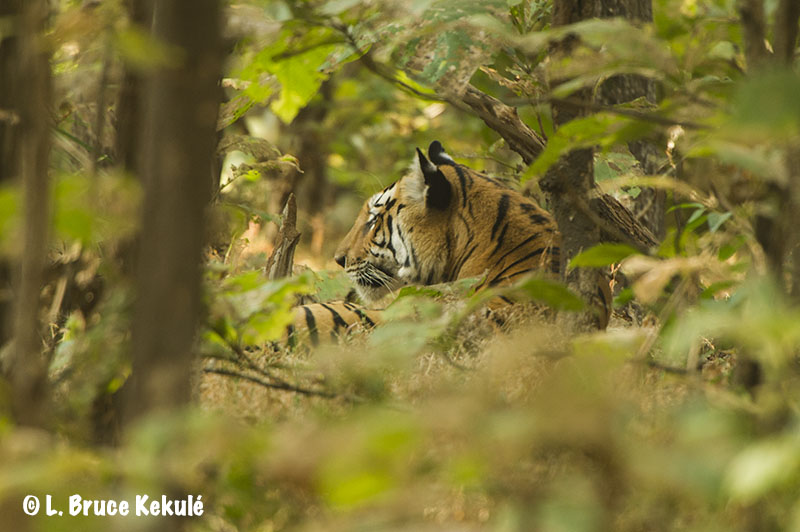
‘Padtev’ tigress in Zone 1 on the first morning in the bush…!

‘Patdev’ tigress in Zone 1 in the afternoon (second sighting that day)…!
 tev
tevSub-adult male on my second morning…!

‘Collerwali’ on the road in 2015 early the third morning….!
In early-2016, I made a second trip to Pench and photographed ‘Collarwali’ and her two cubs. Then, I got the famous ’Raiyakassa’ male tiger the next afternoon.

‘Collarwali’ still sporting a collar in the early morning on the first day in 2016…!

‘Collarwali’ yawning out in the morning sun..

‘Collarwali’s’ cub and mother resting in the morning…!

‘Raiyakassa’ male tiger and ‘Collarwali’s’ mate in Pench near the lake on March. 2016
I just finished my third trip to Pench but after four days, I left empty-handed. The Forest Department had just burnt fallen leaves along all roads to create fire-breaks and I believe this pushed all the tigers into the interior. There were no sightings in the park at all since the burning.
Panna Tiger Reserve – Madhya Pradesh State – Count: 2 tigers…!
In early-2016, I also traveled to Panna Tiger Reserve. As most people know, Panna lost all their tigers due to poaching sometime in 2009. The Forest Department decided on a reintroduction program and moved several tigers including a female named T-1 from Bandhavgarh into Panna.
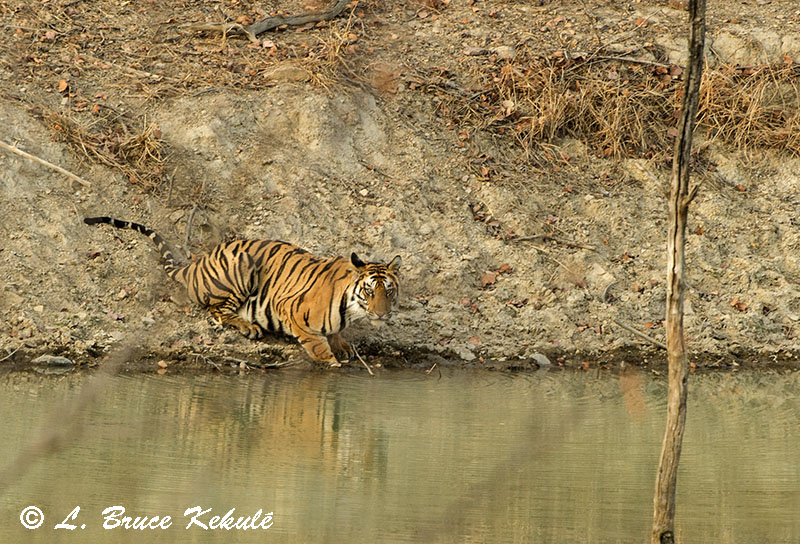
A female cub from the ‘T-1 female’ introduced from Bandhavgarh Tiger Reserve…!
On my very first afternoon, I was lucky and photographed T-1’s female cub at a waterhole. On my third and final day, I got T-1’s other female cub at another waterhole.
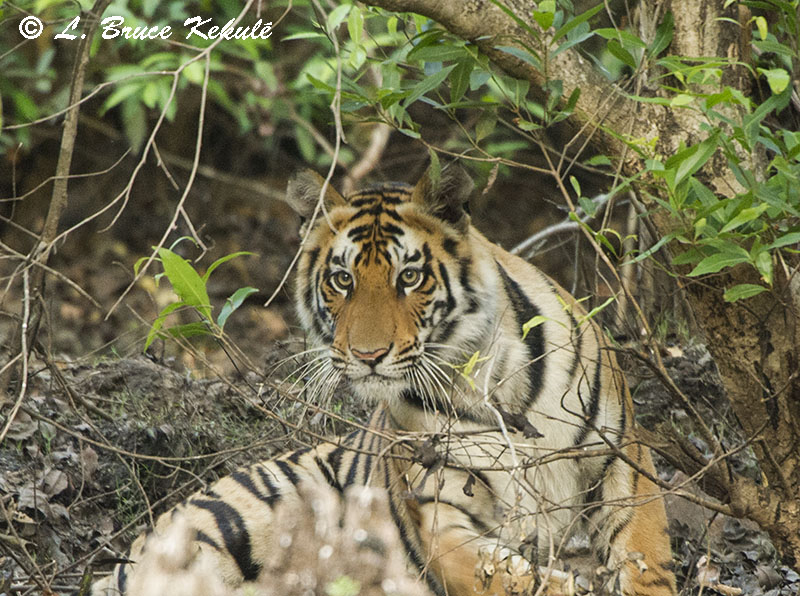
Another one of ‘T-1’s’ cubs. This was on my way out of the park…she said goodbye…!
Corbett Tiger Reserve – Utterakhand State – Count: 3 tigers…!
Of course, no trip to India would not be complete without visiting Corbett Tiger Reserve in Northern East India. This park is named after the very famous Jim Corbett (naturalist, photographer, author and hunter of many man-eating tigers and leopards in India).
In early-2015, I managed to catch a young female tigress chasing chital deer in the Dhikala grasslands not far from the camp. Throughout that day, we saw her several times.

A young tigress in the Dhikala grasslands chasing chital deer…2015…!
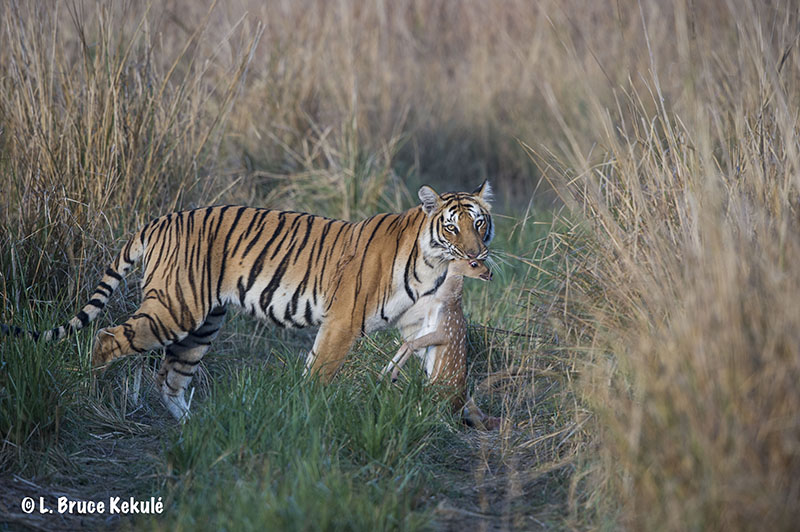
‘Parrwali’ tigress near the Ramgangar River with a chital fawn in her jaws…2016…!
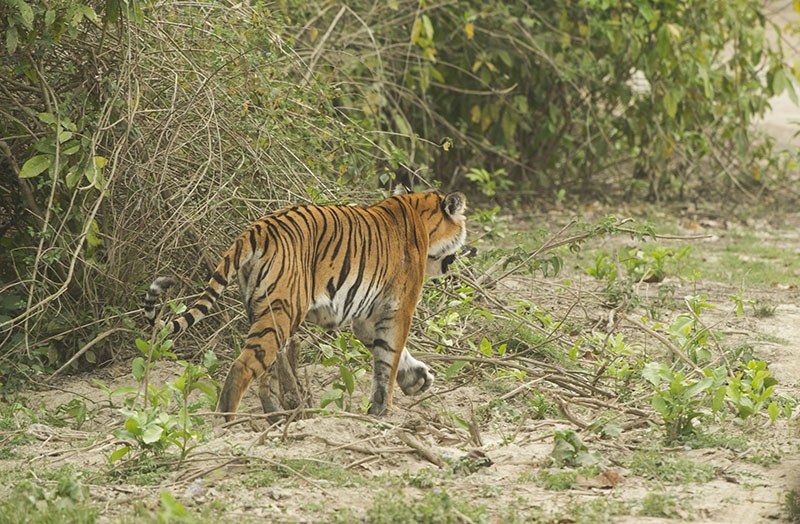
Parrwali on ‘Sambar Road’ not far from Dhikala camp…!
In early-2016, I photographed Corbett’s most famous female tiger at the moment named ‘Parrwali’ with a chital fawn kill in her jaws across the Ramgangar River. This is my best shot of a tiger in India so far; predation is tough to get and I was lucky. I then caught Parrwali and an un-named sub-adult male tiger on ‘Sambar Road’ the next two days.

A mature male tiger crossing the road not far from Dhikala camp…a habitat shot…2017…!
I have just returned from a trip to Corbett in Dhikala and Birjani areas. On the second morning in Dhikala, a male tiger crossed the main road through the ‘Sal forest’ in mid-morning not far from camp and I was able to get some nice shots in the morning sun. In Birjani, I did see the famous ‘Sarmilly’ female tiger in the afternoon on the second day but she stayed hidden for the most part and I did not get a photo.
Kaziranga National Park – Assam State – Count: 0 tigers…!
In Early-2015, I traveled to Kaziranga, one of India’s greatest wildlife reserves with some 2,400 Asian one-horned rhinos, 1,300 wild water buffalos and 1,000 Asian elephants. There are suppose to be about 200 tigers in the park. However, I did not get a tiger but only a set of pug-marks one morning.
Satpura Tiger Reserve – Madhya Pradesh State – Count: 0 tigers…!
In early-2015, I traveled to Satpura but did not see a tiger. They are very difficult to see here.
Vanghat (Private) Eco-lodge – Utterakhand State – Count: 1 tiger…!
I have always wanted to use camera traps in India but the Forest Department does not allow outsiders to do this in any of the tiger reserves, and for the most part is set aside for their own research teams. After some consultations with the owner of an eco-lodge near Corbett, it was decided to set a DSLR camera trap near the Ramgangar River up a mountain ridge line. I managed to get a great shot of a young female tiger on the second night.

Young tigress camera trapped in the Corbett landscape up a ridge line near the Ramgangar River….2016…!
You can say I’m hooked on photographing tigers in India. I’ve just finished my sixth trip and got 6 tigers this time. I look forward to future visits to add more tiger shots to my files.
Note: This number is the actual tigers photographed with some duplication. Nikon D3s, Nikon D4s, D3oos bodies and Nikon 200-400 and Nikon 70-200 Telephoto lenses were used plus a Nikon D3000 for the camera trap shot…!!

A camera trap set at Ken River Lodge – Panna Tiger Reserve – India
Nikon D3000 travel cam catches a palm civet, jackals, wild boar, langur monkey and a semi-feral cat…!

An Asian palm civet in a dry stream bed at the Ken River Lodge, Panna Tiger Reserve, Madhya Pradesh, India…!
In March 2016, I made a trip to Panna Tiger Reserve in India after tigers. I was lucky catching two sisters, the offspring of T1, Panna’s first tiger reintroduced from near-by Bandhavgarh Tiger Reserve. Poachers completely wiped out the big cat in Panna in one year during 2008 but there are 32 tigers thriving now which is an amazing conservation success story.

Jackal shown here bolting from the flash…! These canidae usually travel in pairs…!
I stayed at the Ken River Lodge outside the reserve several kilometers from the front gate to the park. Pugpundee Safari Company manages this hotel plus others in Bandhavgarh, Pench, Kanha and Satpura tiger reserves in the State of Madhya Pradesh.

A wild boar scavenging in the stream bed…!
The owner wanted to see what was roaming the grounds and invited me to set a camera trap in a dry stream bed not far from my room. After two weeks, I came back through to check the Nikon D3000 with a Nikon 24mm manual lens, one Nikon SB-28 flash and a SSII external sensor.

A gray or ‘Hanuman’ langur leaf monkey during the day….!
The cam caught a palm civet, a pair of jackals, a wild boar and a langur monkey plus a semi-feral cat. Although not as glamorous as a tiger or leopard, these wild creatures are still just as important to the ecosystem excluding the cat. Leopard tracks have been found near the river..!

A semi-feral cat; sometimes this feline was found sleeping up at the resort…!
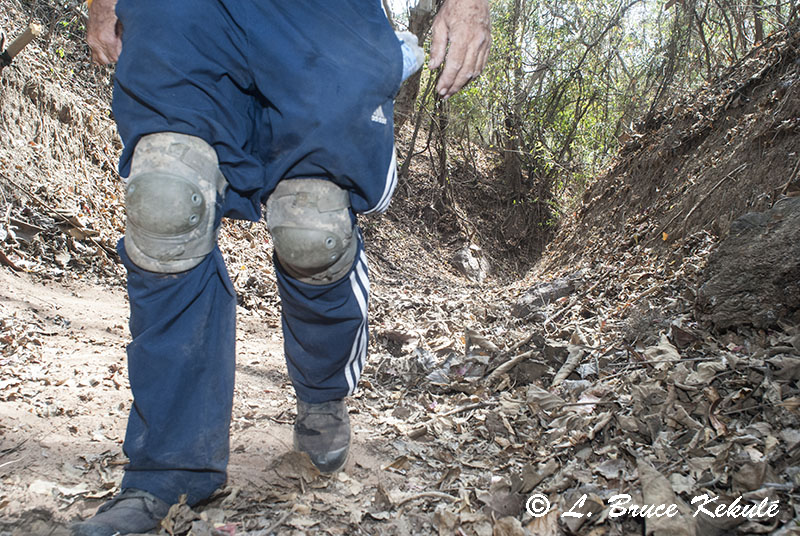
The ‘tiger hunter’ with knee pads walk-testing the D3000…!
Male leopard crosses ‘tiger log’…!
Last month, I had a hamburger at a joint close to my house up-north in Thailand. The next day, I was admitted to hospital with a ‘acute’ food poisoning. It has taken almost a month to get back to normal, hence not much camera trap work from my end. However, I finally got to my only Nikon D700 DSLR trail camera and got a pleasant surprise.
A male leopard (can just see his family jewels) crossing my ‘tiger log’…this is in the ‘Western Forest Complex’ of Thailand…! Daytime shots of leopard are rare for the most part but it does happen here where I work from time to time…Enjoy…!
Camera settings: 1/160 sec; f/8; ISO 400
Nikon D700 – Nikon 35mm manual lens – Two Nikon SB-28 flashes – SSII external sensor

Asian leopard crossing ‘tiger log’ in Huai Kha Khaeng, western Thailand
Canon 400D catches an old Asian tapir and clouded leopard
Southern Thailand’s natural heritage – an odd-toed ungulate and a carnivore

A mature Asian tapir caught by a Canon 400D trail cam…!
Just returned from Khlong Saeng Wildlife Sanctuary in the south of Thailand and pulled my Canon 400D camera trap. These shots are of an old Asian Tapir and the best ones in this set as shown here. Being odd-toed ungulates and strictly vegetarian, these large herbivorous mammals thrive quite well in this unique ecosystem made up of moist evergreen forest. These unique creatures have been on the planet for about 40 million years. They are the largest of the world’s four species with the other three in South America…!


This tapir almost looks pregnant…!

A clouded leopard in daylight…!
This cam also caught a clouded leopard but the cat came in a bit low. These cats are not normally out in broad daylight but I guess they do sometimes prowl during the day. That was the trade off for the full-frame tapir shot. This sanctuary is simply amazing and I look forward to future visits…! Enjoy…!
Indochinese tiger male caught on video and DSLR
A video and still photos of an Indochinese tiger in the Western Forest Complex of Thailand. This male cat was camera trapped in the afternoon and then in mid-morning…a beautiful carnivore.
The message is the same: these magnificent cats need 100% increase in protection and enforcement as they have become extremely rare in the wild. Unfortunately, some bad people chase after them for bones to be sold on the black market…! The main worry is that help will come too little and too late to really save the tiger and other creatures of the Thai forest…! Enjoy the beauty of raw nature but never forget this message: We need to work hard to change things so these magnificent cats will continue to roam the forest…!
Canon 600D catches a big male tiger
A lucky catch in late afternoon…!

I was finally able to set my Canon 600D with two Nikon SB-28 flashes on a trail where I previously set my BFOutdoors P41 and captured tiger, yellow and black phase leopards plus many other creatures found in this forest. It has been a great location and the set has been very productive.
However, the sensor was not working properly (old #5 with refresh) and run the batteries down. I recently got the #5 program without refresh (many thanks to Johnnydeerhunter on Camtrapper.com) and installed the new chip. It worked like a charm and the Canon will fire off 6 shots a second and wake-up the flashes. The cam and flashes were working great when I left it. I also set up a DXG 567 ‘blackflash’ homebrew video cam close to the Canon to record any animals that passed by (I’ll be posting a video of this cat passing the cam twice).
It has been extremely wet and for some odd reason, the flashes stopped working but the camera continued to crank along. I was pleasantly surprised when I visited the location a couple days ago. On the card was a male tiger that walked past the cam at 4:40PM on October 4th but the flashes did not trigger which created some undesirable noise in this image. This shot is the best of the lot with some highlights on his family jewels and legs, plus a superb back-lit forest. Needless to say, I was still happy with the results and will put this Canon back ASAP…the location certainly has potential and my hope for that black leopard continues…one of these days….Enjoy…!
Nikon D700 catches an Indochinese female tiger sporting a radio collar…!
Tiger research in the Western Forest Complex (WFC) of Thailand

Indochinese tiger female sporting a ‘radio collar’ at the tiger log…!
First off, I want everyone to know that I’m not against research that is extremely important for knowledge of the natural world. The practice of studying animals and behavior is needed to understand how Mother Nature’s beings and biospheres live in a complex world. Some people might take offence to the relevant facts stated below but things need to change quickly in order to really save the tiger, and other creatures and ecosystems of Thailand’s natural heritage.

Close-up: A serial numbered tiger and the number can be seen written on the collar.
Frankly, there are some projects that are on-going and not up to standard that have caused many tiger deaths, directly and indirectly. Such is the ‘tiger research’ carried out that is mediocre to very poor to say the least. The researchers working on tigers here have a track record that simply is not acceptable…!
Many problems have come to the forefront about the system of capturing the big cats with snares and then shooting them with darts to sedate them. Some tigers have escaped the snare and ended up with a limp because of pulled joints, tendons and ligaments. This is a serious problem as the cat now cannot chase down its normal prey like deer and pigs, and quickly dies of malnutrition. Botched tiger captures using wrongly administered drugs to sedate tigers has also been noted. The tigers could not be revived and the animals were simply buried and the news suppressed.

Serial numbered tiger – #164 900 – 2014
Another problem of making broad statements about the amount of tigers in certain areas and broadcasting this plus other pertinent ‘radio collaring’ information on national TV channel is like sounding the death knoll to come and get these magnificent creatures. There are still many bad elements in our society and these cold-blooded killers think nothing about dispatching a tiger for its bones used in the making of Chinese medicine and wine. It’s all about money and human greed…!
This has also happened in India where researchers published their work in the local newspapers, and on the radio and TV how many tigers were in Panna Tiger Reserve and within one year, the cats completely disappeared as poachers moved in and systematically killed them all in one quick swoop. Tigers like all big cats, come to carrion and if a carcass is tainted with poison, it’s just a matter of time before the whole local wild feline population is wiped out. They disappeared under the forestry staff and researcher’s noses. Because it is in open forest, other animals like bears, civets, all the cats, wild pigs. vultures also perish. How could this happen..?
Other stories on the Internet can be found about tigers with collars not breeding very well was also documented in India. Finally, researcher’s laptops have been hacked into and important GPS data on tiger whereabouts was stolen. These high tech poachers can kill a population in a jiffy.
Putting collars on young tigers is a serious no-no but this has been done here in the name of research with the researchers finding the collar had stopped moving and the cub found dead having quickly out-grown the leather strap suffocating it. Another serious occurrence of taking tiger cubs out of their den for research data gathering purposes, and then coming back a second time to photograph the researchers holding the cubs. The mother tiger abandon the den and the cubs ended up dead. This is a serious breach of protocol and the National Parks law…!
Needless to say, these people continue to carry on like nothing has happened but these are facts backed-up by reliable sources and boots on the ground. And what is really worrisome is the fact that several international NGOs and a U.S. university are backing this program.
Other tribulations like bringing domestic cattle to act as ‘tiger bait’ was ongoing until recently, and who knows if any disease like ‘foot and mouth’ or ‘anthrax’ was introduced into the sanctuary during this time. The cattle were purchased locally (sometimes, diseased cows are illegally imported from nearby Burma). This baiting technique was used for several years and the researchers brought these domesticated cattle in by the truckload. A cow was then tied to a stake and a bamboo enclosure built around it with only one opening and they built scores of them in the forest. Of course hay and water were provided to the cow. A tiger would step in and maybe get snared. This practice fortunately has been suspended. This is just another breach of the law where domesticated animals are not allowed in wildlife sanctuaries that have been set aside for biodiversity and research.
The researchers already have loads of data including identifying individuals and home-range information through camera trapping, plus the data from the 8-10 collared tigers. My feeling is that the collaring process should cease as there are far to few tigers left in the wild. No amount of research can justify even one tiger getting killed in the name of science. There are only about 3,200 left in the world, and maybe less than 250 in Thailand. It is time to seriously concentrate on protection and enforcement only and less emphasis put on research. We already know there are tigers in WFC, one of the greatest tiger reserves in the world.
Most unfortunate are the old laws that apply to wildlife and protected areas that seem to perpetuate lawless people from being put away in jail. Most poachers and forest product gatherers get light fines and a slap on the wrist when apprehended in national park land, even with solid evidence. The park officials must bring all poachers to the local police station, which then starts another wheel of corruption at a higher level. If the case gets into the courts, pay-offs are used to get light sentences and sometime off ‘Scott-free’. There are very few convictions and long-term jail sentences although once in awhile, some do end-up in jail as a consequence but the ratio of convicted poachers to released offenders is small.
The biggest problem is simply there are not enough ranger personnel to look after these remaining tiger reserves and, budgets are slim and sometime non-existent. My biggest concern is that everything will come too late to save the tiger from extinction. Lawmakers and budget people need to get their head out of the sand but that will take an act of god (AOG) to get going in a culture that thrives on corruption.
One of the most important things to get established in Thailand is a dedicated ‘ranger school’ so that the ranks can be filled with well trained and equipped personnel. The present ranger numbers need to be increased by over 100%. Several revolving 5-man teams need to patrol with men always in the forest from their respective ranger stations. This is the only way to keep the poachers at bay. Again, this will basically need an AOG to get done.
Once again, I’m not against research, but a line must be drawn in the sand. Too much money and effort goes towards this activity and very little into protecting the wildlife and biospheres here that the researchers are researching. This is just not right and I for one, want to try and change things here so that wildlife at least gets a fair shake.
At the end of the day, the only thing that will help Thailand’s tigers in the long run is also a serious look into the middlemen and end-users of tiger bones and other forest products. These people must be apprehended and the masses educated to see the fallacy in using wild animal parts to cure ailments. The Asian medicine trade is still in full swing and will be next to impossible to stop.
But this practice has been going on for hundreds to thousands of years in China where the tiger first evolved two million years ago. The Chinese tiger is extinct in the wild but they now have loads of ‘tiger farms’. Unfortunately, wild tigers are the most sought after for the black market trade. It is a bad situation out there that seems to be getting worse and on the increase due to the ever-increasing population explosion. Sadly and in the long-run, the tiger will simply disappear if things do not change..!
Sony P41 catches tiger and black leopard
Last month I posted some photos collected from my BFOutdoors P41 trail cam and decided to leave it for one more set. The following pics are what the great little trail cam has captured. Of note: I got four captures of a black leopard which is simply amazing….plus I two Indochinese tigers…I have moved this cam to another location further up the road and have installed my Canon 600D on the tree across from the daytime black leopard shot so that could also be interesting when I visit in a few days…two deer species and a banteng also crossed in front of the P41…Enjoy..!

A black leopard in the afternoon: A Canon 600D is setup on the tree opposite the leopard…!

A female tiger at night.

A male tiger in late afternoon.

Another black leopard capture.

Back again.
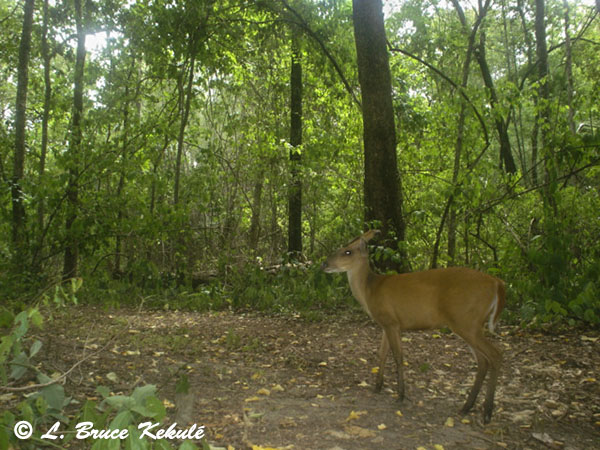
A male muntjac (barking deer).

Male muntjac again.
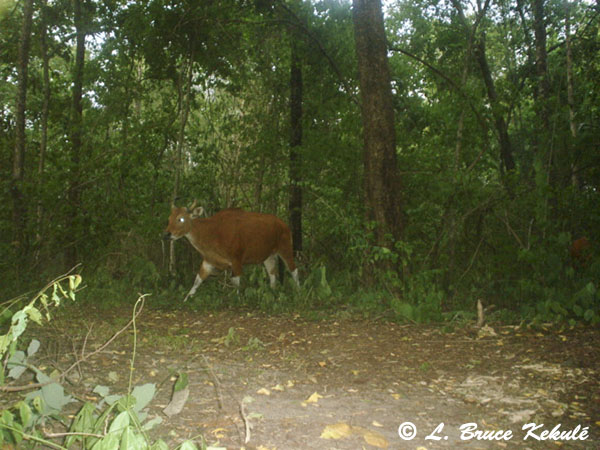
A banteng crossing in the daytime.

A young sambar stag in velvet.
My smallest DSLR camera trap…!
A ‘Hybrid’ trail cam – Sony A55 DSLR/Minolta 50mm macro lens
Sony A55 DSLR – Minolta 50mm Macro lens.
DSLR trail cameras for the most part are pretty big. Camera-trappers have built them mostly using the Pelican 1200 and even the 1300 case, and other makes like Plano and Seahorse large cases have also been used.
I have built a few now and like the smaller Pelican 1150 for my Nikon D700 and D300s plus a Canon 400D and 600D with 8-volt SLA battery packs, and even a smaller Pelican 1120 for a Sony A500 but they are still pretty big and standout sitting on a tree in the forest.

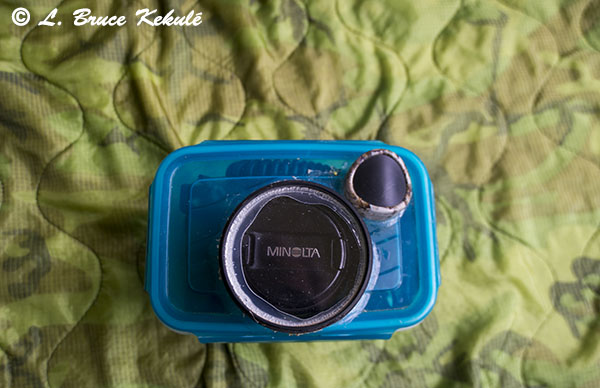
Top view of a Sony A55/Minolta 50mm in a ‘Tupperware’ type box.
In my case, elephant’s will home in on strange objects and strength plus rigidity is the No: 1 priority. With my ‘elephant proof’ boxes and three to four lag bolts, these hard and sharp edged external aluminum boxes have survived the forest giant stomping test many times…!
But I wanted something smaller. After some sole searching, I found this lockable plastic box (a Tupperware type) that would allow a small Sony A55 DSLR to just sit in the box with a Minolta 50mm ‘macro’ lens (just happen to have this lens from my old days when I used Minolta cameras). A pair of 18650 Lithium 4.2 volts for externals is used. The A55 is a 12 megabyte camera and is perfect for a camera trap.
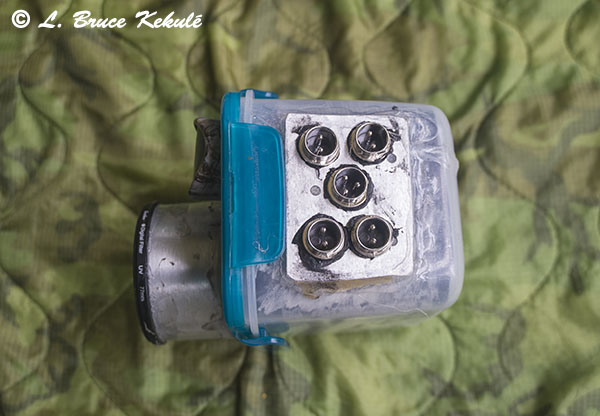
Side view showing connections for flashes (two-pin) and sensor (three-pin).
The Minolta lens works in the Sony perfectly. The snorkel is a length of 77mm diameter thin aluminum tubing secured to the box with Goop. I prefer this to the large, thick and heavy PVC tubing. Goop is also used to attach a 77mm UV filter to the snorkel.
A dedicated ‘elephant proof’ box was built to house the fragile plastic box and camera. I have incorporated a cover to protect the wires and plugs from probing elephant trunks. Four stainless steel lag bolts and a 10mm Python cable secure the box to a tree.
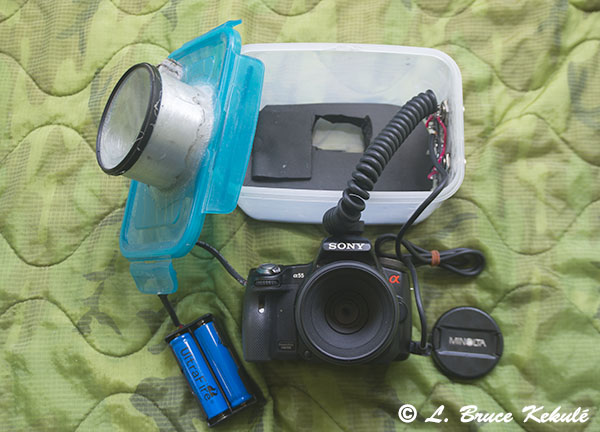
Sony A55/Minolta 50mm showing 18650 4.2-volt externals.
As I won’t be using the flip-up flash or a dedicated hot-shoe flash, I’m using a TTL head and hard-wire everything using two-terminal quick-disconnect plugs for the flashes. A three-terminal plug is used for the sensor, and I seal the plugs with 3M-silicon sealant as shown in the photos. I’ve installed a thin aluminum plate to beef-up this area.
Three flashes are on 10-meter lengths of two-conductor shielded wire with gland fittings on the flash boxes. The fourth flash is on a 15-meter wire to be placed across from the cam hoping to get backlighting of some sort (the set-up and location will require experimentation). I’m using three SB-28s and one SB-80 Nikon flash. All flashes are in ‘Tupperware’ type boxes with elephant proof shrouds made up.

Sony A55 with hard-wired Nikon flashes and SSII hard-wired sensor.
The sensor is a Snapshotsniper SSII with a #5 chip, also on a 10-meter hard-wire cable to be installed on a trail about 6-8 meters from the cam. This way I can focus precisely at the sensor.
I have the perfect place for this cam…to replace the Sony P41 that has captured tiger and leopard plus many other creatures. I will be setting it up in a few days. The rainy season has started and there are not many people around in this area. I’m hoping for some dramatic shots of a black leopard and the other cryptic animals that pass by.

Sony A55 trail cam and ‘elephant proof’ box.
A Sony P41 post with tiger and black leopard to follow…!
‘Battered’ Banteng Bull
A short video and camera trap photos of a banteng bull in the ‘Western Forest Complex’ of Thailand. My Nikon D700 and a Bushnell Trophy Cam captured this seriously injured creature. This is ‘raw’ nature and could be disturbing to some…but this is the natural world and how it really is……!