

Archive for the ‘The North’ Category
Doi Chiang Dao: Northern limestone massif
Mountain sanctuary and protected area in Chiang Mai

Sunset taken from Doi Luang Chiang Dao at 2,226 meters.
Imagine a huge limestone karst massif with vertical cliffs towering strait up into the clouds and Doi Chiang Dao in the northern province of Chiang Mai comes to mind. This enormous horseshoe shaped mountain was formed over 200 million years ago during the mid to late Permian era.
It was a time of widespread mountain building and volcanic activity. Thailand was part of ‘Gondwanaland’ that was still attached to ‘Pangaea’, the ‘Supercontinent’.
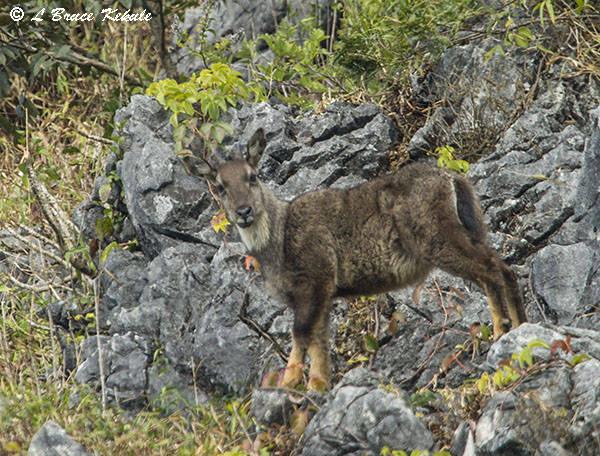
Goral male with a winter coat up on the rocks of Doi Luang.
This colossal outcrop with the highest peak, Doi Luang, reaching some 2225 meters above sea level looks almost ‘architectural’ and is the Kingdom’s third tallest mountain after Doi Pha Hom Pok and Doi Inthanon. Doi means ‘mountain’ in Thai.
In December last year, a trip to photograph the flora and fauna of Doi Chiang Dao Wildlife Sanctuary was undertaken. Prior to that, I visited the headquarters near the famous ‘Chiang Dao cave’ and had a talk with the chief, so I could get an idea what I was about to embark on. The walking trail up to the summit of the mountain is 8.5 kilometers long and said to be pretty tough. This was an understatement!

Parrot flowers or ‘Tien nok kaew’ in Thai (Impatiens psittacina).
From the back of the mountain, some 25 kilometers west of Chiang Dao, a ranger station named ‘Denyacut’ is located where the walking trail begins. From there it is long hard climb that can be very dangerous in some places. The karst mountain still has serious run-off just after the rainy season ending in late-October.
This makes for a slippery trail and in some locations, ‘slick as an eel’ is the only thing that can be described. Every step was with great effort to keep from sliding down to what could be the end of my days.

A view of ‘three in-laws’ karst outcrops.
That first climb took me nine hours but I did take my time going real slow stopping to take pictures of flowers and the view from time to time. My guide and forest ranger named Thep Kanoo and my close friend Sawawut Sawkhamkhet plus four pack bearers accompanied me as we made our way up. I eventually arrived in the dark at 8pm and it was already getting cold.
We had a quick meal and it was straight into the tent for me. I was totally exhausted. Winter is in full swing then and the temperature dropped down to 6 degrees Celsius early the next morning. For a tropics guy like me, it was freezing but I slept fairly comfortable because of a good mountain tent and super warm sleeping bag.

A pansi butterfly near the summit.
The next morning, we all got up at 4am and had breakfast made up of some coffee, eggs and bread. There were about 100 visitors and bearers already up there, set-up in clusters around the valley close to the top. As in many of Thailand’s protected areas, noisy-people is a common occurrence.
We left the campground at 5am and climbed out to a viewpoint on the cliff face to watch the sunrise. We could see Chiang Dao town below beginning to come alive. The air was crisp and hovering then around 10 degrees. It was absolutely beautiful up there and the moment is etched in my memory.

Sunrise from the summit near Doi Luang.
My main photographic objective was to get some pictures of goral or ‘angel horse’ as the Thais call them. These small goat-antelopes are extremely endangered throughout their range in northern Thailand due to serious persecution by the people living in the hills. Goral are considered a delicacy by many and are eagerly sought after.
Since some protection has been afforded here, there is a small-herd that lives primarily out on the cliff face. The steep karst terrain has also helped them to survive. As one of the Kingdom’s rarest-mammals with just a hundred or so left in the county, it was a high priority for me.

A Gould’s sunbird at ‘Denyacut’ ranger station.
I missed a goral on the first trip but went back in January (it took me six hours to climb this time) and the next morning, I got a few shots of a very mature male goral with a winter coat shown in the story. He was sunning himself out on a favorite rock above the camping area around 9am.
Fortunately, it was mid-week and there was nobody up there except us. The goat was not disturbed and the next morning was back at the same spot. Goral are creatures of habit and defecate around the boulders midway up Doi Luang.

A green leaf bird, also at ‘Denyacut’.
The mountain is primarily known for its beautiful flowers with hundreds of species found with some endemic ones. One of the most beautiful is the parrot flower or ‘Tien nok kaew’ in Thai (Impatiens psittacina) as seen in the story. They only last for a couple of months but by January, have disappeared.
Many other species are also found along the trail and up on the mountaintops. There are 150 mammal and 295 bird species recorded plus thousands of plant and flower species, some of them endemic. It truly is a natural paradise and shows the legacy of Thailand’s natural heritage.
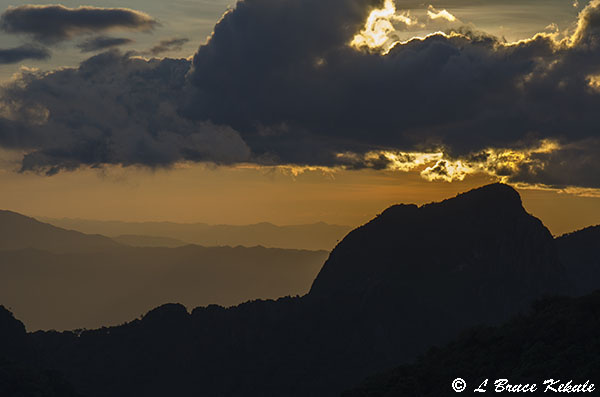
Sunset over Doi Chiang Dao Wildlife Sanctuary
In the early 1960s, there were serious attempts in Thailand to establish protected areas in order to save the flora and fauna, and the natural ecosystems for the Thai people.
Over two-hundred national parks, wildlife sanctuaries and non-hunting areas have been set aside. Doi Chiang Dao 75 kilometers north of Chiang Mai is one of these. The importance of this mountain sanctuary cannot be stressed enough due to its unique beauty, biodiversity and formation.
Like most parks in Thailand that have excessive visitation, the problems here are serious at the moment compounded by no water available at the so-called campgrounds at the top near the Doi Luang summit (the main attraction).
A tent-city has been erected by the pack-bearers and trash is a problem. Fortunately, the park is closed from March 31st to November 1st every year to allow the area to rejuvenate.
Too many people up the mountain at one time should be curtailed. As it takes sometime to hike up to the top and there are no facilities, some people are abusing the natural surroundings for personal reasons. This should stop and be monitored by the park staff.
One thing is for sure: the sanctuary is unique, and needs improved management and better protection to keep its pristine beauty intact. It can be said that Doi Chiang Dao is “a mountain with flowers like birds, and birds like flowers”. Only time will tell whether Thailand’s highest karst formation will continue to be as magnificent and beautiful as it has for ions.

Mountains of the North
Majestic beauty, rugged granite massifs, fertile forests, steep terrain, thunderous waterfalls and sparkling waterways

Satellite map of Northern Thailand, Burma and Laos

Doi Inthanon National Park
Some 60 million years ago, the sub-continent India moving on tectonic plates crashed into the Asian mass that created a ripple effect across Southeast Asia, and many mountain ranges up-lifted forming over time. Most of these run from north to south creating a blanket upshot across northern Thailand plus areas in Burma and Laos.

Mountains in Mae Hong Son province
This terrain is divided into many mountains and valleys with rivers that bring life to the region and the people. The North is essentially a series of mountain ridges folded between two mighty off shoots of the Himalayan Range: The Dawa-Tenasserim in the West and the Annamite Range in the East.

Goral jumping in Mae Lao-Mae Sae Wildlife Sanctuary
The prehistoric significance of animal and plant life is a treasure trove of ancient creatures now extinct. From 80,000 to 140,000 years ago, the giant panda lived in these mountains. Fossil remains have been found in a cave in Mae Hong Sorn by palaeontologists from the Department of Resources with French counterparts. Rhino were common and many remains have come forth.
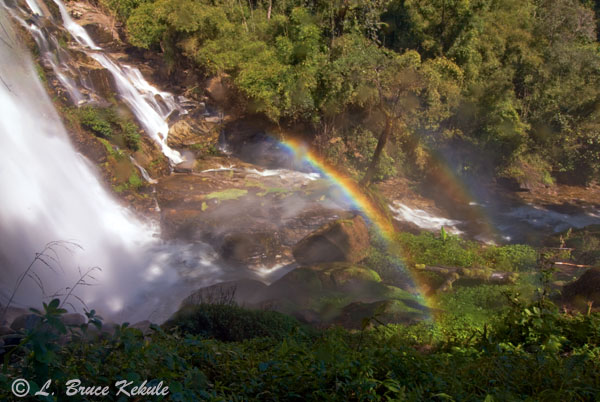
Wachiratan Waterfall in Doi Inthanon
Going back even further to 10 million years ago, ancestors of the orang-u-tang thrived here and fossil-teeth of these great apes have been uncovered in lignite mines in Phrayao district of Chiang Rai. The rainforests were thick vegetation and ecosystems had a vast array of flora and fauna.

Salaween River in Mae Hong Son province
Approximately 4,000-5,000 years ago, a small group of Hoabinhians (named by archaeologists) or ‘Stone Age’ man were hunter-gatherers, and lived in a narrow valley named Ob Luang gorge southwest of Chiang Mai. These people camped under a rocky ledge near the Mae Chaem River and left red and white cliff drawings depicting the wildlife at the time. The fragmented remains of these prehistoric paintings can still be seen today. These people used stone tools, and depended heavily on wild animals for subsidence.
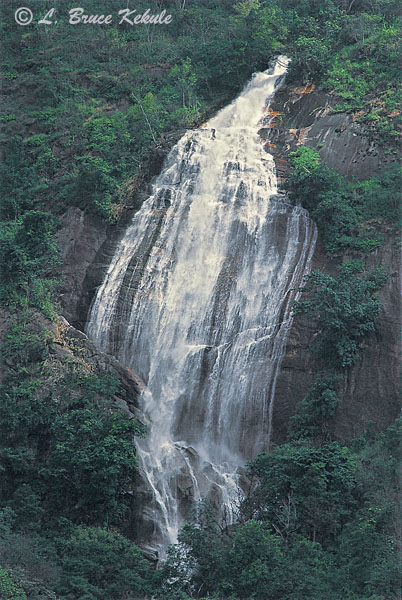
Siriphum Waterfall in Doi Inthanon
During the Bronze Age, people established permanent settlements nearby, leaving behind signs of civilization using bronze tools, jewellery and pottery. With more advanced weapons, they began to decimate the wildlife and clear the forests for agriculture and a settled existence. With the advent of the Iron Age and increased populations and better weapons, hunters began to have a significant impact on the surrounding flora and fauna. Forest clearing increased as populations became bigger. Settlements along the rivers were the first to be colonized.

Wild boar in Om Koi Wildlife Sanctuary
In the old days, large carnivores like the tiger, leopard and bear were found in all these thick forests. Huge herds of gaur, banteng and elephant lived off the profuse vegetation and proliferated. These mega-fauna lived in the precipitous mountains and thrived on abundant food sources and mineral deposits for supplements. Wild flora and fauna was extremely plentiful and at one time was taken for granted.
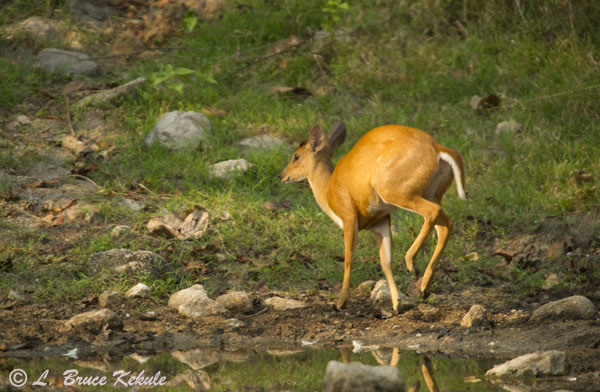
Prancing muntjac in Om Koi Wildlife Sanctuary
Around the beginning of the twentieth century, northern Thailand’s many beautiful mountain ranges and valleys were covered with extensive natural teak and deciduous forests. Unfortunately, much of the area has since been heavily logged, cultivated and/or encroached upon.

Orchids in Doi Inthanon
Humans laid siege to the land. When logging concessions were in full swing, living off the land as the loggers penetrated deeper and deeper into virgin forest tracts literally wiped out many places before the logging ban in 1989 and prior to conservation and protection came into play. The logging companies reaped in the profits from the natural resources that had evolved over millions of years. This sad chain of events shows this destruction layed upon the land and the effects of poor watersheds with only fair water retention ability after large scale flooding downstream from the North last year.
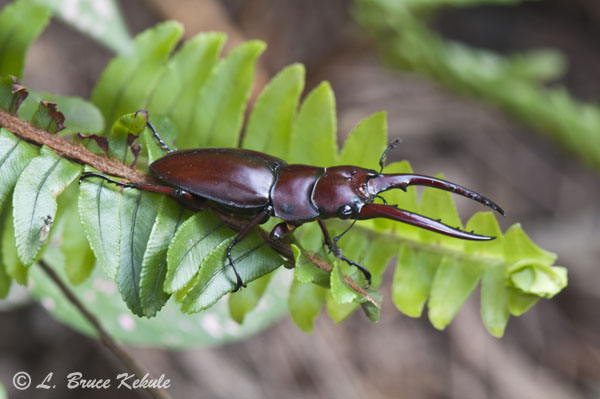
Staghorn beetle in Doi Inthanon
At the beginning of winter during November in the north of the Kingdom is a time of beauty. The skies are normally cloudless blue and the weather is crisp and cool. Early morning fog blankets the lower valleys, and rivers and streams run crystal clear. It is at the end of the rainy season and waterfalls cascade down mountain slopes and moisture is 100 percent.
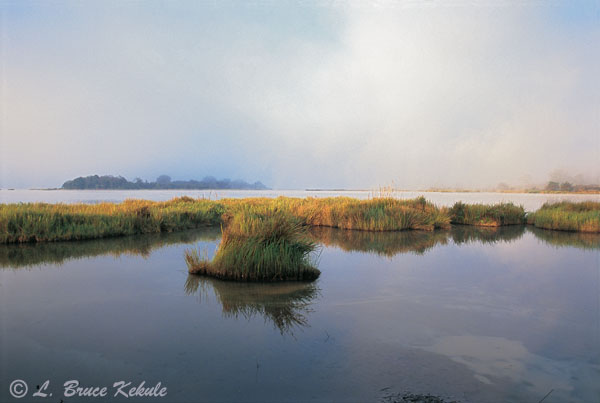
Chiang Saen Lake in Chiang Rai province
In some areas, animals like goral and serow (rare goat-antelopes) still live on rocky crags while deer, wild pigs and wild dogs flourish in steep forests. Birds, insects, reptiles and amphibians plus a huge array of plant life continue to exist. The balance of nature reigns supreme as nature intended. But these biospheres are under greater pressure as time passes on.
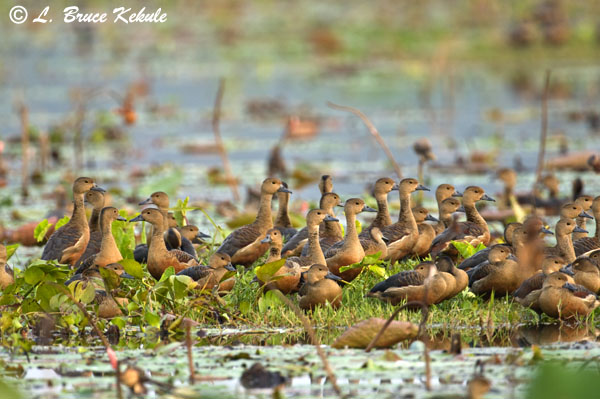
Whistling ducks in Chiang Saen lake
For this story, all the provinces from Tak and Uttaradit up to Chiang Mai, Lampoon, Lampang, Mae Hong Sorn, Chiang Rai, Phrae and Nan are blessed with these unique ecosystems. In Thai, ‘doi’ means mountain. The North’s original pristine beauty however now remains primarily in only a few protected areas, the most important of which are described below:
Doi Inthanon National Park
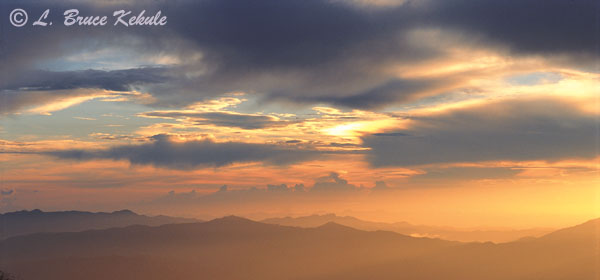
Sunset over Doi Inthanon
Doi Inthanon is Thailand’s highest mountain rising to 2,595 meters, and is part of the Thanon Thongchai Range that extends south from the Shan hills of Burma to the province of Tak. Situated southwest of Chiang Mai, this 482 square kilometre national park was gazetted in 1972 and is now one of the most visited parks in the country. The Royal Thai Air Force maintains a radar station at the peak and the Department of National Parks (DNP) is responsible for the park. This site is visited heavily by Thai and foreign tourists due to its significance as the highest place in the country.
The park’s geology of granitic batholith enables it to support several different types of forest. The most notable of these is at the peak where montane evergreen forest abounds. Native pines grow at the moderate to higher elevations and a sphagnum bog exists at the summit, the only one in Thailand. Important species are the green-tailed sunbird, which is endemic here, and the Himalayan newt (crocodile salamander) found in the bog.
Doi Inthanon National Park was once under full forest cover and wildlife found around the mountain included elephant, gaur, banteng and tiger that was very common here about 50 years ago. However, most of the larger fauna have disappeared due to poaching and encroachment by the hill-tribe and lowland people. A few sambar (Thailand’s largest deer) and smaller mammals like barking deer, wild pig, black bear and a few primates can still be found but all in very small numbers. Goral and serow still survive on Kew Mae Pan cliff-face. Birds predominate the landscape and there are some 383 species that have been recorded here. Doi Inthanon is one of the top bird-watching sites in Thailand.
The influx of hill tribes, first Hmong and later Karen with their practice of slash and burn agriculture has decimated the forests from 1,500 meters down to the lowlands. Opium was once the Hmong’s main cash crop but has now been replaced by rice, vegetables, flowers, fruit and coffee. In the old days, the Karen people were mainly hunters and filled the pot with anything edible. With an ever-increasing population who now use modern agricultural techniques and mechanized transport, this park is under serious threat as the population increases. There is nowhere to go except to expand outwards.
Like most protected areas in the country that have people living in them, it seems that parts of Doi Inthanon have degenerated to the point of no return. The park has been overcome by modernization and it will continue to decline. Probably the most destructive is the amount of pollution generated by vehicles (cars, vans, pick-up trucks and buses) plying the road daily in the thousands that continues to increase. Recent surveys of birds have encountered a drop of some 50 percent over the last 10 years. Unfortunately, it is a downhill run to extinction for many species of flora and fauna at this location.
Doi Suthep – Doi Pui National Park

Sunset over Doi Suthep – Doi Pui National Park in Chiang Mai
The twin peaks of Doi Suthep and Doi Pui, west of the city of Chiang Mai rise from the valley floor to heights of 1,601 and 1,685 meters respectively. The 261 square kilometre national park was finally gazetted in 1981. Unfortunately, due to its proximity to the city, it has been extensively logged and poached for everything it contains. Wild orchids, other flowers and plants, plus mammals, birds have been the prime targets. Once upon a time, elephants, gaur and tiger were common but were quickly decimated by the nearby population.
The park contains two waterfalls, Huai Kaeo and Monthathan that the locals use for recreation. Several Buddhist temples dot the park, the most famous being Wat Phra Borommathat Doi Suthep that is visited by tens of thousands of local and foreign tourists each year. The road at the top to Phu Ping Palace has been widened and other road surfaces have been improved. Continued pressure on the park from more and more traffic and visitors can only have an adverse effect in the long term.
Mae Tuen and Om Koi Wildlife Sanctuaries
Situated in Tak and Chiang Mai provinces respectively, these important contiguous sanctuaries together cover an area of some 2,397 square kilometres. They thus constitute the largest conservation area in northern Thailand. They are bordered to the east by the Mae Ping National Park that is bisected by the Ping River flowing into the Bhumibol reservoir in Tak province. Unfortunately, the lake acts as a gateway to the sanctuaries and park by allowing easy access by boat. The locals are allowed to fish the reservoir but poaching and gathering continues to be a problem for the DNP.
Goral is found here too with a dozen or so animals on Doi Montjong in Om Koi Wildlife Sanctuary. Unlike the serow, which is found more widely in Thailand, the goral is highly endangered. Its future is grim indeed as many Hmong and Karen hill tribes still live within the sanctuaries, engaging in poaching, encroachment, and slash and burn agriculture. This is also one of the last sites in the North for wild elephant. Only a few herds remain. Gaur and banteng are reported but their numbers are few. As time marches on, they could eventually disappear from these two sanctuaries that together constitute the largest northern refuge for Thailand’s large mammals. Very few surveys have been conducted here.
Smaller parks and sanctuaries
There are many other areas in the north that have been designated as national parks, wildlife sanctuaries and non-hunting areas. Of these, the most notable are Mae Lao-Mae Sae and Doi Luang Chiang Dao wildlife sanctuaries in Chiang Mai province, another haven for goral; Namtok Mae Surin National Park, and the Salawin and Lum Nam Pai wildlife sanctuaries in Mae Hong Son province; Doi Khun Tan and Namtok Chae Son national parks in Lampang province; Mae Yom National Park in Lampang and Phrae provinces; and Chiang Saen Lake Non-Hunting Area in Chiang Rai. All these and many other sites not mentioned here are like the rest persecuted by a small minority of people who seem intent on continuing to abuse Thailand’s natural resources for their own benefit. As human populations in the north continue to increase, encroachment into protected areas becomes more difficult to control. The future seems bleak.
Looking back, trying to apportion blame for the enormous damage that has been wrought would be rather like the pot calling the kettle black. Yet if we could turn the clocks back 100 years, and if all those responsible had used careful selective cutting and true conservation techniques, most forests could have been saved. Dwelling on hindsight is thought by many to be a waste of time. Yet hindsight provides us with valuable knowledge, if only we take a little time and trouble to learn from the mistakes made by those who came before us. Using that knowledge today will enable us to save Thailand’s remaining natural treasures for our children and future generations.
Asian Wild Dogs in Mae Lao-Mae Sae Wildlife Sanctuary — Part One
This is my first video post on this website and there will be more to come
Asian wild dogs in Mae Lao-Mae Sae Wildlife Sanctuary, Chiang Mai province, Northern Thailand camera trapped by a Bushnell Trophy Cam
Please check it out.
Common Crane: First recorded sighting of this species in Thailand
Common crane sighting in Nong Bong Khai Non-hunting Area in Chiang Rai
Tremendous excitement prevailed when a common crane showed up for the first time in Thailand during November 2000. Experts had predicted the species would eventually be seen in the Kingdom (Lekagul & Round 1991) but the arrival of the crane was nonetheless big news for bird lovers. It was one of the greatest thrills in my life to be the first person to sight this solitary bird. Undoubtedly, local farmers saw the crane first but took no notice.
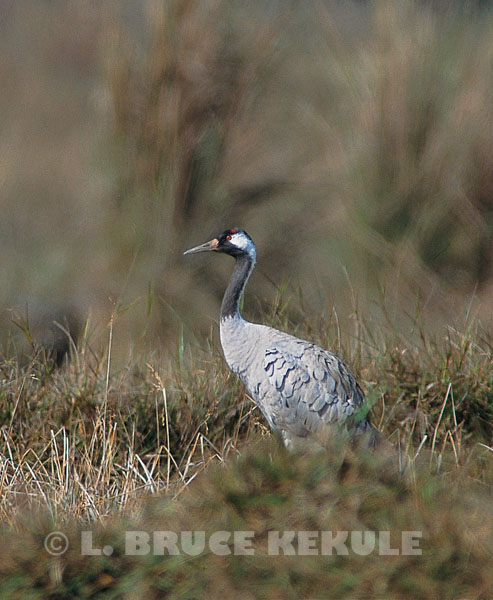
Common crane male in rice fields near Nong Bong Khai
While out scouting for photographic possibilities, I visited Nong Bong Khai Non-hunting Area situated at Chiang Saen Lake located in the northern province of Chiang Rai. The National Parks, Wildlife and Plant Conservation Department (DNP) is responsible for the area, which is a year round attraction for nature lovers. Although surrounded by paddy fields, a swamp to the west of the lake still hosts many resident bird species. The protected area also attracts migrant birds starting in October, when ducks, herons, grebes and other water birds arrive to spend the winter. Some rest for a while before carrying on to other areas in Thailand and Southeast Asia, even on down to Australia.
Arriving at the non-hunting area early in the morning, as always, I drove over the hill for a quick scout of the swamp. My casual visit turned into quite a surprise. Amidst the expected grey herons and little egrets, one bird seemed not quite right. It took some careful watching to isolate the anomaly but once found the crane was very striking indeed, towering over the herons. Its unfamiliar facial pattern and grey plumage stood out in the clear morning sun.
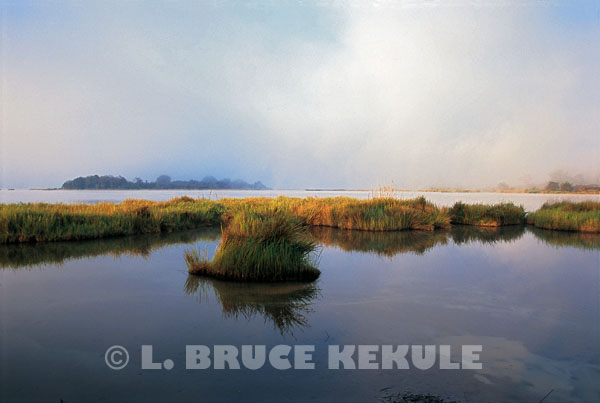
Chiang Saen Lake in Chiang Rai
I immediately called my good friend Philip Round, Thailand’s foremost bird expert, telling him of the sighting. Unfortunately, commitments at work forced me to leave shortly after but I vowed to come back as quickly as possible. Within two weeks, I was back this time with my friend David Murray from Chiang Mai, who came along as my assistant. The crane was extremely wary and maintained a healthy distance with anyone approaching it. The bird, a male, was limping and we assumed it had probably been wounded by a gunshot. Mature cranes usually pair up. The absence of a female was strange and perhaps the crane encountered hunters along the way, and that might have disrupted the bird’s migration.
The next day in early morning darkness we set up a photo-blind near where the bird was first sighted. I got a quick glimpse, but then the crane trumpeted loudly a few times and took off. A few quick shots were snapped as it flew away, but they were distant. The next morning was cool and foggy. About 9 a.m. the fog finally burned off and, as if on cue, the crane swooped down landing in front of the blind, although still a fair distance away. I quickly photographed it with my 600mm Minolta, doubled to 1,200mm by a converter. Once again the bird flew away within seconds, possibly spooked by the blind. The next morning the hide was moved even closer to the middle of the swamp but the crane did not show.
As we were packing up about 11 a.m. the bird flew across the paddy field, with its right leg dangling. We drove to where it landed, and managed to sneak within photographic range. I was finally able to get a few non-flying photographs even though the light was harsh. I left area but was still not satisfied, and again promised to return.
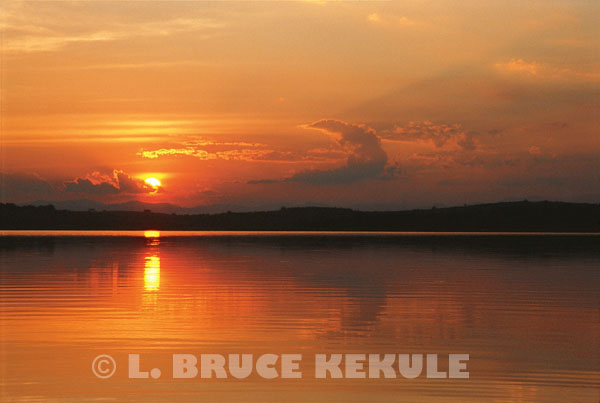
Sunset over Chiang Saen Lake
In early January of 2001 my determination to capture this crane on film continued to burn. After checking with the staff at Nong Bong Khai to confirm that the crane was still present, I decided to try one more time. After almost a thousand kilometer drive from Bangkok to Chiang Saen (including a swing through Chiang Mai to pick up David), we arrived in the late afternoon and to our relief soon spotted the crane in rice fields west of the swamp. I was pleased to see that its limp seemed to have disappeared and that it also appeared a bit more at ease. David and I camped out close-by in frigid cold winter conditions and planned the next morning’s shoot. At 4 a.m. we set the blind very near where the bird was reported to roost.
At about 8am the sun became hotter and the morning mist lifted. The crane suddenly flew in from the west but landed just a bit out of range. Then he walked closer to the blind and, as if in answer to my prayers, stopped 75 meters away pecking for food on the ground. I wasted no time and quickly shot several rolls of film. The final frames shot as he took off showed he still favored his right leg, as it dangled in flight. That was the last time I saw this magnificent bird, and the experience will always be etched in memory.
He left the area shortly after that and was never seen again. Nong Bong Khai had provided a haven for several months while he recuperated. During his stay, this crane delighted many nature lovers, bird watchers and photographers. It even appeared in the newspapers and on television. This single visit was considered an aberration and unlikely to happen again.

Common crane lifting off from the rice fields
But in January of 2004, my good friend John Parr visited the lake and in quite a surprise to the bird community, observed a pair of common cranes. I immediately rushed up to see them but these birds were extremely wary and I could not get any pictures. However, I did see the two birds at the opposite end of the swamp over two days. The pair left the next day.
It was reported that some local people wearing bright clothing were seen very close to the cranes before they flew off. While I was sitting in the blind, I also observed people walking close to the swamp. The birds had probably been pushed to the limit. When or if common cranes ever return again is an open question.
Cranes belong to the family Gruidae and there are 15 species worldwide. They are large birds with long necks and legs, and all have large straight pointed bills. Cranes nest on the ground or in shallow water. They build a bulky bed of sticks and vegetation. Their trumpet-like call reverberates over long distances. These birds fly in a V formation or a long line. Paired mature cranes perform a beautiful courtship display, much like a stately dance.
The sarus crane Grus antigone was once found in Thailand but that was more than 60 years ago. Before the year 2000, it was the only species of crane ever recorded here. A mature saris crane is one and half meters tall with a red head and light gray body plumage. Unfortunately, they are extinct in the Kingdom. The species still survives in the wild of Cambodia, Vietnam and India. But like everywhere else in the world, these cranes are under serious pressure from humans.
The Royal Forest Department (RFD) established a captive breeding program for the sarus crane many years ago but unfortunately, these birds do not breed well in captivity. Successful pairing is very rare under caged conditions, and so the chance of breeding cranes for reintroduction is next to impossible. Most zoos in the country have specimens. However, the Khorat Zoo in Nakhon Ratchasima province has successfully reared sarus crane chicks.
No one knows where this common crane actually came from. It was possibly blown off-course from a flock migrating east or west. The species’ world range includes Europe, North Africa and Asia. The common crane is an uncommon winter visitor to southern China, and the northern areas of Vietnam, Burma and India.
The chance to see and photograph a wild crane might not come for a long time. I feel blessed to have been there at the right place and at the right time. Mother nature works in strange ways and perhaps some future migratory season will bring a tall bird with a trumpeting call to stop by Nong Bong Khai. I will surely be there.
Goats in the Mist: Thailand’s Goat-Antelopes
Goral and Serow – Rare goat-antelopes
Photographing endangered species has become an obsession to me. Many of Thailand’s wild animals have come so close to extinction that their numbers are counted not in thousands or even hundreds but rather handfuls. Goral Naemorhedus goral are one such animal. Surviving on a few scattered mountaintops in northern Thailand, these even-toed ungulates are on the critically endangered list. With fewer than 60 individuals nationwide and low numbers at each site, the goral is considered one of the Kingdom’s rarest mammals.
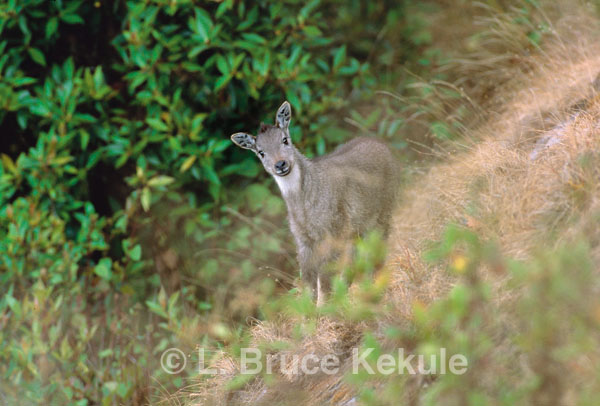
Goral kid in early morning light at Keiw Mae Pan cliff – Doi Inthanon NP
Acquiring photographs of these goat-antelopes is a daunting task considering their natural habitat. Hunting pressure and encroachment have forced them to retreat to the steepest, most inaccessible limestone cliffs and forested mountains. Goral are still found in seven protected areas including Doi Inthanon and Mae Ping National Parks, and in the wildlife sanctuaries of Om Koi, Doi Luang Chiang Dao, Mae Tuan, Mae Lao-Mae Sae and Lum Nam Pai, all in the north of Thailand.
Another species of goat-antelope surviving in Thailand is the serow Capricornis sumatraenis. Both species belong to the Bovidae family, which includes cattle, sheep, goats and antelope. Bovids are ruminants with four-chambered stomachs. In some areas, goral and serow share the same habitat. They have short bodies with long legs ending in padded, gripping hooves enabling them to inhabit steep mountainsides and cliffs. They eat grasses, herbs and shrubs and gain moisture from the plants they eat. Their keen eyesight provides early warning of danger. Like all bovids, they do not shed their horns like deer do with antlers. Serow are normally solitary whereas goral are usually form small herds from four to twelve individuals.

Male serow caught by camera trap
Serow and goral are creatures of habit. These lofty creatures have favorite places to sun themselves, usually a rock or grassy mound. They can stand for hours on one rock as I witnessed in Doi Inthanon where a goral stood from about 9am to almost 12noon. Another habit is to defecate at the same place. Piles of pellets can be found wherever they live, usually on or around a large rock. Research on both species has now been undertaken by Mahidol and Kasetsart University staff studying the impact of human settlements near goat habitat and surveying the remaining populations.
Unfortunately, both species have been hunted for their meat, horns and oil which comes from boiling the head. Supposedly, the oil is used to relieve arthritis and bone ailments. The horns of goral and serow are black, corrugated at the base, pointed and swept back (like their relatives, the Rocky Mountain goat of North America). Their horns are not impressive but are still sought after by poachers. The tip of serow horn is used to make deadly spears which can be attached to a rooster’s spur during a cock fight. It is eagerly sought after, especially in southern Thailand.

Goral kid close-up
Hunting has decimated both goral and serow populations that numbered in the thousands as recently as 50 years ago. In many mountainous areas hill tribe people live and encroach on the forest for the purpose of slash-and-burn agriculture. This has played a major role in the disappearance of both species in the North. Lowland people also hunted them. In other areas where the serow are found, they have declined due to continued pressure from man.
Two sites were chosen to photograph these mountain creatures: Doi Inthanon National Park about 80 kilometers south of Chiang Mai and Mae Lao-Mae Sae Wildlife Sanctuary some 60 kilometers to the north. Staff at the protected areas confirmed goral and serow were still surviving. Working closely with the Wildlife Research Division in Bangkok. My plan was to set up photographic blinds as close to wild goat domain as possible and use a long telephoto lens. But this was easier said then done.
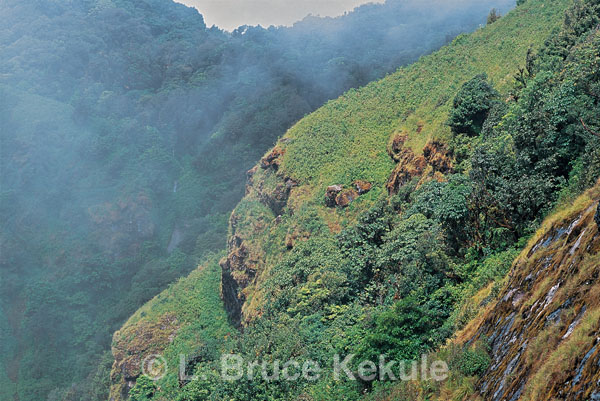
Keiw Mae Pan cliff in Doi Inthanon
Doi Inthanon, Thailand’s highest mountain, supports several small herds of goral around the summit. The animals are quite often seen close to Kew Mae Pan Nature Trail, developed in partnership with the Electric Generating Public Company Limited (EGCO) and the National Parks, Wildlife and Plant Conservation Department (DNP). Three kilometers from the road, a huge cliff rises some 2,500 meters above sea level and is criss-crossed with goat trails etched from thousands of years of use by goral and serow.
The skies are crystal clear over Doi Inthanon in November. This is truly a beautiful and remarkable place. But it does take some effort to get close to the cliff. The nature trail is strictly regulated and a local guide must be used for the three to four hour trek. If you are lucky and get up early, you may see goral and serow sunning themselves on rocky outcrops near the trail. Take a good pair of binoculars or telescope. This is also a good place for birdwatching, and you may see many species including the beautiful endemic green-tailed sunbird.
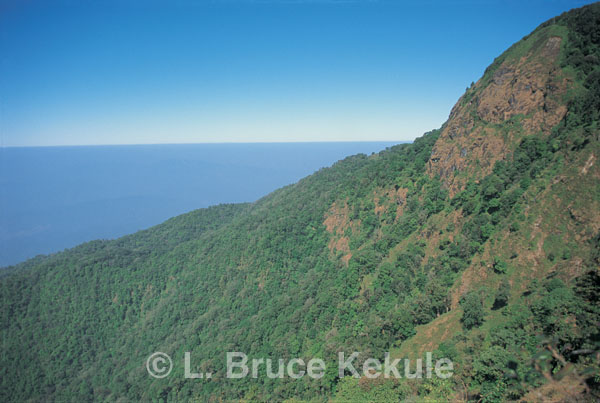
Doi Inthanon National Park
Mae Lao-Mae Sae is situated along the highway from Chiang Mai to Pai. A part of the sanctuary is divided by the road and Mon Liem, a giant granite massif, rises up to 1,200 meters above sea level. The sanctuary is home to a small herd of goral that survive on the summit. It is also criss-crossed by goat trails, and huge pine trees hundreds of years old are found here. The view is majestic, especially to the north where Doi Luang Chiang Dao Wildlife Sanctuary, another haven for goral, is situated. Wildlife sanctuaries are not open to the general public since they have been set aside for wildlife and biodiversity research. In October 2001, I glimpsed a male goral near the summit as the sun was going down. The goat unfortunately, was out of photographic range.
In November 2001, I visited the superintendent of Doi Inthanon to arrange a photographic trip after both goat species at the cliff. At 2,300 meters above sea level, temperatures can plunge at daybreak to zero degree Celsius with ice forming on the grass. It was tough getting out of the tent at 4 a.m. but it was important to move into the blind near the cliff face before the sun was up in order to photograph these wild goats. For the best photographic opportunities, the blind had to blend into the surrounding terrain so as not to spook the goats.
After four days of freezing, windy conditions, I spotted goral and serow on several occasions about a kilometer away. While scanning the cliff with my binoculars on the last morning, I detected a slight movement. A closer look revealed a male goral lying down on a buff about 500 meters from the blind. A short while later, he stood up. Using my 600mm Minolta lens with 2X tele-converter, I got some acceptable photographs of him.
This male had a fluffy white throat and underbelly. His gray winter coat was beautiful. After some time he did what goral do best – jumping straight down off the ledge in order to get closer to his mate who was feeding below. They butted heads affectionately a few times before disappearing into the maze of the cliff.
I made four trips to Doi Inthanon during the winter of 2001 and 2002 in search of goral and serow. Several herds of goral are still breeding here and can be seen almost every day. Serow are more elusive and only a few individuals were spotted from time to time. The spirits of the mountain listened to my prayers. On the last day of the fourth trip, a young goral about five months old appeared twenty meters away from me stamping its feet and snorting. It was nature at its best, making the front cover of this book.

Siriphum Waterfall in Doi Inthanon National Park
These wild goats have an uncertain future. Uncontrolled human population growth both inside and outside of the protected areas is bound to affect them in the long run. There is also the danger of disease carried by domesticated cattle and buffalo around the mountaintops decimating wild goats – something that needs to be checked and stopped at all costs.
Hunting of goral and serow continues in some areas, and the poachers are rarely brought to justice. Jail terms are too light and outdated. As a result, these animals need serious efforts to protect them from the dangers of the modern world with all the resources available, or they could vanish from the Kingdom’s mountaintops forever. A crime against nature should be on par with a crime against a fellow human being. Enforcement must be improved and implemented on a long term-basis. The Thai community needs more wildlife conservation education at all levels of society.
Serow – Capricornis sumatraenis
Serow share much the same predicament as goral but with a larger world range, they have fared slightly better and can be found in many mountainous areas in the Kingdom. In a few places they live all the way down to sea level. These goat-antelopes still survive in the Himalayas, northern India, southern China, mainland Southeast Asia and Sumatra. Several subspecies have been recorded and most populations are localized.
Serow have black or dark-gray coarse hair and a long shaggy mane down their backs. Two subspecies of serow are recognized in Thailand: those found in the steep limestone mountains of the south have black legs and those surviving in the Tenasserim range and further north to Burma have rufous colored legs below the knee. Breeding lasts from October to November and a single kid is born after seven months of gestation. Occasionally, twins are born.
Goral – Naemorhedus goral
Goral are found from about 1000 up to 4,000 meters. Their range is from the Himalayas and northern India, to southern China, Burma and northern Thailand. The Thai species are mainly gray-brown in color much like the boulders and rocks that they live around. A thin black stripe runs along their spine to a short tail. As with other wild Asian bovids like gaur and banteng, goral have white stockings from the knee to the hoof. With white patches on their throat and underbelly that stands out in bright sunlight, goral are distinct. They are compact mammals that can move up and down vertical cliffs with ease, and are tough to spot in their habitat. The breeding season lasts from November to December. One or two kids may be born in May or June.