

Archive for March, 2010
Journey through a World Heritage Site – Part Five
Day 6: March 9th – Wild pig again, and a herd of banteng and a tuskless bull elephant pose for the camera
After breakfast, I drove a kilometer with a forest ranger in tow to look after me and parked in the forest. I thenwalked for a half hour to Huai Mae Dee, a tributary of the Huai Kha Khaeng. A permanent photo-blind is erected across from a mineral lick, also visited by all the large mammals.

After an hour and slightly down stream, a single wild pig was having a great time wallowing in the mud by the bank in the mid-day heat. After awhile, this female ungulate got closer as I continued to photograph her. It was the first time I had ever seen a female by herself. Mostly, they are in herds and only the large male boars live solitary lives.
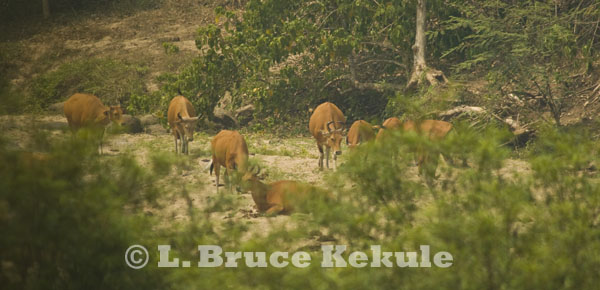
A short time later, a fairly large herd of banteng appeared on a sandbar downstream from the blind. They were just hanging out taking in the sun’s rays and chewing their cud. The cattle then scattered as a huge tuskless bull elephant popped out on the sandbar. He was following a female, probably in heat judging from his actions. The bull did not stay long and actually came up on our side of the river disappearing into the bush, which was a bit unnerving.

At 6pm as darkness fell, our ranger came to help me carry some equipment back actually bumped into the bull elephant but it went crashing off luckily for us. At close quarters, these old cantankerous giants can be extremely dangerous to people and in fact two persons including a ranger and a villager have recently been killed by a tuskless bull in the sanctuary not far from the headquarters. It pays to stay out of their way.

Journey through a World Heritage Site – Part Four
Day 5: March 8th – Waiting on the helicopter
The next morning up at the crack of dawn, I decided to sit in the blind one last time before departing sometime in the afternoon. After an hour, a lone female green peafowl wandered into the mineral lick pecking on the ground for food and coming quite close. A short time later, a little egret also looking for food in the pond was attacked by a changeable hawk-eagle that swooped down from the trees above grabbing and knocking the water bird off its feet. The raptor hung on finally killing the egret. It was all over in a matter of minutes and the bird of prey began feeding.

Finally, the noisy chopper arrived and we piled aboard for the 20- minute ride to the headquarters. Shortly after arriving, we had lunch, and I decided to drive a hundred kilometers south and then west to Khao Ban Dai ranger station that had been our original destination for this trip.

I left after lunch and then stopped at Ban Rai, Uthai Thani for some provisions arriving at the station just as the sun was setting in the west. Dinner was made up of ‘French toast’, a specialty of mine when a quick easy meal is sufficient. Eggs, milk and some whole wheat bread make up the ingredients. The night was cool as I both slept like a log in my hammock.
Journey through a World Heritage Site – Part Three
Day 3: March 7th – Hot trek over the hills

Like clockwork, first light eventually came and after a quick cup of coffee and some breakfast, everyone packed-up their gear and headed out to beat the sun. But it was scorching hot by 10am and the dusty trail went up and down and was long as we threaded our way over the hills on a wildlife trail trodden by elephant and other large animals for millennia.

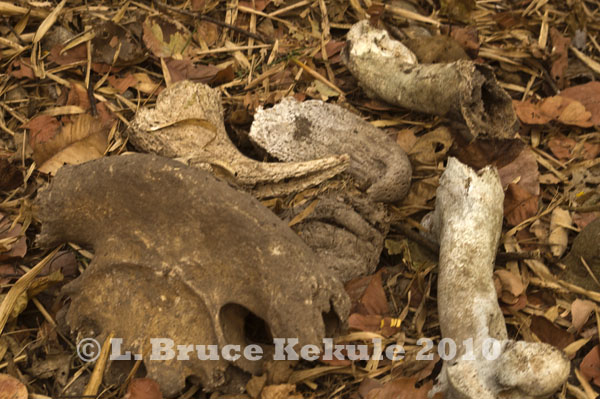
At lunch, a quick camp was erected down at the river as we all cooled off and enjoyed the refreshing water. An hour later, it was up into the hills again. The rangers attached to me got sidetracked and led us down off trail getting lost for a short period until I headed back up and found the right route. From there, we discovered a pile of gaur bones that had certainly been poached for its horns. Continuing on, we trudged along the path until the late afternoon finally reaching our number one objective as the sun dipped low.
Two large mineral licks situated by the river on either side where large mammals like gaur, banteng and elephant come for the mineral supplements. A set of fresh tiger tracks was discovered on the trail down to the deposit. The rangers quickly set-up a photographic blind in the mineral licks for me as we settled in by the river. Promptly, dinner was served and it was a quick dash to bed for most of the group after the long hot day. The excitement of finally sitting at a mineral lick I had never visited kept me up for awhile as I lay in the hammock.
Day 4: March 8th – Pigeons, parrots, and another wild pig
After that, the day passed slowly and about 4pm, a huge wild boar came to wallow in the mud and take in some vegetation staying for quite sometime. I snapped a long series of photos of the solitary pig. The rest of the day was quiet and we finally retired to the camp just before darkness.
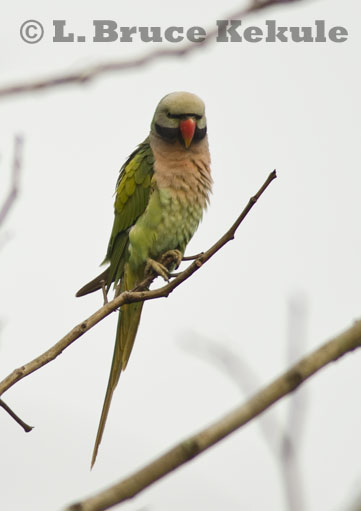
That evening, a decision to cancel the rest of the trip was reached, and to take us by helicopter back to the headquarters due to several issues involving tiger poachers plus the extreme conditions of heat. Three tigers (a mother and two cubs) were found dead from poisoning not to far from our position. Illegal tiger bone hunters were operating in the area and the chief decided to move the group expediently away for our safety as a first priority. In the past, many rangers have been killed or maimed by ruthless poachers. Unfortunately, we would not make our destination down the river but the option to drive there was still open.
Journey through a World Heritage Site – Part Two
On the road to Huai Kha Khaeng

Seub Nakhasatien monument
Day one: March 5th
I left Bangkok slightly behind schedule but made good time as I headed northwest. After five hours of driving with a few pit stops here and there to eat, buy fuel, food and essentials, I arrived at the headquarters of Huai Kha Khaeng. As always, I paid respects to Seub Nakhasatien, a forest ranger who gave his life to nature back in 1990. This site is his spiritual home and many people visit his statue and the house where he lived, in remembrance of his sacrifice. While we were at the headquarters, I photographed a few Eld’s deer that were released into the wild around the station.

Wild boar on the run at a mineral deposit
I then drove another couple of hours going south for a rendezvous at Khao Nang Ram Wildlife Research Station. As I got closer, a huge wild boar flashed across the dirt road and disappeared into the forest giving us a bit of jolt. A total of eight forest guards including the assistant chief graciously welcomed me providing shelter and dinner. I arrived just at dusk and handed over the provisions for the excursion down the river. Dinner was served and we then watched a documentary showing wildlife and tiger research carried out at the station. Everyone retired to bed for an early wake-up.

A racket-tailed drongo by the river
Day two: March 6th – A change of plans
Our original plan was to walk from the research station across the mountains and down to the river but due to extremely hot and dry conditions in the mixed deciduous forest and the possibility of forest fire, it was decided to drive further north to the river and walk from an old deserted ranger station named ‘Yang Dang’ so we would have a good supply of water the entire length of the walk. I brought a water purification pump and we always had clean safe drinking water. This tool was simple to use and carry but extremely important for us city folk accustomed to bottled water.
Through the forest we continued west and arrived at Kabook Kabieng ranger station some 50 kilometers north. During the dry season, this part of the forest in Huai Kha Khaeng is still lush hill-evergreen. For me, this place has many fond memories of great photographic sessions.
Another wild boar at another mineral deposit
I got my first ever camera-trap photograph of a leopard on a deer kill very close to the station. On that same trip, I also photographed another leopard along the road in late afternoon from my truck, and captured a shot of a black leopard from a tree-blind at a nearby hot spring the next day. I got three leopards in two days and it still stands out as one of my great achievements as a wildlife photographer. Leopards are notoriously difficult to see and it was a lucky trip.

A black leopard photographed more than ten years ago at a hot spring
Finally, we all arrived at ‘Yang Dang’ and made preparations for the 30-kilometer trip down river. The road was rough on my old Ford Ranger but we chugged along in low gear for some gut-wrenching 4X4 driving. Unfortunately, a carry rack on top of the cab was ripped off and destroyed during the rough and tumble, and reduced to rubble.
Everyone packed up and off we went down the river. We still had to negotiate about 6 kilometers on foot to the first camp during mid-day temperatures that went past 38 degrees centigrade. It was a struggle but we made it and set-up camp by the peaceful Huai Kha Khaeng waterway just as the sun dipped behind the mountains. The water was extremely cool and it was great having a bath and freshening up for the first night by the river. Dinner was served in typical jungle style with rice cooked in army patrol pots and various Thai dishes including some hot curry. Everyone then hit their beds and sleep quickly overcame the group.
Journey through a World Heritage Site – Part One
Journey through a World Heritage Site: Part One
Hot days, rough terrain and wild pigs galore. Thailand’s last great tiger haven
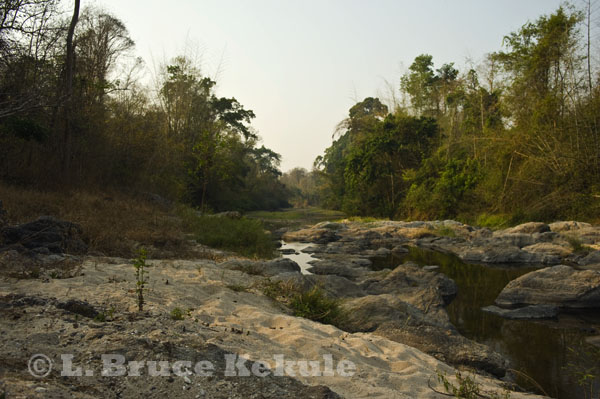
Huai Kha Khaeng Wildlife Sanctuary situated in the provinces of Uthai Thani, Tak, Kanchanaburi and Suphan Buri is Thailand’s last great tiger haven. The protected area covers 2,780 square kilometers, and a seasonal river runs through the center of the sanctuary from north to south with many tributaries along its path. During March, the waterway is low but still flowing for most of its length. In some areas however, the sandy river bottom dries up. The weather is very hot during the day with temperatures soaring above 38 degrees centigrade.
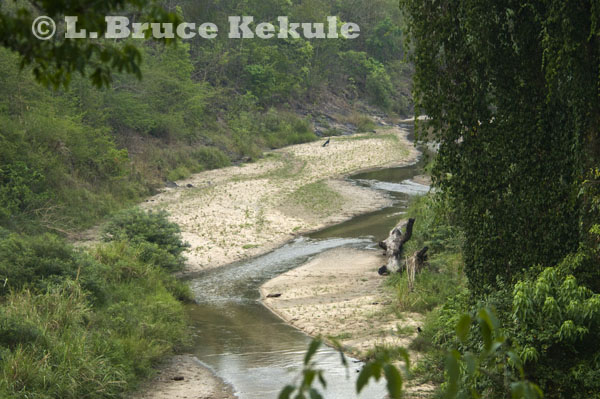
Huai Kha Khaeng riverine habitat
An old dream of mine was to walk the river from north to south and experience this majestic animal kingdom first hand. I met with the Director General of the Department of National Parks at the time, Jatuporn Buruspat, to coordinate all logistics for the trip. The plan was to walk from Khao Nang Ram Wildlife Research Station in the eastern section to Khao Ban Dai ranger station in the central part, a distance of about 30 kilometers. It was expected to take about seven days with several stops along the way at a few mineral deposits, hopefully to photograph wildlife.
My trip began on March 5th and left Bangkok first thing in the morning driving some 300 kilometers diagonally across Thailand going northwest. I passed through the very modern city of Suphan Buri with its excellent roads and modern facilities. My final destination is the Huai Kha Khaeng headquarters area situated in the western forests of Uthai Thani province. The deciduous and hill evergreen forest found in the interior still harbor large herds of elephant, gaur, banteng, sambar and wild pig, plus the amazing carnivores, the tiger and leopard in fair numbers. As a World Heritage Site, it truly lives up to its name as Thailand’s top protected area.
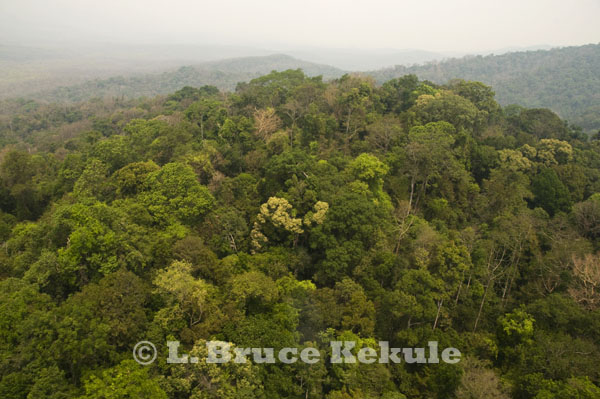
Huai Kha Khaeng forest from a helicopter
Huai Kha Khaeng – 7 day walk in a World Heritage Site
Huai Kha Khaeng – 7 day walk in a World Heritage Site – 1st Entry
A new series of trips to Thailand’s top protected areas in 2010

Indochinese Tiger walking through a mineral deposit in Huai Kha Khaeng
This wildlife sanctuary is Thailand’s last great tiger haven. It covers an area of 2700 square kilometers and a seasonal river runs through the middle from north to south. My trip begins on March 5th and I leave Bangkok first thing in the morning driving some 300 kilometers diagonally across Thailand going northwest. I pass the very modern city of Suphan Buri with its excellent roads and modern facilities.
My final destination is the headquarters area situated in the western forests of Uthai Thani province. This deciduous forest still harbor large herds of gaur, banteng and sambar, plus the amazing tiger and leopard in good numbers. Elephants are also quite common in the interior. As a World Heritage Site, it truly lives up to its name as Thailand’s top protected area.
I have been planning this walk for sometime now. Several months ago, I met with the Director General of the Department of National Parks to coordinate all logistics for the trip. The plan to walk from Khao Nang Ram Wildlife Research Station to Khao Ban Dai ranger station, a distance of about 30 kilometers, would take about seven days with several stops along the way at a few mineral deposits.