

Posts Tagged ‘leopard’
Botched shutter speed and focus…!
Two Asian leopards pass-by my Canon 600D
For the most part, I usually catch something interesting on my camera traps in the ‘Western Forest Complex’ of Thailand. This place is one of the last great Asian forests where rare wild cats like leopard and tiger still thrive plus many other cryptic animals like sambar, banteng, gaur and tapir living alongside the predators. It does not matter if the camera was set right or wrong. I still manage to get some good record shots of black and yellow phase leopards at this new location.

A black leopard on my birthday: May 19th at 1.49pm, exposure: 2.5 sec…a lucky catch…!
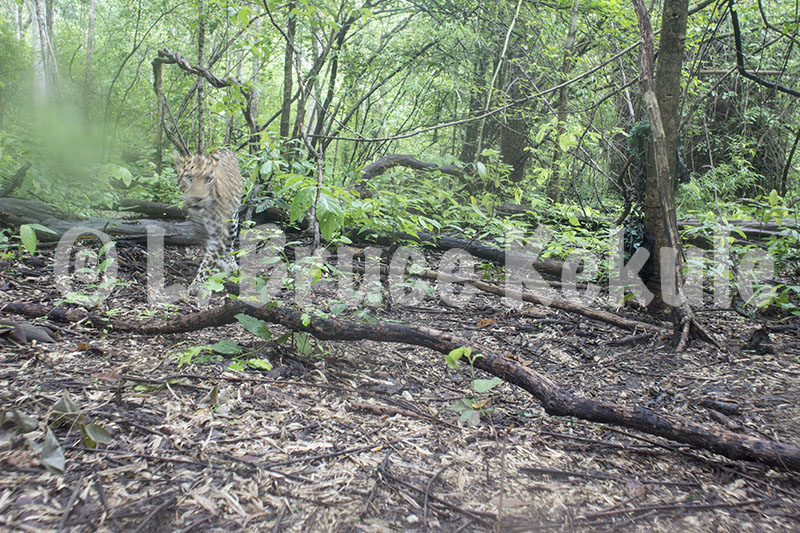
A yellow phased or spotted leopard on May 28th at 8.13am, exposure: 1/8 sec.

A spotted leopard on June 19th at 2.41pm, exposure: 0.3 sec.

A spotted leopard flashing by on May 28th, exposure: 0.6 sec.
I’m not sure how my 600D jumped from ‘Manual’ over to the ‘Tv’ setting (shutter speed priority) but the answer is obvious. I somehow moved the wheel and did not double check it before closing up the cam. So all the shots had very long exposures hence blurry and out-of-focus images. However, the proof that leopards do thrive at this location is still good news. And the bad news is:
Stolen Nikon D90 DSLR camera trap…!

My first DSLR camera trap; a Nikon D90 and SB400 flash with a Yeti’ board in a clear Plano box…!
After capturing leopards on my Canon 600D, I hated to pull it out but had no choice. When I set the Canon, I also set a Nikon D90 DSLR (shown above) in an ‘elephant proof’ box a little bit further down another well-used trail (about 100 meters away). After I checked the Canon, I went straight to the Nikon but it was gone. Someone had stolen it plus two Nikon SB-28 flashes and a SSII (Snapshotsniper) sensor. The complete rig had been taken including the ‘aluminum housings’ and all the hard-wiring. This is my third camera stolen in this ‘World Heritage Site’…!
I have no idea who it is but one thing for sure; it’s the same group that stole my Bushnell Trophy Cam video and ‘Fireman Jim’ 125 DXG video in another section of the sanctuary earlier this year. It means that someone has the special ‘power-torque’ wrench to open-up the ‘elephant proof’ housings, and a 17mm socket wrench (for the 3/8 X 3″ stainless lag bolts) to remove the aluminum boxes from the trees. The ‘power-torque’ wrench is only available at a few special tool shops in Bangkok, or it was found in the forest where I lost one awhile back. Needless to say, it’s back to the drawing board to beef up security of all my cams. I have a new design that will make it even harder to steal that I will post at a later date…!

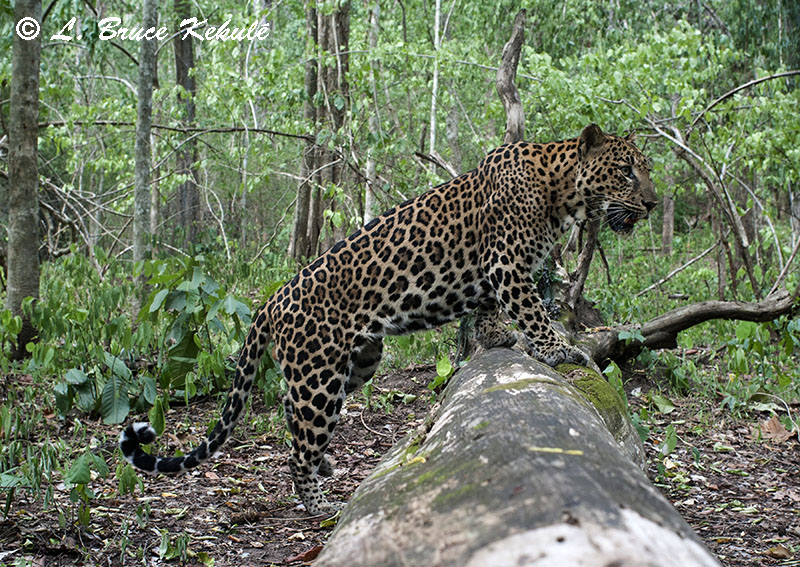
My favorite Asian leopard shot…!
After several years of working my Nikon D700 trail cam, this shot stands out as my best overall leopard shot. These carnivores are quite common where I work in the ‘Western Forest Complex’ of Thailand but daytime shots are rare. Unfortunately, the ‘tiger log’ is now gone (burnt-up in the last ‘fire’ season) and I’m still looking for a good replacement…but I have a few in mind….!! He’s a big mature male Asian wild cat…Enjoy…!
The Forests of Madhya Pradesh in India – Part Four
Satpura National Park and Tiger Reserve

A mugger crocodile in the Denwa River of Satpura Tiger Reserve of Madhya Pradesh, Central India. This very mature reptile is estimated to be 4-meters long..!
After leaving Pench tiger reserve in the East, a break was in need. It was a quick two-hour taxi ride straight south to the large city of Nagpur in the State of Maharashtra. I stayed overnight at a very nice hotel with foreign and Indian cuisine. After almost two weeks of local food, I was ready for some European fare that evening. The next morning, breakfast was superb.

A leopard resting in deep cover. It was difficult to get a clean shot…!
Then it was a six-hour taxi drive to Satpura National Park and Tiger Reserve in the south-central area of Madhya Pradesh State. I arrived in the late afternoon and settled in at the Denwa Backwater Escape lodge five minutes from the boat pier on the reservoir. The tiger reserve was on the opposite side of the Denwa River that was dammed some 60 kilometers down stream.

A bull gaur close to the road in the reserve. These ungulates are prey species for the tiger…!
The next morning, my naturalist Chin was at the meeting point at 5.30am sharp and 30 minutes later after formalities, we were in a boat for the three-minute trip across the lake. Landing on the opposite shore, we jumped into a Suzuki/Maruti jeep for the first morning’s safari. As we moved into the hinterland, sambar and spotted deer were seen plus glimpses of a sloth bear. Later that morning, we bumped into a large gathering of jeeps meaning a big cat was about. It took some jockeying to see a leopard sleeping in the bush. Although the sighting was neat, good photos were tough to get but I did manage to get a few acceptable ones.

Two young gaur head-butting in an ‘eye-to-eye’ confrontation…!
For the next three days, we crossed the reservoir going on jeep safari in the morning and afternoon. On the last morning, I opted for a boat safari into the lake to look for crocodiles and large wading birds and ducks. A grey heron was my first target just as the sun was peeping from behind the morning fog. Later, some woolly-neck storks plus bar-headed geese and Indian river terns were the next targets. But my main objective was to get a crocodile out of the water on its basking spot. We saw two mugger crocs but they slithered into the water before we could get close. The water-safari closed at 10am and I was running out of time.

Mugger crocodile enjoying the mid-morning sun adjusting its temperature…!
Ten minutes before the dock, we saw a huge croc basking with its mouth wide-open. We immediately turned left and headed straight for it. I started cranking my Nikon D300s with a 200-400 VRII lens on a tripod and we actually caught the reptile in a trance as it was soaking in the warmth of the morning sun. We got fairly close. Then it sensed us and got up walking a few steps while I kept on shooting, and then slipped below. Now that’s some serious luck just a mere 10 minutes from the boat dock and the end of my safari. I had just captured one of the oldest living creatures on the planet going back to the Triassic Era when crocodiles had just began to evolve some 200 million years ago and out-living the dinosaurs. It was a fitting end to my 20-day safari to the forests of Madhya Pradesh in Central India.

Asian wild dog or ‘dhole’. These creatures in a pack are the most feared of all the predators in the Indian forest…!
Conclusion: As we move into the 21st Century, many things continue to hack away at nature. Excessive tourism has had a detrimental effect in some of the parks and its wildlife. In particular, the madness that goes on when a tiger is sighted. After traveling through some seven tiger reserves so far, the phenomena of seeing other people with a ‘long-face’ has become an ever-increasingly common occurrence when no tiger had been sighted. However, this is a problem when one is sighted: most people go berserk trying to get a photo of the big cat mostly with their smart phones. This has been dramatic as talking and screaming goes on and the drivers push each other (sometimes crashing into one another) to get a shot of the striped cat. Some may disagree, but I say the tigers are now becoming smarter and avoid the big jeep-crowds that invariably build up quickly. The big cats just melt into the forest and sometimes disappear for the day. They surely walk the roads at night as their tracks can be found everywhere when on morning safari.
Excessive anything is sure to have cause and effect. Tiger tourism has become a big money business and as more hotels and lodges spring-up around the tiger reserves like mushrooms, invariably more people will be pushed into the parks to see the almighty tiger. Limitation is the only answer that works but mandates to minimize the effect on too much tourism are overlooked by most who make money at it.
And the recent scandal incriminating ‘Ustad T-24, a wonderful tiger from Ranthambore National Park and Tiger reserve by the local forest authorities has done some serious damage to the reputation of India’s wildlife conservation programs. This resident male tiger was unjustly accused of killing a forest guard and then illegally moved to a zoo where he is near death after medical teams removed mud from his stomach probably picked up from throwing meat on the dirt for him to eat. He was also paraded around as a man-eating tiger, and zoo visitation jumped more than 100%. Not a nice situation for any wild animal
At the end of the day, I did get some really great photographs of tiger, leopard, crocodile and other Indian creatures on this trip but my outlook has changed ever so slightly concerning the senseless hordes of jeeps chasing after tigers and leopards in these parks. Can they sustain an ever-increasing tourist presence, as is the case of ‘tiger tourism’ today? Only time will tell but if you want to see the big striped cat, India is still the best place to see this magnificent predator as one of Mother Nature’s greatest creatures.
I have one more trip to India planned for March-April, 2016. I will be going to a wildlife sanctuary near Corbett tiger reserve to do some camera trapping. Then it will be across country by train (in fact most of the travel this time will be by train) to the Blackbuck National Park after some beautiful antelopes, and then back across to Panna tiger reserve that lost all their tigers awhile back and was restocked from Bandhavgarh Tiger Reserve. Then it’s on to Pench once more. Finally, it’s up to collect my camera traps and back to Delhi for the flight back to Thailand. That’s the plan and I look forward to catch a few more species for my up-coming book on wildlife from Africa and Asia. I hope everyone has enjoyed reading about my trip to India as much as I have enjoyed seeing and photographing nature up-close.
A spotted leopard and yellow-throated marten on the ‘tiger log’

A male leopard crosses ‘tiger log’ on 8/26/2015 – 1:26 AM
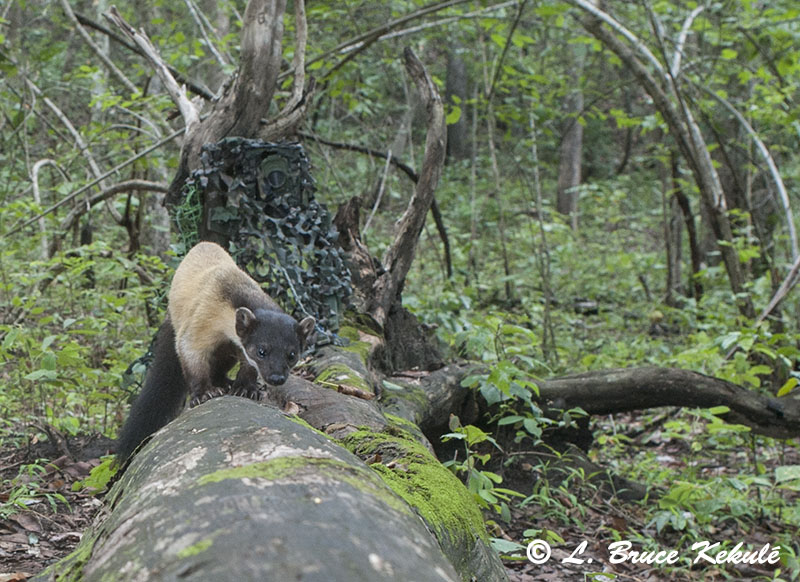
A yellow-throated marten in the afternoon on ‘tiger log’ on 9/4/2015 – 11:09 AM…!
This is my latest camera trap pull: a male leopard at night and a yellow-throated marten in the daytime captured by a Nikon D700 trail camera in the ‘Western Forest Complex’ of Thailand on my ‘tiger log’…! Enjoy…!
Canon 400D catches two male leopards: But poor camera placement affects the image..!
A black and yellow phase leopard caught on trail cam
After the dry season when the first monsoon rains arrived here in Thailand this year, I decided to go back to my old stomping grounds where tigers, leopards and other Asian species travel back and forth down a wildlife trail deep in the Western Forest Complex of Thailand. Last year, a bull gaur charged me not too far from this location and it still brings shivers down my spine when I look back on that incident. However, it is one of my favorite sites to catch the denizens of the Thai forest on camera traps.
Spotted leopard caught in the afternoon.


A couple months ago, I pulled out my first DSLR trail cam that had been rumbling around in my truck for sometime. It’s a Canon 400D with a Nikon 50mm manual lens that uses an external hard-wired SSII (Snapshotsniper) sensor and three hard-wired Nikon SB-28 flashes. The camera is housed in a Pelican 1150 encased in one of my ‘elephant proof’ aluminum boxes and firmly bolted to a tree just by the trail. When I set the cam, it was pointing a bit high and the framing was off. Of course I did not notice it at the time of installation. I recently posted somewhere that sometimes if takes a little experimentation and adjustment to get the composition just right. This is one of those times…!
Black leopard caught in the morning.


The cam has been on that tree for almost two months now, and I decided to go and service it. A female muntjac (barking deer) had passed but on August 22nd at 3.40pm, a yellow phase leopard passed the Canon that ripped off six quick shots. Then on August 28th at 8.26am, a black leopard got caught going the other way and tripped the cam for another 6-shots. Funny enough, both cats are males. For some reason, the flashes were not powerful enough and the images of the black leopard are underexposed with loads of noise. I have tweaked them a bit but they are what they are; good record shots.
Common red muntjac or barking deer female

A female on the run…!

I have re-adjusted the cam for better framing and put in another flash near the sensor down low (switched to radio flash triggers). Hopefully that will lighten things up a bit in the target area. Replaced the batteries, card and desiccant, and tested the system. Seems to be working OK. This highway in the forest should produce more mammals as they go about their daily lives. I now have four DSLRs working in this forest: a Nikon D700 at the ‘tiger log’ and a Nikon D90 just up the trail a bit, plus another Canon 400D at another location and then this Canon. Hope to get one of my Canon 600Ds and a couple Sony DSLRs going soon with different locations and composition. Enjoy…!
Male leopard crosses ‘tiger log’…!
Last month, I had a hamburger at a joint close to my house up-north in Thailand. The next day, I was admitted to hospital with a ‘acute’ food poisoning. It has taken almost a month to get back to normal, hence not much camera trap work from my end. However, I finally got to my only Nikon D700 DSLR trail camera and got a pleasant surprise.
A male leopard (can just see his family jewels) crossing my ‘tiger log’…this is in the ‘Western Forest Complex’ of Thailand…! Daytime shots of leopard are rare for the most part but it does happen here where I work from time to time…Enjoy…!
Camera settings: 1/160 sec; f/8; ISO 400
Nikon D700 – Nikon 35mm manual lens – Two Nikon SB-28 flashes – SSII external sensor

Asian leopard crossing ‘tiger log’ in Huai Kha Khaeng, western Thailand
The Asian Leopard – Thailand’s 2nd largest wild cat…!
This film is a culmination of videos and still photographs of leopards captured by video and DSLR camera traps in the ‘Western Forest Complex’ of Thailand. The first black cat video was taken just a few months ago. Enjoy..!
India’s ‘Big Six’: Majestic creatures thriving on the sub-continent…!
A photographic tour in three national parks with some pretty amazing animals

A tigress on the run in the grassland at Dhikala, Corbett National Park in the northern State of Uttarakhand.
In 2014, I made a decision to visit India once again in search of the most iconic species still thriving in three protected areas in the northeast, central and northern parts of the country. Kaziranga, Tadoba and Corbett national parks and tiger reserves respectively, were chosen for their wildlife biodiversity with the tiger at the top of the list. I visited the three from February 22 through March 16, 2015.

A mature bull elephant with some impressive ivory in Kaziranga National Park.
I wanted to photograph the big six: elephant, rhino, gaur, wild water buffalo, leopard and the tiger. I was extremely lucky encountering all of these amazing animals during this trip. This has definitely left a huge impression on me and is etched in memory. India’s wildlife and protected areas are some of the best places in the world to see Mother Nature’s wonderful creatures.

Male One Horned Indian rhino 10 minutes from the front gate on my first day in Kaziranga National Park.
A century ago, India was teeming with wildlife. There were some 40,000 tigers found here but that number quickly dropped primarily due to habitat loss after World War II when the population really began to surge and forest areas were overcome, and turned into agriculture fields and estates. Hunting on a grand scale was also responsible for the disappearance of the tiger.

Wild water buffalo cow in Kaziranga National Park.
In 2011, there were only about 1,706 tigers left but in 2014 after better methodology and camera trapping, that number increased to 2,226 individuals found throughout the continent. As a result of mass awareness and conservation measures, the tiger population has rebounded showing a remarkable growth of 30% in the past three years. But some scientists believe this number to be inflated and put the amount of tigers around the 2,000 mark.

A bull gaur with an extremely long tongue in Tadoba National Park.
On 22nd of February 2015, I boarded Air India for the 4-hour flight from Bangkok to New Delhi arriving at noon. After a quick hair-raising taxi ride through the city, I got to the hotel spending one night to rest-up in order to catch the next morning’s flight to Gauhati, the largest city in the State of Assam in northeast India. The hustle and bustle through the domestic airport in Delhi is very tight on security as it should be. But once through the x-ray machines, a bit of a breather and a coffee is welcome. You must get there at least three hours early because of the amount of flights leaving, and the thousands of people trying to catch their respective connections.

A female leopard during late morning in Tadoba National Park.
Kaziranga National Park: State of Assam

A young bull elephant in Kaziranga National Park.
I wanted to visit Kaziranga National Park with the objective of finding out why this place is the number one protected area in the world, and my top priority was the Great Indian one-horned rhino, and then on my list was the wild water buffalo, elephant and tiger in that order. I got the big three but the tiger remained elusive.

A water buffalo photographed by my friend Polash Borah.
My newly acquired friends, Polash Borah and Mohammed Nekib Ali, my naturalist and driver respectively were a big help in locating these large mammals. I let Polash use my Nikon D7000 with a brand new Nikon 70-200mm VRII lens, and he got a really nice buffalo shot posted here. I also managed to get some good photographs myself. It was a great trip and I met some very nice people.

A young one-horned rhino up-close. He was a curious fellow wanting to know who we were.
I will be going back to Kaziranga maybe in November of this year when the skies are clear blue and the air is crisp wanting to get some nice scenic shots especially of the wide Brahmaputra River that runs through the park from the Himalayas in the background, and the lush swamps and grasslands after the monsoon rains.

A mature wild water buffalo bull near a waterway in Kaziranga National Park.
Probably the most important fact concerning Kaziranga is that some 80 years ago, there were about 12 rhinos left here. The Government of Assam decided to do something and implemented some serious laws with a ‘shoot-to-kill’ policy on all poachers and illegal squatters, plus an increase of several hundred personnel. At last count, there are 700 rangers and 161 ranger stations to look after a small 430 square kilometer core area, and a 400 square kilometer buffer zone. After a census last year, there are over 2,400 rhino, 1,500 wild water buffalo and 1,200 elephant. Over 120 tiger have been recorded here and prey species also number in the thousands. In my opinion, it is probably the best-protected area in the world…!
Tadoba National Park: State of Maharashtra
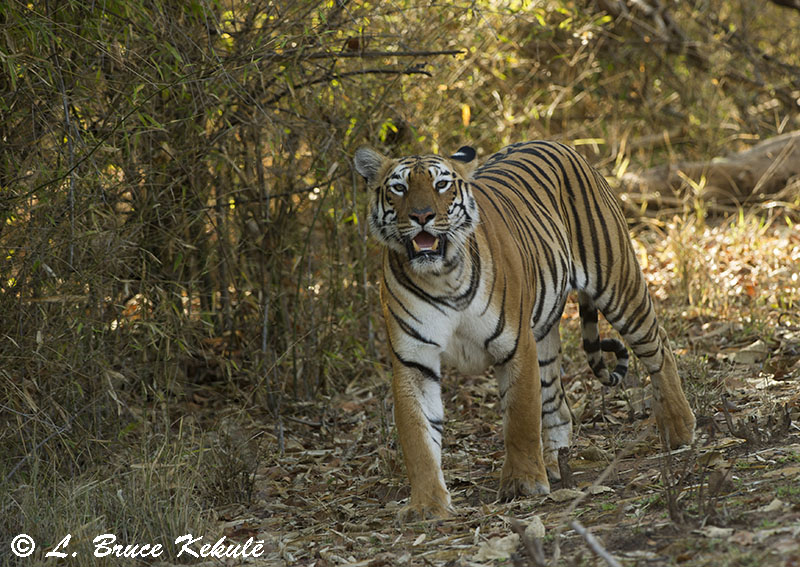
A tiger named ‘Maya’ in Tadoba National Park; she is the most famous tigress seen almost everyday.
After four days in Assam, I flew back to New Delhi for a two-day rest and then boarded a flight on March 3 in the morning down to Nagpur further south. Then a two-hour taxi ride was needed to Tadoba National Park and tiger reserve in the State of Maharashtra. Arriving at the lodge in mid-afternoon, a needed rest and some lunch was in order. I did not go out on safari that afternoon because the park is closed on this day.
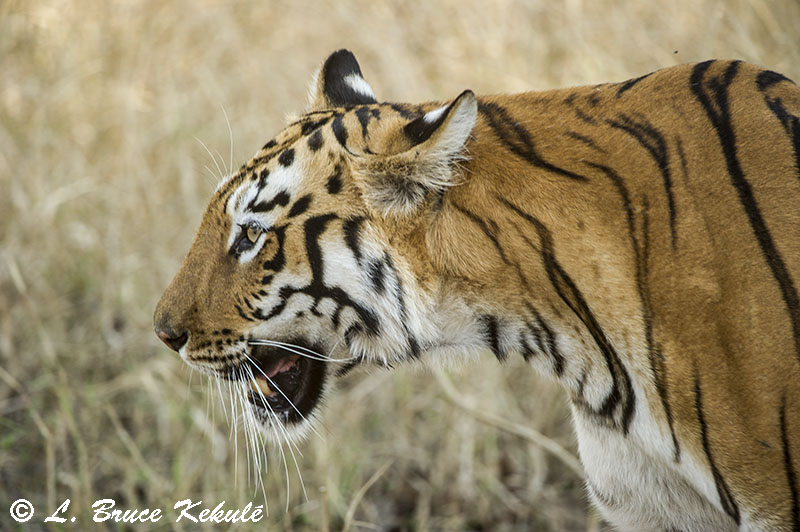
‘Maya’ up-close as she walked the road marking her territory.
The next morning’s safari netted a beautiful female leopard highlighted by some wonderful back-light. My spirits were up a hundred percent after photographing the spotted cat.

Female leopard jumping in front of our jeep.

Female leopard up-close as she checks her surroundings.
The next morning as we were rolling around the dusty roads, we bumped into a big crowd of jeeps but they were at the far-end of a one-way road. We waited and saw a tiger walk out of the forest near the jeeps but melted back in. The group then moved close to us but the tiger stayed in the forest. My driver Lahu from the Tiger Trails Lodge has been driving for the owner of the lodge for some 35 years, and knew exactly where the big cat would come out. And as sure as the sun comes up everyday, she popped out and walked right in front of us.

‘Maya’, the female tiger queen in Tadoba National Park: This was my last sighting of this beautiful cat.
I did not stop shooting as Maya, (probably the most popular tigress in Tadoba at the moment) walked along the road spraying and marking her territory. My new friend Dr Sundran Rajendra was with me, and the both of us were so elated that we just kept on shooting our cameras. Then time was up and we had to leave the beautiful cat to herself. It was Sundran’s first tiger and he managed to get some very nice shots of the big cat. She came so close I could almost touch her.

Another tigress, named ‘Choti Tara’ fitted with a radio collar snarls at my friend Dharmendra Sharma.
My other friend and naturalist with the lodge Dharmendra Sharma, was in another jeep so I let him use my Nikon D7000 and the new Nikon 70-200mm VR II, and he got some very nice photos of another female named ‘Choti Tara’ fitted with a radio collar. He also got a few nice shots of Maya.

Male tiger named ‘Gabbar’ fitted with a ‘radio collar’ in pretty bad shape.
On my last afternoon safari in Tadoba, I bumped into ‘Gabbar’, a male tiger also fitted with a collar. He got swatted by another male and was in pretty bad shape. But the wheels are in motion to fix him up. I just hope that the squeaky Indian bureaucracy does not wait too long to help this tiger, as he could turn into a cattle killer or even worse, a man-eater. Needless to say, news on Facebook is that he did kill a village buffalo but is OK for the moment, and is being monitored. After four days, I was back on the plane to New Delhi for a two-day rest before heading north to India’s first national park.
Corbett National Park: State of Uttarakhand

A young tigress stalking a herd of spotted deer in the grassland of Corbett National Park.
It takes about four to five hours north of Delhi by taxi through some very congested and dangerous traffic in the State of Uttar Pradesh to get to Ramnagar, a city in the State of Uttarakhand where Corbett National Park, India’s first national Park. It is situated in the foothills of the great Himalayas. I spent the first night at the Forest Department’s lodge at Bijrani, and went on safari that afternoon and then again the next morning.

A golden jackal on the run near the Forest Department’s lodge at Bijrani.
I did not see a tiger but the big cats were around as other jeeps that I bumped into got some nice close-up photos taken with an iPhone. An occupant in one of the vehicles gave me a telephone slide show. I did see a pair of golden jackals early in the morning and then later a small family unit of elephants. One old cow did a mock charge and came within 15 meters but stopped short and turned around going back to her calf. The elephants then faded off into the forest.

Elephants near the Forest Department lodge at Bijrani.
Around 12-noon, we left this section and went over to the Forest Lodge at Dhikala that is the best site in Corbett to see tigers. Near the lodge, there is a grassland savannah that attracts herbivores like spotted deer in great numbers, and of course many tigers come looking for prey. It is said the park has some 200 tigers, one of the highest densities in India.
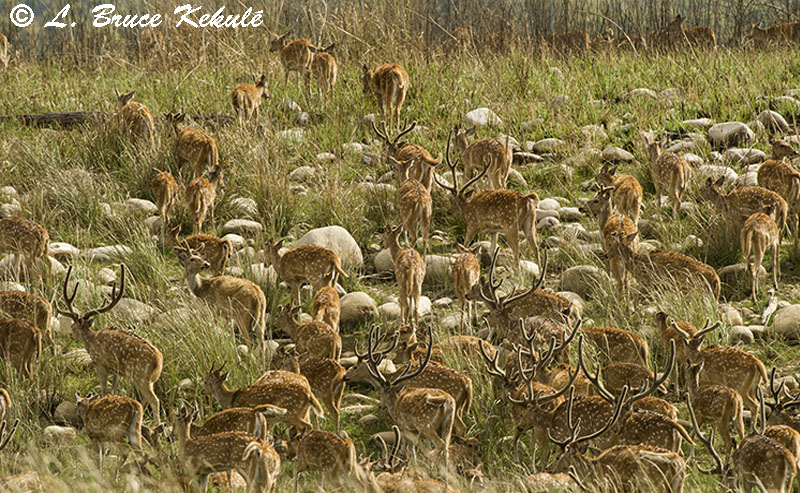
A herd of more than 100 spotted deer; the prime food source for tigers in Corbett National Park.
On the second morning, we bumped into a young hunting tigress stalking a herd of over a hundred deer. Me, my naturalist Devendra Singh Neui and my driver Rasheed Ali, were the only ones at this location as all the other jeeps from the lodge (about 10 of them) were waiting for tigers by the forest road. She tried several times unsuccessfully to chase down a deer but the herbivores were on to her. I managed to get some really great images in the process.

The tigress on the run after spotted deer not far from the Forest Department’s lodge at Dhikala.
Later in the afternoon, the camp was abuzz with the news that a tiger was in the lower grassland, and after lunch, they all headed that way and waited nearby. When she appeared, the group went wild chasing after her but they all came up short. We hung back and this very smart tiger circled around to avoid them. I saw her one more time slinking in the grass as the light was fading but time was up as I snapped a few last frames. I had a great time here and have vowed to return to this remarkable place…!

The unlucky tiger chasers in the grassland of Dhikala, Corbett National Park.
The trip to Corbett was scheduled on very short notice by my agents Anu Marwah in New Delhi, and Jason Fernandes in Mumbai both wildlife photographers of great standing in India. They are joint owners of Wilderness Uncut (wildernessuncut.com), a company set-up to cater to wildlife photographers, naturalists and bird watchers. Their superb management and arrangements are first class with absolutely no hiccups and they are reasonable priced. It was a great, enjoyable and memorable trip for me. I can honestly say that I need look no further for anyone to help me with any of my up-coming trips to India.

The female tiger in the grassland of Corbett: this was my last sighting of this beautiful tigress.
One point that I must make here! You never get tired of seeing the world’s biggest cat and is one of the greatest predators that ever walked the face of the Earth. My thoughts are always with these felines and their future survival. Unfortunately, the future for the tiger looks dim, as the situation concerning the Asian medicine trade using their bones seems to be getting worse with more and more stories on the net and in the papers about this draconian belief. The biggest culprits are China, Vietnam, Laos and Thailand (Chinese in Thailand) that perpetuate this market. The tiger needs the whole world to stand up to these people and this illicit trade must be stamped out soon but it carries on with impunity. Until action is taken with economic sanctions and other means against the countries involved, this illegal black-market will continue to take the wild tiger into the dark depths of extinction.
A rare Asian leopard sighting…!
The big cat makes a surprise appearance in India
In 2013, I visited Tadoba Tiger Reserve and national park in the State of Maharashtra, Central India, and spent nine days chasing after tigers with my good friend Luke Stokes from England but who also lives in Thailand like me. We saw seven tigers in nine days that was just awesome for our first trip to the ‘Land of the Tiger’. But the leopard stayed elusive and we did not even get a glimpse of the smaller big cat.
Female posing for me very close to the road – my favorite shot…!
Last year I decided to return to Tadoba once more in March 2015 but had to make bookings way in advance to guarantee a slot. Plans were drawn up, the lodge was selected, dates were locked in and fees were sent. Unfortunately Luke was not able to make this trip with me due to other commitments so I had to go it alone this time. But after a trip to two other Indian tiger reserves in November 2014, I have now become familiar with travel in India that is hectic but has now become almost second nature learning the ropes and system of chaotic India.
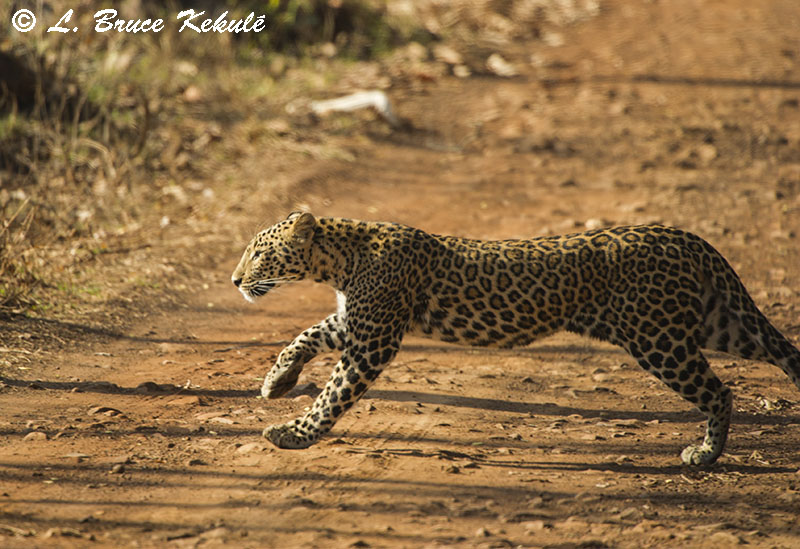
Jumping across the road in front of us…!
The flight from New Delhi to Nagpur (the closest city to Tadoba) further south takes about one and half hours and is pretty straightforward. The crowds and security at the airport are tight in Delhi with loads of flights leaving first thing in the morning. I arrived safe and sound to a waiting taxi for the three-hour drive southwest to the lodge just outside the park gate about noon. After some lunch, I rested up and got my cameras ready for the next morning’s safari first thing at 6am.

She is winking at us…!
After a quick coffee and some toast, I jumped into the jeep with a driver and a new acquired friend named Sundran Rajendra, an Indian guy born in Malaysia, brought up in Australia, and now from London. We become immediate friends so at least I had a companion. This was his first trip to India but he was a season traveler having been to Africa many times. We arrived at the gate in five minutes and after paying a small fee for our cameras, moved into the protected area in the dark with a forest guard in tow. The sun began to rise and light filled the forest as we spotted deer and peafowl and other birds just waking up. I was all pumped up but the morning dragged on a bit as we plugged along.

Got her eyes on us now…!
All of a sudden, a leopard was sighted disappearing into the bush. At first I thought that would be it but the driver has worked here for some 35 years and knew what to do. He skillfully moved along the road and stopped ahead of where the leopard might appear. And as sure as the day is long, she moved out of the forest in front of us, hesitated and then jumped across the road disappearing once again. I took a few shots and then we moved once more but this time near a deer kill the mature female had made earlier that morning. She had been chased off by the arrival of several jeeps.

Her final pose before slinking off into the bush – another favorite…!
Once again the driver moved forward and then we waited once again. And like magic, she appeared a third time right in front of us. I did not stop shooting until she left being spooked by too many jeeps arriving. The light became harsh and we had run out of time as the Forest Department has strict rules that must be followed to avoid being fined. Later that morning when the jeeps and everyone had gone, she came back and took the deer kill into the forest for a meal. Sundran and I cheered and jumped up and down celebrating our luck at a rare sighting of an elusive cat. It certainly made our day…! The next morning, we bumped into a female tiger up-close but that is another story to be posted at a later date…Enjoy…!
Nikon D300s catches an Asian Leopard
A male cat shows off its family jewels…!

A male leopard with its reproductive organs in full swing…Shot No: 6.
Back at the end of June, I pulled a card from my D300s DSLR trail cam at the ‘big cat trailhead’ and when I looked, I did not see anything so I threw the card in the with the rest of my CF cards.
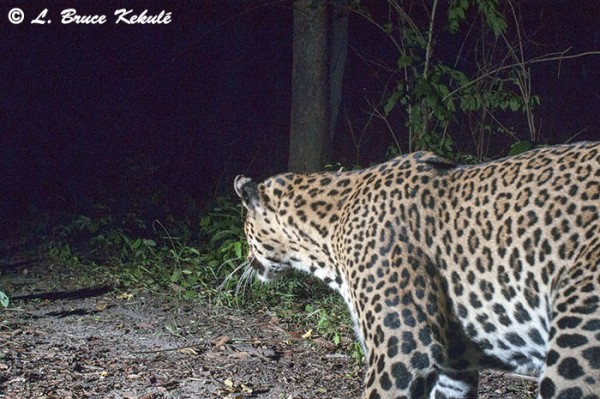
Shot No: 1
It was somehow put into my D3s but fortunately I did not format it. After doing some work while in the forest last week, I pulled both cards (Nikon D3s had two CF card slots) and downloaded them.

Shot No: 2
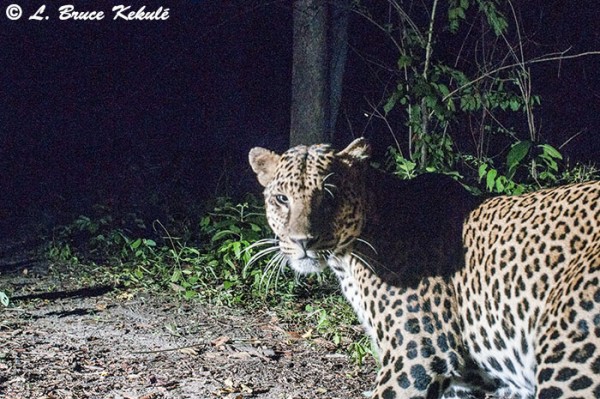
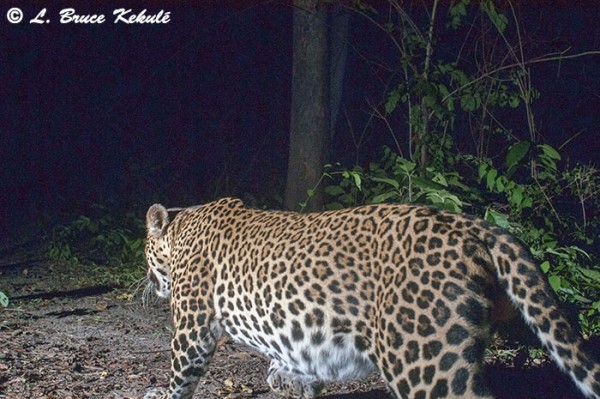
Imagine my surprise…! There was a male leopard and he had been captured at night while walking past the D300s. Where the heck did that come from…?
Shot No: 3
I guess my short-term memory is on the blink. Unfortunately, the other two flashes were dead creating a horrible shadow…!

Shot No: 4
Needless to say, I’m lucky I did not lose these shots and of course, shot No: 6 is my favorite…enjoy…!
Shot No: 5
Nikon D300s set to low continuous.
Nikon 35mm manual lens.
ƒ11 @ 1/125 ISO 400
Single SB-28 set to full (the other two flashes did not fire and were dead).
SSII sensor #6 chip – Pelican 1150.