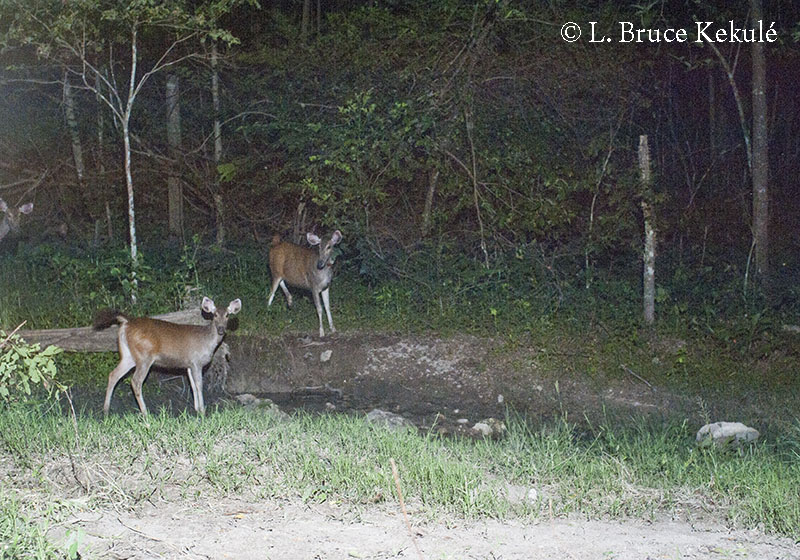
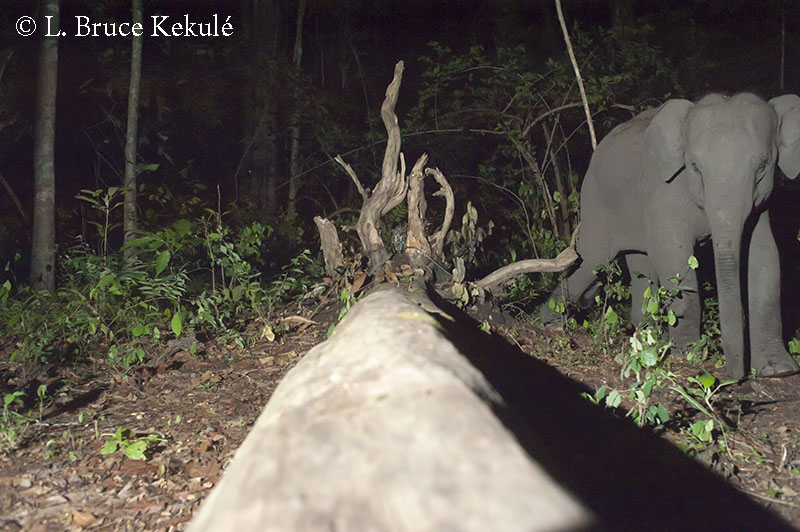
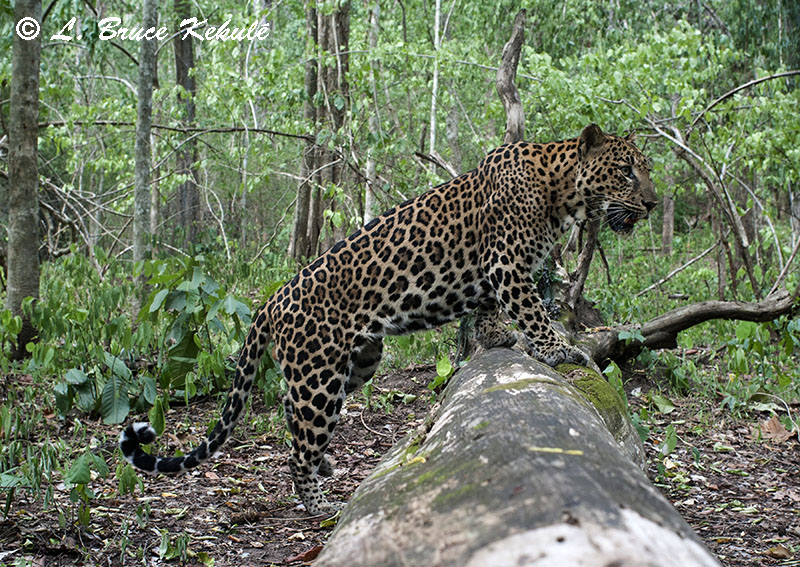
Posts Tagged ‘Thailand’

The Asian Tapir – Living fossil and bizarre mammal

Wednesday, September 1, 2010 posted by Bruce 1:35 PM

Odd-toed ungulate and strictly vegetarian

Asian tapir in Kaeng Krachan National Park

Asian tapir posing in the Phetchaburi River

It was an amazing day in March 2005 near the headwaters of the Phetchaburi River deep in Kaeng Krachan National Park situated along the border with Burma in southwest Thailand. One morning, a buffy fish-owl found stuck in a fishnet was going into shock from hypothermia. I luckily saved this creature from certain death.

Buffy fish owl in Kaeng Krachan

Buffy fish-owl saved from certain death

The campfire was going well and I used it to warm up the bird of prey. When it could stand by itself, I placed it on a tree branch and then played wildlife photographer for a short while. I then left the confused animal in peace and it eventually flew across the river and disappeared into the forest. I felt good saving the owl. Under other circumstances, it might not have fared too well.

King cobra hunting by the Phetchaburi River

King cobra hunting by the Phetchaburi River

Later in the day as we were up-river and just about ready to turn back, a huge king cobra showed-up hunting for prey along the riverbank. I was able to catch a few photographs of the largest venomous snake in the world before it U-turned and disappeared into the forest.

That definitely got the blood flowing as I checked out my shots on my brand new Minolta D7 DSLR digital camera, the first with anti-shake technology in the camera body. I shot off-hand and was getting some acceptable digital captures. When the smoke cleared, I had only two shots left on the card and decided not to delete any poor exposures as I felt nothing would show after the big snake.

Asian tapir in Kaeng Krachan National Park

Asian tapir swimming in the Phetchaburi River

It was about 4pm and the light was nice and warm as we headed back to camp more than an hour away. Just then, an Asian tapir bounced out of the forest and dived into the river. It submerged for a short time probably trying to evade a swarm of biting forest flies before surfacing and swimming towards us. I took a shot waiting for the ungulate to get closer. It stopped in the water about twenty meters away.

The tapir has very poor vision and it took a few seconds before the unusual creature saw five humans standing out in the open. Just as I snapped my last shot shown in the lead photo, it swam away and jumped back into the forest it had come from. Seeing one of nature’s remarkable animals, even though briefly, is the ultimate thrill for me.

I know I missed quite a few shots because of old age forgetfulness (not having spare memory cards), but then again, the two shots I captured were more than enough. I was thrilled to capture the world’s largest tapir in broad daylight offhand. If I used a tripod that day, I might have missed it. These creatures are mainly nocturnal and rarely seen during the day. This event was truly the beginning of a new dream and this tapir made the front cover of my third book Wild Rivers. It certainly was special for me, and is etched in memory.

In Thailand, photographing three separate species in one day is surely a rare occurrence as most animals are now tough to see and photograph, especially the tapir. It must have been something about saving the owl earlier in the day and the ‘spirits of the forest’ made up these magical sightings. I will never know. It had been a dream of mine to photograph a tapir in the Phetchaburi River in Kaeng Krachan National Park after seeing a painting in a book produced by the Tourist Authority of Thailand (TAT).

Asian tapir in Huai Kha Khaeng Wildlife Sanctuary

My first tapir from a tree-blind in Huai Kha Khaeng

Years ago when I made regular trips to Huai Kha Khaeng Wildlife Sanctuary in western Thailand, one visit stands out as a lucky tapir sighting. There is a hot spring deep in the interior that attracts all sorts of large mammals including the tiger, leopard, elephant, gaur, banteng, and the tapir among others. This mineral deposit is part of a complex natural seep several hundred meters long. I was sitting at the bottom-end in a tree blind about eight meters up and waited throughout the day until about 5pm. A few sambar stags came for a drink followed by a doe. A barking deer nervously stepped in but somehow was spooked by something on my right and departed.

Asian tapir in Huai Kha Khaeng Wildlife Sanctuary

My first tapir moving in the forest under the tree-blind

A few minutes later, a black and white creature plowed through the brush and popped out into the clearing. I quickly snapped off a bunch of frames with my Nikon 600mm as the tapir took a long drink filling the frame with the large mammal. The tapir then moved under the tree I was in and I managed a couple of shots with a smaller lens as the tapir disappeared into the forest behind me. In those days I was shooting film and was not sure my photos were good until I processed the film back in Bangkok. Shooting black and white mammals is fraught with exposure problems but most of the shots were OK. It was my first lucky sighting of an animal known for its secrecy and nocturnal habits.

Asian tapir and gaur in Huai Kha Khaeng Wildlife Sanctuary

Tapir and gaur photographed at a hot-spring in Huai Kha Khaeng

Another memorable tapir sighting was not by me but my close friends, Samak Khodkaew, Amonsak Sirwichai, Sarawut Sawkhamkhet and Ajarn Prapakorn Tarachai. These gentlemen are nature photographers and have helped me in the past with my book projects. I set the four of them up in a permanent photographic blind about noontime at the top-end of the hot spring mentioned above. I then waited for them back at the truck.

Just as darkness arrived, a bull gaur and a tapir arrived almost together. I have never seen a bunch of excited photographers like this group when they finally came out. Two species in one photo is also quite an achievement. I was happy and glad the ‘spirits of the forest’ had smiled on them.

QQ_27_2_750

Asian tapir camera-trapped in Kaeng Krachan

When I began a photographic and camera-trap program in 2005 along the Phechaburi River in Kaeng Krachan, it was not long before I caught a mature tapir at a mineral deposit late one night. They are thriving there as are other large mammals like tiger, leopard, sun bear, wild dogs, elephant, gaur and sambar.

Asian tapir in Khlong Saeng Wildlife Sanctuary

Asian tapir mother and calf camera-trapped in Khlong Saeng

In early 2009, I started a new program in Khlong Saeng Wildlife Sanctuary in Surat Thani province down South. I now have quite a few camera-trapped tapir photos where the species is proliferating. The flooded forest of Cheiw Larn reservoir habitat is now unnatural for them but they have adapted to the changed landscape. These amazing herbivores are surviving quite well in the mountains of Khlong Saeng-Khao Sok Forest Complex.

Asian tapir in Khlong Saeng Wildlife Sanctuary

Tapir calf camera-trapped in Khlong Saeng

However, tapir numbers have decreased in recent years, and today, like all of the species, is in danger of extinction. Because of their size, tapirs have few natural predators, and even reports of killings by tigers are scarce.

Asian tapir camera-trapped in Khlong Saeng Wildlife Sanctuary

Young ear-bitten tapir camera-trapped in Khlong Saeng

The main threat to the Asian tapir is human activity, including hunting for meat, deforestation for agricultural purposes, flooding caused by the damming of rivers for hydroelectric projects, and illegal trade. Protected status in Thailand, which seeks to curb deliberate killing of tapirs but does not address the issue of habitat loss, has had limited effect in reviving or maintaining the population.

In closing, this remarkable wild animal is just another cog in the wheel of Mother Nature’s wonderful array of species adapted to living in the evergreen forests of western and southern Thailand. Their survival depends on one thing: protection and enforcement of the protected areas where they live. Over the long run, it is up to the Ministry of Natural Resources and Environment, and the Department of National Parks to insure that the tapir and all the other beautiful creatures get the best possible safeguards for the future. It is hoped the powers to be will take action to prevent further destruction of the Kingdom’s natural resources.

Tapir up-close

Tapir are considered living fossils as the genus has been traced back as far as Early Oligocene times. These remarkable mammals have been on the planet for about 40 million years. The first tapirs are named Miotapirus judging from fossil evidence found in North America. Tapiridae, a sub-family belong to the Order Perissodactyls, or odd-toed ungulates that goes back to the Late Paleocene 55 million years ago including rhinoceros-like creatures evolving in North America and eastern Asia from small animals similar to the first horses.

The Asian tapir Tapirus indicus, also called the Malayan tapir, is the only one native to Southeast Asia. It has an unmistakable black and white two-tone pattern distinguishing it from the other three tapir species of Central and South America. The Asian species is the largest, and is the only ‘Old World’ tapir with the females slightly larger than the males. They live in the rainforests of Thailand, Myanmar, Malaysia and Sumatra.

The general appearance and characteristics of the Asian tapir is easily identified by its markings, most notably the white “saddle” which extends from its shoulders to its rump. The rest of its hair is black, except for the tips of its ears, which, as with other tapirs, are rimmed with white. This pattern is for camouflage as the disrupted coloration makes it more difficult to recognize it as a tapir at night, or in the dark jungle during the daytime that they prefer. They are mainly nocturnal but do show sometimes in the late afternoon at the river or mineral deposit. Other animals like tiger may mistake it for a large rock rather than a form of prey when it is lying down to sleep.

The Asian tapir grow to between 1.8 to 2.4 m in length, stand 90 to 107 cm tall, and typically weigh 250 to 320 kg, although they can weigh up to 500 kg. The females are usually larger than the males. Like the other types of tapir, they have small stubby tails and long, flexible proboscises. They have four toes on each front foot and three toes on the back feet.

The tapir has very poor eyesight, and making them rely greatly on their excellent sense of smell and hearing to go about in their everyday lives. The tapir has small, beady eyes with brown irises on either side of their face. Their eyes are often covered in a blue haze, which is corneal cloudiness thought to be caused by repetitive exposure to light. Corneal cloudiness is when the cornea starts to lose its transparency.

The gestation period of the Asian Tapir is approximately 390-395 days, after which a single offspring, weighing around 6.8 kg, is born. Young tapirs of all species have brown hair with white stripes and spots, a pattern that enables them to hide effectively in the dappled light of the forest. This baby coat fades into adult coloration between four and seven months after birth. Weaning occurs between six and eight months of age, at which time the babies are nearly full-grown, and the animals reach sexual maturity around age three. Breeding typically occurs in April to June, and females generally produce one calf every two years. Asian Tapirs can live up to 30 years, both in the wild and in captivity.

Tapirs are primarily solitary creatures, marking out large tracts of land as their territory, though these areas usually overlap with those of other individuals. Tapirs mark out their territories by spraying urine on plants, and they often follow distinct paths that they have bulldozed through the undergrowth.

Exclusively vegetarian, the animal forages for the tender shoots and leaves of more than one hundred species of plants (around 30 are particularly preferred), moving slowly through the forest and pausing often to eat and note the scents left behind by other tapirs in the area. They tend to eat soon after sunset or before sunrise, and they will often nap in the middle of the night.

However, when threatened or frightened, the tapir can run quickly despite its considerable bulk. They can also defend themselves with their strong jaws and sharp teeth, and have thick hides protecting them from predator attack. They communicate with high-pitched squeaks and whistles. They usually prefer to live near water and often bathe and swim, and they are also able to climb steep slopes.

Post to Twitter Tweet This Post

Photographing three wild species in one day

Sunday, August 1, 2010 posted by Bruce 10:41 AM

The beginning of my 3rd book project entitled Wild Rivers

Buffy fish owl

Buffy fish owl by the Phetchaburi River in Kaeng Krachan National Park

Like most of my mornings in the forest, getting out of the hammock before dawn is a routine affair for me. Sleeping by the pristine Phetchaburi River in Kaeng Krachan National Park in southwest Thailand is a peaceful and soothing experience with the sound of rushing water flowing down to the lowlands. The night creatures fade into their abodes and daytime is greeted by singing birds and insects. As the sun comes up, gibbons call and hornbills honk from the treetops. It is nature at its very best.

Phetchaburi River

The mighty Phetchaburi River during the dry winter season

I adhere to an old saying; “an early bird get’s the worm” to sometimes work wonders. This was the case one particular morning in March 2005. After a quick cup of coffee, I got my cameras ready for the days’ shoot. I was about to embark on my third book project capturing some extremely lucky wildlife photographs of three different species in one day.

About 6am, one of the Karen porters went upstream and found a buffy fish-owl stuck in his fishnets. I was upset at them to say the least but had to think quickly. The bird was going into shock as hypothermia took control over the owl. It was on the verge of dying and only quick thinking saved this creature from certain death. The campfire was going well so I placed the bird close to warm it up and get its blood flowing. I’m sure the creature had no idea what was going on but the bird was calm and collective as I assured it everything would be OK.

Buffy fish owl in Kaeng Krachan

Buffy fish owl just after being saved from certain death

The owl began to perk up and I knew then it would survive. I placed it on a tree branch by the river and it locked its talons into the bark. The bird of prey just sat there while I played wildlife photographer. After shooting almost an entire memory card and without further ado, I left the owl in peace.

As I sat down to eat breakfast, it left its temporary perch and flew across the river disappearing into the dense forest. The bird was not seen again. I felt pleased at having saved this beautiful creature’s life. I had just switched to a Minolta digital SLR camera and was able to double-check all my shots for exposure, color and focus. Everything looked good and I was excited at having photographed this owl during the day as they are nocturnal.

King cobra hunting by the Phetchaburi River

King cobra hunting along the Phetchaburi River

After breakfast, we packed up our gear for a day trip headed upriver. In March, the water level is low, and the riverine habitat easy to transverse. The team and I crossed the river several times till about 4pm when I decided to turn back to camp. Just then, my research companion Detchart “Top” Saengsen sighted a large snake and called out. I reached for my camera with a 280mm lens and found a slithering black reptile in the underbrush. Its head appeared and I started shooting, not thinking about the danger. The king cobra – the world’s largest venomous snake – moved into an overhang so I flipped up the flash and took a few more shots. The reptile did a u-turn and was gone in a split second.

King cobra hunting by the Phetchaburi River

The big snake just before it made a u-turn and disappeared in a split second

The rest of the team had already retreated, leaving the crazy photographer to his own devices. It certainly was an exciting experience. I was elated that I had just photographed the true king of the forest. It is said large mammals like elephants, gaur and tigers stay out of the king cobra’s way. I checked my camera and had two shots left on my card. I decided not to delete any poor images until later as I felt nothing would show itself after the big snake.

Asian Tapir in the Phetchaburi River

Asian tapir swimming in the Phetchaburi River

The team and I were in good spirits as we headed back to camp. Suddenly, an Asian tapir bounced out of the thick forest on the opposite bank about a hundred meters away. It dove into the river and started swimming towards us, now fifty meters off. Tapir have fair eyesight but this black and white creature did not notice five humans standing out in the open up on a sandbank. I took one shot of the swimming tapir then waited, knowing very well I only had one frame left. The creature got closer and then stopped in the water about 20 meters away. I centered the focusing ring on the eye and took the shot. Then we watched this elegant animal go back the way it had come.

I know I missed quite a few shots because of old age, forgetfulness (not having spare memory cards), but then again, the two shots I had were more than enough. I was thrilled to photograph the world’s largest tapir in daylight. These creatures are mainly nocturnal and rarely seen. That day was truly the beginning of a new dream and my last shot of this tapir made the front cover of my third book Wild Rivers now published and available at bookstores in Thailand and the region. It certainly was a special day for me and one that is etched in memory.

Asian Tapir in the Phetchaburi River

Asian tapir posing for me in the late afternoon sun

I am now working on book four which will be a collection of stories published over a two year period in the Bangkok Post, Thailand’s number one English daily. Chapters are about the top protected areas in Thailand and wild species reports on the animals thriving in the remaining forests including mammals, birds, reptiles and other categories. Hopefully, this book project will be out in a couple of years. My dream to produce wildlife books continues, but that is another story.

Post to Twitter Tweet This Post

The Asian Leopard: Thailand’s second largest cat

Friday, July 23, 2010 posted by Bruce 8:57 AM

WILD SPECIES REPORT
An ambush predator – solitary, stealthy and naturally camouflaged

Black leopard in the afternoon sun

Black leopard in the late afternoon sun

The late French poet Robert Desnos (1900-1945) wrote a short poem entitled “The Leopard”

“If you go into the woods, beware of the leopard.
He meows in subdued voice and arrives from nowhere”

The leopard Panthera pardus described by Linnaeus in 1758 is the second largest cat in Thailand. Once upon a time, leopards could be found in all the forests of the Kingdom. These felines are still surviving quite well in protected areas in the West, with some in the South. A few have been reported in Phu Khieo Wildlife Sanctuary in Chaiyaphum province, but there are no reports from other parts of the Northeast. There have been no records from the North for many years. The reason that most areas have no leopards are quite simple; prey species has been hunted out including the leopard itself, plus encroachment has destroyed much of its habitat.

Sighting a leopard in Asia is extremely difficult, and even catching a rare glimpse of this very essential top predator is tough due to its solitary and stealthy behavior. However, luck can sometimes play an important part in viewing the leopard and I feel lucky to have seen and photographed them on quite a few occasions.

Leopard hunting on a trail

Leopard camera-trapped in Kaeng Krachan National Park

The most thrilling or heart stopping adventure with a black leopard happened in Huai Kha Khaeng about five years ago while I was sitting overlooking the river. A photographic blind was erected on a cliff-face about 20 meters up with a small trail that enabled me to get into the hide. The sun was bright and the weather was warm during the dry season.

About 9am, several monks passed by but did not see the camouflaged structure as they went on their way. After that, I came down for lunch and set some camera-traps at a mineral deposit nearby. At 2pm, I settled back in the blind and then began a vigil of the river. I started to feel a bit groggy as the sun was beating down on my position.

All of a sudden, I was startled by a guttural growl outside the enclosure. I stood up slightly and peering out the window came face to face with a huge black head and yellow eyes about two meters away that penetrated my soul. My first instinct reaction; it was a big black dog. But that quickly changed as the creature stared intently at me before bounding down the trail it had come up. The big cat was gone in a split second. Of course there was not enough time to get any photographs. The incident surely is etched in my memory.

Black leopard camera-trapped in Kaeng Krachan

Black leopard camera-trapped in Kaeng Krachan

Why had the leopard come so close without smelling me? On that particular day, I was using an old hunters technique by collecting fresh wild water buffalo droppings and putting them in front of the blind, and that probably covered my scent. Maybe the leopard thought there was a newborn calf, or an old weaken animal. Or maybe it used this natural place overlooking the river to spot prey like sambar, barking deer or wild pigs that are abundant around here and came up to investigate. The vantage point is on a bend in the river and one can see for quite a distance both ways.

I will never know how close I came to being attacked by a leopard but it was a heart stopper for sure. I sat motionless for quite sometime. Only a few sticks and camouflaged material separated me from a wild creature armed with fangs and claws. On that day, the spirits of the forest looked after me, or was it the ‘Spirit of the Forest’. I like to believe that was the case. I hope one day to go back and stake out this bluff and believe this leopard is probably a resident around here. I camera-trapped tiger and a yellow phase leopard not far from here.

Leopard resting on a trail

A leopard resting on a wildlife trail

Speaking of leopard attacks, my close friend and associate Dr Lon Grassman was once seriously injured in Kaeng Krachan National Park, Phetchaburi province by a leopard while working there on a survey to camera-trap and collar the big cat. When Lon released one, it looked up and turned on him in a split second mauling his legs and arms. It was a close call but he survived to carry on his work researching wild carnivores. Lon established the home range and other behavior of leopards in the park.

He then moved to Phu Khieo Wildlife Sanctuary, Chaiyaphum province in the Northeast and continued this work catching and releasing quite a few golden cats, clouded leopards and a marbled cat. He eventually received his doctorate for this excellent work.

In the beginning of my profession as a wildlife photographer, I was very fortunate. The Director of the Wildlife Conservation Division of the National Parks Department (DNP) at the time, my dear friend Dr Viroj Pimmanrojnagool (now retired), had confidence in me and gave permission to enter the realm of the leopard and the tiger, something not easily acquired. Entry into wildlife sanctuaries has always been very restricted but is possible with the right qualifications. Viroj and I are still very close and I visit him from time to time at his durian farm in Surat Thani down south where he is happily enjoying retirement.

Leopard in bamboo in Huai Kha Khaeng

Leopard in the bamboo – my very first photo of the big cat

My first encounter with the sleek cat goes back to the beginning of my career more than a decade ago. Driving into the forest late one afternoon in Huai Kha Khaeng Wildlife Sanctuary, a World Heritage Site, the sun was low but the light still quite good for photography. The protected area is situated in Uthai Thani province and is part of the Western Forest Complex.

I was about to capture my very first Asian leopard on film. This was in my early days as a wildlife photographer with a newly acquired Nikon N90 camera and 300mm lens. I was on a learning curve that would take me into some unique natural habitats and bump into some very unusual animals around Thailand.

Leopard camera-trapped in Kaeng Krachan National Park

Leopard posing in Kaeng Krachan

About 4pm some 10 kilometers from the headquarters area as I was driving in, a leopard jumped in front of my truck and bounded up the steep embankment on my right. I gently came to a halt and there looking down at me was these two big yellow eyes that brought my attention to 100 percent. In the meantime, I had already grabbed my camera and started snapping through the window as fast as possible but quickly slowed the pace concentrating on focus. After a few more shots, the spotted cat melted into a bamboo thicket and was gone. The encounter was measured in mere seconds.

I sat in the vehicle for a few minutes to catch my breath as my heart was thumping. A close encounter with a carnivore capable of tearing us apart is something that can get the blood flowing. I finally got going again as my destination was still a couple of hours away deep in the forest.

Leopard on sambar kill

Leopard on a sambar kill – my first camera-trap photo of the feline

Arriving at the Kabook Kabieng ranger station just at dusk, the head of the station Loong Waitanyakarn, another good friend, came immediately to the truck and said, “ a sambar mother and fawn have been killed by a leopard or wild dogs not far from the station and let’s go look”.

It didn’t take me long to ponder that an opportunity had presented itself. I had a new infrared sensor for my Nikon camera and decided to set-up the unit next to the dead sambar. A new role of film was loaded and the lens focused on the mother deer. The sensor was active infrared that uses a transmitter and receiver hooked to the camera. When an animal trips the beam, the shutter is activated taking a self-portrait. At the time, this technology was rather new but I needed it to supplement my regular photography.

Black leopard at a hot spring

Black leopard posing for me at a hot spring

The next day at noon some 10 kilometers away, Loong took me to a tree stand over-looking a hot spring. The box-like structure was quite high up and it was a bit scary getting situated in the blind but finally, I settled down with my Nikon 500mm lens and camera scheduled for a three-day stint. The mineral deposit and hot springs attracts many large mammals including elephant, gaur, banteng, tiger, leopard, wild dogs, tapir and many other animals that come for the life-giving minerals.

Leopard at a mineral lick

Black leopard at the hotspring

About 3pm, a troop of leaf-monkeys visited the hot springs for a quick drink but did not stay long. They had been spooked by something as they all panicked and gave flight in the trees up the hill. A short time later, a black leopard appeared from the top end and walked over to where the monkeys had just been. The sun was low in the sky and I could see the leopard’s pattern of rosettes through the lens that jumped out at me.

My heart began racing as the stealthy cat stopped at the top to take a drink and it stayed for about an hour. I calmed down but continued shooting changing several rolls of film and watching this magnificent creature. Just before the sun was gone, it moved closer to the tree I was in and then walked across the stream. The cat plopped down on a log and stretched out posing for me, all the while looking up at my position. I kept shooting and then it came even closer before veering off probably spooked by my scent. As the leopard moved through the forest, monkeys, barking deer and sambar barked at the predator.

Leopards camera-trapped on kill in Huai Kha Khaeng Wildlife Sanctuary, West Thailand

Leopard mother and cub at a sambar kill – A rare photo showing both color phases

I will never forget these encounters. Three leopards in two days are pretty good going for a new wildlife photographer and it was truly the beginning of many sightings and photographs of this amazing carnivore. I have seen loads of them on film while working in Kaeng Krachan. Both black and yellow phase were camera-trapped in three separate locations in the interior at almost every camera.

The Tenassarim Range in southwest Thailand is an absolute haven for the leopard due to a very good prey base here. Tigers also survive and have overlapping territories with the spotted cat. Both species hunt during the day and night. My old friend Suthad Sapphu, a forest ranger in Kaeng Krachan, was extremely helpful while we were camera-trapping the big cats.

Leopard track in Kaeng Krachan National Park

Leopard track in Kaeng Krachan

Without doubt, the future of the leopard depends on one thing only – the complete protection of the remaining forests where they live. If the national parks and wildlife sanctuaries remain intact with a high number of prey species, the big cats will survive. But if overdevelopment, poaching and encroachment are allowed to continue, the large cats will eventually disappear.

Unfortunately, too much time and money is wasted by too many organizations talking about saving wildlife and their habitats, with very little actually being done. Human population growth will eventually destroy most wild places. Only true protection by some dedicated people will slow the destruction of nature’s precious wildlife and wilderness areas. It is hoped the leopard, and the tiger, will continue to survive as they have for millions of years.

Leopard Ecology:
Pound for pound, the leopard can take on some seriously large animals several times its size. The leopard is closely related to the jaguar of South America. Both have a spotted coat pattern, incidence of melanism or black phase, and relatively short legs.

The present distribution of the leopard is restricted to Asia Minor, India, Southeast Asia, the Himalayas, Tibet, China, Siberia, and Africa. Fossils of leopards were found in Pleistocene deposits throughout Europe, the Middle East, Java, and Africa, some 1.5 million years old, indicating the leopard arrived after the tiger. These secretive cats are mainly nocturnal but in some localities, they are active in the day too. Their populations and ranges are difficult to determine but radio tracking of collared animals has shed new light on their movements and areas they live in.

Black leopard camera-trapped in Kaeng Krachan

Black leopard camera-trapped in Kaeng Krachan

The leopard is a member of the Felidae family and is the smallest of the four “big cats” in the genus Panthera, or roaring cats. The other three are the tiger, lion and jaguar. The leopard’s range of distribution has decreased radically because of hunting and loss of habitat. It is now chiefly found in sub-Saharan Africa; there are also fragmented populations in Pakistan, India, Sri Lanka, Indochina, Malaysia, and China. Because of its declining range and population, it is listed as a “Near Threatened” species by the IUCN (International Union for Conservation of Nature).

The species’ success in the wild is in part due to its opportunistic hunting behavior, its adaptability to habitats, human settlements and activity, its ability to run at speeds approaching 58 kilometers per hour (36 mph), its unequaled ability to climb trees even when carrying a heavy carcass, and its notorious ability for stealth. The leopard consumes virtually any animal it can hunt down and catch. Its habitat ranges from rainforest to desert terrains.

Post to Twitter Tweet This Post

Gaur – Majestic Wild Forest Ox

Thursday, December 17, 2009 posted by Bruce 7:40 AM

Wild Species Report
Gaur: Majestic wild forest ox
Rare mammal and largest bovid in the world
Endangered wild cattle close to extinction

Gaur Cow in Khlong Saeng

About 20 million years ago, the first ungulates evolved from small, hornless deer-like ancestors. Cattle, sheep, antelopes and goats are grouped together in the family Bovidae, and the most common hoofed grazing animal seen today. Sometime during the Pleistocene Epoch 1.8 million years ago, the genus Bos evolved in Asia and spread to Europe, Africa and eventually North America. Gaur Bos gaurus is a descendent of Bos Bibos, a wild cattle that lived on the great plains of Asia. Saber-toothed cats were one of the top carnivores at the time, and evolved alongside the ancient herbivores.

Young calf by Khlong Ya River

Gaur, the largest bovid in the world, is threatened with extinction and deserves much greater attention. The tiger and elephant have taken most of the conservation spotlight but gaur, like all the other wild animals need just as much protection, research and concern. Unfortunately, these wild forest ox continue to vanish from the wilderness areas in the Kingdom. After years of poor protective management and neglect, poaching and trophy hunting, plus a disappearing habitat suitable for these enormous creatures once found throughout Thailand, is the main reason for the decline.

Over their entire range, they are classified as internationally threatened. But not all is lost as gaur still survive quite well in a few of Thailand’s top protected areas in fair numbers, and where there are true safe havens, the species has actually made a come back. It is now estimated that more than a 1,000 individuals remain in Thai forests. This number is up from the 500 recorded in Dr Boonsong Legakul and Jeffery McNeeley’s book Mammals of Thailand published in 1977. Dr Sompoad Srikosamatara and Varavudh Suteethorn published a paper in the Siam Society’s Natural History Bulletin in 1995 about gaur and banteng. Their estimate then was about 1000 gaur were surviving so the number is basically stable and most likely on the increase.

Gaur herd at mineral lick in Huai Kha Khaeng WS

In Southeast Asia and India, gaur is found in scattered and splintered habitats. Other large wild bovine are banteng and wild water buffalo of Southeast and Southern Asia, the yak of Central Asia, the cape buffalo of Africa, and the bison of North America and Europe. In recent times, the number of these wild creatures has dwindled as humans continue to hunt them for meat and trophies, and destroy and encroach on their habitat in some places. The American bison came close to extinction but was saved in the nick of time. Thousands of wild bison now survive due to conservation efforts initiated by many people including the late U.S. President Teddy Roosevelt.

Gaur is Thailand’s second largest terrestrial animal after the elephant and tends to inhibit deep mountainous terrain far from humans. They survive in dry and moist evergreen forest plus mixed deciduous forests and therefore, have fared better than their cousin, the banteng that live in more open lowland forest. Gaur occasionally mixes with banteng that has been documented in Huai Kha Khaeng Wildlife Sanctuary, Uthai Thani province. Gaur will also shadow elephant herds using the same trails made by the larger mammals.

Gaur cow by Khlong Saeng River

My favorite photographic wildlife subject is gaur. In Thailand, these majestic ungulates can still be found in the following places: the Western Forest Complex and Kaeng Krachan Forest Complex, both in the west; the Khao Ang Rue Nai Forest Complex in the east; the Dong Payayen – Khao Yai Forest Complex and the Phu Khieo – Nam Nao Forest Complex, both in the Northeast; and down south in the Khlong Saeng – Khao Sok Forest Complex. Due to the serious instability in the deep south, very few surveys have been carried out and there is no consensus on gaur but they do survive in the Hala-Bala Forest Complex situated along the border with Malaysia. It is doubtful if any gaur survive in the North but the Omkoi – Mae Tuen Forest Complex might have few left.

Gaur has a keen sense of smell and hearing, and is always alert for danger. As a result, they can be tough to spot in the dense forests of Asia. However, luck does come sometimes, and the following accounts describe the few times I have had the great fortune to observe these magnificent beasts in the wild.

Gaur bull camera-trapped in Huai Kha Khaeng WS

My first photographic encounter with gaur in 1986 was at the beginning of my career as a wildlife photographer deep in the interior of Huai Kha Khaeng Wildlife Sanctuary. A natural deposit or mineral lick several hours walk from the road attracts many animals – gaur, banteng, elephant, sambar and muntjac come for the life-giving minerals, plus tiger, leopard and Asian wild dog hunt for prey. The balance of nature runs in harmony where “eat or be eaten” is the rule. I was extremely lucky and photographed two mature bull gaur that arrived late one afternoon as the sun was setting. The old bull on the front cover of my first book Wildlife in the Kingdom of Thailand stayed at the waterhole for quite sometime and I shot several rolls of film. This place has always been special to me.

A year later, I began visiting Thung Yai Naresuan Wildlife Sanctuary along the western border with Burma specifically to photograph gaur. In 1985, a herd of more than 50 individuals was seen from a helicopter by park officials on the huge grassland in the center of the sanctuary. Thung Yai is a tough place to work as many off-road 4X4 enthusiasts with big tires and jacked-up truck chassis have abused the road into the sanctuary for many years. Deep ruts in many areas make travel along the road difficult even for normal off-road vehicles. The rangers have a real rough time patrolling this sanctuary.

Young Gaur bull by Khlong Ya River

On one of my many trips to Thung Yai, and after many grueling hours of travel, and then a couple hours’ walk to a mineral lick in the sanctuary, I set-up a photographic blind along the forest perimeter. Late in the afternoon, two bachelor bulls entered and drank from the spring at the top end. I managed to get some good photographs as they went about their business. One bull snorted at our position as I had placed fresh gaur droppings in front of the blind, and I believe he was just letting us know who he was. Both bulls then departed peacefully and I was elated to say the least. It is estimated that more than 100 individuals thrive in Thung Yai.

In October 2008, I began a camera-trap program and set several units at a mineral lick visited by gaur and elephant in Kaeng Krachan National Park in Phetchaburi province, southwest Thailand. A month later, I visited the park and collected the cameras. A herd of gaur had come to the deposit including several cows and their offspring. It seemed as if the camera had spooked them initially, but the herd came back again the next day and a long series of captures was obtained. There are about 70 of these beautiful creatures thriving and breeding in this protected area.

Over in Huai Kha Khaeng Wildlife Sanctuary in the west during December 2008, I also set some digital camera-traps at a water hole, and after one month, two gaur bulls visited the waterhole. I also sat by the river in a photo-blind across from another mineral lick and photographed a large herd of gaur that had come for the minerals and lush grass. It is estimated that 350 gaur survive in this sanctuary. Better protective measures have allowed gaur to breed profusely and this World Heritage Site lives up to its name. Predators like tiger and wild dogs capable of taking on gaur, also thrive here. In the whole of the Western Forest Complex, it is estimated that more than 500 individuals live in scattered areas covering some 15,000 square kilometers.

Gaur-cow

Early this year while photographing wildlife in Khlong Saeng Wildlife Sanctuary in Surat Thani province down south, I had an amazing journey of discovery. Deep in the protected area, gaur is still thriving quite well. I set camera-traps in the sanctuary and managed to capture a very old bull gaur and several herds at many locations. A close look at the photograph shows seriously worn hooves on his hind feet. He is definitely past his prime and would not be a contender for female gaur in heat. With poor traction, he could not fight the younger bulls with stronger hooves and horns.

I also toured the flooded forests of Khlong Saeng and Khlong Ya rivers created by the Chiew Larn or Ratchaprapra Dam using a boat-blind and silent electric trolling motor. I was able to approach many herds and individuals over a four-month period. In every herd, there were young calves and yearlings indicating a healthy breeding population. Most of the mature bulls have become nocturnal due to past and present poaching pressure in the reservoir. In the Khlong Saeng – Khao Sok forest complex, it is estimated that more than 100 gaur are thriving.

In Kui Buri National Park, Prachuap Kirikan province, gaur has definitely made a come back due to increased awareness by the park staff plus financial support extended to help the rangers. It is now estimated that the population of gaur is about 70 individuals. Khun Chalerm Yoovidhya, MD of the Huai Hin Hills Vineyard and Siam Winery has taken a special interest in gaur at Kui Buri. Working with the park officials, he has funded many projects to help these creatures by sending volunteers to plant grass in selected areas to propagate grasslands, and setting up salt licks and check dams to attract the herbivores. Other projects initiated by Khun Chalerm include selling wildlife photographs and paintings at the vineyard to help the park rangers with food, clothing and equipment giving them more incentive to patrol the forest. Over time, other areas will put on the list for special help to protect Thailand’s natural heritage from the damaging effect of human poaching and intervention.

Gaur herd bolting in Kaeng Krachan National Park

In the northwest section of Thap Lan National Park, my very close friend Gate Glomchum who worked for the Petroleum Authority of Thailand (PTT) as chief reforestation officer (ret.) did some amazing things during his career as a reforester. Prior to 1996, a 10,000 rai area in Wang Nam Kheaw was completed degraded by a logging concession and squatters. Under his management and following a mandate set by His Majesty the King, this forest was replanted and the people were moved out. Today, this forest has completely grown-over, and there is elephant, gaur and tiger plus many other classic Asian species living in total harmony with nature. Other areas in Thailand also reforested under his supervision have had similar success.

Over in Khao Phang Ma just outside the eastern part of Khao Yai National Park, a national forest reserve was reforested by Wildlife Fund Thailand (WFT) and Khun Suthirat Yoovidhya (Director of CSR) of Red Bull-Thailand fame. Gaur moved back into this forest from Khao Yai after protective measures increased. There are about 50 gaur at this location and is probably the only place in Thailand where gaur live outside a protected area. Many projects like helping the rangers, setting-up salt licks and check dams have also been funded by Khun Suthirat under the ‘Red Bull Spirit’ program that is on-going. A couple of years ago, WFT shutdown all conservation operations due to internal conflicts but the Department of National Parks, Wildlife and Plant Conservation (DNP) took over responsibility of the reserve. They should be commended, and it is reassuring that some people are serious about conserving the Kingdom’s natural heritage.

 Gaur-herd

In the long run, the importance of protecting a prey species like gaur should be the number one priority for the government. The DNP need to increase budgets and personnel to look after these forests and animals. Thailand remains one of the best places for the survival of gaur in Southeast Asia. Protection, conservation awareness, education and monetary support are the keys to the future of these magnificent creatures of nature, and it is hoped they will continue to live in their natural habitat far from the destructive forces of man.

Ecology and Behavior

Gaur is the largest bovid in the world with a distinctive dorsal ridge and a large dewlap, forming a very powerful appearance. A fully mature bull stands about 1.6-1.9 meters at the shoulder and average weight of a big bull is 900 kilograms on up to a ton. Cows are only about 10cm shorter in height, but are more lightly built and weigh 150 kilograms less. These even-toed ungulate have stout limbs with white or yellow stockings from the knee to the hoof. The tail is long and the tip is tufted. Newborns are a light golden, but soon darken to coffee or reddish brown. Old bulls and cows are jet black but south of the Istamas of Kra, many take on a reddish hue.

All bovine share common features, such as strong defensive horns that never shed on males and females, as well as teeth and four-chambered stomachs adapted for chewing and digesting grass. Their long legs and two-toed feet are designed for fast running and agile leaping to escape predators. They are gregarious animals, staying in herds of six to 20, or more.

Due to their formidable size and power, gaur has few natural enemies. Leopards and Asian wild dog packs occasionally attack unguarded calves or unhealthy animals, but only the tiger has been reported to kill a full-grown adult. Gaur grazes on grass but also browse edible shrubs, leaves and fallen fruit, and usually feed through the night. They also visit mineral licks to supplement their diet. During the day, they will rest-up in deep shade.
There are three separate sub-species of gaur: Bos gaurus gaurus of India and Nepal, Bos gaurus readi of Indochina and Bos gaurus hubbacki of Southern Thailand and Malaysia. However, in 1983, the zoological classification of both the Indochinese and Southern gaur was changed to Bos gaurus laosiensis. In 1993, Pleistocene fossil evidence of Bos gaurus grangeri, an ancient sub-species, was uncovered by G.B. Corbet and J.E. Hill in Sichuan province, China.

Post to Twitter Tweet This Post

Comments Off

Banteng: Endangered Herbivores

Thursday, November 26, 2009 posted by Bruce 8:00 AM

WILD SPECIES REPORT

Banteng: Endangered herbivores
The magnificent wild cattle of Southeast Asia
Bovids threatened with extinction

Banteng bull at a waterhole in Huai Kha Khaeng

It was a hot steamy morning deep in the wilderness of Huai Kha Khaeng Wildlife Sanctuary, a World Heritage Site located in the central province of Uthai Thani. Not much was stirring other than a few birds and insects as the sun rose high in the sky. A hot breeze whiffed through, and heat shimmered from the center of a natural mineral deposit several hours walk from the nearest road. As the day got hotter, thirst kicked in among the many species of herbivore that live in the forest nearby.

Muntjac (barking deer), sambar, banteng and gaur use this important source of minerals. Many smaller mammals, birds, and reptiles also come to the lick as part of their everyday life. Tiger, leopard, and wild dog frequent the area in search of prey. Occasionally, wild elephant stop for a drink. A male barking deer stepped cautiously down to the water hole. Moving slowly and constantly watching out for predators, the young buck took a long-awaited sip of the life giving minerals. Shortly after, it disappeared back into the forest it had come from. Silence again took precedence as the morning wore on.

Banteng bull and cow at a waterhole in Huai Kha Khaeng

About an hour later at the top-end of the clearing, a herd of twelve banteng magically appeared and went straight down to the waterhole, as their kind have done for aeons. The herd included one old bull, a couple of young bulls and cows, plus three calves, and, like the deer, were extremely alert for carnivores. All of a sudden, a cow snorted an alarm, and the herd bolted for the safety of the bush. Curious by nature, the herd bull stopped short near the forest edge for one last look. The herd surrounded the bull and the young calves trailed behind before disappearing into the trees. For a moment, they were vulnerable to attack by predator. Banteng are very sensitive to any disturbance and flee immediately on the first hint of danger.

Banteng herd running on a sandbar in Huai Kha Khaeng

Another hour went by and suddenly, a solitary banteng bull appeared from the forest and moved down to the waterhole but stayed only momentarily. These loners usually pursue the herd during the mating season and have an irresistible urge to mate with the females. However, the herd bull will keep the young bulls in check.

The spirits of the forest had just provided a vision; some beautiful moments in the lives of banteng, Southeast Asia’s wild cattle. My friend Robert Semon and I were sitting in a photographic blind set up just inside the forest edge, but with an open view to the water hole. Banteng had been the main photographic objective on this trip, and it was magnificent seeing and photographing these wild bovids. My camera was very busy during that short period. As it was the first time I had photographed them, the encounter will be forever etched in memory.

Banteng bull at a waterhole in Huai Kha Khaeng

Coming back to Huai Kha Khaeng a couple of years later, my team erected a photo-blind while I went looking for tracks. A large granite rock sits in the middle of this oasis in the forest, so I paid my respects to the spirits of the forest thanking them for my previous good fortune here. It was about an hour’s walk back to the truck, and another hour to camp, but I was feeling lucky. After dinner, and a few drinks with the team, I retired to my hammock for an early wake-up.

The next morning I was in the blind at 6am and, after a three-hour wait, a lone banteng bull lumbered down to the waterhole for a drink. My wish had come true. After getting very close to the blind, he sensed danger and bolted. I shot several rolls of film. Alone, the bull was open to attack by tiger or wild dogs. It was very exciting photographing this beautiful creature.

A couple of years later, on one of my many forays into Huai Kha Khaeng, I decided to stay overnight in a permanent photographic blind set-up along the banks of Huai Mae Dee, a tributary of the Huai Kha Khaeng. That night as I lay in my hammock, I wished once again to see banteng. The next morning, the mist was thick as soup, coating the forest with dew. My focus was on a mineral lick across the river. Many rare species of large mammal visit this natural deposit for a drink, and a nibble on the lush grass growing on the rocky slope. A female muntjac nervously appeared, took a drink but quickly departed.

Banteng cow at a waterhole in Huai Kha Khaeng

At about 8am, as the sun was just peaking over the treetops, a large herd of banteng stepped out into the mineral lick. There were five bulls and numerous cows and calves in this herd totaling 18 banteng, and it was an exciting ten-minute session. It was during the mating season, the reason so many bulls had come together. I was shooting a digital camera by now and did not stop photographing them until the last one had gone. As always, I gave thanks to the spirits of the forest for my good fortune.

The accompanying photographs show the beauty and gracefulness of these magnificent ungulates. Over the years, I have seen these wild cattle many times, not only in Huai Kha Khaeng (present herd estimated at over 250 individuals), but also over in Khao Ang Rue Nai Wildlife Sanctuary, eastern Thailand (about 80 banteng). These two santuaries are the last bations of a sizable banteng herd left in the Kingdom.

Banteng cows camera-trapped at a waterhole

Huai Kha Khaeng still retains the best prey/predator relationship with many tigers and a sizable herd of banteng plus many other ungulates like gaur, sambar and wild pig. Khao Ang Rue Nai has very few carnivores but Asian wild dogs do take banteng from time to time. Humans unfortunately, are the most devestating predator and are directly responsible for the disappearence of these wonderful creatures. Trophy hunting and bush meat are the two main reasons for this demise.

The other remaining sites that have recorded banteng but are probably now close to extirpation of the species with very few remaining are: Om Koi Wildlife Sanctuary in the North; Nam Nao and Tap Praya national parks in the Northeast; Salak Phra Wildlife Sanctuary and, Sai Yok, Sri Nakharin and Kaeng Krachan national parks in the west; Khlong Saeng and Khlong Yan wildlife sanctuaries in the south; and Sri Satchanarai National Park in the foot-hills of Central Thailand. Their present numbers are estimated to be no more than a very low 300-500 nationwide.

Fossils of an antelope-like ox named Leptobos was discovered in Early Pleistocene deposits 1.8 million years old in Eurasia. Another ancient cattle found in Europe called Bos primigenius or better known as aurochs were domesticated some 6,000 years ago but died out about 500 years ago. Banteng are common ansestors to Bos bibos, a cattle that inhibitated the vast plains of Asia during prehistoric times. Fossil finds of banteng from the Pleistocene epoch in Bali and Java are common.

Banteng herd on a sandbar in Huai Kha Khaeng

Wild banteng Bos javanicus have a scattered distribution throughout Southeast Asia, and three subspecies are recognized. The Java banteng Bos javanicus javanicus of Java and Bali, the Borneo banteng Bos javanicus lowi, and the Burma banteng Bos javanicus birmanicus, also of Thailand and Indochina. Only a few thousand wild banteng are reported to survive throughout their entire range, since human encroachment and poaching in all the above countries have exacted a heavy toll on them. Their future hangs in the balance. Thailand is no exception and the banteng population has declined drastically since World War II.

The Kingdom’s protected areas include national parks and wildlife sanctuaries, and are all controlled and managed by the Department of National Parks, Wildlife and Plant Conservation (DNP). It is extremely difficult defending these forests from human intervention, and the DNP has a heavy burden to bear. Let us hope that they will succeed in this very important but really tough task!

One alternative to disappearing banteng is a reintroduction program to save the species. There are a few breeding centers around the country with banteng. Unfortunately, most of the stock is Indonesian banteng. Years ago, Kukrit Pramote, Thailand’s Prime Minister using government to government relations, imported Indonesian banteng that were released at Lum Phow Non-hunting Area in Kalasin province. There are about 60 surviving on a 900 rai plot. Only one breeding center at Khao Nam Phu, Kanchanaburi province is reported to have Thai banteng. Several young banteng were taken from Salak Phra Wildlife Sanctuary next door and produced off-spring. Presently, there are about 10 individuals at Khao Nam Phu.

Captive Banteng Bull

Another pilot program started in 1991 was initiated at Khao Kheow Open Zoo and 13 banteng (unknown origin) were released to adjacent Khao Kheow-Khao Chumpu Wildlife Sanctuary (144 sq.kilometers) in Chonburi province. There are now an estimated 49 banteng surviving in this herd with a few mature bulls living in a very splintered habitat. Poachers however, are a serious threat here using pipe guns and rope snares left in the forest, and inflict casualties on these reintroduced denzins. DNP needs to make sure they are protected to the fullest.

Banteng have been called the most beautiful of all the wild relatives of cattle. The colouring of young bulls and cows is generally a vibrant reddish brown, though some are fawn. The old bulls in Thailand are mostly blackish-brown, but Indonesian banteng bulls are very dark brown to black in some. Regardless of sex, all Thai banteng have a white band around the muzzle, small white patches over the eyes, white stockings on all four legs, and a large white patch on the rump. Another distinct feature is a black stripe along the spine. The dorsal ridge is pronounced in the large adult bulls. Some Thai banteng have white spots along the flank, but this is not found among the other subspecies.

The skull and horns of banteng are less massive then their cousins the gaur Bos gaurus, but are nevertheless formidable weapons. They use their horns for protection, but the males also use them to decide who will get the females during the breeding season in May and June. Gestation is nine and a half to ten months, and one or two calves may be born. The calves are suckled until they are fourteen to sixteen months old.
Banteng look very much like some domestic cattle and are probably ancestral to them. In Indonesia and Borneo, banteng have been successfully domesticated and are widely used there. For some reason, this practice has not caught on in mainland Southeast Asia. However, many villagers living close to banteng habitats have had wild bulls mingling with their domesticated cattle, and hybrids have been born. Hybrids have also been reported from some forests in the west where banteng and gaur overlap

The habitat where banteng are normally found is open deciduous forests and hence banteng are more seriously endangered than gaur. They are grazers and prefer open grasslands. However, they have become more nocturnal due to hunting pressure and are rarely seen during the day, preferring to come out in the open at night. Herds of two up to twenty-five or more have been recorded and usually there is only one mature bull.
Solitary bulls, or loners, are quite common, as the herd bull has kicked them out. They will typically shadow the herd, especially during the breeding season when they are hoping for the chance to mate with the cows that come into heat. The herd bull will remain supreme only for as long as he remains fit and has not broken a horn.

The future chances of these magestic creatures is slim. Pressure from humans and increased population growth over the long run can only have an adverse effect on the flora and fauna of the nation. The question is, how long will these magnificent bovid survive and in what places? Can we say that in 50 years banteng will continue to live in their protected areas, safe from human poachers and encroachment. Nature’s clock is ticking relentlessly, and only time will tell.

Post to Twitter Tweet This Post

Phu Khieo: Saving a species

Tuesday, November 10, 2009 posted by Bruce 8:20 AM

Phu Khieo: Saving a species
Land of the plateau – pristine forest in the Northeast
Hog deer haven and introduction site

Hog deer buck running in Phu Khieo Wildlife Sanctuary

On Thai wildlife day, December 26, 1983, Her Majesty Queen Sirikit released four hog deer made up of two mature males and two females in breeding age at ‘Thung Kamang’ grassland in Phu Khieo Wildlife Sanctuary situated in the northeastern province of Chaiyaphum. This was the beginning of what is now a successful introduction program in order to save the species.

The Crown Prince in 1987 introduced another four hog deer, and reintroduced several male and female sambar (Thailand’s largest deer) in the same area. In 1992, Her Majesty the Queen once again released more hog deer to boost the numbers of the herd. She also released three Eld’s deer (one male and two females). Unfortunately, this species has been difficult to monitor because of their preference for deep forest unlike the hog deer that prefer grassland and swampy habitat.

Phu Khieo enscaprment

Over the years, the herd of hog deer has steadily increased due to a safe haven away from poachers and encroachment. In 2004, there were approximately 75 deer, and in May 2008, Kasetsart University conducted a survey around the grasslands and headquarters area counting more than 120 individuals. There are now approximately 140 hog deer in three or four separate herds. The sanctuary officials are constantly monitoring the herd with six hog deer fitted with radio collars and have established their range in the sanctuary.

It’s November and not a single cloud can be seen in the clear blue sky. Early morning air is crisp and cool. Heavy dew blankets Phu Khieo as mist rises from the forest. The sun arcs up into the sky and morning heat builds up.

A mature sambar stag barks a warning call alerting all the animals within audible range that a predator is on the prowl. In the grasslands, a herd of hog deer grazing on tender young shoots is now on high alert. They are nervous and begin moving as the top carnivore of this forest stalks them.

Sambar yearling in Phu Khieo Wildlife Sanctuary

A pack of hungry Asian wild dogs working like a well-oiled machine concentrate on their target. They bump into the deer scattering them. The dogs go after an inexperienced doe and separate her from the herd. The chase is on. The deer becomes confused and makes a wrong turn. The dogs pull the struggling creature to the ground and go in for the kill. Within an hour the carcass is stripped and almost nothing is left except a few scraps. But it’s just another day in the balance of nature where natural selection and the struggle for life and death between predator and prey is played out.

In the early 1830s’ during the reign of King Mongkut, the French missionary Monsignor Jean-Baptiste Pallegoix, in his excellent book entitled ‘Description of the Kingdom of Siam’ published in 1850 reported seeing large herds of deer grazing on the central plains. Hog deer were still quite common in the Kingdom even at the turn of the 19th Century and could be found in all the river basins of the far North, the Northeast, the West and the whole of the Chao Phraya River basin and its tributaries. Hog deer fossils taken from sand dredging in many rivers dates back thousands of years to the Holocene, and teeth fossils of hog deer were discovered in a cave in Phu Khieo dating to the Pleistocene.

Sambar yearling in Phu Khieo Wildlife Sanctuary

Unfortunately, these lowland deer were totally overcome by habitat destruction converting natural grasslands and swampy areas into agricultural land throughout the hog deer’s former range. Hunting deer was also a big business and warfare in Asia drove the skin trade. From the late Ayutthaya Period up to the early 20th Century, Siam exported millions of deer pelts from all the large species of deer including Schomburgk’s deer (extinct), sambar, Eld’s deer and hog deer to Japan. Deerskin being soft and supple was used to make leather for Samurai armor and clothing, boots and equipment mostly for the military. This was one of the main reasons for the disappearance of these remarkable creatures from the wild.

Fruit bats in Phu Khieo Wildlife Sanctuary
Captive breeding of hog deer, Eld’s deer, sambar and muntjac (barking deer) is carried out in some of the 22 wildlife breeding centers around the Kingdom set up by the Royal Forest Department, and now managed by the National Parks, Wildlife and Plant Conservation Department (DNP). The Phu Khieo Wildlife Breeding Center outside the sanctuary has been active since 1983 and is still breeding deer and wild pigs for future release into other wildlife sanctuaries and national parks.

Essarn is not all barren and dry like many people think. Over in the western part of the Northeast is Phu Khieo – Nam Nao Forest Complex that incorporates 19 protected areas, covering some 7,725 km2 (twelve national parks and seven wildlife sanctuaries) in the provinces of Chaiyaphum, Khon Kaen, Nong Bua Lum Phu, Udon Thani, Loei, Phechabun and Lop Buri.  The complex incorporates a number of large forests on the Phetchabun and upper Dong Phayayen ranges. Phu Khieo, established in May 1972, is the largest sanctuary in the complex at 1,560 km2 made up of, a rocky plateau and steep mountains. The protected area is covered in forests of pine, deciduous, dry dipterocarp and evergreen with many streams that flow into the Chi, Lam Phrom and Sa Phung rivers.

Bird-eating spider in Phu Khieo Wildlife Sanctuary

Phu Khieo has elephant, gaur, sambar, muntjac, mouse deer, tiger, clouded leopard, golden cat, back-striped weasel (extremely rare), black bear, gibbon, langur and macaque plus many other mammals can still found here. Jeffery McNeely found tracks in 1977 of the Sumatran rhinoceros on a mountain in the middle of the sanctuary. The last set of rhino footprints was recorded by the sanctuary staff some 10 years ago but has not been seen since. Crocodiles are thought to lurk in the backwaters but again, only footprints and feces have been discovered several years ago. These two species need further investigation and research to establish if they still exist, especially the rhino.

Rare birds such as the Oriental darter and white-winged duck live in the secluded wetlands found in this forest. Other birds include hornbill, osprey, black baza, blue pitta, Siamese Fireback, plus loads of babblers, flycatchers, barbets, kingfishers and other forest birds. The very rare purple cochoa has been sighted and photographed here.

Oriental darter in Phu Khieo Wildlife Sanctuary

Much research has been carried out by foreign and local researchers from various organizations. Stonybrook University in New York sent a team to monitor and record behavioral habits of the Phayre’s langur and crab-eating macaque. Lon Grassman, as a master student with Kasetsart University, did a camera-trap survey and, collared golden cat and clouded leopard plus other carnivores with support from Texas A&M University and he received his PhD from this excellent work. Kitti Kreetiyutanont who heads the Phu Khieo Research Station has done much research on biodiversity of flora and fauna found here, and in the buffer zone outside the sanctuary. He also has done some archaeology work finding pottery and tools thousands of years old. There are some cave drawings in the sanctuary indicating past civilizations. Wanchnok Suvarnakara, the deputy superintendant, is an avid wildlife photographer and has recorded many species on film and digital, and published a photographic book.

Brown pansi butterfly Phu Khieo Wildlife Sanctuary

For the first time in the history of wildlife sanctuaries since Salak Phra in Kanchanaburi was established in December 1965, a woman has been nominated as superintendant to Phu Khieo. Dr Kanjana Nitaya received a doctorate on management, and has run this protected area with determination to succeed. The staff and locals who have benefited from her management skills and leadership over the last four years respect her. In 2006, Phu Khieo was voted as the best wildlife sanctuary in all categories by DNP due to criteria established by the department. She is proud of this achievement and hopes this will help the conservation of this magnificent place well into the future.

Bombay locust in Phu Khieo Wildlife Sanctuary

However, poaching and encroachment is still an on-going problem for the staff. Another serious long-term idea from politicians in the lowlands is to build a dam across the Sa Pung Nua River on the southern face of the plateau not far from Nong Bua Daeng in Chaiyaphum. If this dam were to become a reality, a large swath of forest would be inundated and damage the ecosystem already in jeopardy. All efforts should be made to stop this project before it goes too far. As Thailand’s best wildlife sanctuary, it should not be compromised by the construction of a man-made scheme.

Saving a species from extinction should be a top priority of the DNP. Other ungulates like goral, serow and banteng should be reintroduced into protected areas where they once thrived. Some may argue against introduction or reintroduction, but as we loose more and more species, release is a practical way to save Thailand’s rare animals from extinction in the wild. It is up to the department to instigate and increase these introduction/reintroduction projects, and then to protect these animals from danger by all means available. Budgets for enforcement and protection need to increase, and more staff to man any project to save a species from extinction is an utmost priority.

Hog deer buck in Phu Khieo Wildlife Sanctuary

Hog deer – (Cervus porcinus annamiticus)

Historically, the range of the hog deer spread from India and Nepal, east through Burma and Thailand, to Laos, Cambodia and Vietnam. This deer is now restricted to just fragments of its former range. In Thailand, the last sighting of hog deer was in Nong Khai province in the Northeast sometime during November 1963. There are some hog deer herds in the wilds of Cambodia and Laos.

Hog deer were typically found on alluvial plains and lowland forest along rivers, particularly near marshes with tall grass. Today it would be impossible to reintroduce these deer into any of their former habitat, but a few protected areas like Phu Khieo are ideal. Any introduced or reintroduced species needs the full protection afforded by a national park, wildlife sanctuary or non-hunting area.

Hog deer are medium-sized animals that resemble the larger and more common sambar deer in appearance. Male hog deer antlers are similar in shape as sambar but smaller. Depending on the season, they have grayish to dark brown fur. Females like all other deer species, have no antlers. Fawns have spotted coats. Spots can also be clearly seen on some adults.
These deer are more of a grazer than a browser and feeds on grass. They are gregarious, forming large family groups. The rut starts in September and goes on through October. A single fawn is born eight months later, during the rainy season around July or August. Hog deer received their name because of the way they move. Unlike other deer, they seldom jump over a bush or high grass, but they tend to run through the underbrush with head held low to the ground, much like a hog.

Post to Twitter Tweet This Post

Wildlife Candid Camera – Infrared cameras ‘trap’ Thailand’s elusive wildlife

Indochinese tiger in Sai Yok National Park, western Thailand

Indochinese tiger camera-trapped in Sai Yok NP, Western Thailand

One evening as the shadows were melting into darkness in the jungle of Sai Yok National Park, an Indochinese tiger Panthera tigris corbetti was meandering up toa forest pool for his evening drink. At the planned position, a camera-trap mounted on a dead tree tripped a photograph of the cat, causing it to bound into a bamboo thicket. The tiger could not of course have understood exactly what had just taken place. Instinct triggered its reaction to the flash and the camera’s mechanical click. Taking a photograph of a tiger in the wild is a very daunting task but the wizardry of modern electronics has made the job much easier.

Gaur herd bolting in Kaeng Krachan National Park

Gaur herd caught at a mineral deposit in Kaeng Krachan NP, Southwest Thailand

A few days later and just two kilometers away, another tiger pads slowly through the forest topping a 600-meter-high ridge in late afternoon. Its senses are on high alert for any movement or sound that could lead to its next meal. A passive infrared camera-trap set on a wildlife trail catches the tiger as it passes through an invisible motion-detection field. The time and date is recorded and the wildlife photographer has just triumphantly photographed one of Thailand’s rarest mammals in the wild – without even being there at the time; a rare candid wildlife photograph set off by the subject itself.

Leopards camera-trapped on kill in Huai Kha Khaeng Wildlife Sanctuary, West Thailand

Mother and cub in Huai Kha Khaeng WS, Western Thailand

Far away in Huai Kha Khaeng Wildlife Sanctuary in Western Thailand, a mother leopard guides her young cub to a sambar kill. The carcass is ripe after a few days but still good for a full meal. In early-morning darkness the leopards trigger an active infrared SLR camera and strobe strategically positioned close to the dead deer. When the film was processed, I saw two feeding leopards – a mother and its cub. The female is yellow but the young one is black. Photographs of the notoriously elusive leopard would be far rarer if not for modern technology.

The history of camera-traps goes back more than a hundred years. In 1906, pioneer wildlife photographer George Shiras III used a flashlight camera with trip wires to photograph wild animals. His equipment was very heavy and very complicated to use, with the lens aperature being very difficult to anticipate. Two other men experimented with camera-traps activated by pressure-plates: F.M. Chapman in 1927 and F.W. Champion in 1928. Their primitive traps produced many superb black-and-white photographs that thrilled magazine and book readers at the time.

Banteng cows camera-trapped at a waterhole

Banteng herd at a waterhole in Huai Kha Khaeng Wildlife Sanctuary

For the last four decades or so, researchers and biologists to collect data on wildlife and also to investigate the secretive and nocturnal lives of such rare and endangered species as the tiger and leopard use camera-traps. Beyond glamorous predators, species such as wild cattle, deer and pig are also, without discrimination, recorded to reveal such useful information as relative abundance and activity patterns. Camera trapping can lead to important scientific databases.

The units are most often attached to a tree, usually half a meter above the ground and three to four meters away from water holes, mineral licks, wildlife trails, forest roads or stream beds. The time and date is imprinted on each frame for scientific research.

An American hunter whose goal was to survey designed one of the first camera-traps utilizing infrared technology and scout possible locations for big game like deer and bear. These active infrared sensors manufactured by TrailMaster.com in Kansas used a separate transmitter and receiver connected to a small ‘point-and-shoot’ camera which is triggered when the beam between the two units is interrupted by any moving object. A major drawback of active systems is that even an insect momentarily blocking the sensor will stimulate a photograph of seemingly empty forest. Active infrared camera-traps are best suited to conditions that are dry with minimal insect activity. Further, three separate units are quite complicated to set up and maintain.

Problems with active infrared systems caused a researcher in Texas to ask a friend to develop a passive infrared camera-trap, leading to the establishment of CamTrakker.com in Georgia. Passive camera-traps are a self-contained unit with the camera, batteries and sensing electronics sealed in a box. The sensor detects motion. The chief advantage of the passive system is the ease of a single unit installation with no alignment or external wires.

Asian leopard on sambar kill

Asian leopard feeding on a sambar carcass in Huai Kha Khaeng

Passive infrared camera-traps, which can work for one month or more between battery changes, have proven the most utilitarian for both researchers and wildlife photographers. The relatively high cost of commercial units is the major drawback, particularly to budget-strapped researchers in developing countries.

Both TrailMaster  and CamTrakker  have steadily improved their equipment over the years. Other companies have now joined the competition, bringing prices for entry level units down to about US$200 (Top-of-the-line models are about US$500 and CamTrakker offers a digital model that costs US$1,200).

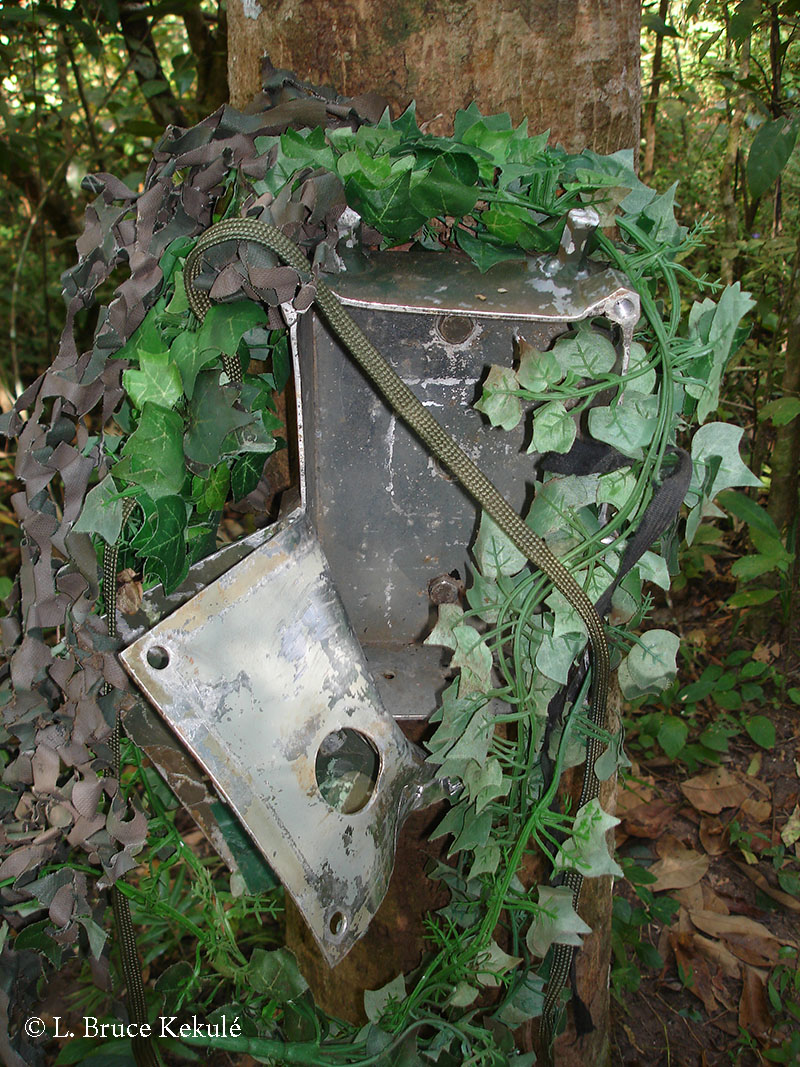
Throughout my early years of wildlife photography, the thought of camera trapping had frequently crossed my mind. Finally, with many years of mechanical experience, I decided to build my own camera-traps. Using existing units as a model, I built a passive infrared camera-trap housed in a 6” x 6” tig-welded aluminum alloy box with a removable front cover. The camera-trap as an enclosed unit that is fixed to a tree using two stainless steel lag bolts contained within the box. A small bag of dessicant (silica gel) is set inside to protect the delicate electronics and camera from moisture, and the front cover is hermetically sealed using silicon sealant and stainless steel screws. The unit is elephant-proof that is very important in the forests I work in. Elephants destroy plastic camera-traps.

Tuskless Bull Elephant

Tuskless bull elephant in Kaeng Krachan NP

Out of my home workshop, I was able to make these custom-built cameras for way less than half the price of imported commercial units. My very close friend Yutdhana Anantavara from Chiang Mai modified the cameras and installed the infrared electronic systems. This early work really helped me onto the road to successful home-made camera-traps.

feral-cat-at-home-in-chiang-mai-w

Feral cat camera-trapped at home in Chiang Mai

The first batch of prototype units employed several brands of ‘point-and-shoot’ cameras and different experimental housings. To evaluate each camera’s quality and reliability, I intensively tested each on the domestic cats that regularly walked on top of a wall behind my machine shop. Various films were tested but slide film at 400 ISO proved to produce the highest quality image.

Indochinese tiger in Sai Yok National Park

My 1st camera-trapped tiger in Sai Yok National Park

To field test the new gear I took a trip to Sai Yok National Park in western Thailand. All of the cameras were placed along wildlife trails and mineral licks. Over several months, the film was collected and developed. I was ecstatic when I saw two different tigers, an elephant, serow, muntjac, stumped-tailed macaque, bear, porcupine, water monitor, jungle fowl and wild pigs. The omnivores were the most frequently photographed and probably the tiger’s main prey species. A totally unexpected bonus was photographs of a few poachers.

Serow camera-trapped in Kaeng Krachan National Park

Serow male camera-trapped in Kaeng Krachan NP

Numerous camera-trap surveys have been conducted in many of Thailand’s forests. A 2001 survey produced a photograph of a Siamese crocodile in Kaeng Krachan National Park. The croc was caught in broad daylight on a sandbar along the river. Park staff set cameras for a month along the Phetchaburi River. The amazing discovery of this very rare reptile has prompted more investigation into this endangered species. In 2003, I camera-trapped a crocodile in Khao Ang Rue Nai Wildlife Sanctuary.

Siamese crocodile in Khao Ang Rue Nai Wildlife Sanctuary

Wild Siamese crocodile camera-trapped in Khao Ang Rue Nai WS, Eastern Thailand

To analyze wildlife in a given area, researchers use two main techniques: a trail-based survey (where cameras are randomly placed along wildlife trails and roads covering 100 to 300 square kilometers) and a more intensive plot-based method. A smaller plot is chosen (usually 40-50 sq. kilometers) and a camera is placed in each one-kilometer grid. An area can eventually be exhaustively surveyed – the duration depending on the number of cameras used – to prove the presence or absence of tigers and other animals. The data then can be used for conservation management of the protected area.

Indochinese tiger in Kaeng Krachan

Indochinese tiger abstract in Kaeng Krachan

Camera-traps can reveal very disturbing information. Extensive surveys around Khao Yai National Park indicate that only two tigers survive. The patterns of tigers are as unique as human fingerprints so it is essential to get photos of both sides of each animal so that individuals can be identified. Researchers often set cameras on either side of a trail to capture both sides simultaneously. Khao Yai might have more tigers but the fact that only two individuals are confirmed is depressing. As of 2005, no tigers have been seen in intensive surveys carried out by Kate Jenks from the Smithonian Institute.

An indochinese tiger on the prowl camera=trapped by the Phetchaburi River in Kaeng Krachan National Park, west Thailand

Indochinese tiger camera-trapped abstract

Poachers have also been camera-trapped here. Usually they walk obliviously past the camera but they sometimes damage or steal cameras. Elephants also destroy cameras, tearing the plastic commercial housings off the tree and smashing them or lobbing them into the bush. A Royal Forest Department researcher at Hala-Bala Wildlife Sanctuary in the deep south of Thailand found a unit damaged by elephants, but the camera was still working and developed the film. The last frame shows a very close view of an elephant’s trunk! Some researchers have built stronger steel boxes to protect the plastic units.

Buffy fish-owl in Kaeng Krachan Nationa Park

Buffy fish-owl landing by the Phetchaburi River in Kaeng Krachan NP

My aluminum-cased camera-traps firmly bolted to a tree have survived many inquisitive elephants. However, they can be stolen or vandalized by determined people who do not want their photo taken. In May of 2005, I lost three cameras near the headwaters of the Phetchaburi River in Kaeng Krachan National Park. Forest fires in the dry season destroy cameras. Insects will invade the interior of imperfectly sealed units, playing havoc with their operation. High humidity in the rainforest also damages electrical circuitry, cameras, film and batteries not protected by a well sealed unit and a small bag of moisture absorbing silica gel.

Infrared camera trapping has undoubtedly become a uniquely useful tool for conservation biologists. This ‘candid camera’ is also a blessing for wildlife photographers wanting images of rare and endangered animals. Who knows? In the future, a camera-trap could photograph a species new to science. I’m always excited when I get camera-trap film back from the lab. But the digital age had arrived. Film is being slowly phased out and digital cameras have now overtaken the market dominating it.

Leopard camera-trapped in Kaeng Krachan National Park, Southwest Thailand

Asian Leopard hunting on old logging road in Kaeng Krachan NP

********************************************************

Wildlife Candid Camera: The Digital Age has arrived

LBK Camera-trap-Sony S600 & Yeticam.com board

LBK camera-trap attached to a tree usin Python locking cable

********************************************************

LBK Camera-trap-Sony S600 & Yeticam.com board

LBK camera-trap with Yeticam board and Sony W7 in custom aluminum case

********************************************************

Digital camera traps have now become the new sensation, especially the home-brew (self-made) market. It is now a huge business with a few companies vying for market share. The most predominant are Snapshotsniper.com, Yeticam.com and BFOutdoors.com and they offer parts (sensor boards, lens, battery packs, cases, etc.) to the home builder.

Gaur bull at a waterhole in Huai Kha Khaeng Wildlife Sanctuary, Western Thailand

Very old bull gaur at a waterhole in Huai Kha Khaeng WS

My friend Chris Wemmer, the ‘Cameratrap Codger’, was the first person to tell me about a new company in the US producing infrared circuit boards and other accessories for the home-brew camera trap market. The company is Pixcontroller.com. Unfortunately, they no longer offer parts but now sell completed units with digital camera and video.

Gaur Bull in Huai Kha Khaeng Wildlife Sanctuary

Mature bull gaur at water hole

As a wildlife photographer, I decided to produce my own digital camera-traps using passive infrared circuit boards acquired from the U.S., and digital cameras modified locally with housings and constructed from tig-welded aluminum alloy at my machine shop at home in Chiang Mai. The first cameras used Nikon L11 and L14 cameras and Snapshotsniper boards that were set-up in the forest of Kaeng Krachan National Park in Phetchaburi province in Southwest Thailand over a three-month period in October to December 2008.

tapir-mother-and-youngster

Asian tapir – mother and calf in Khlong Saeng WS, Southern Thailand

Animals captured were elephants, gaur, tiger, sambar and muntjac. One camera had over 300 captures in one month at a mineral deposit in the park.

Young Asian tapir and mother in Khlong Saeng Wildlife Sanctuary

Asian tapir calf in Khlong Saeng

Down in Khlong Saeng Wildlife Sanctuary in the first part of  2009, I set both film and digital camera-traps deep in the forest. Elephants, gaur, tapir, sambar, muntjac, golden cat and Argus pheasant were captured.

Asian elephant - tuskless bull at a waterhole in Huai Kha Khaeng Wildlife Sanctuary, Western Thailand

Tuskless bull elephant camera-trapped at waterhole in Huai Kha Khaeng

I now have more than a dozen digital camera-traps using primarily ‘Sony S600’ cameras and Yeticam.com circuit boards.

Asian elephant - tusker at a waterhole in Khao Ang Rue Nai

Tusker elephant in Khao Ang Rue Nai WS, Eastern Thailand

The Sony cameras have been the best and most durable due to the manual features like ISO and f.stop adjustments. Picture quality with the ‘Carl Zeiss’ lens is usually good.

Wild pig mother and piglets in Khlong Saeng Wildlife Sanctuary, Southern Thailand

A herd is wild pigs including a runt in Khlong Saeng WS, Southern Thailand

Post to Twitter Tweet This Post

Common Crane: First recorded sighting of the species in Thailand

Tuesday, October 20, 2009 posted by admin 11:19 AM
Common crane in Northern Thailand

Tremendous excitement prevailed when a common crane showed up for the first time in Thailand during November 2000. Experts had predicted the species would eventually be seen in the Kingdom (Lekagul & Round 1991) but the arrival of the crane was nonetheless big news for bird lovers. It was one of the greatest thrills in my life to be the first person to sight this solitary bird. Undoubtedly, local farmers saw the crane first but took no notice.

While out scouting for photographic possibilities, I visited Nong Bong Khai Non-hunting Area situated at Chiang Saen Lake located in the northern province of Chiang Rai. The National Parks, Wildlife and Plant Conservation Department (DNP) is responsible for the area, which is a year round attraction for nature lovers. Although surrounded by paddy fields, a swamp to the west of the lake still hosts many resident bird species. The protected area also attracts migrant birds starting in October, when ducks, herons, grebes and other water birds arrive to spend the winter. Some rest for a while before carrying on to other areas in Thailand and Southeast Asia, even on down to Australia.

Arriving at the non-hunting area early in the morning, as always, I drove over the hill for a quick scout of the swamp. My casual visit turned into quite a surprise. Amidst the expected grey herons and little egrets, one bird seemed not quite right. It took some careful watching to isolate the anomaly but once found the crane was very striking indeed, towering over the herons. Its unfamiliar facial pattern and grey plumage stood out in the clear morning sun.

Sunrize at Chiang Saen Lake, Nong Bong Kai Non-hunting area

I immediately called my good friend Philip Round, Thailand’s foremost bird expert, telling him of the sighting. Unfortunately, commitments at work forced me to leave shortly after but I vowed to come back as quickly as possible. Within two weeks, I was back this time with my friend David Murray from Chiang Mai, who came along as my assistant. The crane was extremely wary and maintained a healthy distance with anyone approaching it. The bird, a male, was limping and we assumed it had probably been wounded by a gunshot. Mature cranes usually pair up. The absence of a female was strange and perhaps the crane encountered hunters along the way, and that might have disrupted the bird’s migration.

The next day in early morning darkness we set up a photo-blind near where the bird was first sighted. I got a quick glimpse, but then the crane trumpeted loudly a few times and took off. A few quick shots were snapped as it flew away, but they were distant. The next morning was cool and foggy. About 9 a.m. the fog finally burned off and, as if on cue, the crane swooped down landing in front of the blind, although still a fair distance away. I quickly photographed it with my 600mm Minolta, doubled to 1,200mm by a converter. Once again the bird flew away within seconds, possibly spooked by the blind. The next morning the hide was moved even closer to the middle of the swamp but the crane did not show.

As we were packing up about 11 a.m. the bird flew across the paddy field, with its right leg dangling. We drove to where it landed, and managed to sneak within photographic range. I was finally able to get a few non-flying photographs even though the light was harsh. I left area but was still not satisfied, and again promised to return.

Sunset at Chiang Saen Lake

In early January of 2001 my determination to capture this crane on film continued to burn. After checking with the staff at Nong Bong Khai to confirm that the crane was still present, I decided to try one more time. After almost a thousand kilometer drive from Bangkok to Chiang Saen (including a swing through Chiang Mai to pick up David), we arrived in the late afternoon and to our relief soon spotted the crane in rice fields west of the swamp. I was pleased to see that its limp seemed to have disappeared and that it also appeared a bit more at ease. David and I camped out close-by in frigid cold winter conditions and planned the next morning’s shoot. At 4 a.m. we set the blind very near where the bird was reported to roost.

At about 8am the sun became hotter and the morning mist lifted. The crane suddenly flew in from the west but landed just a bit out of range. Then he walked closer to the blind and, as if in answer to my prayers, stopped 75 meters away pecking for food on the ground. I wasted no time and quickly shot several rolls of film. The final frames shot as he took off showed he still favored his right leg, as it dangled in flight. That was the last time I saw this magnificent bird, and the experience will always be etched in memory.

He left the area shortly after that and was never seen again. Nong Bong Khai had provided a haven for several months while he recuperated. During his stay, this crane delighted many nature lovers, bird watchers and photographers. It even appeared in the newspapers and on television. This single visit was considered an aberration and unlikely to happen again.

Common crane flying sequence

But in January of 2004, my good friend John Parr visited the lake and in quite a surprise to the bird community, observed a pair of common cranes. I immediately rushed up to see them but these birds were extremely wary and I could not get any pictures. However, I did see the two birds at the opposite end of the swamp over two days. The pair left the next day.

It was reported that some local people wearing bright clothing were seen very close to the cranes before they flew off. While I was sitting in the blind, I also observed people walking close to the swamp. The birds had probably been pushed to the limit. When or if common cranes ever return again is an open question.

Cranes belong to the family Gruidae and there are 15 species worldwide. They are large birds with long necks and legs, and all have large straight pointed bills. Cranes nest on the ground or in shallow water. They build a bulky bed of sticks and vegetation. Their trumpet-like call reverberates over long distances. These birds fly in a V formation or a long line. Paired mature cranes perform a beautiful courtship display, much like a stately dance.

The sarus crane Grus antigone was once found in Thailand but that was more than 60 years ago. Before the year 2000, it was the only species of crane ever recorded here. A mature saris crane is one and half meters tall with a red head and light gray body plumage. Unfortunately, they are extinct in the Kingdom. The species still survives in the wild of Cambodia, Vietnam and India. But like everywhere else in the world, these cranes are under serious pressure from humans.

The Royal Forest Department (RFD) established a captive breeding program for the sarus crane many years ago but unfortunately, these birds do not breed well in captivity. Successful pairing is very rare under caged conditions, and so the chance of breeding cranes for reintroduction is next to impossible. Most zoos in the country have specimens. However, the Khorat Zoo in Nakhon Ratchasima province has successfully reared sarus crane chicks.

No one knows where this common crane actually came from. It was possibly blown off-course from a flock migrating east or west. The species’ world range includes Europe, North Africa and Asia. The common crane is an uncommon winter visitor to southern China, and the northern areas of Vietnam, Burma and India.

The chance to see and photograph a wild crane might not come for a long time. I feel blessed to have been there at the right place and at the right time. Mother nature works in strange ways and perhaps some future migratory season will bring a tall bird with a trumpeting call to stop by Nong Bong Khai. I will surely be there.

Post to Twitter Tweet This Post

A World Heritage Treasure in the North East

Tuesday, September 29, 2009 posted by admin 5:24 PM

Khao Yai: Thailand’s first and most famous national park

Bankgkok Post
Writer: Story and photos by L. BRUCE KEKULE
Published: 31/08/2009

The concept of parks or wildlife sanctuaries in Siam dates back to the 13th-century Sukhothai Period during the reign of King Ramkhamhaeng the Great, who created a park known as “Dong Tan”, which was used for royal recreation and preservation. The people were also encouraged to set up parks around Buddhist temples and other religious sites because it was against Buddhist strictures to take a life and, hence all parks were havens of safety for the animals of the forests. However, from the end of the Sukhothai Period to the 19th century, parks and conservation declined.

Haew Narok


The Royal Forest Department (RFD) was established in 1896, introducing modern management practices to forestry, especially the teak industry. However, conservation fields were not addressed in the beginning. In 1900, the first law protecting animals was the Law Governing Conservation of Wild Elephants, and thus elephants became the first species protected by a law. In 1921, the law was amended, which superseded the previous act providing better protection.

Then in 1943, the RFD began turning its attention to conservation and efforts to manage certain forests for the public’s recreational use. The department established Phu Kradueng National Park in Loei province. However, due to World War II and very limited budgets and trained personnel, the park project was shelved.

In 1959, Field Marshal Sarit Thanarat, Thailand’s prime minister, voiced his opinion about protecting some of the immense forests that existed in the Kingdom at the time. He made several inspection tours into the wild areas of the North and Northeast, and became impressed with the natural resources. His idea was to establish reserved areas much like Yellowstone National Park in the US and Kruger National Park in South Africa. His foresight has developed into one of the largest concentrations of protected areas in the world. At last count, there are more than 260 national parks, wildlife sanctuaries, non-hunting areas and marine national parks, plus 1,221 reserved forests situated throughout Thailand.

Water monitor


Sarit’s fascination with nature prompted him to establish the National Parks Committee and the Wild Animals Reservation and Protection Committee to hash out necessary protective management plans, and to select pristine wilderness areas suitable for preservation. The first new step to conserving wildlife was the enactment of the Wild Animals Reservation and Protection Act of 1960. The next law passed by legislation was the National Park Act of 1961, which really got the ball rolling. By Royal Decree, on September 18, 1962, the 2,165km2 Khao Yai National Park was appointed, becoming the nation’s first national park, thanks to Sarit and many others.

The core group was made up of General Surajit Jarusaraenee, the Minister of Agriculture and General Prapas Jarusatien, who was the Minister of Interior, along with Chalerm Siriwan, the director general of the RFD and Pramual Unhanand, who was the director of the Bureau of Silviculture under the RFD. The first chief of the park was Boonlueng Saisorn. One man who was also involved in the establishment was Dr Boonsong Lekagul, who was the executive-director of the Association for the Conservation of Wildlife that was actually started up in 1951.

Dr Boonsong, a well-to-do Thai medical physician, was also a hunter and biologist. He published scores of scientific papers and books on mammals, birds and butterflies found in Thailand. His enormous contribution to natural science was the first stepping-stone to knowledge of the natural world and a better understanding about Thai fauna. Dr Boonsong also collected wildlife specimens to document as many species as possible. He certainly made an impact on the movement of wildlife conservation.

Sambar stag


Dr George C. Ruhle, a national park expert from the US National Park Service, did a survey from 1959 to 1960 and a report in 1964 for the International Union for Conservation of Nature and Natural Resources (IUCN), as well as the American Committee for International Wildlife Protection about the forests. This work contributed to a greater understanding of Thailand’s natural heritage. He made many treks into the wilderness areas of Khao Yai, Thung Salaeng Luang and Doi Inthanon, among many others, and was instrumental in some of the first “National Parks Management Plans” that were to follow.

After World War II, about 70 percent of the country was still covered in thick vegetation with an amazing array of wild animals and ecosystems. The first big area to be acknowledged was the primaeval contiguous forest once known as Dong Phaya Fai (or “Jungle of Fire”). This remarkable wilderness stretched from the lower Northeast all the way into Cambodia, and north to parts of the Central and north-Northeast regions. These mountain formations were created during continental uplift about 60 million years ago when the Indian Plate crashed into the Himalayas.

Banded Kingfisher


Kouprey, a rare wild cattle and now most likely extinct, lived in parts of this great forest. Large tigers preyed on abundant deer and other ungulate species that proliferated in the deep jungle. Smaller species, including clouded leopard, sun bear, gibbons, hornbills as well as many others were common. It was an impenetrable and dangerous place due to the steep mountainous terrain where no roads existed. Very few humans lived in the depths of this once great biosphere. Malaria and fierce creatures reigned supreme.

Before Khao Yai was formed, settlers and outlaws used slash-and-burn agriculture in the mountains, creating huge grasslands around the present-day headquarters area. Many of these people were evading the police, but they were evicted after the park was established. The government decided to establish a golf course on the grassland and bungalows to generate income, which was run by the Tourist Authority of Thailand (TAT). Back in the mid-1970s, I actually played golf on the links when it was opened to visitors. It was amazing seeing all those wild animals crossing the fairways. However, the “rough” was jungle, and if you did not hit the ball straight and true, it was a goner! It was a tough course to play on and I lost quite a few balls. It was, however, finally closed in 1991 at the urging of the Anand Panyarachun government.

In 1955, a road (Mittraphap Highway: Saraburi to Nakhon Ratchasima) was cut through the forest to facilitate the US military machine at the airbases in

Nakhon Ratchasima, Udon Thani and Ubon Ratchathani provinces, as well as Phanom Sarakham district in Chachoengsao province in the Northeast. Later, another road separating Khao Yai and Thap Lan (Route 304: Kabin Buri to Pak Thong Chai) was constructed. These roads basically cut all migration routes of elephant, gaur, banteng and other large mammals established over thousands of years, and opened up virgin forest to settlement. In the meantime, Khao Yai was being encroached on from all sides and can be seen today as resorts, golf courses and agriculture that completely surrounded the park.

Great hornbill


Khao Yai (“Big Mountain” in English) is part of the Dong Phaya Yen-Khao Yai forest complex covering 6,152km2, and is also Thailand’s second World Heritage Site, which was granted on July 14, 2005 by Unesco. The complex is comprised of five protected areas – Khao Yai, Thap Lan (1981, 2,235km2), Pang Sida (1982, 844km2) and Ta Phraya (1996, 594km2) national parks, and Dong Yai Wildlife Sanctuary (1996, 312km2).

Khao Yai is Thailand’s third largest national park and covers four provinces including Saraburi, Nakhon Nayok, Prachin Buri and Nakhon Ratchasima (Korat). It incorporates parts of the Sankampaeng range made up of shale and sandstone at the south-east edge of the Korat Plateau. The highest peak is Khao Rom at 1,365m and vegetation includes moist evergreen, dry evergreen, hill evergreen, mixed deciduous, dry dipterocarp, secondary forest and grassland. Some formations in the park go back more than 100 million years when dinosaurs roamed here. One set of dinosaur footprints has been found in Khao Yai on an isolated slab of red sandstone by the banks of the Sai Yai River. Some dinosaur fossils have been found close by in Thap Lan and Pang Sida national parks to the east.

A male Muntjac


Today, elephants, gaur, sambar and muntjac (common barking deer) are still common, but unfortunately, only survive around the Khao Yai headquarters area for about 300km2. Years and years of degradation and poaching have taken its toll imploding towards the centre. Very few animals or birds survive in the outlying areas after many wildlife surveys done by various organisations and individuals came up with data to confirm the void. Even though Khao Yai was the first national park, it certainly has been devastated by years of minimal protective management and prolonged encroachment and poaching.

However, much research, training and management planning has been carried out in Khao Yai, primarily around the headquarters area. One of the first people in 1975 was Dr Chumphon Ngampongsai, who studied habitat relation of the sambar. Secondly, Dr Warren Brockelman of the US and some of his students from Mahidol University have conducted what is now the longest primate study in the world at “Mo Singto Forest Dynamics Plot” of the intricate lives and habitats of both white-handed and pileated gibbons that live together and sometimes produce a hybrid of the two species. Philip D. Round and George Gale also carried out a bird survey in the plot. In 1978, a hornbill ecology research team under Dr Pilai Poonswad began hornbill surveys and helped increase nest sites. In the 1980s, Dr Surachet Chettamas from Kasetsart University wrote a Khao Yai park and recreation management plan, and Robert Dobias from the US also did planning at that time.

Pig-tailed Macaque


In the late-1990s, a master student, Sean C. Austin from New Mexico State University, did a survey for sympatric carnivores such as the leopard cat, clouded leopard, Asian wild dog and binturongs, as well as radio-collared quite a few of them. He also used camera-trap technology to build up a database. In 1999, “Wild Aid”, now known as “Freeland”, started the Khao Yai Conservation Project including community outreach, wildlife monitoring, ranger training and park management in partnership with the Department of National Parks, and the Wildlife Conservation Society who did camera-trapping and managed to catch a few tigers on film plus a multitude of other creatures. Wild Aid also set up a team to monitor the park’s wild elephants and provided some equipment to the rangers.

Another master student, Kate Jenks, from the Smithsonian Institute carried out a camera-trap programme that involved an attempt to photograph carnivores in conjunction with Wild Aid from 2004 to 2007. Sadly, she camera-trapped no tigers during the programme but did record one set of tiger footprints in 2005. Dr Naris Bhumpakphan of Kasetsart University sent master student Preecha Prommakul to monitor and camera-trap tigers in Khao Yai, but with a lack of data, the programme was shelved. Preecha did, however, see a set of tracks around the back of a camera-trap, indicating a tiger was possibly avoiding the traps.

An elephant on the road


Unfortunately, it looks as though the tiger has probably disappeared from the park. These magnificent cats have not been seen or recorded for some time now and no camera-trap photos have been collected of tigers since 2001. However, reports of sightings and tracks do come in from time to time, but these are now rare. If leopards once thrived here, it was a long time ago. Asian wild dogs are now at the top of the food chain. A large pack of more than 20 dogs devouring a sambar in one hour has been observed by a tour guide and the rangers. These pack animals are ferocious carnivores and once a feeding frenzy has begun, it’s every dog for itself. They have been consistently seen and photographed around the headquarters area.

Khao Yai is one of the best places to see wild elephants up close during the day or night. These giants can be seen along the road down to Nakhon Nayok, but from the safety of one’s motor vehicle. They also can be seen at the mineral licks set up on the grasslands. It is definitely recommended not to exit your car and strike out on foot as the elephants can become irritated and things could get dangerous, especially an encounter with a bull in musth, or a mother with a baby. Bull elephants in the park have killed several Buddhist monks in the forest meditating. A birdwatcher friend of mine took his family out one night and was surrounded by a herd of elephants on the road. These gentle giants dented his van, costing him thousands of baht in repairs, and scaring the heck out of them while they sat motionlessly waiting for the herd to pass.

A muntjac jumping a motorcycle


The most famous waterfalls in Khao Yai are Haew Narok, which takes a hike of about one kilometre and Haew Suwat, not far from the road. During the rainy season all of the rivers in the park become raging torrents. Quite a few elephants have been washed over the falls at Haew Narok and killed during heavy rain with swollen rivers. A temporary ranger station has been set up to ward off any elephants trying to cross during a heavy surge.

There are more than a dozen marked nature trails covering about 50km for the adventurous type, but it is advised to hire a guide from the park as some are ever-changing and one could get lost in the dense forests. During the rainy season, leeches and malaria mosquitoes are a problem. During the dry season, ticks can be irritating and dangerous to one’s health as some carry diseases. Insect repellent, leech socks and heavy clothing are the best way to ward off the bothersome creatures. But seeing the exotic mammals, birds, reptiles and amphibians, butterflies and other insects in their natural habitats, plus the beautiful flora is still quite good and worth the effort. The best time to visit is during midweek. Make your bookings in advance with the department’s online website for accommodations. Food and services are good but close shop at around 6pm.

One of the biggest problems facing Khao Yai is the over-abundance of visitations during the holidays and long weekends, plus excessive spotlighting during these times. There is quite a large number of buildings, bungalows and campsites, and rubbish can be a problem for the park. Many deer and other animals have perished from foam and plastic intact by eating discarded food containers.

Khao Yai as Thailand’s first national park should be a role model for all other conservation areas. Given this important heritage, increased efforts by those responsible need to be made to save this magnificent biosphere. It is a fact that, with good protection, animals and plants will make a comeback. The park has the potential and we the people need to ensure its future survival.

Post to Twitter Tweet This Post

Goats in the Mist: Thailand’s Goat-Antelopes

Tuesday, September 29, 2009 posted by admin 5:07 PM

Goral and Serow – Rare Mammals of the North

Goral kid in Doi Inthanon National Park

Goral kid in early morning light at Keiw Mae Pan cliff – Doi Inthanon NP

Photographing endangered species has become an obsession to me. Many of Thailand’s wild animals have come so close to extinction that their numbers are counted not in thousands or even hundreds but rather handfuls. Goral Naemorhedus goral are one such animal. Surviving on a few scattered mountaintops in northern Thailand, these even-toed ungulates are on the critically endangered list. With fewer than 60 individuals nationwide and low numbers at each site, the goral is considered one of the Kingdom’s rarest mammals.

Kiew Mae Pan cliff in Doi Inthanon National Park

Doi Inthanon National Park

Acquiring photographs of these goat-antelopes is a daunting task considering their natural habitat. Hunting pressure and encroachment have forced them to retreat to the steepest, most inaccessible limestone cliffs and forested mountains. Goral are still found in seven protected areas including Doi Inthanon and Mae Ping National Parks, and in the wildlife sanctuaries of Om Koi, Doi Luang Chiang Dao, Mae Tuan, Mae Lao-Mae Sae and Lum Nam Pai, all in the north of Thailand.

Serow in Kaeng Krachan National Park

Serow male camera-trapped

Another species of goat-antelope surviving in Thailand is the serow Capricornis sumatraenis. Both species belong to the Bovidae family, which includes cattle, sheep, goats and antelope. Bovids are ruminants with four-chambered stomachs. In some areas, goral and serow share the same habitat. They have short bodies with long legs ending in padded, gripping hooves enabling them to inhabit steep mountainsides and cliffs. They eat grasses, herbs and shrubs and gain moisture from the plants they eat. Their keen eyesight provides early warning of danger. Like all bovids, they do not shed their horns like deer do with antlers. Serow are normally solitary whereas goral are usually form small herds from four to twelve individuals.

Goral kid in Doi Inthanon National Park

Goral kid close-up

Serow and goral are creatures of habit. These lofty creatures have favorite places to sun themselves, usually a rock or grassy mound. They can stand for hours on one rock as I witnessed in Doi Inthanon where a goral stood from about 9am to almost 12noon. Another habit is to defecate at the same place. Piles of pellets can be found wherever they live, usually on or around a large rock. Research on both species has now been undertaken by Mahidol and Kasetsart University staff studying the impact of human settlements near goat habitat and surveying the remaining populations.

Siriphum waterfall in Doi Inthanon National Park

Siriphum Waterfall in Doi Inthanon National Park

Unfortunately, both species have been hunted for their meat, horns and oil which comes from boiling the head. Supposedly, the oil is used to relieve arthritis and bone ailments. The horns of goral and serow are black, corrugated at the base, pointed and swept back (like their relatives, the Rocky Mountain goat of North America). Their horns are not impressive but are still sought after by poachers. The tip of serow horn is used to make deadly spears which can be attached to a rooster’s spur during a cock fight. It is eagerly sought after, especially in southern Thailand.

Kiew Mae Pan cliff in Doi Inthanon National Park

Keiw Mae Pan cliff in Doi Inthanon

Hunting has decimated both goral and serow populations that numbered in the thousands as recently as 50 years ago. In many mountainous areas hill tribe people live and encroach on the forest for the purpose of slash-and-burn agriculture. This has played a major role in the disappearance of both species in the North. Lowland people also hunted them. In other areas where the serow are found, they have declined due to continued pressure from man.

Two sites were chosen to photograph these mountain creatures: Doi Inthanon National Park about 80 kilometers south of Chiang Mai and Mae Lao-Mae Sae Wildlife Sanctuary some 60 kilometers to the north. Staff at the protected areas confirmed goral and serow were still surviving. Working closely with the Wildlife Research Division in Bangkok. My plan was to set up photographic blinds as close to wild goat domain as possible and use a long telephoto lens. But this was easier said then done.

Doi Inthanon, Thailand’s highest mountain, supports several small herds of goral around the summit. The animals are quite often seen close to Kew Mae Pan Nature Trail, developed in partnership with the Electric Generating Public Company Limited (EGCO) and the National Parks, Wildlife and Plant Conservation Department (DNP). Three kilometers from the road, a huge cliff rises some 2,500 meters above sea level and is criss-crossed with goat trails etched from thousands of years of use by goral and serow.

The skies are crystal clear over Doi Inthanon in November. This is truly a beautiful and remarkable place. But it does take some effort to get close to the cliff.

The nature trail is strictly regulated and a local guide must be used for the three to four hour trek. If you are lucky and get up early, you may see goral and serow sunning themselves on rocky outcrops near the trail. Take a good pair of binoculars or telescope. This is also a good place for birdwatching, and you may see many species including the beautiful endemic green-tailed sunbird.

Mae Lao-Mae Sae is situated along the highway from Chiang Mai to Pai. A part of the sanctuary is divided by the road and Mon Liem, a giant granite massif, rises up to 1,200 meters above sea level. The sanctuary is home to a small herd of goral that survive on the summit. It is also criss-crossed by goat trails, and huge pine trees hundreds of years old are found here. The view is majestic, especially to the north where Doi Luang Chiang Dao Wildlife Sanctuary, another haven for goral, is situated. Wildlife sanctuaries are not open to the general public since they have been set aside for wildlife and biodiversity research. In October 2001, I glimpsed a male goral near the summit as the sun was going down. The goat unfortunately, was out of photographic range.

In November 2001, I visited the superintendent of Doi Inthanon to arrange a photographic trip after both goat species at the cliff. At 2,300 meters above sea level, temperatures can plunge at daybreak to zero degree Celsius with ice forming on the grass. It was tough getting out of the tent at 4 a.m. but it was important to move into the blind near the cliff face before the sun was up in order to photograph these wild goats. For the best photographic opportunities, the blind had to blend into the surrounding terrain so as not to spook the goats.

After four days of freezing, windy conditions, I spotted goral and serow on several occasions about a kilometer away. While scanning the cliff with my binoculars on the last morning, I detected a slight movement. A closer look revealed a male goral lying down on a buff about 500 meters from the blind. A short while later, he stood up. Using my 600mm Minolta lens with 2X tele-converter, I got some acceptable photographs of him.

This male had a fluffy white throat and underbelly. His gray winter coat was beautiful. After some time he did what goral do best – jumping straight down off the ledge in order to get closer to his mate who was feeding below. They butted heads affectionately a few times before disappearing into the maze of the cliff.

I made four trips to Doi Inthanon during the winter of 2001 and 2002 in search of goral and serow. Several herds of goral are still breeding here and can be seen almost every day. Serow are more elusive and only a few individuals were spotted from time to time. The spirits of the mountain listened to my prayers. On the last day of the fourth trip, a young goral about five months old appeared twenty meters away from me stamping its feet and snorting. It was nature at its best, making the front cover of this book.

These wild goats have an uncertain future. Uncontrolled human population growth both inside and outside of the protected areas is bound to affect them in the long run. There is also the danger of disease carried by domesticated cattle and buffalo around the mountaintops decimating wild goats – something that needs to be checked and stopped at all costs.

Hunting of goral and serow continues in some areas, and the poachers are rarely brought to justice. Jail terms are too light and outdated. As a result, these animals need serious efforts to protect them from the dangers of the modern world with all the resources available, or they could vanish from the Kingdom’s mountaintops forever. A crime against nature should be on par with a crime against a fellow human being. Enforcement must be improved and implemented on a long term-basis. The Thai community needs more wildlife conservation education at all levels of society.

SerowCapricornis sumatraenis

Serow share much the same predicament as goral but with a larger world range, they have fared slightly better and can be found in many mountainous areas in the Kingdom. In a few places they live all the way down to sea level. These goat-antelopes still survive in the Himalayas, northern India, southern China, mainland Southeast Asia and Sumatra. Several subspecies have been recorded and most populations are localized.

Serow have black or dark-gray coarse hair and a long shaggy mane down their backs. Two subspecies of serow are recognized in Thailand: those found in the steep limestone mountains of the south have black legs and those surviving in the Tenasserim range and further north to Burma have rufous colored legs below the knee. Breeding lasts from  October to November and a single kid is born after seven months of gestation. Occasionally, twins are born.

Goral – Naemorhedus goral

Goral are found from about 1000 up to 4,000 meters. Their range is from the Himalayas and northern India, to southern China, Burma and northern Thailand. The Thai species are mainly gray-brown in color much like the boulders and rocks that they live around. A thin black stripe runs along their spine to a short tail. As with other wild Asian bovids like gaur and banteng, goral have white stockings from the knee to the hoof. With white patches on their throat and underbelly that stands out in bright sunlight, goral are distinct. They are compact mammals that can move up and down vertical cliffs with ease, and are tough to spot in their habitat. The breeding season lasts from November to December. One or two kids may be born in May or June.

Post to Twitter Tweet This Post