

Archive for the ‘Journal Entries’ Category
THAILAND’S NATURAL HERITAGE: A look at some of the rarest animals in the Kingdom – Part One

FRONT JACKET – A young goral kid in Doi Inthanon National Park near the summit of the Kingdom’s highest mountain in Chiang Mai province, Northern Thailand.

BACK JACKET – The Emerald Pool in Khao Phra Bangkram Wildlife Sanctuary in Trang Province, Southern Thailand, and home to the rarest bird in Thailand; the Gurney’s Pitta.

INSET: BACK JACKET – The Gurney’s Pitta in Khao Phra Bangkram Wildlife Sanctuary. Unfortunately, as of this posting, these wonderful avian creatures are now officially extinct in Thailand. Some may be lingering on in nearby southern Myanmar (Burma).

FRONT ENDPAPER: Thailand 130 million years ago.

BACK ENDPAPER – Sunset and lightning in Kaeng Krachan National Park, Phetchaburi province.
THAILAND’S NATURAL HERITAGE

Page 2-3
Common Shelduck in Bueng Boraphet Non-hunting Area in Nakhon Sawan province. This duck species is a rare winter visitor.

Page 4-5
Green Bee-eaters at sunset in Mae Hia Agricultural Research Station in Chiang Mai province. These colorful birds are found in many parts of the Kingdom. They feed on bees and other insects caught in flight by hawking.
CREDIT PAGE
Published in 2004:
WKT Publishing Co., Ltd
102/32 Soi Ronnachai, Setsiri Road,
Phayathai, Bangkok 10400, Thailand
Tel:(66-2) 619-6774 Fax:(66-2) 619-6775
e-mail: lbkekule@mac.com
website: www.brucekekule.com
Distributed in Thailand:
Asia Books Co., Ltd
5 Sukhumvit Road Soi 61
Bangkok 10110, Thailand
Tel:(66-2) 715-9000, 714-0740
Fax:(66-2) 381-1621, 391-2277
e-mail: purchase@asiabooks.com
website: www.asiabooks.com
Photography, text & design:
Copyright © 2004 L. Bruce Kekule
Consulting Editor:
The late Hardy Stockmann
Text Editors:
Ben Davis
Jim Pollard
Proof Editor:
Pongpet Mekloy
WKT Publishing Directors:
Puangpayom Kekule
Marguerite Dalal
Tipp Dalal
Paper supplied:
Advance Agro Public Co., Ltd
Bangkok, Thailand
Reproduction & Printing:
2004 – 1st Edition: Sirivatana Interprint Public Co., Ltd, Bangkok, Thailand
2006 – 2nd Edition: Phongwarin Printing Ltd. Bangkok, Thailand
All rights reserved. No part of this book may be reproduced, stored in a retrieval system or transmitted in any form or by any means, electronic, mechanical, photocopying recording or otherwise, without prior permission from:
WKT Publishing Co., Ltd
For information about reproduction, contact WKT Publishing Co. Ltd
ISBN — 974-92327-7-1

Page 6-7
A Gaur bull entering a mineral deposit in Thung Yai Naresuan Wildlife Sanctuary in Kachanaburi province along the western border with Burma. They are the largest bovine in the world standing 1.7 meters at the shoulders and large mature bulls can weigh close to a ton. These even-toed ungulates are very shy.
Contents
Foreword 9
The Creatures of Nature 10
Thailand’s Mesozoic Vertebrates 52
Submarine of the Jungle 68
Vanishing Asian Giants 80
The Brink of Extinction 90
The Lonely Crane Incident 100
Wildlife Candid Camera 114
Goats in the Mist 128
Deer in Jeopardy 144
Bulls, Cows and Calves 160
Big Cats in Kaeng Krachan 180
Carnivores of the Phetchaburi River 198
Perils of Wildlife Photography 208
Wildlife in Danger 218
Bibliography 223
Photograph Index 224
Acknowledgements 227

Page 8-9
Sunrise at Mae Lao – Ma Sae Wildlife Sanctuary in the northern province of Chiang Mai. Mon Liem, a granite massif in the northern part of the sanctuary is home to a small herd of goral. Other rare creatures like the Hume’s pheasant, Ultramarine flycatcher and Asian Wild Dog thrive here.
Foreword
Thousands of plants and animals will become extinct in the 21st Century. The world loses some 60,000 species every year to extinction. This situation is unacceptable and unforgivable.
Persistent human encroachment into wilderness is a prime reason for this tragedy. As the human population explodes, expansion into protected reserves is nearly unstoppable. Interlopers takeover land where wild animals live. Forests are transformed into tourist attractions, agricultural land, golf courses and resorts. Wildlife disappears forever.
The importance of protecting and saving the Kingdom’s remaining forests and wildlife is critical. The key to success in preserving nature is to create awareness at all levels of society. Do your part to help Mother Nature and she will reward you.
L. Bruce Kekule
Thailand – 2004
The Creatures of Nature:
An introduction to the Kingdom’s natural history

Page 10-11
Forest Crested Lizard in Sai Yok National Park. These beautiful ground dwelling reptiles are common here, and hunt earthworms and other creatures in the leaf litter.
Life has been evolving on earth for thousands of millions of years. Evolution is the supreme mechanism which continues relentlessly. New species are created by natural selection, Darwin’s chilling insight. Cataclysmic changes are a regular occurrence on Mother Earth.
For all of its ability, intelligence and technology, the species Homo sapiens still remains largely powerless against the forces of nature. Lightning, volcano’s, hurricanes, cyclones, tornados, floods, typhoons, drought, earthquakes and meteor strikes are uncontrollable and unstoppable by any means. As the planet passes through time, natural selection will inexorably generate new species.
Mother Earth hosts a truly wondrous array of animals and plants, each with its own niche. Some have taken to the air, some to the land and many stayed in the sea. Insects, make up three-quarters of all living species and are the most numerous of nature’s creatures. There are said to be 200 million insects for every human being.

Page 12-13
Goral in Doi Inthanon National Park. These goat-antelope can be seen around ‘Kew Mae Pan’ Nature Trail close to the summit of Doi Inthanon, Thailand’s highest mountain. A small herd of goral still survive in the park.
Today several million species survive on the planet. Hundreds of thousands have become extinct. The dinosaur, surely the most exciting in the popular imagination, survived for over 160 million years before succumbing to the law of survival of the fittest.
To properly showcase the beauty of Thailand’s natural heritage, we need to return to the beginning of life. Earth is now thought to have started evolving about 4,550 million years ago (mya). Because sedimentary rocks have not been found from the first 800 million years, the earliest life forms are lost in the geological record. All that can be said for sure, Earth was an extremely inhospitable place during this time of evolutionary change.

Page 14
Elephants camera-trapped at a mineral deposit in Kaeng Krachan National Park in Phetchaburi province. The park is about two hundred kilometers southwest of Bangkok. The forest and its biodiversity is still fairly intact, and the park supports about 200 wild elephants.
During the Archaean eon (4,550-2,500 mya) very primitive life forms appeared and by 3,500 mya began to photosynthesize and increased oxygen in the atmosphere. These first life forms were single-celled creatures known as cyanobacteria (blue-green algae).
The Proterozoic eon (2500-543 mya) brought dramatic changes to Earth. At the beginning of this eon, the only living things were bacteria, but by its end there were multicellular plants and animals, all in the sea. Together, the Archean and Proterozoic known as the Precambrian or ‘hidden life’ taking up 90 percent of Mother Earth’s time clock.
The Phanerozoic eon followed and is also known as ‘visible life’ including the Paleozoic, Mesozoic and Cenozoic eras. This eon has produced multi-celled organisms that have dominated life on earth.

Page 15
Gaur bull entering a mineral lick in Thung Yai Naresuan Wildlife Sanctuary along the western border with Burma. They are the largest bovine in the world standing 1.7 meters at the shoulders and can weigh close to a ton. These even-toed ungulates are shy and hard to see in the forest due to acute senses of hearing, smell and eyesight, and this bull is in his prime.
In early Archean times, a huge global ocean covered most of the planet. Earth’s first continents were small and evolved from volcanic rock. These islands assembled into proto-continents on tectonic plates that moved across the globe. Continental fragmentation and reassembly took place, and ancient outlines are not certain.
These early continents came together into one and at the start of the Triassic period, Pangea the ‘supercontinent’ formed with Laurasia in the north, and Gondwana in the south. There was only one ocean; Panthalassa. Pangea stayed stable throughout this period but by Early Jurassic, began breaking up. By the end of the Cretaceous, the continents assembled into the world we know today.

Earth during the Triassic Period
Thailand is formed by two continental blocks that drifted from Gondwana during the Late Devonian-Carboniferous and then collided joining together in the Late Permian-Triassic. The ‘Indochina’ block is in the east, and the ‘Shan-Thai’ or ‘Sibumasu’ block is in the west and peninsula. These two blocks drifted north and then eventually collided with what is now South China in Late Triassic-Early Jurassic.

Southeast Asia and its continental blocks
Many mesozoic vertabrate fossils have been discovered in the Kingdom found mainly on the Khorat Plateau in Khon Kaen, Kalasin, Chaiyaphum and other northeastern provinces. Sauropod dinosaur fossil bones have recently been discovered in the northern province of Phayao and Krabi in the south. Cenozoic fossils have also been unearthed in abundance from lignite mines in the Krabi basin and the northern provinces of Lamphun, Lampang and Phayao.

Page 16
Banteng at a water hole in Huai Kha Khaeng. This mature bull was chasing after a herd during the breeding season. He was very alert for any sign of predators like leopard, tiger or wild dog, and did not stay long. A quick moment in the life of Thailand’s beautiful wild cattle that have become quite rare due to poaching pressure and encroachment.
An enormous array of animals still survive in the Kingdom. Thailand’s geographic position in the heart of Southeast Asia and its varied habitats have gifted the country with an astonishing wealth of biological diversity. The country possesses many different types of wilderness, from seabed to coastal mudflats, from mangrove swamps and lowland evergreen rainforest to montane evergreen pine forest. Luckily, the country’s flora and fauna is well documented.
The Kingdom has recorded some 289 species of mammal, over 1000 bird species, 313 reptile and 107 amphibian species, and many thousands of insect and plant species. An infrastructure of more than 207 protected areas divided into national parks, wildlife sanctuaries, non-hunting areas, and marine parks guard these rich natural resources. The magnificent Huai Kha Khaeng and Thung Yai Naresuan Wildlife Sanctuaries in the west have been bestowed World Heritage Site status by UNESCO in recognition of their biodiversity in wildlife. The eastern Dong Phayayen-Khao Yai Forest Cpmplex is now also a World Heritage Site as of 2005.

Page 17
Wild Water Buffalo in Huai Kha Khaeng Wildlife Sanctuary. This young bull was part of a herd of twelve buffalo that just visited the river to drink and cool off during the mid-day heat. They are quite rare with about 50 individuals surviving in this World Heritage Site.
The world’s smallest flying mammal, Kitti’s hog-nosed bat, lives in caves along the western border with Burma. A miniature nocturnal animal no bigger than a human thumb, it is also known as the ‘bumblebee bat’. Sadly, Kitti’s hog-nosed bat is critically endangered because of encroachment and capture for the illegal trade in stuffed animals sold along the streets in cities that have tourists.
On the other end of the spectrum, the Asian elephant is, Thailand’s largest terrestrial mammal. These giant creatures prefer to live in deep forest far away from human beings. The wild elephant have declined over their range and it is estimated that 2,000 or more remain in the larger national parks and wildlife sanctuaries.
Some 2,600 domesticated elephants live throughout Thailand. Unfortunately, many are abused for the sake of money. Some of these poor creatures are paraded around by their mahouts at tourist centers and major cities selling food to be given to the elephants to make merit. Their future is bleak and only improved protective management can save them.

Page 18
Indochinese tiger at a hot spring in Huai Kha Khaeng Wildlife Sanctuary. The tiger is the largest cat in the world and sometimes can take mammals as large as gaur and banteng. They are rarely seen in the open and have keen senses to keep them out of harm’s way. These big cars have become rare in Thailand with about 250 found nationwide.
Other mega fauna include gaur, the world’s largest bovine. These forest-dwelling oxen are dark brown to black with white or yellow stocking feet. Living primarily in evergreen forest, gaur is very shy and not easily seen apart from their hoof prints and droppings. In some protected areas gaur can be found alongside banteng, a red colored bovine which prefers open woodland and dry deciduous forest. Both species visit mineral licks to supplement their diets. In Thailand, banteng are more endangered than gaur. Fewer than 500 individuals of each species remain.
Wild water buffalo are quite rare and survive only in Huai Kha Khaeng Wildlife Sanctuary which has several small herds with no more than 50 or so individuals. Wild buffalo are much larger and fiercer than domesticated buffalo. All wild bovidae are endangered because of poaching and encroachment of habitat in the protected areas where they occur. Thailand is the only country in the world with three species of wild bovid including cattle, forest ox and wild buffalo.
Tapir, still found in the western forests down to the southern border with Malaysia, are odd-toed ungulates like rhinos. Unfortunately, neither Javan nor Sumatran rhino have been sighted for thirty to forty years. Rhino horn was and still is sought after for Arab dagger handles and for Chinese medicine. These huge beasts vanished from Thailand before any national parks and wildlife sanctuaries were established.

Page 19
Asian Leopard feeding on a sambar carcass close to a ranger station in Huai Kha Khaeng. Both black and yellow phase leopard occur here. This feline species usually feeds on the intestines and buttocks first before devouring the rest, and coming back several times to feed.
Smaller even-toed ungulates of the Kingdom include sambar, muntjac, mouse deer, serow, goral and wild pig. Goral number less than 60 individuals nationwide and are highly threatened. Found only in seven protected areas in the north. Serow still survives in limestone karst mountain areas throughout the country. Both goral and serow are prized by poachers for their meat, horns and bones.
Sambar, the largest deer in Southeast Asia, is found in some of the larger reserves. Male sambar have large multi-tined antlers. Muntjac, popularly called barking deer, is the most common cervidae species, and it still thrives in many forests. The rare Fea’s muntjac is found only in evergreen forests of the western mountains. All deer are sought after for meat, and antlers used in traditional medicine and as a trophy.

Page 20
Asian Wild Dog hunting along the Phetchaburi River in Kaeng Krachan National Park. Also known as ‘dhole’, this canine species is still surviving very well in this important watershed. They are very efficient carnivores. These dogs were caught by camera trap.
Eld’s deer and hog deer, each once very common in Thailand, is unfortunately extinct in the wild although they are being bred in captivity for reintroduction. The National Parks, Wildlife and Plant Conservation Department run several programs. Both species have been introduced into Phu Khieo Wildlife Sanctuary in the Northeast. Schomburgk’s deer was endemic to the marsh habitat of the central plains but became extinct in the 1930s due to agricultural expansion. For centuries, Thailand exported millions of deer to other Asian countries like Japan and China. That was one of the main reasons for the extinction of these deer.
One of the world’s smallest ungulates is the Greater and Lesser Oriental Chevrotain. These delicate mouse deer still live in some forests of the east, west and southern Thailand. Males have no antlers but long fang-like canine teeth much like male muntjac.

Page 21
Malayan Sun Bear in Kaeng Krachan National Park caught by camera trap. This animal is looking up into the trees for beehives or fruit, or maybe scraching it’s back. Known as the world’s smallest bear, they are identified by a u-shaped mark on the upper chest and neck. These omnivores are ferocious creatures and excellent climbers with long claws.
Tiger still survive but only in very small numbers and only in the larger protected areas rich in prey species such as deer, wild pig and wild cattle. With a massive build, powerful legs, and long muscular torso, the tiger is the world’s largest feline and the only one with stripes. The stripes are like fingerprints and thus no two tigers are exactly alike. This magnificent cat has been extremely persecuted for its skin as a trophy, and for bones and other body parts for the Chinese medicine trade. It is impossible to say exactly how many tigers still survive in the wild in Thailand but 250 is the number accepted by most experts. The future is bleak for the big cat unless its remaining habitat is fully protected.
The leopard is the second largest cat in Southeast Asia. They come in two color phases – some have a yellow coat with black spots, and the others are melanistic black. Both have spots but on the black phase, can only be seen in certain light. Still found in a few protected areas, they, like the tiger, have been hunted by poachers for their pelts and bones. The Asian sub-species are slightly smaller than the Indian or African leopard. Leopards survive better than tiger close to human settlements because they are largely nocturnal and because prey species are mostly smaller. The total population of leopard in the Kingdom is not really known.

Large Indian Civet in Huai Kha Khaeng Wildlife Sanctuary. These beautifully marked carnivores feed on small animals but also eat fruit, and thrive close to villages as scavengers and poultry thieves.
Smaller cats include the clouded leopard, golden cat, fishing cat, flat-headed cat, jungle cat and leopard cat. As with the larger felines, most are now very rare, with the exception of the leopard cat that is still found in most forests. All wild cats are in serious decline due to human population growth and habitat loss.
The most social of all carnivores is the Asian wild dog, also known by the Indian word ‘dhole’. Preying mostly in large packs on large herbivores, they are very efficient hunters devouring skin, bones and all. Wild dog normally do not eat carrion like their smaller relative, the Asiatic jackal. Both species survive in many areas as long as there are prey species in good abundance. Wild dogs tend to thrive where the tiger and leopard have vanished, taking advantage of the void left by the cats’ disappearance from many forests.

Page 23
Smooth-coated Otter in Kaeng Krachan. This lone male romped about playing in the sand but did not stay for long. An old Siamese crocodile also lives here in the pond and showed up about an hour after the otter had left. A great day on the Phetchaburi River.
Two bear species are found in Thailand: the Asiatic black bear and the Malayan sun bear. Both of these omnivores have been hunted for their paws, gall bladder and bile, rendering them very endangered throughout their range. The sun bear, the smallest bear in the world at about 27-65 kilograms, has a U-shaped mark on the upper chest and neck. Black bears are considerably larger at 65-150 kilograms and carry a V-shaped mark, also on the upper chest. Both species are omnivorous, eating both plants and small animals. The bears eagerly seek bee hives and will claw trees apart for the honeycomb inside.

Page 24
Muntjac at a mineral lick in Thung Yai Naresuan Wildlife Sanctuary in western Thailand. Also known as barking deer for the loud bark they make when a predator is detected. This male came in early morning for a drink. These small deer are still found in many forests in Thailand, but are poached mainly for their meat.
Smaller carnivores include otter, civet, linsang, yellow-throated martin, badger, weasel and mongoose. The largest civet is the binturong, which looks like a small bear. The slightly smaller large Indian civet is very beautifully marked. Four otter species are found here and the largest is the smooth-coated otter, found only in a few protected areas in Thailand. Small carnivores have been drastically reduced by loss of habitat and poaching.
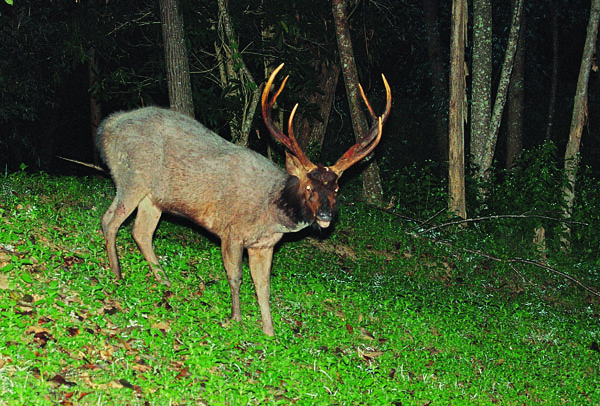
Page 25
Sambar Stag at night near a guard station in Huai Kha Khaeng Wildlife Sanctuary. This mature deer was a resident around this area and was seen almost every night. Male sambar is sought after for their trophy antlers and meat.
Primates started evolving in Thailand about 35 mya during the Eocene epoch, when mammalian evolution accelerated. The order Primate includes lemurs, lorises, monkeys, gibbons, apes and humans. This diverse order consists of about 13 families and some 52 genera, and is the largest mammalian order. Also known as simians or simiiforms, the sub-order Anthropoidea is comprised of New and Old World monkeys, including apes and humans.

Page 26
Sambar doe taking a drink at a hot springs in Huai Kha Khaeng Wildlife Sanctuary. This ungulate lived close by and came to this water hole almost daily. These deer are preyed on by tiger, leopard and Asian wild dog.
Several fossils of flying lemur and apes have been found in Krabi, Phayao and Nakhon Ratchasima provinces by Thai and French scientists. This has changed ideas about the evolution of anthropoids in Southeast Asia.
Some scientist now conjecture that hominoid primates evolved in Asia, possibly in parallel with Africa. A faunal dispersal corridor is believed to have existed between Southeast Asia and Africa during the Middle Miocene. Homo erectus has been found both on the island of Java and in China. Many new hotly debated theories have erupted within scientific and academic circles.

Wild Pig at a mineral lick in Huai Kha Khaeng. This solitary boar had been wallowing in mud close by during mid-morning. These ungulates are still fairly common here but are poached for their meat.
A very important find by palaeontologist Dr Yaowalak Chaimanee of the Department of Mineral Resources in 2003 in a lignite mine in Chiang Muan district of the northern province of Phayao was the fossilized teeth of a hominid primate aged between 13.5 to 10 million years old. The ape was first named Lufengpithecus chiangmuanensis and is related to the orangutans but it has latterly been reclassified as Khoratpithecus chiangmuanensis, all because of an amazing new discovery in Nakhon Ratchasima.

Page 27
Asian Tapir camera-trapped in Kaeng Krachan National Park. This is the largest tapir species in the world and their two-tone coloring is natural camouflage breaking up their outline at night and even during the day in dark evergreen forest.
In 2004, a new species of orangutan ancestor about 7-9 million years old was found when fossils were dramatically uncovered on the Khorat Plateau in Nakhorn Ratchasima province and Thailand once again found itself on the world’s palaeontological map. The new ape was named Khoratpitithecus piriyai (ape from Khorat) after Piriya Vachajitpan, who played a major role in the discovery deep in the Tha Chang sandpits of Chalerm Phrakiat district. The lower jawbone and teeth have a U-shaped dental arcade similar to that of the living ape – and of human beings. This fossil dates from way before human evolution in the region began and has been found nowhere else in the world.

Page 28
White-handed Gibbon in Kaeng Krachan National Park. This primate was spotted in late afternoon at the end of the road (Kilometer 36) past Phanern Thung Ranger Station. They are still quite common around the interior of this protected area and their call in the morning as the sun comes up is magical.
Wild primates in the Kingdom include slow loris and various macaques, langurs and gibbons. Many live in the forests of some protected areas. Populations are dwindling, however, as forest habitat is slowly destroyed and unsurped by humans. The future of wild primates is grim.
Three species of gibbon live in Thailand: white-handed gibbon, pileated gibbon and agile gibbon. A ‘hybrid’ has been identified where the white-handed and pileated gibbons overlap in forest habitat in the east. If a forest has substantial gibbon populations, it usually means the wilderness is fairly intact. But some suitable forests are becoming as rare as the animals themselves as the deadly tandem of encroachment and poaching spread throughout the wild primate range.

Crab-eating Macaque troop along the Mae Nam Lo River deep in the interior of Sai Yok National Park. Also known as ‘long-tailed macaque’. They are the most common of the five species of macaque in Thailand.
Gibbons spend their entire life in the trees. Their whooping call can be heard over long distances and can erupt at any time during the day or night. Gibbons often start calling at 4:00 in the morning in some forests and they usually quiet down after mid-morning, although they will sometimes vocalize in the afternoon. Gibbons are very active as the sun rises, usually congregating in fruiting trees. The white-handed gibbon, the most common, is found in most forests while the pileated gibbon survives only in the east. Agile gibbon live in a small pocket in the south near Malaysia.

Page 30
Pig-tailed Macaque in Khao Yai National Park alongside the road near the headquarters. These primates beg for food from passing motorists which have habituated them. They come right up to the vehicle and grab food before running off into the forest. They sometimes become quite aggressive and have bitten unsuspecting people who believe they are doing good. They have very long fangs and a bite can become quite severe.
Four species of langur, also known as ‘leaf monkeys’ share the same predicament as gibbons: Phayre’s, banded, silvered and dusky or ‘spectacled’. All have slender bodies and limbs, with a tail longer than the head and torso. Langur species range widely in coloring: black, gray, dark brown to reddish with some individuals albino. Langurs are eagerly hunted for their meat, blood, and for gallstones, which are valued in Chinese medicine. These nimble acrobats live in trees but do descend to the ground to eat fallen fruit and to drink water.

Page 31 – Photo by: Saman Khunkwamdee
Dusky Langur in Khao Sam Roi Yod National Park alongside the road near the headquarters. Also known as ‘spectacled’ langur, they are found in a wide range of habitats from montane to coastal forests, and even some offshore islands in the peninsula of Thailand.
Five species of macaque are found in Thailand: Assamese rhesus, stump-tailed, pig-tailed and crab-eating. Macaques are the most common wild primate, and some species live near or even within cities, usually associated with Buddhist temples where they have become habituated. Some species live in steep limestone hills and cliffs abounding human settlements. On the road near the headquarters at Khao Yai National Park, pig-tailed macaques beg for food from passing motorists. People who feed these creatures often receive serious bites.

Large Bamboo Rat in Huai Kha Khaeng Wildlife Sanctuary. They prefer secondary growth with large stands of bamboo, where they dig extensive burrows with their feet and teeth. They are often heard digging underground.

Page 32
Common Treeshrew on a wild banana blossom in Huai Kha Khaeng. These insectivores also eat spiders, fruit, seeds, buds, lizards, and even other small rodents.
Stump-tailed macaques are the largest and the fiercest of the five species, living mostly in deep forest far from humans. Males have huge fangs and can inflict terrible wounds. Primarily terrestrial, these monkeys forage for food on the ground and rarely climb trees, although they have been seen in forest canopy, most often when fleeing poachers and gunfire. Now rare in the wild, stump-tailed macaques are found only in a few protected areas.

Page 33
East Asian Porcupine in Kaeng Krachan National Park near Ban Krang ranger station. These nocturnal creatures are Southeast Asia’s largest rodent. They are still quite common in most of the top protected areas in the Kingdom.
Slow loris is the smallest of Thailand’s wild primate species. Nocturnal and arboreal, they inhibit trees of primary and secondary forest and also groves of bamboo. These cuddly balls of fur are seldom found on the ground and are renowned for their deliberate, slow hand-over-hand movement while transversing a tree branch. Slow loris can be seen at night on fruiting trees in some of the best protected areas. Sadly, these vulnerable creatures are sought after for the illegal pet trade.

Page 34
Lyle’s Flying Fox on a tree in a Buddhist temple in Ang Thong district, central Thailand. This species is rare and found only at a few places. Roosting in large colonies, they feed on ripe fruit and can wipe out a farmer’s crop in one night.
Other small mammals found include two species of pangolin: the Malayan pangolin, found all over Thailand, and the Chinese pangolin, living only in the north. Strange looking creatures with scales all over their body, pangolins look like reptiles but in fact are true mammals. (Their scales are composed of the same protein as hair or fingernails.) Pangolins are armed with a long sticky tongue and very powerful claws enabling them to ravage ant hills and termite mounds, consuming up to 200,000 ants in one meal. Being nocturnal, they spend the day curled up in a burrow. When threatened by a predator, a pangolin will wrap its tail completely around its body, locking itself into a ball. Their scales are hard enough to defeat most attackers. Pangolins are hunted for meat, and for Asian medicine and the illegal wildlife leather trade.

Greater Short-nosed Fruit Bat in Huai Kha Khaeng Wildlife Sanctuary. These medium sized fruit bats are wide-ranging and have been recaptured over 90 kilometers away from one capture site. They roost in small groups.

Page 35
Horseshoe Bat in a cave close to the Mae Nam Noi River in Sai Yok National Park. These insectivorous bats survive in the thousands in this cave. Many have been persecuted by humans using nets to capture them as they fly in and out.
Rodents form the largest number of mammal species in the Kingdom. The biggest rodent is the porcupine, of which there are two species: the Asiatic brush-tailed and East Asian. Porcupines are nocturnal creatures armed with quills, used mainly for defense against predators. Quills are hair which has evolved into sharp spines. When threatened, porcupines will spread their quills, turn their back and either attack or wait for the predator to move. The quills detach easily and have caused the death of many predators. Tiger and leopard with quills embedded in their face and front paws are often unable to hunt effectively anymore and eventually die. Some big cats have reportedly become man-eaters after having fallen victim to a porcupine’s defense.

Page 36-37
Green Peafowl in Huai Kha Khaeng. These amazing birds are thriving quite well in this World Heritage Site. They are the largest, and the most beautiful birds in Thailand with their metallic green color.
Three species of bamboo rat, burrowing rodents, still survive: large, hoary and bay. Living underground in bamboo clumps, sometimes they can be heard gnawing on the roots below the surface. Sporting long and razor sharp incisors used for both eating and digging, bamboo rats are ferocious little creatures when cornered. Hunted down for the pot, bamboo rats are considered a delicacy by hilltribe people and villagers alike.

Page 38
Black-winged Stilt in Khao Sam Roi Yod. This national park is in Prachuab Khiri Khan province, southwest of Bangkok along the coast. The species nests on the ground in the mud-flats and marshy areas. The chick is only a few days old.

Asian Golden Weaver in Bueng Boraphet Non-hunting Area in Nakorn Sawan province, Central Thailand. Weavers nest in marshy areas close to paddyfields, and rear three to four young.

Page 39
Purple Swamphen in Bueng Boraphet Non-hunting Area in central Thailand. This wetland, also home to other water birds like watercock, pheasant-tailed jacana and common moorhen, is under serious pressure from humans.
Thailand hosts 28 species of squirrel and flying squirrel. Found in many different habitats throughout the country, some squirrels are nocturnal and others diurnal, some arboreal and some terrestrial. Most eat fruits and nuts, but some supplement their diets with insects and other small animals. A few squirrel species are mainly insectivorous.
The largest is the Black Giant squirrel, a shy forest species which normally haunts the forest canopy; and only rarely ventures to the ground. Other species include: belly-banded, variable, gray-bellied, Burmese and Cambodian striped tree-squirrels. Flying squirrels, mostly nocturnal, do not actually fly but rather glide from tree to tree. The largest flying squirrel is the red giant flying squirrel, found in forests throughout the country. Unfortunately, squirrels are declining in many areas as they are sought after, both for their meat and for the skin and tail which is used to make trinkets such as key chains.

Great Comorant at Laem Phak Bia in Phetchaburi province. Once common along the Kingdom’s coastlines and waterways, this species has unfortunately disappeared but show-up from time to time possibly from Cambodia. Four vagrant birds arrived at this site in 2004.
Insectivores are insect-eating mammals including treeshrew, shrew, mole, moonrat and gymnures. Most insectivores are small although the moonrat can attain the size of a domestic cat. The colugo or Malayan flying lemur, found only in the deep south near the border with Malaysia, is an arboreal insectivore with a wing-like membrane used to glide from tree to tree like flying squirrels.

Page 40
Indian Skimmer at Laem Phak Bia. This lone vagrant arrived here in 2004. It was the third sighting of this rare species in Thailand. It is thought this lonely bird came from the Irrawaddy basin in Burma.
Bats, the only true flying mammals, are distinguished by ‘hand-wings’ formed from elongated fingers with skin stretched between them. The flying fox, still found in some areas of the South, is the largest bat in the world with a wingspan of up to 1.5 meters. Bat habitat includes city buildings, orchards, forests and limestone caves. The Kingdom hosts 112 species of bat divided into two groups: the fruit bats eating mainly fruit and nectar, and the insectivorous bats which feed on amphibians, mice or smaller bats, and some eat fish.

Page 41
Ruddy Shelduck at Mae Jo Agricultural Research Station in Chiang Mai. This female arrived in late 2003. The species is a rare winter visitor to the Kingdom. Only a few sightings occur each year.
Fruit bat have large eyes, dog-like faces and short or no tails at all. Fruit bats are important pollinators of many plants including banana, durian and kapok. A group of long-tongued bats specialise in eating nectar from flowers, inadvertently collecting pollen which they transfer to fertilize other flowers.

Page 42
Japanese Sparrowhawk along the Phetchaburi River in Kaeng Krachan. The species is a winter visitor and can be found all over the Kingdom. These raptors have keen eyesight. This juvenile stayed long enough for only one shot.
Insectivorous bats have small eyes and poor sight but very large ears used both to navigate and hunt down prey using echolocation. Emitting a series of high-pitched squeaks from their noses or mouths as they fly, the sound waves striking prey or an object are reflected back to the bat’s ears, enabling them to navigate in dense forest, catch an insect on the wing, or steer safely in a cave crowded with other flying bats. Despite being an incredibly effective means of naturally controlling insect pests, all insectivorous bats have unfortunately declined as a consequence of habitat destruction, poaching for meat, and the black market trade in stuffed animals.

Page 43
White-throated Rock Thrush at Ban Krang ranger station in Kaeng Krachan. This lone winter visitor came to the national park in 2003 and stayed for many months. This male bird became habituated to humans around the camp-ground and was easily seen.
Snakes and other reptiles can be found in several types of habitats, from the northern mountains to the southern rainforests and coral reefs. The king cobra, the largest venomous snake in the world, is found in Thailand. They can grow up to almost six meters in length and their venom is a very potent neurotoxin that can easily kill humans. Other poisonous land snakes include cobras, pit vipers and kraits, among others. Extremely vemonmous sea snakes are found both in the Gulf of Thailand and the Andaman Sea. Many non-poisonous snakes also occur: pythons, water snakes, racers, keelbacks, whip snakes, to name a few. Unfortunately, snakes are persecuted because humans as a whole, have an innate fear of the slithering creatures.

Page 44
Asian Brown Tortoise along the Phetchaburi River in Kaeng Krachan National Park. These distinctive reptiles feed on plants along the river. Ticks were found all over this tortoise.
Other than snakes, Thailand is also home to several other groups of reptiles – the largest are the freshwater crocodiles, but they have disappeared from the wild save a few individuals. Water monitors still thrive as scavengers, even in the canals of Bangkok. Smaller lizards can be found in almost every habitat. Tortoises and turtles occur on land and in waterways. Sea turtles come ashore in southern Thailand to lay eggs. But like in other parts of the world, these ancient reptiles are in serious decline.

Page 45
Hill Frog in Sai Yok National Park. They are predators of insects and other small creatures along forest streams. Amphibians started evolving on Earth about 330 million year ago.
Masters of the air, birds make up a large portion of wildlife. With over a thousand species recorded, bird-watching is very popular in Thailand. In fact, the Kingdom is one of the top birding destinations on the planet.

Page 46
Common Forest Skink along the Mae Nam Lo River in Sai Yok National Park. These reptiles forage for insects and other small creatures amongst forest litter. They are preyed on by snakes and larger lizards.
Insects number in the thousands and is the largest group of animals in the world. They are found in every habitat except the sea. Some insects are pests and raise havoc with agriculture, households and everyday life. Some are eaten and others exterminated. But they are facinating creatures evolving around us. Some need protection just like the plants and larger animals.


Page 47
Green Pit Viper devouring a skink in Huai Kha Khaeng Wildlife Sanctuary. Pit vipers are equipped with heat-sensitive organs to help them locate prey. Their fangs fold back against the roof of the mouth except when they strike. Can be deadly to humans if a bit is inflicted far from medical care and is not taken care of quickly.
The Kingdom of Thailand is truly a remarkable place, and its biodiversity second to none. It is hoped the Thai people will make wildlife conservation a top priority. More emphasis should be placed on protecting the remaining wilderness areas and creatures living within. As the human population expands and natural habitat shrinks, the future hangs in the balance. Only quick positive action by people can avert the disappearing beauty we once took for granted.

Page 48
Blue Crested Lizard in Salak Phra Wildlife Sanctuary, western Thailand. These colorful lizards are abundant and hunt insects on tree trunks. They change color when alarmed.

Rhinoceros Beetle in Salak Phra Wildlife Sanctuary, Kanchanaburi province, western Thailand. These insects are found in elephant dung, which is their main diet. They also lay their eggs in dung.

Cruiser Butterfly along a forest stream in Sai Yok National Park. These invertebrates have three body segments, antennae, three pairs of legs and one or two pairs of wings.

Page 49
Bird-eating Spider in Sai Yok National Park. They prey on insects, small birds, rodents and bats. Arachnida started evolving on earth more than 380 million years ago. Spiders are not insects but many people misunderstand this. They have two body segments and four pair of legs but there are a few six legged spider species.

Damselfly in Salak Phra Wildlife Sanctuary, western Thailand. These delicate creatures are usually found along forest streams where they perch on plants or rocks until they have spotted their insect prey.

Page 50
Dragonfly in Thung Yai Naresuan Wildlife Sanctuary close to Burma. These winged predators have been on Earth for some 320 million years from the Late Carboniferous. This one has a striking color pattern like a tiger and was about 2.5 inches long.

Common Rose and Dark Blue Tiger butterflies on the road in Thung Yai Naresuan Wildlife Sanctuary. They are attracted to urine left by large mammals like muntjac, sambar and gaur.

Page 51
Hawk Moths mating in Huai Kha Khaeng Wildlife Sanctuary. Male moths use their branched antennae to detect the scent of a female from long distances away. This was a lucky photograph.
THAILAND’S MESOZOIC VERTEBRATES
Endemic dinosaurs that once roamed on this land

Page 52-53
Theropod footprints in Phu Faek Non-hunting Area, Kalasin province, Northeast Thailand. This is the Kingdom’s best preserved dinosaur trackway found by two school girls in 1996.

Page 54
Theropod Dinosaur Footprint in Phu Faek Non-hunting Area. This track is about 140 million years old, and is Thailand’s most intact dinosaur footprint. The creature that left this print is estimated to have weighed about 2 tons and was the ancestor to T-Rex.
During the Early Cretaceous 140 million years ago in what is now Kalasin province in northeast Thailand, a lone theropod dinosaur walked slowly along a riverbank searching for prey. Herbivorous dinosaurs also inhibited this land and were probably the main diet for the huge carnivore. This solitary hunter walked up-right. Weighing about two tons, it left massive footprints in the sandy banks of the river. Over millions of years, the sand bank eventually solidified but these footprints have miraculously remained intact. This remarkable prehistoric site is one of the Kingdom’s many
reminders when dinosaurs ruled the land.

Theropod Tooth from a Siamotyrannus isanensis found in Kuchinarai district of Kalasin province. It is in perfect condition with the serrated edge intact, and is about 130 million years old.

The Mesozoic (meaning middle life) is also known as the Age of Dinosaurs comprised of three periods: the Triassic ( 248-206 mya), the Jurassic (206-144 mya) and the Cretaceous (144-65 mya).
Dinosaurs evolved over 160 million years into a myriad of shapes and sizes. While some were the tallest and heaviest animals to ever walk the earth, others were no bigger than a chicken. Hundreds of species adapted to widely different environments. This adaptation contributed to the success and diversification of the dinosaur.
Thailand has the largest and finest representation of dinosaur fossils in Southeast Asia. The only other fossils in the region are a few small discoveries in Laos. Thai fossils show a close relationship to the Chinese and Mongolian dinosaurs.

To date, all dinosaur fossils and footprints discovered have come from Mesozoic freshwater sediments, turning into sandstone, clays and limestone.
One man has undeniably been at the forefront of the discovery of Thai dinosaurs. A walking encyclopedia on the subject, Varavudh Suteethorn is surely Thailand’s top paleontologist and geologist, of the Department of Mineral Resources. He has found more dinosaur fossils in Thailand than anyone else, and has published scores of scientific papers. Varavudh’s latest find is a stegosaur or ‘plated lizard’ of the Late Jurrasic, and more new species are bound to follow.
Eric Buffetaut and his wife Haiyan Tong of the National Center of Scientific Research in France have worked in a Thai-French project. Considered leading authorities on the identification of Thai dinosaurs, they have published many papers in collaboration with Varavudh. The meticulous work of the Thai-French paleontological team has found some 15 species in Thailand.

Page 58-59
Huai Hin Lat Formation 220 million years old in Nam Nao district in Phetchabun province, Northeast Thailand.

Page 60

Page 61
Archosaur Footprints on the Huai Hin Lat Formation in Nam Nao district of Phetchabun province. The sharp toes (Page 60) indicate this creature was a predator. Dating back to the Late Triassic period, these footprints are the Kingdom’s oldest trackway.
In time, Thailand’s dinosaurs range from the Late Triassic to the Early Cretaceous. The first fossil was discovered in 1976 in Phu Wiang National Park in Khon Kaen province. A femur from a sauropod was discovered by Sutham Yamniyom, geologist with the Department of Mineral Resources.
Then teeth from a theropod and several bones from a sauropod of the Early Cretaceous were found in Phu Wiang. (These discoveries come from the Sao Khua Formation, a very productive stratum.)
Five new species of dinosaur known nowhere else have been found in Thailand. In 1986, Siamosaurus suteethorni, a fish-eating theropod named after Varavudh, was unearthed from the Sao Khua Formation in Phu Wiang.
In 1992, a small, parrot-beaked herbivorous dinosaur, Psittacosaurus sattayaraki, only about a meter long, was excavated in Chaiyaphum province. In 1994, the largest dinosaur ever found in Thailand appeared. A sauropod of the Early Cretaceous, it was named Phuwiangosaurus sirindhornae after HRH Princess Maha Chakri Sirindhorn, who followed the excavation keenly. This giant plant-eater has been found at three sites on the Khorat Plateau.

Page 62
Fossilized teeth found at Wat Sakawan. These teeth belong to a Phuwiangosaurus sirindhornae from the Early Cretaceous Period, about 140 million years ago. Fossils are very important reminders and proof of dinosaur history in Thailand.
A carnivorous theropod, Siamotyrannus isanensis was found in 1996. The oldest Tyrannosaur found in the world, it is Tyrannosaurus rex’s earliest known ancestor. The next species from the Northeast is a very primitive sauropod from the Late Triassic, Isanosaurus attavipachi. It is the oldest sauropod found in the world so far. The fact that Thailand’s dinosaur discoveries have often proved to be the earliest example of lineages well known all over the world has led many scientists to believe that quite a few dinosaur species originated in Asia.

Page 63
Sauropod dinosaur fossil at Wat Sakawan, Sahat Sakhan district in Kalasin province, Northeastern Thailand. This site has seven fossilized skeletons of the sauropod Phuwiangosaurus sirindhornae.
The Kingdom’s single most significant discovery was in 1980 at Wat Sakawan, a Buddhist temple in Sahat Sakhan district, near the city of Kalasin. The temple lies at the foot of Phu Kum Khao hill and the site attracts many visitors all year round. The first fossils were found and kept at the temple. Subsequent excavations by Thai-French paleontologists in the Sao Khua Formation then discovered seven fossilized skeletons of the sauropod Phuwiangosaurus sirindhornae. Several fragments of theropod teeth were found at the same site suggests scavenging on the sauropod carcasses. Theropod teeth were also discovered together with sauropod fossil bones at Phu Wiang.
In 1996, two schoolgirls spotted two sets of dinosaur footprints in the Phra Wihan Formation at Phu Faek Non-hunting Area in Kalasin province. The two-ton, three-toed theropod dinosaur portrayed at the beginning of this chapter made the clearest and best preserved footprints in Thailand, a total of 21. A smaller set criss-cross the larger set. The prints unfortunately lie in a seasonal stream and are covered with running water during the rainy season.
In 2003, a set of tracks were found by the Nam Nao Conservation Group in Nam Nao district, Phetchabun province. Villagers told of footprints which they believed had been made by the spirits of the forest. Superstition plays a big part in their lives.

Page 66-67
Phra Wihan Formation of the Early Cretaceous Period in Phu Faek Non-hunting Area, Kalasin province, Northeast Thailand.
The conservation group contacted Varavudh Suteethorn, who investigated and determined that the tracks had been made on a huge mud flat by an archosaur or ‘ruling reptile’ sometime during the Late Triassic, 220 mya. (This formation is known as Huai Hin Lat.) Over millions of years, the 200 by 250 meter slab somehow remained intact as geological forces thrust it up to a 40 degree angle. There are three separate trackways, and they are the Kingdom’s oldest fossil footprints. Because this important site is situated just outside Nam Nao National Park, it is not in protected land. Like all fossil sites, it needs absolute protection if it is to survive.
The downside of Thailand’s wonderful discoveries is that fossils are in big demand by both local and international collectors, stimulating village people to pillage fossil sites. Some fossils even end up cold at tourist venues as curios. Knowledge of millions of years of evolution is being lost to wanton ravaging of these sites. It is essential that the looting be controlled.
Thailand has gained the role of a major dinosaur site, in fact one of the richest in the world. Thai fossils are revealing very important information about Mesozoic dinosaurs in Asia. The joint Thai-French search for fossils continues, and surely new revelations will emerge from the rock stratum to delight paleontologists worldwide. Thailand’s dinosaur fossils are priceless and are truly a tribute to the Kingdom’s natural heritage.
SUBMARINE OF THE JUNGLE
The last wild Siamese Crocodiles in Thailand

Page 68-69
A Siamese Crocodile in Klong Takrow in Khao Ang Rue Nai Wildlife Sanctuary, Eastern Thailand with a forest fly resting on its bony ridge.
Two hundred and thirty million years ago, the first crocodiles began to evolve during the Mid-Triassic period of the Mesozoic era. Having branched off from archosaurs or ‘ruling reptiles’ when primitive dinosaur also roamed the planet, crocodilians have changed little in body structure since then. Apart from birds, crocodiles are the only living archosaurs.
In 1909, J.B. Hatcher discovered a few fossilized bits and pieces of a giant crocodile in Montana from the Late Cretaceous period 80 mya of North America. Deinosuchus was also found in Texas by Barnum Brown of the American Museum of Natural History in New York in the 1940s. The skull of this huge crocodilian is two meters long and body length estimated at more than 10 meters. Sarcosuchus, a 12 meter crocodile, was found in Central Africa from the Early Cretaceous 110 mya by France de Broin and Phillip Taquet in 1966. A huge crocodilian was also found in Brazil by a British geologist, and described by Eric Buffetaut and P. Taquet in 1977 as the same species found in Africa. These ‘super-crocs’ pulled dinosaurs into the water and devoured them.

Page 70-71
Siamese Crocodile in Kaeng Krachan National Park, Southwest Thailand. This individual was photographed in 2003 along the Phetchaburi River deep in the interior. The species is considered the rarest wild crocodilian in the world.
In 1979 in the northeast province of Nong Bua Lam Phu, Nares Sattayarak, a geologist for the Department of Mineral Resources, discovered the lower jaw of a huge crocodile in a road-cut excavated from the Phu Kradung Formation of the Late Jurrasic 150 mya. Sunosuchus thailandicus was described as a new species by Eric Buffetaut and Rucha Ingavat (also from the Department of Mineral Resources). Estimated to have been at least eight meters in length and with a lower jaw over a meter long, it was Thailand’s ‘super-croc’.
Crocodilians for most of their 230-million-year history have been large, long-bodied, aquatic carnivores. Armor-plating (in the form of bony scutes set in their hides), extended tails, short strong limbs, and powerful sharp-toothed jaws made them into formidable predators.
Crocodiles come onto land to defecate and, being cold-blooded, bask in the sun so as to regulate their body temperature. Female crocs come ashore to lay from 20 to 40 eggs in mound nests on land near the water’s edge. These streamlined predators glide through water with ease, surfacing and submerging at will. Man is the mature crocodile’s only enemy, and the wild Siamese crocodile are the world’s most endangered crocodilian species.
Siamese crocodiles grow broad and heavy. Mature individuals have distinct bony ridges behind the eye socket. Historical records report specimens of up to four meters in length but three meters is presently average for an adult. They feed primarily on fish but also take frogs, small mammals and birds. Undulating their powerful tails while tucking in their legs, crocs can glide through water without making a ripple. Stealthily stalking prey along the water’s edge, in an instant they can snatch their victim in powerful jaws and pull it below to drown it. Some species lay in wait on the bottom of a river or pond in order to grab fish. (Crocs can stay underwater for long periods of time.) Adults can survive a year without a meal and thus are nature’s most efficient predator in terms of consumption in proportion to body size.

Page 72-73
Siamese Crocodile camera-trapped along Klong Takrow in Khao Ang Rue Nai Wildlife Sanctuary. This individual is the same animal shown on page 68-69. Siamese crocodile hunt mostly fish but also take small birds and mammals.
Thailand once had three species of crocodile found in a host of enviroments: the sea, estuaries, rivers and marshes throughout most of the country. The most common species was the Siamese crocodile Crocodylus siamensis, a freshwater species. Another freshwater crocodile was the Tomistoma schlegelii, also known as the ‘false gharial’. This thin-snouted crocodile was only found in rivers of the southern peninsula. The estuarine saltwater crocodile Crocodylus porosus, is the largest croc in the world. Also known as the ‘Indo-Pacific’ crocodile, it was very common in river estuaries and islands in the Gulf of Thailand and the Andaman Sea. These huge saltwater crocodiles could even be seen swimming in open ocean.
The tomistoma and saltwater crocs are probably extinct in the wild in southern Thailand, but, along with the Siamese, they are farmed. The freshwater tomistoma and Siamese can live in the brackish water found in most farms. A fast growing crocodile has been hybridized by cross-breeding the Siamese and saltwater crocodiles. This human creation is the crocodile most often farmed for its meat and hide.
Siamese crocodile were once very common in Southeast Asia including Thailand, Vietnam, Cambodia, Indonesia, Malaysia, Laos and possibly Burma. Populations throughout the region have declined and exact numbers of wild crocs are not known in any of the range countries.

Page 74
Klong Takrow in Khao Ang Rue Nai. This river dries up in the winter leaving small but deep ponds. Many species of fish survive in this habitat and are the main diet for the Siamese Crocodile found here.
At the end of World War II, crocodile farming came into vogue in the Kingdom, and wild crocs were captured for breeding stock. Thousands upon thousands were caught in the booming trade. Habitat loss and crocodile farming started the countdown to extinction for these ancient creatures. There were no laws to protect them and the crocodiles was eradicated from every river and swamp in the country. Only the Siamese crocodile survives in a few places in the wild.
Khao Ang Rue Nai Wildlife Sanctuary in the province of Chachoengsao, is about three hours drive from Bangkok. It was established in 1977 and the protected area, consisting mainly of semi-evergreen forest and many streams, is eastern Thailand’s largest remaining tract of lowland rainforest, with a rainfall of some 3,000-4,000 millimeters a year.
This wilderness was almost completely surrounded by agricultural land, and squeezed down to the last 1,030 square kilometers before being gazetted by royal decree. Fortunately, enough forest was saved that elephant, gaur, banteng and many other animals have been able to survive so far, including birds such as the black-and-red broadbill and the Siamese fireback pheasant. Khao Ang Rue Nai is home to one of the last wild Siamese crocodiles in eastern Thailand.
The opportunity to photograph one of Thailand’s rarest animals had been a dream of mine for some time. In January 2001, I erected a photographic blind on the banks of Klong Takrow close to where a croc had been seen basking.

Page 75 – Photo by: Kitti Kreetiyutanont
Siamese Crocodilein Khao Ang Rue Nai. This mature crocodile was photographed in 1993 by Kitti Kreetiyutanont who did a survey of wild crocodiles in the Kingdom for the Royal Forest Department.
The murky waters of the forest pool lay still and quiet in the mid-morning heat. Now and then a fish catching an insect or a falling leaf would disrupt the mirror image of the pond. A pair of wreathed hornbills croaked nearby while high in the trees, pileated gibbon sang a booming crescendo. It was nature at its best.

Page 76-77 – Photo by: Kitti Kreetiyutanont
Siamese Crocodile in Khao Ang Rue Nai photographed back in 1993.
Dripping with sweat, I sat hoping to see a crocodile. A slight movement in the water at the far end of the pool caught my eye. A strange but familiar shape surfaced and then submerged, moving closer to its basking spot. Slowly, its eyes and snout rose to the surface. A large forest fly landed on the bony ridge behind its eye to drink the salty secretions from the croc’s eye (Page 68-69). As the reptile checked the surrounding area for danger, I snapped a long series of photographs of Thailand’s most endangered animal. Suddenly, as if sensing it was not alone, the croc submerged and disappeared into the depths of the pool. My dream had come true and 230 million years of evolution had passed through my lens.
For capturing images of such elusive creatures like crocodiles, infrared camera-traps is a very productive alternative to endless days of sitting in a hot photo-blind. Crocodiles are creatures of habit, so I set a camera-trap at its favorite basking spot. The croc was caught on film many times during a two-week session, the best shot being on page 73. Since Siamese crocs can live for 60-70 years, it is hoped this individual will be in Khao Ang Rue Nai for a long time to come.
Kaeng Krachan National Park, mostly semi-evergreen forest, is the Kingdom’s largest national park with an area of some 2,915 square kilometers. Probably Thailand’s most intact remaining ecosystem, much was saved from logging by the ban in 1989. The main water course is the Phetchaburi River, which flows down to the Kaeng Krachan reservoir from the Tenasserim Mountain Range staddling the border with Burma. Kaeng Krachan is just three hours drive southwest of Bangkok.
Many species still thrive in the park: elephant, gaur, tiger, leopard, and many more including the Siamese crocodile. In early 2001, park rangers found crocodile tracks along the river and a Siamese crocodile was camera-trapped on a sandbar. A few months later, I found another set of tracks further up-river from the first set. No crocs were sighted at this time, but a population may exist in the interior nonetheless.
In March 2003, while tending camera-traps along the Phetchaburi River, I found crocodile feces and tracks at the 2001 site where I built a photographic blind across the river. After a two day wait, a mature croc emerged at the deep end of the pool in mid-morning. Fortunately, it was within range of my Minolta 600mm lens and 2X tele-converter. Several rolls of film later, the rare croc submerged and disappeared. These photographs are the first ever through the lens of a Siamese crocodile in Kaeng Krachan.
Both brief encounters will remain etched in my memory for as long as I live. The solitary crocodiles have instilled an urge in me to help these rare creatures – but how?
As of 2004, Khao Ang Rue Nai and Kaeng Krachan are the only known sites where the Siamese crocodile is found – and only one animal is confirmed at each site. In 2003, a female croc with eggs was killed by poachers in Yot Dom National Park not far from Cambodia. Its skull and skin are now on display at the park.

Page 78
Crocodile Tracks along the Phetchaburi River in Kaeng Krachan National Park. Crocodiles are creatures of habit and come to the same spot to bask and deficate unless disturbed. This river is also home to the otter, fish-eagle and water monitor.
Some old reports suggest that Siamese crocodile may still exist in the northeast in several other protected areas: Pang Sida National Park (Sa Kaeo province) and Phu Khieo Wildlife Sanctuary (Chaiyaphum province). Kitti Kreetiyutanont of the Royal Forest Department, wrote a paper on Siamese crocodile sightings in 1993 and, indeed, photographed the croc at Khao Ang Rue Nai.
The National Parks, Wildlife and Plant Conservation Department and other organizations should support surveys to see if other crocodiles still exist in Thailand. With only a couple of animals confirmed, action must be taken to ensure their survival. Restocking a few carefully selected sites with yearling Siamese crocodiles seems to be the only solution. But that raises questions about the farmed crocodiles available for release. Have farmed Siamese crocodiles been subject to excessive inbreeding? Even more critical, have they been crossbred with other species? Only good DNA analysis can unravel this intricate problem of the species integrity in captivity.

Page 79
Crocodile Pond along the Phetchaburi River. This waterway could possibly be a reintroduction site in the future for the extremely endangered reptile, but extensive surveys are required to determine if a viable population exis. Only one individual has been photographed and camera trapped here.
Serious efforts are required to save Thailand’s remaining wild crocodiles from total extinction. No matter how many crocodiles are kept in farms, only an intact wild population can save these ancient creatures.
Public access to the Phetchaburi River in Kaeng Krachan and to Klong Takrow in Khao Ang Rue Nai should be limited and strictly regulated. These crocodiles need absolute protection if the species is to continue to survive the dinosaurs. Thailand should serve as a role model for wildlife conservation in Southeast Asia, and the people need to join hands to protect their Kingdom’s natural heritage for future generations.
TO BE CONTINUED IN ‘PART TWO’

WILDLIFE in THAILAND: A Photographic Portfolio of Thailand’s Natural Heritage – Part Three
++++++++++++++++++++++++++++++++++++++++++++++++++++++++++++++
CHAPTER SIX
Mountains of the North: Northern
Thailand’s majestic beauty

Page 132
Mountains due south of the city of Mae Hong Son, in the northwest corner of the Kingdom, close to the border with Myanmar. There are literally hundreds of viewpoints in the north that offer these majestic sights; mountain after mountain, as far as the eye can see. However, many are sadly deforested.

Doi Inthanon National Park
Around the beginning of the twentieth century, northern Thailand’s many beautiful mountain ranges and valleys were covered with extensive natural teak forests. These are threaded by sparkling rivers and waterfalls that brought life to the region. Unfortunately, much of the area has since been heavily logged and degraded. Its original pristine beauty now remains primarily in some protected areas, the most important of which are described below:

Doi Inthanon National Park and Kiew Mae Pan Massif in Chiang Mai province, Northern Thailand. This is the Kingdom’s highest national park. The cliff face is home to goral, a goat-antelope that lives on the cliff-face. The larger serow, also a goat-antelope are also seen from time to time.
Doi Inthanon is Thailand’s highest mountain. Rising to 2,595 meters, and is part of the Thanon Thongchai Range that extends south from the Shan hills of Myanmar. Situated southwest of Chiang Mai, this 482 square kilometer national park was gazetted in 1972 and is now one of the most visited parks in the country.

Kiew Mae Pan cliff-face during the early morning in Doi Inthanon National Park. The rugged terrain is what keeps the goral and serow safe from poachers. There is a good-sized herd of goral but serow are rarely seen. Temperatures can drop down to zero degrees Celsius during the wintertime, and it was tough for me in this steep terrain but I was very successful here. I got some wonderful photos of the wildlife.
The park’s geology of granitic batholith enables it to support several different types of forest. The most notable of these is at the peak where the only montane evergreen forest in the country is found. Native pines grow at the moderate to higher elevations and a sphagnum bog exists at the summit, the only one in Thailand. The most important species are the green-tailed sunbird, which is endemic here, and the Himalayan newt (crocodile salamander) found in the bog.

Siriphum waterfall in Doi Inthanon National Park. There is a camp ground before the national park headquarters where these falls are visible. The protected area gets thousands of visitors every year and can be visited year round.
Doi Inthanon was once under full forest cover and wildlife on the mountain, including elephant and gaur, were very common. Now, however, most of the larger fauna have disappeared. Some smaller mammals like barking deer, wild pig and black bear can still be found, but birds now predominate. Some 383 species of bird have been recorded and Doi Inthanon is one of the top bird-watching sites in Thailand.

A kid goral in Doi Inthanon about 3-4 months old near the summit. The author was sitting in a blind up on the cliff-face in freezing weather early one morning. This little creature was curious and came very close before going back down. It’s parents had left it to fend for itself but it lived on to see another day. Some very happy moments in my life as a wildlife photographer. One of my greatest achievements.
The influx of hill tribes with their practice of slash and burn agriculture has decimated the forests from 1,500 meters down to the lowlands. First it was the Hmong and then the Karen, Opium was once the Hmong’s main cash crop but has now been replaced by rice, vegetables, flowers, fruit and coffee. The Karen were mainly hunters and gatherers. With an ever-increasing hill tribe population who use modern agricultural techniques and mechanized equipment, this national park, which is also a popular tourist destination, is under serious threat like most protected areas in the country that have people living inside them. It seems that Doi Inthanon may degenerate to the point of no return with an exception for some areas around the peak.

Serow C. sumatraensis early one morning as the author sat in a photo blind some 100 meters away. It was near zero degrees centigrade and I was freezing while my feet felt like two frozen rocks. This was the first serow I was able to photograph here during the two-years of work around Kiew Mae Pan cliff-face.
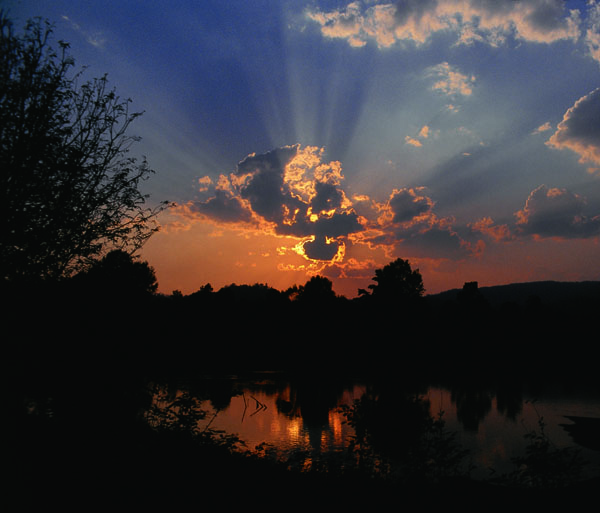
Page 133
Sunset, below Doi Suthep-Doi Pui National Park, near the city of Chiang Mai. The pond is part of Mae Hia Agricultural Center, a government facility. Lesser whistling-duck, Chinese pond-heron, white-breasted waterhen and common moorhen are just some of the water birds found here. Also in the area are black-shouldered kite, common kingfisher, white-throated kingfisher and many other smaller species of bird. This agriculture research center is fairly safe from local poachers so the future of birds that live or migrate here is very good even though their numbers have declined over the years.
Doi Suthep-Doi Pui National Park
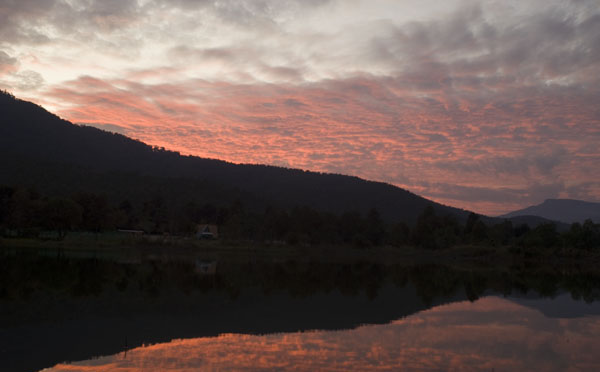
Sunset over the northern section of Doi Suthep-Doi Pui National Park in Chiang Mai. During the monsoon season, some cloud formations allow for spectacular photos at dusk.
The twin peaks of Doi Suthep and Doi Pui, west of the city of Chiang Mai, rise from the valley floor to heights of 1,601 and 1,685 meters respectively. The 261 square kilometer area was finally gazetted as a national park in 1981. Unfortunately, due to its proximity to the city, it has been extensively logged and poached for everything it contains. Wild orchids, other flowers, mammals and birds have been prime targets.
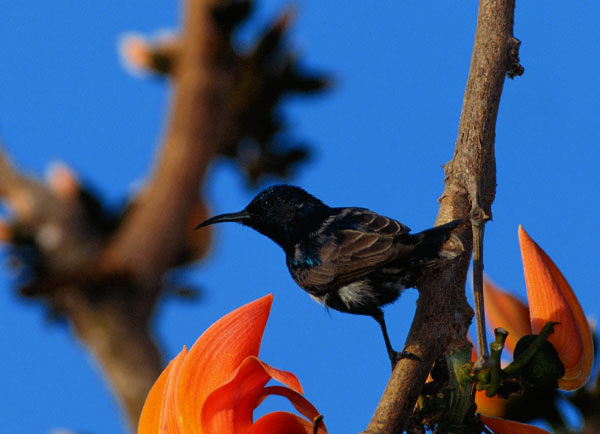
Page 134
Purple Sunbird Nectarinia asiatica. This photo was taken in Chiang Mai province near the base of Doi Suthep. These small and delicate birds are not seen that often and their habitat is deciduous woodlands and open scrub country. The male bird appears mostly dark blue-black at a distance. They take nectar and small insects like the other species of sunbird in Thailand.
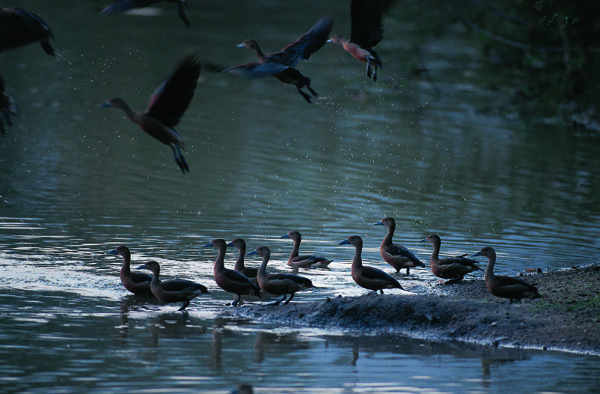
Page 135
Lesser Whistling-Duck Dendrocygna javanica, also known as lesser treeduck, lifting off from a pond in Mae Hia Agricultural Center, Chiang Mai. Several hundred migrate annually from the north, mostly from China living here during the winter months. They rest during the day and fly off to feeding grounds, usually rice fields, at dusk. Sought after and trapped by villagers, for food and due to the damage they inflict on rice fields, their numbers are dwindling. This decline is likely to continue.
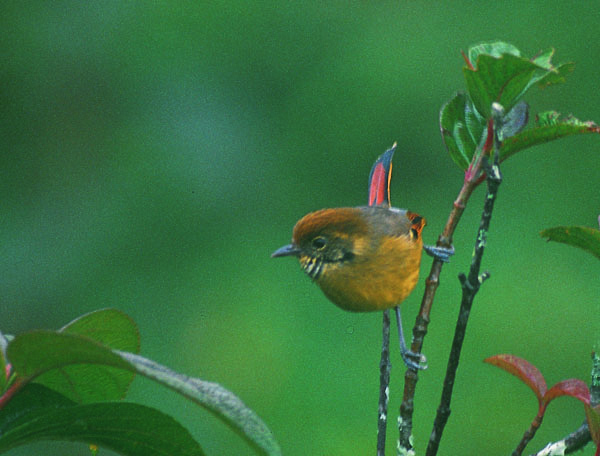
Chestnut-tailed Minla Minla strigula. This photo was taken at the summit of Doi Inthanon National Park, next to the Royal Thai Air Force radar station. They are common up here and can easily be seen, morning and afternoon. They are only to be found in evergreen forests above 1,600 meters. Noisy and gregarious, they feed on insects in treetops and in low herbage.

Page 136 – Photo by: Amonsak Sriwilai
Red-spot Jezebel Delias descombesi. This butterfly is common here and is taking in nectar from mistletoe by the roadside near the summit of Doi Inthanon
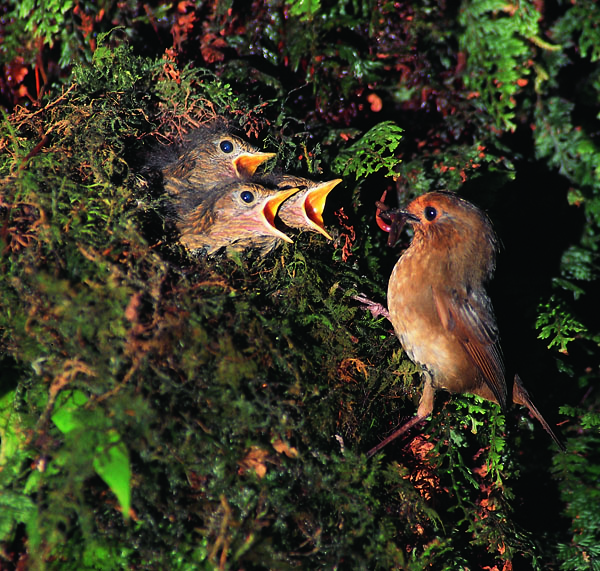
Photo by: Amonsak Sriwilai
Lesser Shortwing Brachypteryx leucophrys. These nesting birds were photographed near the top of Doi Inthanon, feeding its young with what looks like a worm. These skulking inhabitants of the evergreen forest floor are common here from 1,000 to 2,000 meters.

Page 137 – Photo by: Samak Khodkaew
Green-tailed Sunbird Aethopyga nipalensis. This beautiful bird is endemic to Doi Inthanon above 1,500 meters and can be seen in the vicinity of the Royal Thai Air Force radar station. From the same genus, its cousin is found in the southern peninsula of Thailand but lacks the scarlet lower breast. Like all sunbirds, they take nectar and insects. They are similar to New World hummingbirds but are less agile in flight and when hovering.
The park contains two main waterfalls, Huai Kaeo and Monthathan that the locals use for recreation. Several Buddhist temples dot the park, the most famous being Wat Phra Borommathat Doi Suthep which is visited by tens of thousands of local and foreign tourists each year. The road at the top to Phu Ping Palace has been widened and other road surfaces have been improved. Continued pressure on the park from more and more traffic and visitors can only have an adverse effect in the long term.

Photo by: Amonsak Sriwilai
Hawk Moth Acherontia lachesis. This insect was photographed in Doi Inthanon’s sphagnum bog. With its narrow wings and long stout body, it flies mostly at twilight.

Page 138 – Photo by: Samak Khodkaew
Giant Atlas Moth Attacus atlas. Photographed in Doi Suthep-Doi Pui National Park in Chiang Mai. It is considered the world’s largest moth and is common throughout Asia in deciduous and evergreen forests.

Photo by: Amonsak Sriwilai
Himalayan Newt Tylototriton verrucosus. Also known as the crocodile salamander, this one was photographed in the sphagnum bog at the summit of Doi Inthanon. This little salamander is the only member of the family Salamandridae found in Thailand. Quite rare, due to collecting by amphibian enthusiasts and medical scientists wanting to learn how it regenerates its limbs, it is found on only a few of the north’s highest mountains.
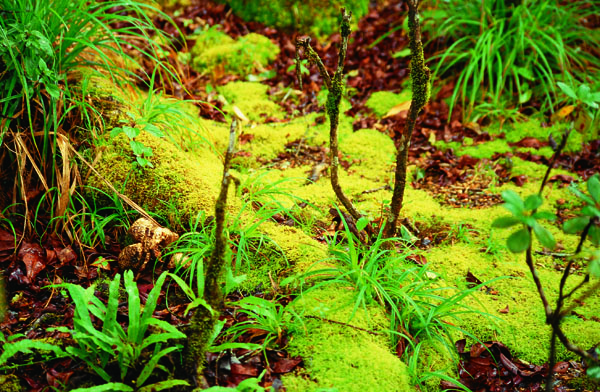
Page 139
Sphagnum bog. It is situated at the summit of Doi Inthanon National Park, near the radar station. This bog, the only one in Thailand, attracts thousands of visitors every year. A pleasant walkway allows one to view many birds and the rare Himalayan newt along the way.

Photo by: Samak Khodkaew
Rafflesia Sapria himalayana. This one is the smallest of the three species of Rafflesia found in Thailand. On Doi Inthanon, it has become increasingly rare due to habitat destruction and indiscriminate collecting of wild flowers.

Page 140
Scarlet Wild Ginger Zingiber zerumbet. This one was found at the summit of Doi Suthep. This perennial can be found in most evergreen forests. It announces itself during the rainy season by coming into bloom.

Photo by: Samak Khodkaew
Praying Mantis. This one caught in an extraordinary pose as it reaches for a higher leaf. These carnivorous insects of the Mantis family mimic twigs and branches, blending into their natural surroundings to ambush other insects. Kung fu, the Chinese martial art, in turn mimics the mantis in its many poses.

Page 141 – Photo by: Amonsak Sriwilai
Jumping Spider. They are from the family Salticidue, seemingly just having landed from outer space. Its eyes resemble sunglasses. This ferocious looking carnivore could easily intimidate its prey. Creepy-crawlies are everywhere in the forests, some living on intricately woven webs that catch flies and grasshoppers. Others lurk under loose bark and leaves, waiting for dinner to pass by. Most have poisonous bites. Some are deadly.

Stag beetle in Doi Inthanon National Park. This beetle was photographed at kilometre 38 near the road going up to the summit. There are common here in the evergreen forest that covers most of the top of this mountain.
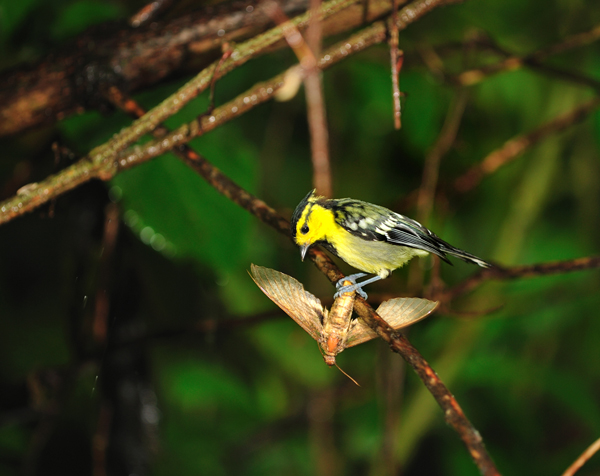
Yellow-cheeked Tit Parus spilonotus with a moth photographed near the road at kilometre 38 in Doi Inthanon. Timing was just right as this male flew away with its prey shortly after this shot was taken.
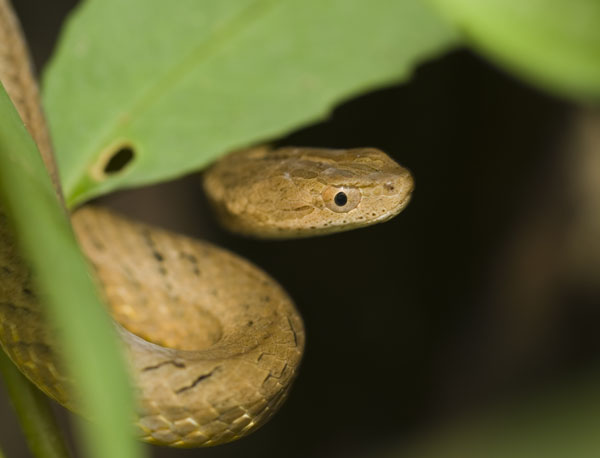
Common mock viper in Doi Inthanon. I photograph this snake while checking out a camp-sight one day. It was the first snake I saw at about 1,600 meters in the lower valley.
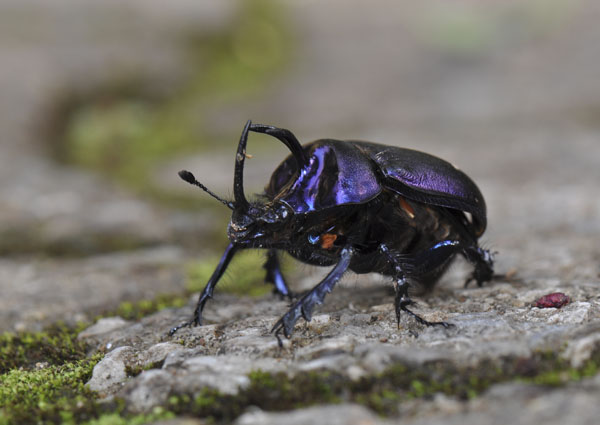
A purple Scarab beetle photographed at the summit of Doi Inthanon near the radar station. The author was walking around the Buddhist shrine when this remarkable insect flew over my head and landed in front of me. Most scarab beetles are black but the colour of this one is really stunning.
Mae Tuen and Om Koi Wildlife Sanctuaries
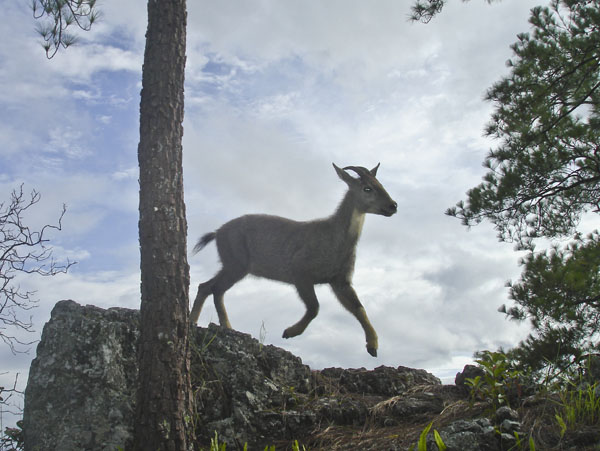
A goral camera-trapped near the top of the mountain jumping from rock to rock. They can move straight-up and down, and is the way they evade predators. These goat-antelopes used to exist on every mountain top in the north all the way down to Tak province in Mae Ping National Park several hundred kilometres due south of Chiang Mai. It is hoped these amazing creatures will continue to thrive into the future.
Situated in Tak and Chiang Mai provinces respectively, these important contiguous sanctuaries together cover an area of some 2,397 square kilometers. They thus constitute the largest conservation area in northern Thailand. They are bordered to the east by the Mae Ping National Park that is bisected by the Ping river which flows into the Bhumibol reservoir in Tak province. Unfortunately, the reservoir acts as a gateway to the sanctuaries and park by allowing easy access by boat. The locals are allowed to fish the reservoir.

Sunset as viewed from Doi Inthanon toward the south. The Thanon Thongchai Range can be seen and goes on for several hundred kilometres. At this time of the year (winter), the air is crisp and clear and photos are beautiful at this time of the day.
Goral, the goat-antelope, is found here as a small herd of some dozen or so animals on Doi Montjong in Om Koi Wildlife Sanctuary. Unlike the serow, which is found more widely in Thailand, the goral is highly endangered. Its future is grim indeed as many Hmong and Karen hill tribes still live within the sanctuaries, engaging in poaching, encroachment, and slash and burn agriculture.

Eurasian wild pig Sus scrofa. This boar (male) pig was photographed at a waterhole in the Om Koi Wildlife Sanctuary. They need a constant source of water and minerals. Sought after by poachers for their meat.
Mae Tuen and Om Koi is also one of the last sites in the north for elephant. Only a few individuals remain. Gaur and banteng are reported but, as everywhere, their numbers are few. As time marches on, they could eventually disappear from these two sanctuaries that together constitute the largest northern refuge for Thailand’s large mammals.
Other parks and sanctuaries

A goral camera-trapped in Mae Lao-Mae Sae Wildlife Sanctuary, Northern Thailand. It is quite rare to catch one in daylight this close. They are thriving here and the sanctuary is one of 7-protected areas that have them. These mammals get moisture from the grasses, buds and leaves they consume. They are endangered due to poaching by hill-tribe people that consider it a delicacy to give them strength. Their decline along with the serow is an on-going threat to both species.
There are many other areas in the north that have been designated as national parks, wildlife sanctuaries and non-hunting areas. Of these, the most notable is Maelao-Maesae Wildlife Sanctuary in Chiang Mai province, another haven for goral; Namtok Mae Surin National Park, and the Salawin and Lum Nam Pai Wildlife Sanctuaries in Mae Hong Son province; Doi Khun Tan and Namtok Chae Son National Parks in Lampang province; Mae Yom National Park in Lampang and Phrae provinces; and Chiang Saen Lake Non-Hunting Area in Chiang Rai. All these and many other sites not mentioned here are under serious threat from the small minority who seem intent on continuing to abuse Thailand’s natural resources for their own benefit. As human populations in the north continue to increase, encroachment into protected areas becomes more difficult to control. The future seems bleak.
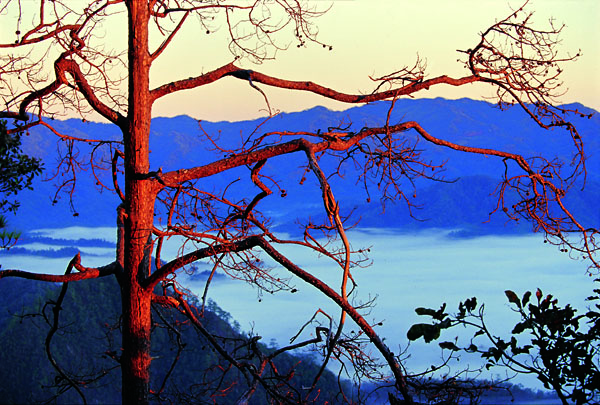
Maelao-Maesae Wildlife Sanctuary located some 60 kilometres north-west of Chiang Mai on the road to Pai and Mae Hong Son. This shot was taken at sunrise just as the sun rose up into the sky, hence the red coloured branches on the tree in the foreground. Below, fog build-up through the night is seen. The temperature was almost freezing. The author spent the night on the peak in order to be in place for this photographed first thing in the morning.
Looking back, trying to apportion blame for the enormous damage that has been wrought would be rather like the pot calling the kettle black. Yet if we could turn the clock back 100 years, and if all those responsible had used careful selective cutting and true conservation techniques, most forests would have been saved. Dwelling on hindsight is thought by many to be a waste of time. Yet hindsight provides us with valuable knowledge, if only we take a little time and trouble to learn from the mistakes made by those who came before us. Using that knowledge today will enable us to save Thailand’s remaining natural treasures for our children in the future.
++++++++++++++++++++++++++++++++++++++++++++++++++++++++++++++
CHAPTER SEVEN
Beung Boraphet: A non-hunting
area and wetland for birds
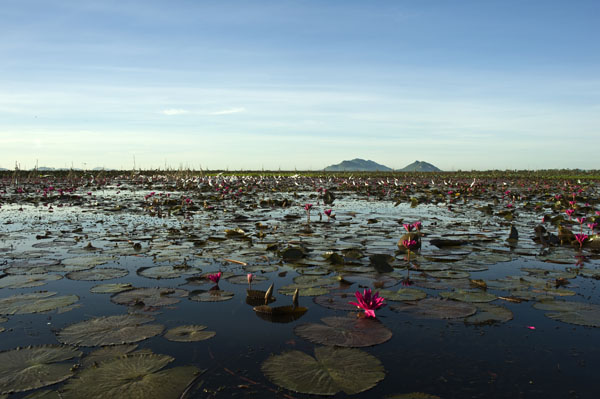
Breeding area in Beung Boraphet Non-hunting Area (NHA) in Nakorn Sawan province, Central Plains of Thailand
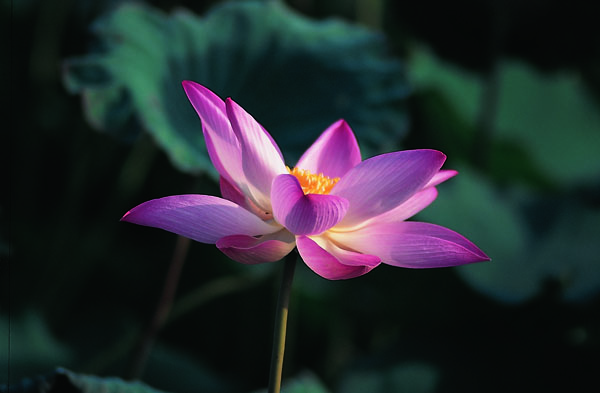
Page 142
Lotus Nelumbo nuciferais. This is a common sight around the waterways of central Thailand, being found naturally, and cultivated for the seedpod and stems as food. This native water lily floats on water and is home to many water birds, reptiles and amphibian species. There is also a totally white phase.
Beung Boraphet is the largest bird sanctuary and fresh water body in Thailand. Located 150 kilometers north of Bangkok in the central plains, it lies east of Nakhon Sawan. In former times, this lake was a giant marshland (the Thai word, ‘beung’ means marsh), harbouring many birds and aquatic animals including the Siamese crocodile, no longer seen here, and the white-eyed river-martin, now extinct in Thailand. The reason for some species disappearing is plain and simple — encroachment by man in his everlasting search for food and a livelihood.

Page 143
Little Grebe Tachybaptus ruficollisin. This beautiful water bird was in the central area of the lake. Pale gray-brown most of the year, they turn dark chestnut-red during the breeding season. They are very secretive when breeding and only become bold when the chicks are ready to hatch. These aquatic birds seldom fly, preferring to dive when alarmed. They can stay submerged for long periods of time.
The swamp was dammed by the Fisheries Department before World War II and turned into a fishery that was later drained and dredged to expand the lake. This had a devastating effect on the flora and fauna of the lake. Gathering of aquatic plants and fishing by the inhabitants, now numbering in the thousands, has been permitted by the department, which has a station on the northern shore. Although birds are strictly protected, their numbers have drastically dwindled since the early 1990s. If present conditions remain unchanged, the decline will continue. There are 204-recorded species of bird here!
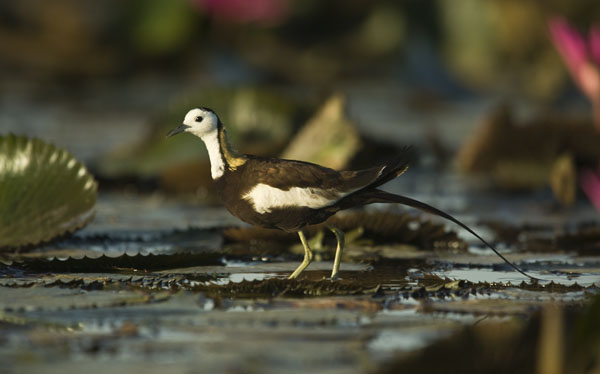
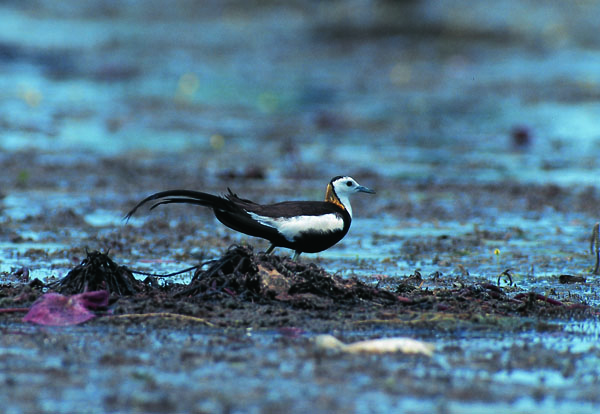
Page 144
Pheasant-tailed Jacana Hydrophasianus chirurgus. Photographed near its nest during the breeding season, and showing its elongated tail and colours. These aquatic birds are common residents and winter visitors, and can be seen in many marshy areas in Thailand. They have very long toes that allow them to walk across floating vegetation. The male takes care of the chicks as they grow up while the female is often mating with another male.
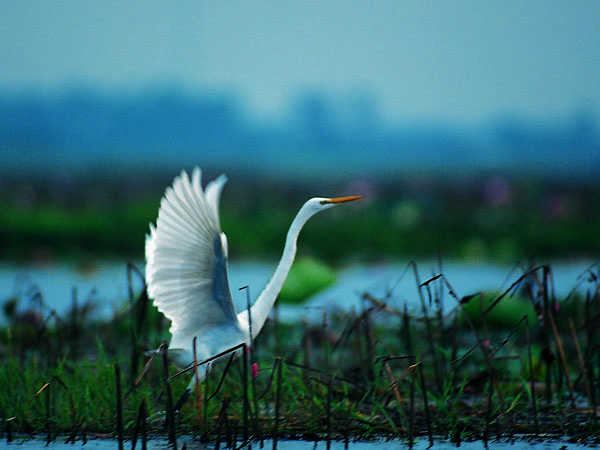
Page 145
Great Egret Egretta alba. This large water bird is lifting off from the central area of the lake. These birds are often seen mingling with little egret, little cormorant and Asian openbill stork. Both resident and winter visitors, they are unmistakable with their large size, kinked neck, yellow bill and black feet. They are uncommon and are seen in only a few reserved areas in Thailand. Once in a while, great egret are seen in open rice fields along Highway 1, north of Bangkok

Page 146
Little Cormorant Phalacrocorax niger. This is the smallest of the three species of cormorant found in Thailand. They are common residents in the central provinces. Excellent swimmers, they dive beneath the surface to catch fish. They fly in a strong direct line with neck outstretched. These medium-sized birds can be seen perched in the morning with wings held away from the body to dry.

Page 147
Cotton Pygmy-Goose Nettapus coromandelianus and Lesser Whistling-Duck Dendrocygna javanica. The three ducks seem to be ganging up on the single goose which flies away just after the photo is taken. Nature as it actually works, where numbers are used to bully a single opponent! Like all duck and goose, these birds have plump bodies and webbed feet. They are excellent swimmers and fly extremely well.
Beung Boraphet is the largest freshwater wetland in Thailand for resident, passing migrant and wintering birds, and is a very important breeding area. The purple swamphen, pheasant-tailed jacana, yellow bittern, cinnamon bittern, black-crowned night-heron, Chinese pond-heron, lesser whistling-duck, little cormorant, great egret, purple heron and little egret, and many other species, thrive here as residents and can be seen all year round. Cotton pygmy-goose and little grebe are also resident but are much more difficult to observe except during their breeding seasons.
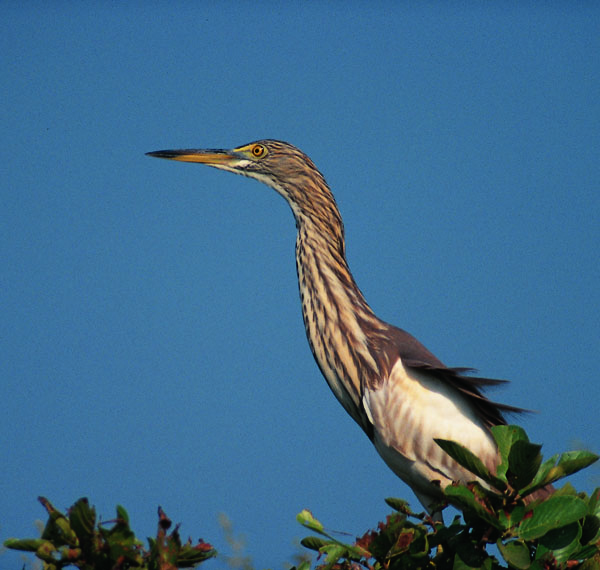
Page 148
Chinese Pond-Heron Ardeola bacchus. This bird is in non-breeding plumage. They are often indistinguishable from the Javan pond-heron out of breeding. These medium-sized water birds are common winter visitors and can be seen all over Thailand. They feed on fish and will wade in shallow water, spearing them with their dagger-like bills.
The comb duck has mostly disappeared from the area. Wintering birds in their thousands used to be observed from October to March, especially species of duck, coot, heron and some stork. Passing migrants and winter visitors that use the lake include, more than a dozen species of very large bird such as purple heron, grey heron, Asian open-bill stork and spot-billed pelican.

Little Egret Egretta garzetta. They are a very common water bird found throughout Thailand and one of 19 species of egret/heron found in the Kingdom. They can be seen feeding on fish in shallow ponds, rice fields and marshy areas.
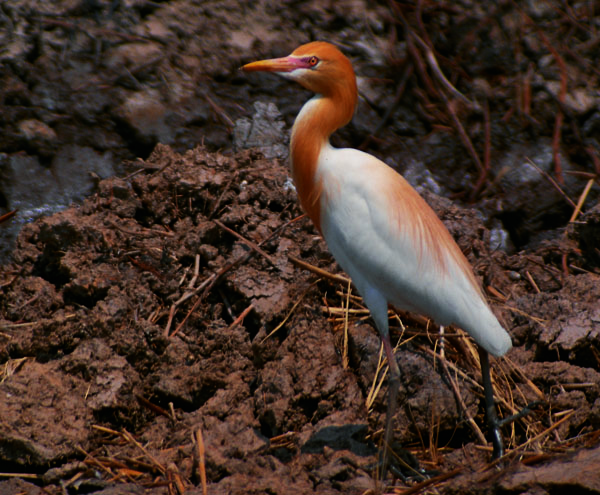
Page 149
Cattle Egret Bubulcus ibis. This bird is in breeding plumage. These gregarious birds normally stay around water buffalo and cattle to feed on insects disturbed by the grazing herbivores.

Asian Openbill Anastomus oscitans. This large stork, a common breeding visitor that returns to Bangladesh during the rainy season. However, many Asian openbill are now resident here in their thousands, nesting in a few large colonies around the central plains, and can be seen morning and evening flying across Highway 1 that runs north from Bangkok. They are among the largest birds here. Of the eight species of stork in Thailand, all of which are highly endangered, openbill are the most numerous. Looking like enormous nutcrackers, their bills are specially suitable to open apple snails and other molluscs for the succulent meat inside. Thai farmers now love them and hardly ever harm or kill them by doing the people a favour by keeping their fields clear of the destructive snails.

Page 150
Common Kingfisher Alcedo atthis. This small bird is a common winter visitor but rare resident. This very small bird typically perches on a branch or rock, then plunges after fish and aquatic animals. Like many other kingfishers, after catching a fish and holding it in its beak, it beats its victim until it is subdued enough to be swallowed.
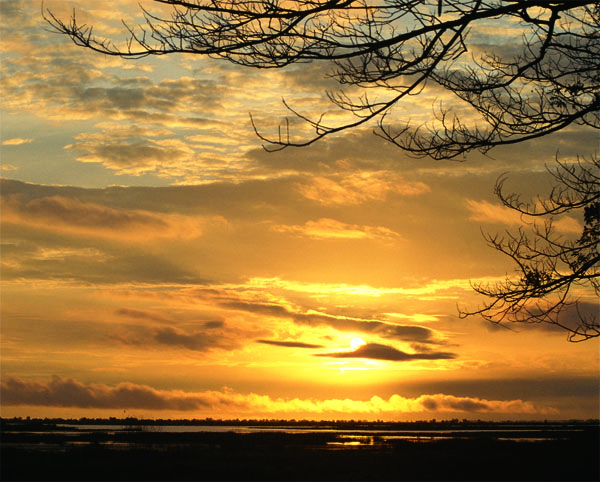
Page 152
Sunrise at Beung Boraphet Non-Hunting Area. This magnificent sanctuary is the largest freshwater wetland for passing migrant and resident water birds in Thailand. Once upon a time, the freshwater Siamese crocodile lived here. But extreme poaching pressure and the conversion of the marsh into a fishery caused its demise. Another former resident, the white-eyed river-martin, received its scientific name, Pseudochelidon sirintarae, in honor of Her Royal Highness Princess Sirinthorn but, sadly, is now extinct in Thailand. The thousands of people that live around the lake, plus a multitude of visitors, are disturbing its wildlife and the balance of nature. Only time will tell how well the lake can survive and whether the continuing disappearance of birds can be checked.
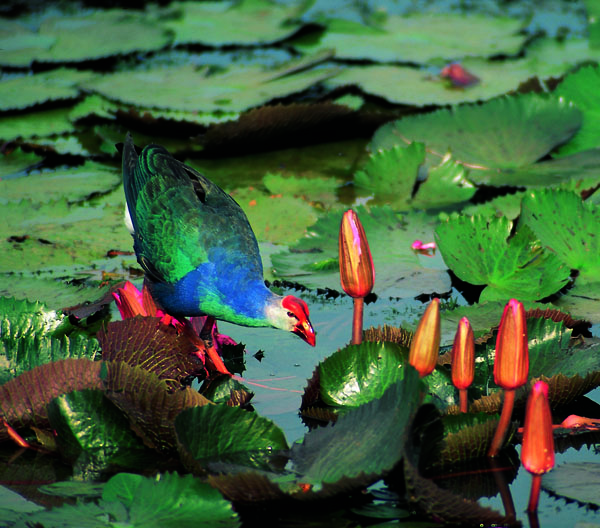
Page 153
Purple Swamphen Porphyrio porphyrio. This is one of the most common birds found here. It can be seen easily, morning and evening, from the road leading to a watchtower by the lake. A large aquatic bird, it breeds and resides here. It has a large red beak and beautiful dark purplish-blue plumage. It has very long toes, which enables it to walk on floating vegetation.
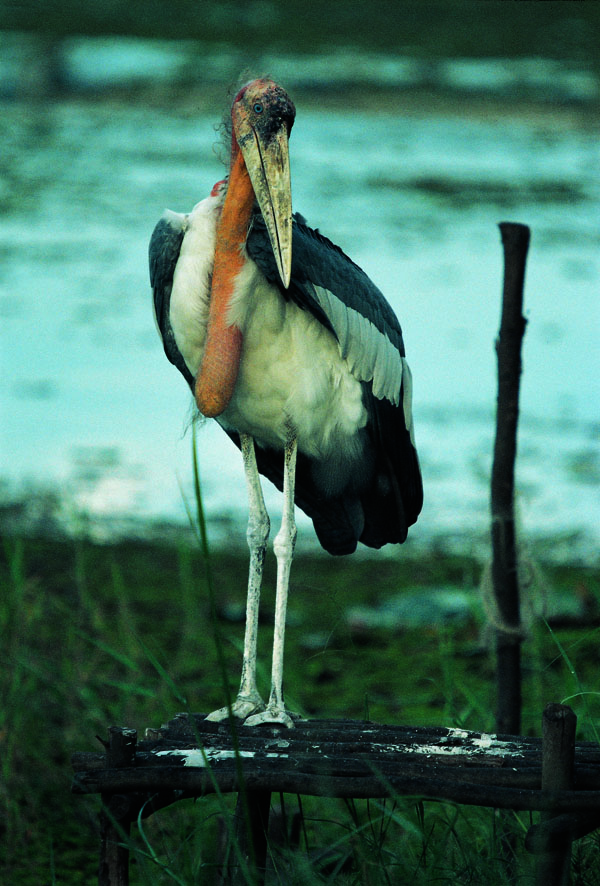
Page 154
Greater Adjutant Leptoptilos dubius. This one was the last of its kind in the wild of Thailand. This bird lived in Beung Boraphet for around ten years. It had been wounded by gun-shot and was unable to leave the area. Unfortunately, the bird was killed by a drunken tourist one night who beat it with a stick when it was found scavenging in the camp ground kitchen. The largest of the stork family, greater adjutant have disappeared from the wild in Thailand but are being bred at a few zoos and captive breeding stations. They are yet another species in the long list of disappearing water birds in the Kingdom.
Spot-billed pelican will stop to rest on their way either to Cambodia or Myanmar but are very wary of all fishing boats and pleasure craft, and are seen here occasionally. For example, 15 or so spot-billed pelican were seen in 1997 but, the following year, none were recorded. They usually do not stay long and leave quickly if harassed. There are a few introduced spot-billed pelican at the boat dock that are free flying. A single greater adjutant that had been wounded lived here for over 10 years but was killed by a drunken tourist one night. The bird was scavenging in the camper’s pots and pans, and he got up and clubbed it with a stick. A sad ending to the last of its kind in Thailand.


Page 155
Spot-billed Pelican Pelecanus philippensis. These two were photographed on the lake in mid-1997. The pair stayed only one day. These birds are now very rare in Thailand. Only 15 birds were reported as having stopped here that year and none stayed long. Of seven species of pelican in the world, this is the only species found here. They are endangered throughout their range. Years ago, huge numbers of these remarkable birds could be seen in Thailand.
The long-term effect on all species of bird and animal that visit Beung Boraphet or are resident here depends on whether the Fisheries Department will take further steps to curb the number of people who use it. There is also a problem with litter, and with discarded fishing nets and traps. Opening up the lake as a tourist destination to hordes of boats and people will just continue to play havoc with nature. It therefore needs some serious management and protection if it is to survive intact.
++++++++++++++++++++++++++++++++++++++++++++++++++++++++++++++
CHAPTER EIGHT
Wildlife Research: The never-
ending search for knowledge of the
natural world

Page 156 – Photo by: Antony Lynam – WCS
Clouded Leopard Neofelis nebulosa. This amazingly marked cat was caught prowling at night in Hala-Bala Wildlife Sanctuary on the border with Malaysia, in Narathiwat province. This very rare photo was taken with a remote camera set up in deep jungle and left for several weeks. These nocturnal and arboreal cats are Thailand’s third largest after the tiger and leopard. They prey primarily on macaque monkeys in evergreen forests and are hardly ever seen. Extremely rare, the clouded leopard is one of nature’s most beautifully marked carnivores.
Wildlife researchers are engaged in a race against time to map natural species in the wild before deforestation and poaching exterminate them. Many government and NGO project personnel in national parks, wildlife sanctuaries and non-hunting areas around Thailand are doing excellent work in this field. These projects focus on endangered species like elephant, wild cattle, deer, tiger, and bat; plus many birds such as hornbill, woodpecker, barn swallow and the Gurney’s pitta, one of the rarest birds in the world. Projects are primarily funded by NGOs, both local and foreign. The Royal Forest Department is also funding wildlife research in many national parks, wildlife sanctuaries and non-hunting areas.

Page 157 – Photo by: Antony Lynam – WCS
Tiger P. tigris corbetti. This huge cat was caught by camera trap in Hala-Bala Wildlife Sanctuary in Southern Thailand. The cat shown here is an Indochinese tiger, slightly smaller than its cousins, the Siberian tiger and Bengali tiger. A mature male, it was also photographed in several other areas of the sanctuary. The top photo on page 160 shows the same cat but at a different place and date. His markings along the lower left flank are unmistakable. The tiger in Thailand is seriously endangered. There may be 250 left, a sad and serious situation.
Notable activities include on-going projects at various national parks and wildlife sanctuaries around the country. Khao Yai National Park has the Hornbill Research Foundation Project and the Gibbon Project, initiated by Dr Pilai Poonswad and Dr Warren Brockelman respectively. In addition, extensive research on wild cattle and other herbivores has been conducted by Dr. Sompoad Srikosamatara and many bird surveys have been conducted by Philip Round. All four of the above are with Mahidol University. Kaeng Krachan National Park was the site of a recent carnivore ecological study where leopard, leopard cat and palm civet were tracked via radio-telemetry by Lon Grassman Jr., an American wildlife ecologist working out of Kasetsart University.


Page 158-159
Leopard P. pardus. A female sambar was killed by a a pack of Asian wild dog near a guard station in Huai Kha Khaeng Wildlife Sanctuary. A forest guard heard the deer being killed one afternoon and went to have a look. After killing the deer, the pack deserted it, which happens when they are disturbed by humans or a big cat. Its young one was also killed and found lying a few meters away. A remote Nikon camera with infrared sensors was set up that evening and left overnight, and then retrieved the next morning. This leopard had been photographed before, and during its many visits that night and appeared unbothered by the flashing strobe. Feeding on the rear end of the sambar, and peeling its stomach like an orange, in order to feed on the intestines, is a common trait among these carnivores. The following day, this cat abandoned the big deer but dragged the young one away to a more secluded place and devoured it.
Some good research has been conducted by using camera-traps in which remote cameras are set up on known trails to photograph passing wildlife. Some remarkable photographs have been taken as can be seen in this chapter. Using this technique, it is possible to map and therefore assess wildlife populations in a given area. Tiger populations can be estimated, for example, by identifying differently marked individuals. This is a necessary research technique to establish wildlife concentrations in the protected areas.
Many species in Thailand are so endangered that continuous surveys of their status should be made. The Asian wild water buffalo and goral are two species that come readily to mind, but there are many others. More funds and personal are urgently needed for these and many other research projects that could be undertaken by foundations, institutions, universities, NGOs and the Royal Forest Department in the never-ending search for knowledge of the Kingdom’s forests and wildlife.
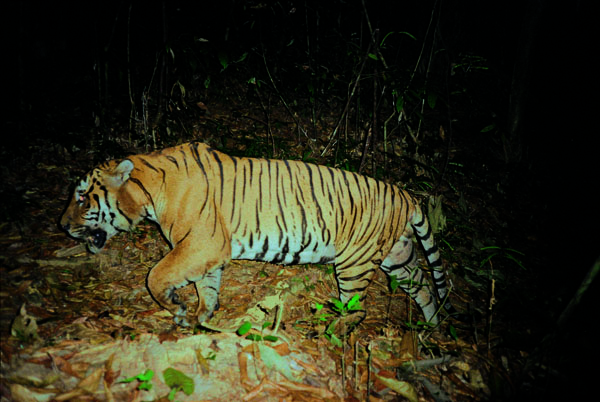
Page 160 – Photo by: Antony Lynam – WCS
Tiger P. tigris corbetti. This cat is the same one camera-trapped on Page 157. This magnificent cat was photographed at a different place and time in a 40 square kilometer research grid area. Stripe patterns, like human fingerprints, are never shared by two individuals and are noticeably different. This allows research scientists to evaluate tiger populations and habits within a given area.

Photo by: Antony Lynam – WCS
Asian Tapir Tapirus indicus. Also known as the Malayan tapir, caught by camera trap in Hala-Bala Wildlife Sanctuary. These large nocturnal mammals are among the prey species of the tiger and leopard. They move slowly while feeding but their sleek bodies allow extreme speed through thick bush when escaping from a predator. Their average weight is 250-300 kilograms and they are strictly vegetarian, eating aquatic or low-growing vegetation and some fallen fruit. Excellent swimmers, they can stay submerged for long periods. Tapir are endangered throughout Thailand due to continued poaching and habitat loss.

Page 161 – Photo by: Antony Lynam – WCS
Sakai Hunter-Gatherer with his blowpipe, photographed in 1998 by camera trap in Hala-Bala Wildlife Sanctuary. The Sakai, an indigenous people whose Malay-derived name is known in Thai as ‘Khon Ngoh Pa’, still survive in this border area which has been their home for thousands of years. Being very secretive and nomadic, usually only their footprints are seen. The Sakai live in complete harmony with nature. Hopefully, in the dense jungle of this southernmost protected area of Thailand, they will continue to survive.
Counting Cats by their Stripes: Written by Dr Antony Lynam – WCS

Photo by: Antony Lynam – WCS
Tiger, camera-trapped in Hala-Bala Wildlife Sanctuary down south near the border with Malaysia. These magnificent cats thrive very well here and are a testament to the Kingdom’s natural heritage. However, the area is compromised by Southern Muslim Separatists and danger is around every corner, and makes travel to and from the sanctuary perilous. I personally never planned a trip here because of the danger.
Precious little is known about the abundance and behavior of the fauna of Thailand’s forests. This is partly because many wildlife species that live in these tropical forests, especially large mammals, are extremely rare, or are difficult to see, or maintain nocturnal activity patterns. Traditionally, researchers would record rain forest fauna only when they could shoot or trap them. Between 1854 and 1862, Alfred Russell Wallace, a pioneer biologist, described literally hundreds of new species from his travels through the Indonesian and Malay archipelagos. Wallace’s methods involved sacrificing and collecting most of the animals he encountered. Other nondestructive methods for assessing wildlife involve recording the signs of animals: their tracks, feces, scrapes, prey kills or other evidence of their presence. Experienced trackers can identify which species are in an area from looking at such signs. Tracking in a rain forest often involves long hours of walking, but the animals themselves are rarely observed in the dense vegetation.
A special technique is now available to rapidly assess the status and distribution of tropical fauna. This technique allows researchers to count wildlife without disturbing their natural activity patterns. The method involves the use of infrared-based camera traps. The camera traps are simple 35mm cameras with infrared mechanisms contained within a weatherproof housing. The traps are tied to trees or logs a short distance from the ground near animal trails or streams. They automatically record any wildlife which cross in front of the beam and imprint the time and day when the photograph was taken. These methods are harmless in that they do not involve capture of animals. The camera traps function without the researcher having to be present. Camera traps can be used to count wildlife, learn about their movement patterns and the times at which they are active, and assess their distribution.
Camera-trapping is especially useful for monitoring cryptic species such as wild cats (e.g. tiger, clouded leopard and leopard cat). This is because the pattern of stripes or spots on a cat is unique to an individual, just as fingerprints differ between humans. The coat pattern can therefore be used to identify individuals. The number of individuals living in a particular area can then be calculated. Care must be taken to use photographs of only left or right sides since coat patterns are asymmetrical.
++++++++++++++++++++++++++++++++++++++++++++++++++++++++++++++
CHAPTER NINE
Zoos and Captive Breeding Stations:
Important educational and
breeding sites for Thailand’s
wildlife

Page 162
Banteng B. javenicus. This bull was photographed in Sadong Captive Breeding Station in Kanchanaburi province. These cattle are highly endangered in the wild but are being bred in several such stations around the Kingdom. This place also has sambar, hog deer, barking deer and wild pig. Large animals in zoos and captive breeding stations make a good starting point for the novice wildlife photographer.
The pressures of modern life mean that the average person has very little time to visit the natural world or to enjoy the country’s zoos and national parks. Many people are not even interested in such things. Tragically, this means that society at large suffers from at least two serious misconceptions about this country’s wildlife.
First, most people seem to have no idea that the country still harbours some magnificent flora and fauna. Because most television programs on wildlife are aired either during the day when few people are home, or late at night when almost everyone is in bed, most people have no idea of the status of Thailand’s wildlife and forests. Most of these programs feature wildlife abroad. Consequently, many people believe there are very few, if any, wild animals left in our forests. They think the wildlife that still exists is found only in zoos and safari parks. And if nothing is left in the wild, why worry about it?

Sambar Stag R. unicorn photographed in Sadong Captive Breeding Station near Salak Phra Wildlife Sanctuary and the lower Sri Nakharin dam in Kanchanaburi province, western Thailand. The sambar’s horns are in velvet.
This is a most damaging belief because it creates a great void of misunderstanding concerning the country’s natural wealth. It is precisely this lack of caring that allows destruction to continue unchecked with almost no consequences for the perpetrators. Only on rare occasions are culprits actually brought to justice for their misdeeds against nature.
A second, equally erroneous but almost opposite belief is that if an animal can be found in a Thai zoo, it must also exist in the wild in Thailand. Someone once asked the author if there were any giraffes or lions in Thailand because they had seen them in a safari park.

Brow-antlered Deer Cervus eldi, also known as Eld’s deer in Doi Suthep Nature Education Center in Chiang Mai. This male can easily be seen with other deer in the grounds. Brow-antlered deer are now extinct in the wild in this country. Several breeding programs for later reintroduction into the wild are underway but none have yet been introduced to any protected areas. These deer have recently been reintroduced into Huai Kha Khaeng Wildlife Sanctuary in Western Thailand and a small herd can be seen here now.
Misconceptions like these are commonplace, especially amongst the younger generation whose free time is so often devoted to modern pastimes that do not include nature and wildlife. Quite clearly, more education and awareness about Thailand’s wildlife are urgently needed. The country’s zoos and breeding stations offer excellent places to start, and they can be stepping-stones to a lifelong love affair with wildlife and the forests. A day spent at the nearest zoo, provided it is well designed and operated, should be on everyone’s calendar as a truly enjoyable outing for family and friends.
Thailand’s public zoos are run by the Zoological Park Organization which was founded in 1954 to look after what was then the country’s only zoo, the Dusit Zoo in Bangkok. It now manages five zoos — at Dusit, Chiang Mai, Khao Khieo, Nakhon Ratchasima and Songkhla.
The most famous of these is still Dusit Zoo (Khao Din) in Bangkok. Established in 1938, it occupies 10 rai (1.6 hectares) of land in Dusit district between Chitlada Palace and Parliament. It attracts 2.5 million people a year, a remarkable figure. A trip to Khao Din with its waterways and superb array of species on show is an experience.

Common Barking Deer within the spacious grounds of Doi Suthep Nature Education Center in Chiang Mai. This station is managed by the Royal Forest Department. The area is quite large and also houses two sizeable herds of banteng cattle, including one very old bull. The setting is very tranquil in the foothills of Doi Suthep next to Wat Umong which also has a forested area where barking deer and hog deer roam.
The next zoo to open in Thailand was the Chiang Mai Zoo. Conceived by an American, the late Harold Young, who was an expert on Thai flora and fauna, having lived in Thailand and Burma before World War II, is nestled at the bottom of Doi Suthep-Pui National Park and has an excellent aviary. This is one of the finest zoos in Thailand. A visit here is a must for all Thai and foreign tourists who love nature and are in Chiang Mai.
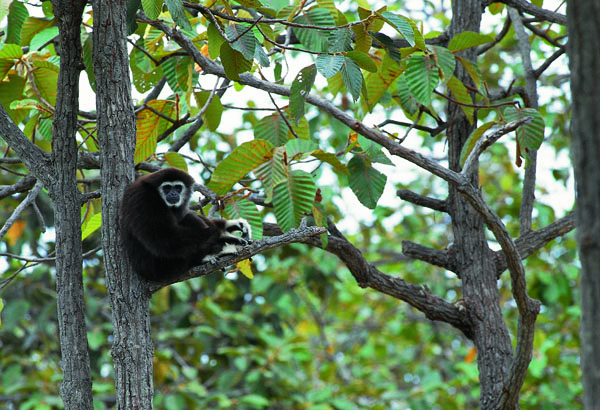


Page 166=167
White-handed Gibbon (top), Common Otter Lutra lutra (middle), also known as the Eurasian otter, and Cinereous Vulture Aegypius monachus (bottom) in the Chiang Mai Zoo at the base of Doi Suthep-Pui National Park. Gibbon are still found in the wild as are otters but their numbers have seriously declined due to habitat loss and poaching pressure. The vulture have disappeared but a few are seen from time to time in Huai Kha Khaeng and else where.. The Chiang Mai Zoo is well-designed, with large enclosures, landscaping, and shade for the animals. It’s a great place to spend the day enjoying nature and wildlife. The zoo offers many opportunities for budding wildlife photographers. A great place to practice.
The Doi Suthep Nature Education Center is managed by the Royal Forest Department and is a couple of kilometres south of the Chiang Mai Zoo. It is actually not all that well-known but it too is tucked into the base of Doi Suthep. In the first of its two enclosures one can see sambar, brow-antlered, hog and barking deer, and other species including many birds. In the other are banteng, the magnificent wild cattle, where two-herds are supported by one old bull. The most amazing thing about them is that they are extremely hard to spot even in this two square kilometer plot.

Page 168
Asian Elephant E. maximus. This shot was taken in Khao Khieo Open Zoo in Chonburi province. History was made when the world’s first captive elephant twins were born here. Elephant are very sociable as is evident from the photo. The father is reaching out with his trunk, over the mother, to the twins in the foreground. This zoo is also a good one for photographing rare wildlife in natural surroundings.
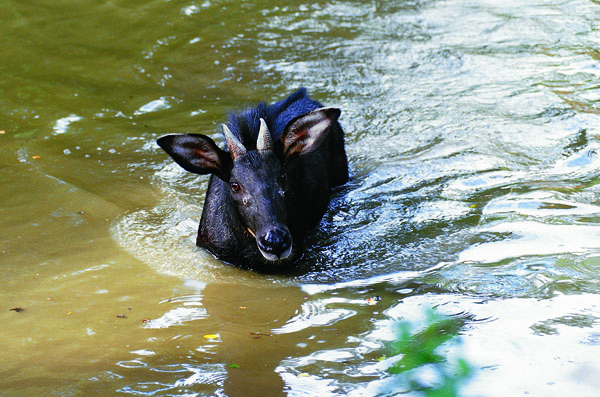
Serow C. sumatraensis in the Dusit Zoo in Bangkok. These goat-antelope are good swimmers and have been seen in the wild, navigating deepwater reservoirs in mountainous areas. Fortunately, they still survive in the wild, but their numbers have declined over the years. The demand for their horns by ‘cock-fighting’ enthusiasts to make daggers for the fighting chickens, and the use of oil from boiled Serow heads has been the reason for the decline.
Khao Khieo Open Zoo, in Chonburi province on Thailand’s Eastern Seaboard, is the country’s largest open zoo. This zoo contains the very rare gaur that cannot normally be kept in captivity. It also has one of the world’s largest aviaries. The zoo has the further distinction of having the only elephant twins in the world to have been born in captivity. The breeding station supports and studies many species. Nakhon Ratchasima Zoo has a breeding program for the sarus crane and has been successful in producing chicks.
Of the Kingdom’s many privately run zoos, the Samut Prakan Crocodile Farm is perhaps the best known. South of Bangkok, at the mouth of the Chao Phraya river, it is the largest such farm in the world. It breeds Siamese crocodile — Crocodylus siamensis, the false gavial — Tomistoma schlegelii, and the estuarine crocodile — Crocodylus porosus. This extremely good zoo also raises other species, such as elephant, tiger and monkey, and attracts many thousands of visitors every year.
In addition to good zoos, another way to further educate the public regarding the Kingdom’s wildlife is through visits to nature education and wildlife captive breeding stations run by the Department of National Parks. At these stations many animal and bird species that have disappeared in the wild are being bred for possible reintroduction into appropriate wildlife habitats. These centres offer special group programs, both for children and adults alike, and are thus suitable for visits by schools, universities and other organizations.
Hog and brow-antlered deer have all but disappeared from Thailand’s wilderness but are being bred in several such stations. Some species like banteng, the wild cattle that still survive in the wild but are endangered, are also being bred. Other mammals such as wild pig, sambar and barking deer are less endangered but, nevertheless, are being stocked for later reintroduction. Birds like sarus crane, greater adjutant and spot-billed pelican, to name but a few, can be found at several stations. Hopefully, sizeable numbers of all these magnificent creatures will again proliferate in the Kingdom’s natural habitats.
Wildlife breeding programs are not without their problems, however. For example, the sarus crane does not breed readily in captivity. Furthermore, many people suspect that reintroduced birds and mammals will not be able to survive long in the wild due to many negative factors such as poaching, encroachment, and interruption of breeding cycles. For reintroduction programs to stand a better chance of success, it is also imperative that substantial attention be paid to saving the forests where, if well-protected, the likelihood of wildlife being able to survive on its own terms will be enhanced.
Without doubt, zoos and captive breeding stations are essential. They educate people while offering fun, excitement and the pleasure of seeing wildlife up close. Other than visiting Thailand’s protected areas, zoos and stations provide an excellent alternative for seeing some of the Kingdom’s fine wildlife. Visiting and supporting important education and breeding centres is well worth the effort.
++++++++++++++++++++++++++++++++++++++++++++++++++++++++++++++
CHAPTER TEN
The Dark Side of Nature: An on-
going threat to Thailand’s wildlife

Page 170
Poachers photographed in a protected area. These men are part of a group of six, five of whom have guns and the other a set of male sambar antlers. On-going poaching of mammals creates a serious drain on the ability of many species to reproduce through natural selection, thus reducing their numbers. This photograph is one of the first of hill-people illegally poaching in Huai Kha Khaeng Wildlife Sanctuary, a World Heritage Site.
One cannot emphasize too strongly the urgent message of this book that the wildlife in the Kingdom of Thailand is under very serious threat from the ultimate predator, man himself. The photograph shown below confirms in unmistakable and dramatic fashion that poachers continue to enter protected areas in search of wildlife. These men were photographed by the author, sitting alone in a photographic blind at a mineral lick within a reserved area. It was a dangerous experience, hopefully never to be repeated.
There are several different levels off poaching, some for food, some for sport, and contract hunting for meat, animal parts, trophies and live animals. Unfortunately, this evil practice by certain individuals, at all levels and sectors of Thai society, who know that hunting, is illegal in protected areas. They continue to hunt personally or entice local people living close to those areas to hunt for them. Usually, well-to-do people with influence supply the locals with guns, ammunition, food, clothing and money this is gladly received. The villagers then travel with these patrons in vehicles, or venture out on their own, to bring down the Kingdom’s magnificent fauna for monetary gain.

Page 171
Forest fire in a protected area. Fires such as this, often started deliberately by poachers, create serious problems for both the Royal Forest Department and the Forest Fire Protection Center units. Putting these fires out early is a must. Sometimes they consume large areas of pristine forest and kill many creatures not able to escape the inferno.
Throughout Thailand, many villagers and ethnic tribes live close or within protected areas. Most of them farm, raise cattle and live off the land as their fore-bearers did for centuries before them. Some of these have been evicted by the government after their area has been gazetted a park or sanctuary. Many of these poor people feel they have a right to use the forest for all it has to offer. It is difficult to blame them for their instinctive need to survive in this fashion.

Forest encroachment in one of northern Thailand’s national parks. Every year, large areas are nibbled away at the fringes of Thailand’s protected areas, that are truly detrimental to the ecosystem and its wildlife.

Page 172
A group of poachers are shown walking into a mineral lick in a wildlife sanctuary. Poaching poses a serious problem in Thailand’s national parks, wildlife sanctuaries and non-hunting areas. Better protection and enforcement by the Royal Forest Department is needed to curb further destruction of the forest and wildlife. More money and personnel is the key but corruption is still and on-going problem and also needs attention.
Poachers use modern and antiquated weapons, snares, traps, pitfalls and poison to bring down wildlife indiscriminately. The black market for tiger and leopard bones, big cat skins, elephant ivory and horns of buffalo, gaur, banteng and antlers of sambar and barking deer is a serious threat to these large mammals. Those poachers seeking trophies regularly move in and out of protected areas, usually taking just the tusks of elephant or the head and trophy of the herbivores. Bear parts and tiger bones are also in big demand for the Asian medicine trade, which continues to threaten these very rare animals. It is common to see wildlife trophies of rare fauna in homes and business establishments around Thailand.
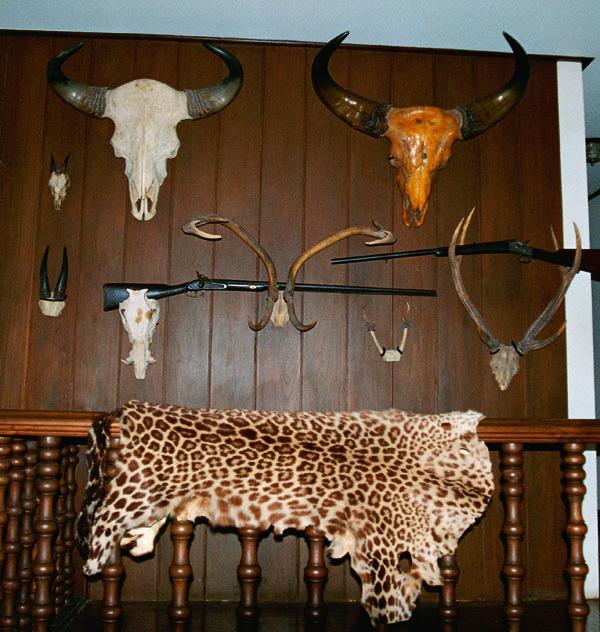
Page 173
Wildlife Trophies. A sad ending for some of Thailand’s magnificent wildlife. They are displayed in homes and business establishments all over the country and are regarded as a status symbol by many. The trophies shown here are of gaur, sambar, brow-antlered deer, serow, goral, barking deer and wild pig. The skin is from a leopard. Most of these species are seriously endangered. The future of Thailand’s innocent wildlife looks very bleak, to say the least. Extreme measures need to be taken to stop those who trade in wildlife trophies.
If all illegal hunting is to be curtailed, the problem needs to be addressed now, before further species disappear. Perpetrators, at all levels, caught in possession of hunting weapons and animal parts should be properly penalized, so much so that the punishment serves as a strong deterrent. All villages in and outside the protected areas should be visited and the people notified of new measures to protect the forests and their wildlife. Continued contact with village officials and patrols, so that designated areas remain poacher free, is of paramount importance. New programs to help villagers find new ways of making an income should be implemented.
Emphasis should be placed on security in protected areas, using dedicated, properly trained groups, similar to the Endangered Species Protection Unit (E.S.P.U.) that operates in some countries in Africa. Wildlife protection units should be established, comprised of men specially handpicked from the Border Patrol Police and the Royal Thai Army Special Forces or Rangers, in conjunction with the Royal Forest Department and the Department of National Parks. These militarized units have the equipment, training, commando techniques, spirit and dedication needed for this difficult task. Detachments should be permanently stationed in areas requiring nonstop protection. Continuous patrols and strict enforcement by such units would greatly restrict poaching. NGOs and government must be prepared to work together and fund programs like this if the wildlife in Thailand is to survive intact into the future.
++++++++++++++++++++++++++++++++++++++++++++++++++++++++++++++
CHAPTER ELEVEN
Wildlife Photography: Techniques
and equipment for wildlife
photographers

Page 173
Chinese Pond-Heron Ardeola bacchussitting. Standing on a tree branch in Sai Yok National Park. Common water birds of medium size, pond-herons can be seen all over Thailand as residents and winter visitors in marshy areas and rice fields. Wading in shallow water, they feed on fish and aquatic animals with their dagger-like bills.
Every wildlife photograph captures a moment in time seldom repeated in the wilderness. In this sense, if an ordinary photo is worth a thousand words, a wildlife photograph is worth a million. Wildlife photography is one of the toughest tests of a photographer. Not only is the subject extremely shy and wary, a fact that makes it extremely difficult to see, let alone photograph, but a whole range of intricately interactive technical issues must also be mastered.
A good photograph combines perfect focus with the right composition and exposure. In the wild, the ever-changing state of light, and sometimes dark and wet conditions, and the thick jungle and forest cover are just the beginning of the technical challenges that must be overcome. The photographer then needs the proper combination of camera, lens, film, support and technique plus a certain amount of luck. Even if the timing is just right, the chances of taking the perfect photo are still slim due to a host of other variables. Understanding nature and wildlife is just another part of the complicated process of acquiring the perfect wildlife image.
The true wildlife photographer takes photos of everything that catches his eye no matter how much film he burns, in the quest for that exceptional image. In this game, the likelihood of taking a perfect picture on the first shot is hugely remote, yet on many occasions in the wild, the single shot opportunity is the only one that presents itself. If all the right conditions drop magically and instantaneously into place, then the shot of a lifetime, the one we have always dreamed of taking, comes along. A wildlife photograph that is sharp and catches the right moment is something of which the owner can be proud. It should be shown to as many people as possible to educate them about the natural world.
In meeting all these challenges, it is essential to have the right equipment. Starting with the camera itself, there are many brands from which to choose. The author’s choice is Nikon. Its system of using the finest quality bodies and lenses, completely interchangeable for more than the past 40 years, speaks for itself.

Page 174
Chinese Pond-Heron. This the same bird as on Page 173 but a few seconds later, showing the bird lifting off from the tree branch. This photograph could never be repeated. A lucky moment of time in the natural world.
Of these two components, the most important single piece of equipment in capturing that stunning image is the lens. If used with proper care and maintenance, it will produce stunning photographs.
For general all-round use, a telephoto 300mm ƒ4 or 400mm ƒ5.6 lens is a good starting point but, if the pocketbook will allow, the more expensive 300mm ƒ2.8 or 400mm ƒ2.8 is even better. Any of these lenses can then be used with a 1.4X or 2X tele-converter to increase their focal length that allows the photographer to get in closer to the subject without in fact moving.
If birds are the subject, a 500mm ƒ4 or 600mm ƒ4 is the lens of choice due to the small size of most feathered creatures. These lenses are of course, very heavy and expensive as is most camera equipment.
Besides telephoto lenses, the wildlife photographer will also need a wide-angle lens for those sweeping, majestic landscapes, plus other lenses for close-up work on flowers, insects and forest view shots. Modern zoom lenses like a 24mm-120mm ƒ3.5-5.6, 70mm-300mm ƒ4-5.6 and the 80-200 ƒ2.8 are great lenses for all-round work and cover a wide spectrum. These zoom lenses can also facilitate good close-up macro work with the right attachments. Fixed focal length lenses are great, but many lenses are needed to cover short to medium focal lengths. For anyone wanting to take a wide variety of wildlife photos, one can manage very well with just two zooms and a 300mm, 400mm or 500mm telephoto with a 1.4 or 2X tele-converter.
After lenses, the next most important camera component is the body. With so many different models to choose from, depending on one’s budget, the choice between a mechanical or electronic body is best left to the individual. The bottom line is to obtain one that suits your needs. Modern electronic bodies allow more precise metering and bracketing (taking several photos at different exposures automatically) while photographing. The mechanical ones are slower and more noisy, but tolerate moisture better. Forests are normally highly moist places that can play havoc with lenses, bodies and film. Nikon bodies used by the author for this book included the FM2, FE, F601, F3, F4, N90s and the latest F5. Proper care and maintenance, plus a spare body or two, are hugely important to the wildlife photographer.
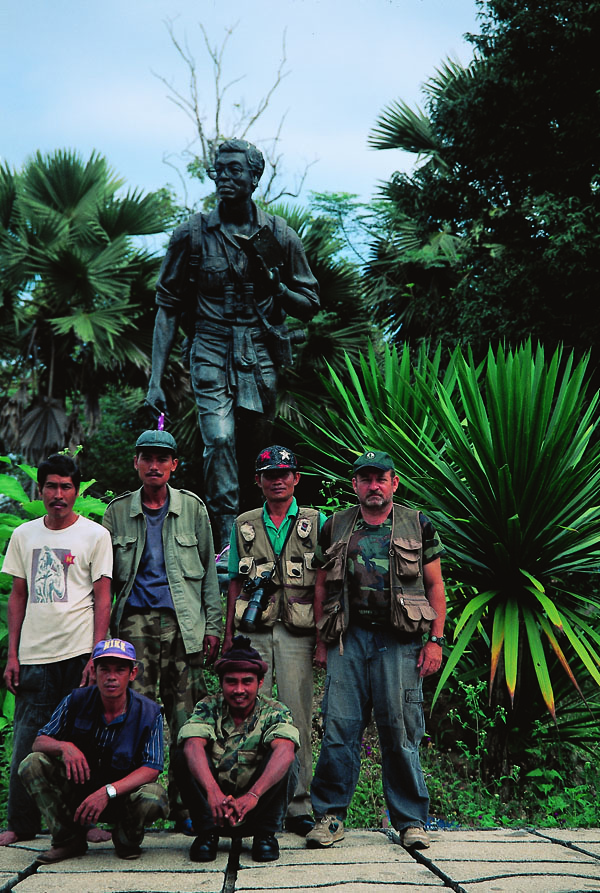
The author with his photographic team at the Seub Nakhasathien Monument in Huai Kha Khaeng Wildlife Sanctuary in Uthai Thani province, and now a World Heritage Site. Seub was one of the original authors in the bid for this status.
Film used by professionals is slide film in speeds from 50 to 400 ISO. Lower-speed films allow sharp photos but are difficult with available light. Higher-speed films are grainy, but give more latitude with exposure. Most of the photos in this book were taken with 100 ISO and some were pushed one or two stops. This push process allows one to gain some speed during low light conditions but requires special lab processing and results in images with a slight loss in sharpness. A technique sometime used is to have two camera bodies loaded with 100 or 200 or 400 ISO film — one set at the standard setting and the other pushed one or two stops for those early morning or late evening shots.
Other essential equipment includes a good tripod and a solid ball-head. These are probably just as important as the camera and lens for without steady support the image will not be sharp. A good flash is also required. Modern TTL (through the lens) programming is often preferred but earlier models can do just as well. Again, this depends on one’s budget. Camera bags are also very important in helping to protect very expensive photographic gear. There are many good brands on the market. Peripheral photographic equipment includes filters, shutter release cables, cleaning materials, etc. Once again, choice is up to the individual.
Another very important aspect of the wonderful world of wildlife photography is proper use of a photographic blind. This allows you to blend in with your natural surroundings. The art of staying hidden while waiting for wildlife subjects to appear is difficult but must be mastered. Most wildlife is extremely attuned to possible danger. Its single instinctive response is to flee immediately.
Probably the single most productive approach is to set up a photographic blind in advance and as close to the subject as possible. Location will be determined by the lay of the land and where the subject is likely to visit, such as a water hole, mineral lick, bird’s nest or den. The blind can consist simply of the black or green netting that is sold in all hardware stores. This is used to make a cubicle with openings for the camera lens and viewing port. A plastic tarpaulin to keep out the sun and rain is draped over the top. The outline of the blind is broken up by using camouflage cloth, tree branches, leaves and grass.
A comfortable seat is important to minimize movement within the blind. Another very good approach is to construct a permanent blind in a tree. This puts the photographer high up and out of most wildlife’s range of vision and scent. A good photo blind is one that allows you to move comfortably within it and operate your camera freely without being detected.

Page 180
The author and his old trusty Land Rover (Series 1-1957) in Thung Yai Naresuan Wildlife Sanctuary in Western Thailand. This vehicle was absolutely reliable and tough to withstand the horrendous road conditions in Thung Yai that were created by 4 X 4 offroad vehicles that entered the sanctuary for excitement and thrills. These groups usually had an influential person on board so entry was easy. It has made it very difficult for the rangers and patrolling as their vehicles are less then, adequate for the rough road conditions. These groups were finally banned from entering the protected area.
The toughest test is to cover your scent as most large fauna like gaur, deer and the cats, can smell you from a long way away. Just a whiff is all it takes. They will move away before you even see them. A technique used by the author is to set fresh gaur dung, when available, around the outside of the blind. These are then agitated often, with a stick to cover human scent, thus making the chance of taking photographs of wary wildlife more likely.
In the blind, subdued clothing is best. Dark green, brown, black or, best of all, camouflage, enables you to remain undiscovered. Some birds’ eyesight is so acute they can detect the blink of your eye as you sit in the blind. The main objective is to blend in, stay hidden and be absolutely quiet.
If you are new to wildlife photography, practice by taking lots of photos close to home. Patience and persistence are two important virtues that must be mastered. Evaluate your ability at zoos and wildlife captive breeding stations before venturing out into wilderness areas and incurring higher expenses. Learn by listening to those who have produced good images; read and study books and articles on the art of photography. These things will all pay off in the long run. Then, when you are ready to venture forth, the only way to acquire that prized wildlife photograph is to get out into the wilderness and shoot lots of film. The more you are out and shoot, the better your chances in the fantastic world of wildlife photography!
++++++++++++++++++++++++++++++++++++++++++++++++++++++++++++++
THAILAND’S PROTECTED AREAS
© David Unkovich

++++++++++++++++++++++++++++++++++++++++++++++++++++++++++++++
Thailand’s Top Twenty
Protected Areas
1) Huai Kha Khaeng WS (Uthai Thani)
2) Thung Yai Naresuan WS (Kanchanaburi)
3) Khao Yai NP (Nakhon Ratchasima)
4) Kaeng Krachan NP (Phetchaburi)
5) Khao Sok NP (Surat Thani)
6) Thap Lan NP (Prachinburi)
7) Salak Phra WS (Kanchanaburi)
8) Phu Khieo WS (Chaiyaphum)
9) Khao Soi Dao WS (Chantaburi)
10) Doi Inthanon NP (Chiang Mai)
11) Phu Luang WS (Loei)
12) Umphang WS (Tak)
13) Om Koi WS (Chiang Mai)
14) Erawan NP (Kanchanaburi)
15) Sai Yok NP (Kanchanaburi)
16) Hala-Bala WS (Narathiwat)
17) Doi Suthep-Pui NP (Chiang Mai)
18) Thung Salaeng Luang NP (Phetchabun)
19) Beung Boraphet NHA (Nakhon Sawan)
20) Thale Sap Songkhla NHA (Songkhla)
++++++++++++++++++++++++++++++++++++++++++++++++++++++++++++++
ACKNOWLEDGMENTS
Wildlife in Thailand has required much support from many people and organizations in the Kingdom. For almost four years, I traveled through many national parks, wildlife sanctuaries and non-hunting areas, photographing the wildlife. Quite a few new friends and acquaintances were made during this period.
The most important people in my life are my immediate family. Sincere thanks go to my wife, Puangpayom (Noi), and my daughter, Marguerite Dalal, along with her husband, Tipp Dalal. Their untiring support throughout this project was truly inspirational to me. They are as much a part of this book as I am.
Niyom Tumtamala, my wife’s younger brother, unselfishly ran our company while I spent many, many months away from the office, working on my project. He is specially thanked.
Sincere thanks go to Dr. Plodprasop Suraswadi, Director-General of the Royal Forest Department for his support. Also, from the RFD, I should like to thank M.R. Bhadharajaya Rajani, Watana Kaeokamnerd, Chatchai
Rattanopas, Charin Itharat, Dr. Viroj Pimmanrojnagool, Dr. Schwann Tunhikorn, Sa-Nguan Tanachaisittikool, Komolchai Boonchai, Dr. Thawatchai Santisook, Dr. Theerapat Prayurasiddhi, Dr. Chaweewan Hutacharern, Witthaya Weerasumpan, Ourb Cherng Sa-ard, Maroot Nilsuwan, Manop Chompoojan, Kriangsak Ketjuntra, Picha Pitayakajornwute, Niwat Jatkanond and Veerawat Dheeraprasart. Also, Patrick Baker, Chris Dickinson, Robert Cunningham and Adrian Hillman, working with the RFD, are thanked for their help in species identification.
George Poole, Waranun Chutchawantipakorn and Sunthorn Teeratamtada are sincerely thanked for their advice and support on cameras, technique and equipment.
Special recognition goes to Kanokwan (Kai) Sansri for her graphic design. She is sincerely thanked for her patience and the long hours spent on a computer.
During the course of producing hundreds of slides and direct prints needed for this book, Green House Photo Lab was a great help. Many thanks to the staff for their friendly and professional service.
Many of the photos presented in this book would not have been possible without the help of the following people living in Sai Yok district, Kanchanaburi province: Prawet Suckjai, Sawad Puangprasert, Sophon Thongpradab, Somboon Siangsai, Tik Sangharoen and Sereechai Tinthong. They were the members of my photographic team. They are true friends and my heartfelt thanks go to them for their patience and support. My sincere thanks and appreciation goes to the contributing photographers listed on page 181.
Phanom Klowjunterc is thanked for his bird expertise during the many trips to Beung Boraphet NHA.
Much appreciation goes to many other people who helped with the book: my old friend of over 30 years, Hardy Stockmann, gave me much publishing guidance; another very good friend, David Unkovich, produced the map of Thailand’s protected areas; Tim Sharp edited the early stages of this book; Mark Standen, advised on production matters; Dr. Sompoad Srikosamatara, Dr. Warren Brockelman and Philip Round, all of Mahidol University; Varavudh Suteethorn of the Department of Mineral Resources; Dr. Robert Mather of World Wide Fund for Nature (WWF-Thailand); Dr. Naris Bhumpakphan and Lon Grassman Jr. of Kasetsart University; Jarujin Nabhitabhata of National Science Museum for all their support.
For his untiring work in editing Wildlife in the Kingdom of Thailand and for his invaluable assistance, I should like to express my grateful thanks to Keith Hardy.
M.L. Birabhongse Kasemsri and Prakas Vacharaporn are sincerely thanked for their inspiration at the very beginning of this book project.
And finally, to all those other people, too many to mention here, who played a part in helping me bring this book to publication, I give my sincere thanks.
L. Bruce Kekule – Bangkok, October 1999
++++++++++++++++++++++++++++++++++++++++++++++++++++++++++++++
BIBLIOGRAPHY
Gray, Denis and Piprell, Collin and Graham, Mark. National Parks of Thailand.1991. Industrial Finance Corporation of Thailand, Bangkok, Thailand.
Henley, Thom. Waterfalls & Gibbon Calls.1996. Thom Henley, Phuket, Thailand.
Lekagul, Boonsong and McNeely, Jeffrey. Mammals of Thailand. 1977. Saha Karn Bhaet Co., Ltd., Bangkok, Thailand.
Lekagul, Boonsong and Round, Philip. A Guide to the Birds of Thailand.1991. Saha Karn Bhaet Co., Ltd., Bangkok, Thailand.
Paine, James. National Parks and Protected Areas Directory and List.1987. IUCN Conservation Monitoring Centre, Cambridge, UK.
Srikosamatara, Sompoad and Suteethorn, Varavudh. Populations of Gaur and Banteng and Their Management in Thailand.1995. Natural History Bulletin. Vol. 43/No. 1. Siam Society, Bangkok, Thailand.
Srikosamatara, Sompoad and Hansel, Troy. Mammals of Khao Yai National Park. 1996. World Wildlife Fund, Bangkok, Thailand.
Askins, Charles. Asian Jungle-African Bush.1959. The Stackpole Co., Harrisburg, Pa, USA.
Balfour, Daryl and Sharna. African Elephants.1997. Struik Publishers (Pty) Ltd., Cape Town, South Africa.
Cox, Merel J. and van Dijk, Peter Paul and Nabhitabhata, Jarujin and Thirakhupt, Kumthorn. Snakes and Other Reptiles of Thailand and Southeast Asia.1998. Asia Books Co., Ltd., Bangkok, Thailand.
Cubitt, Gerald and Mountfort, Guy. Wild India. 1985. William Collins Sons & Co., Ltd., London, UK.
Cubitt, Gerald and Stewart-Cox, Belinda. Wild Thailand.1995. Asia Books Co., Ltd., Bangkok, Thailand.
Ecological Research Department. Endangered Species and Habitats of Thailand.1993. Thailand Institute of Scientific and Technological Research, with Wildlife Fund Thailand, Bangkok, Thailand.
Graham, Mark and Round, Philip. Thailand’s Vanishing Flora and Fauna.1994. Finance One Public Co., Ltd., Bangkok, Thailand.
+++++++++++++++++++++++++++++++++++++++++++++++++++++++++++++

WILDLIFE in THAILAND: A Photographic Portfolio of Thailand’s Natural Heritage – Part Two
++++++++++++++++++++++++++++++++++++++++++++++++++++++++++++++++
CHAPTER TWO
THUNG YAI NARESUAN
WILDLIFE SANCTUARY:
Thailand largest protected area and
World Heritage Site

Page 74
Large Bamboo Rat Rhizomys sumatrensis. These stocky rodents are found in bamboo thickets. They defend themselves vigorously when cornered and have razor-sharp teeth that could easily bite off a finger. These mammals seldom come above ground, living beneath the surface in bamboo groves. Their diet consists of bamboo, young grass, leaves and roots. They are highly prized as food by hilltribe people and are eagerly poached.
Thung Yai Naresuan Wildlife Sanctuary is situated in Kanchanaburi and Tak provinces on Thailand’s western border with Myanmar. At 3,622 square kilometers (1,398 square miles) it is Thailand’s single largest protected area, surpassing both Huai Kha Khaeng Wildlife Sanctuary and Kaeng Krachan National Park. Thung Yai is now a UNESCO World Heritage Site along with Huai Kha Khaeng Wildlife Sanctuary on its eastern border. Also adjoining Thung Yai are Sri Nakharin and Khao Laem National Parks to the southeast and southwest respectively and, to the north, Umphang Wildlife Sanctuary.
Thung Yai gained its status due to the richness of its flora and fauna, and the absolute need to save this vast area from further human destruction. However, a road to the tribal village of Jakae in the northern part of the sanctuary unfortunately traverses it. There is heavy traffic to and from the village, especially during the dry season. A mineral mine near the village has also been active for some time. It is supposedly still operating on a minimal basis. The concession was recently extended for another 30 years.
The sanctuary consists primarily of ‘karst’ mountains which are common to the Dawna-Tenasserim Range. Many rivers and streams divide the area into valleys and lowland plains. Its distinguishing feature is a ‘large central grassland’ (or ‘big field’ as the Thai name ‘thung yai’ means) that once harboured many large herds of elephant, gaur and sambar that roamed here in complete harmony.
Unfortunately, elephant have almost disappeared from the area although passing migrants have been recorded from time to time. There is still a sizeable herd of gaur. However, this is split up into small groups that prefer to remain in the deep ravines during the day. For safety, they only come out on to the plains at night. Occasionally, in May and June, after the grassland fires and subsequent first rains, they can be seen during the morning or evening, feeding on the newly sprouted young grass. Gaur are very shy, and difficult to see or photograph, but occasionally one gets a lucky glimpse of this wild forest ox. These large beasts of the family ‘Bovidae’ stand more than 1.7 meters at the shoulder and weigh up to 900 kilograms for a mature bull. Some very old bulls have been estimated to weigh up to a ton.
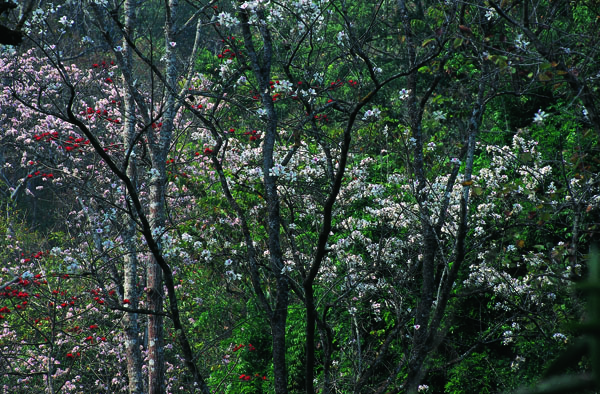
Page 75
Bauhinia erthroelada in bloom near the southern entrance to the sanctuary close to Tee Nuay guard station. This photo was taken in February, when many trees in flower are to be seen, as are many different species of orchids.
There are some banteng, the wild red cattle, in the South-eastern part of the sanctuary, bordering Huai Kha Khaeng, but their numbers are small and they probably move back and forth between the two sanctuaries. Sambar, barking deer, wild pig and serow are common here, and a small area in the western part of the sanctuary supports tapir. With sizeable herds of large mammals as prey species, tiger and leopard can survive. Smaller mammals like the leopard cat, civet cat and porcupine are very common and easily seen along the road at night. The bamboo rat is often heard gnawing away underground in bamboo clumps but is seldom seen. Unfortunately, these large rodents are poached for their meat and are thought to be dwindling in numbers.
There are a few mineral licks in Thung Yai and these are visited by gaur, sambar, barking deer, monitor lizard, plus many species of birds including the mountain imperial pigeon, pin-tailed pigeon and blue magpie, all of which come to take in minerals.
Many other bird species survive here, including the very rare white-winged duck. The crested kingfisher, also rare, has been spotted at some remote forest lakes and along waterways. The sanctuary has many rivers and streams. These include the Mae Khlong, Suriya, Dongwee, Songthai, Tsesawoh and Maekasa, plus many other small tributary streams.
One of the oldest plant species in Thailand, the cycad, can be found in Thung Yai. These beautiful plants were around during the time of the dinosaur and may be seen from the road. Many types of orchid flower here during February and March. One of the most notable is the elephant orchid that can be found in the interior.
Thung Yai’s worrisome traffic along the road is a problem. This definitely affects the sanctuary’s wildlife and ecosystem. The human population at Jakae and the other Karen villages will continue to increase and thus the greater number of vehicles plying the road can only be detrimental to the sanctuary. Litter thrown from passing vehicles along the road and at various stops is also a problem that needs attention.
The Karen villages and the mine are well entrenched. Unfortunately, there is no alternative road nor could one be constructed that would not damage the sanctuary. More and more people are traveling back and forth through Thung Yai, further weakening it.
These are sad but true facts that are adversely affecting this World Heritage Site today and will debilitate it further in the long term if access is not strictly controlled. Many conflicts have occurred and it is hoped that a solution can be initiated where man and nature can live in balanced harmony.

Page 76
Mineral lick in the interior of the sanctuary. Gaur, sambar, barking deer and monitor lizard visit almost daily as do many birds such as pin-tailed, thick-billed and mountain imperial pigeons. Occasionally, tiger will come looking for prey. Many well-beaten trails enter from all directions and crisscross this natural spring.

Page 77
Gaur B. gaurus in late afternon. These two bulls came in from the south and went straight up to the waterhole to drink. Not many photographs of gaur have been taken here. They are extremely wary and this dish-shaped natural deposit with its ever-changing wind currents allows them to scent intruders immediately. I was with a helper in a blind far enough away to hide plus I used gaur-droppings to hide our scent.

Page 78-79
Gaur B. gaurus walking back across the mineral lick. The more mature bull leads the younger one, a common trait among bulls away from the herd. These two bulls are extremely alert for any predators that might be lurking nearby. The two bulls have probably been expelled by the herd bull to live separate lives until breeding time. They will then stick close to a herd, hoping to mate with the females. Fierce fights sometimes take place between the herd bull and outsiders like these two. Occasionally, one gets killed in the process. The author was extremely lucky to have taken these photographs. None have been taken here in recent times.


Page 80
Sambar C. unicolor at the end of the dry season. This stag has shed much of his hair. He also sheds his antlers once a year in March and quickly grows a new set. The antlers are very tender in the first few months, a state known as ‘in velvet’. Sambar are mainly browsers and feed in areas of secondary growth on young leaves, soft buds of shrubs, new grass and fallen fruit. Thailand’s largest deer, they are threatened throughout their range. The bloody patch on the throat of this species is very evident in both photographs. Not much is known about this glandular lesion. All wild sambar have one but it disappears in captive animals. The female is smaller than the male and has no antlers as seen in the lower photograph of two does.
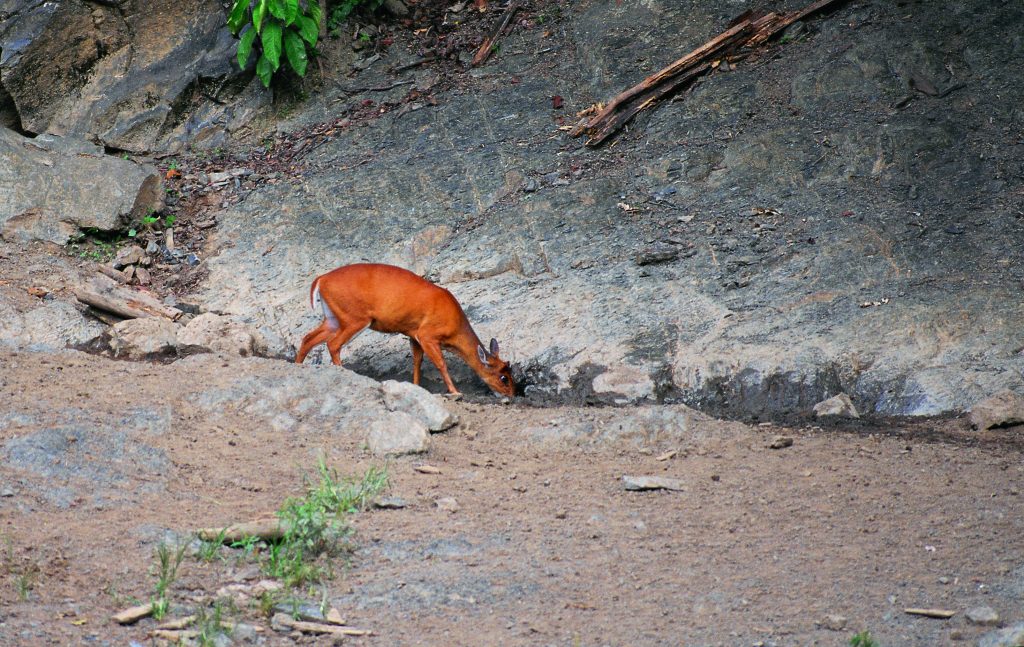
Page 81
Common Barking Deer M. muntjak female taking in minerals. All large herbivores visit mineral licks as a natural part of their life. Many birds also flock here including the little cuckoo-dove, mountain imperial pigeon, thick-billed pigeon and pin-tailed pigeon. Natural alarm birds for mammals are the blue magpie and white-throated kingfisher. They call out loudly at approaching danger as they fly around this mineral lick, alerting all that a predator is close-by.

Page 82
Huai Talursuh. Much wildlife uses the crystal clear waters of this year-round stream as a primary water source. Many of the large mammals in Thung Yai, plus many species of reptile, amphibian, bird and smaller mammal, visit this water source daily. The headwaters flow from a limestone formation just south of the big grassland in the central section of the sanctuary.

Page 83
Scarlet Minivet Pericrocotus flammeusnear close to Talursuh stream. These brightly colored but smallish arboreal birds are common throughout the area. The male is bright scarlet red and the female bright yellow. They feed mainly on insects and build cup-shaped nests in tree forks.

Water Monitor close to Huai Dongwee. This beautifully marked reptile is still young and has been found very close to camp. It eats fish, birds, am-phibians and any carrion it comes upon. Being young, coloration is sharp but will fade as it grows larger and older.
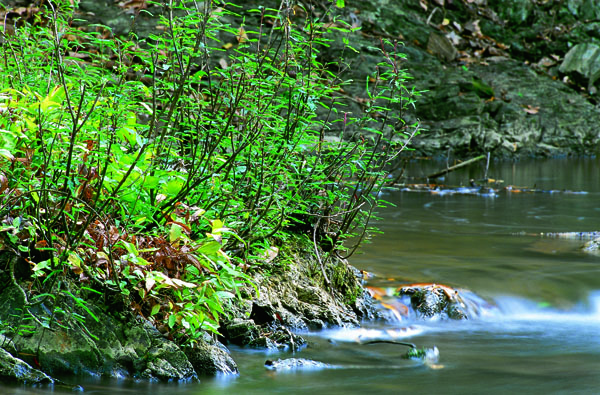
Page 84
Huai Dongwee. This seasonal stream is in the central area of the sanctuary. This waterway harbours the very rare crested kingfisher that is found only along a few streams within the Western Forest Complex. Many other birds use this stream including the hooded pitta, blue magpie, red junglefowl and silver pheasant. Large wildlife such as gaur, sambar, barking deer and wild pig plus tigers and leopards also frequent this stream to drink.
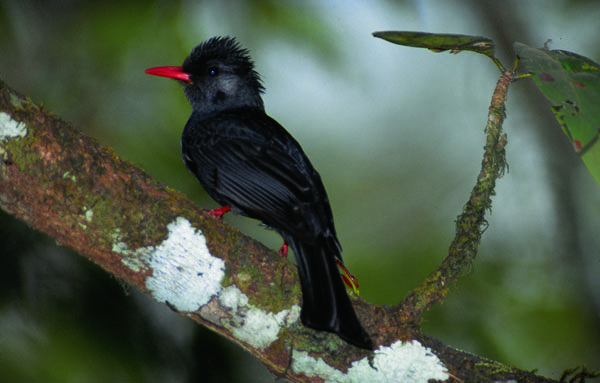
Page 85
Black Bulbul Hypsipetes madagascariensis. This beautiful bird was photographed in the northern section of Thung Yai, at Maekasa Stream. One of 36 species of bulbul, black bulbul are not often seen, however, they are common around this stream. Their main food source is fruit. Flocks of several different species of bird can be seen together in one tree during the fruiting season.


Thung Yai Naresuan Wildlife Sanctuary grassland area. The sanctuary has many majestic viewpoints and offers beautiful scenery. Large mammals like gaur, sambar, barking deer and tiger are seen occasionally in the open spaces. Thung Yai is one of Thailand’s most magnificent natural treasures

Page 86
Ground Gingers Curcuma aeruginosa. These plants are thought to be endemic to Thung Yai, and are common sights during May just after the fires and the first rains. This is also when the tender grass sprouts entice gaur out into the grassland. Occasionally, one can glimpse these wild forest ox in the morning and evening as they graze.
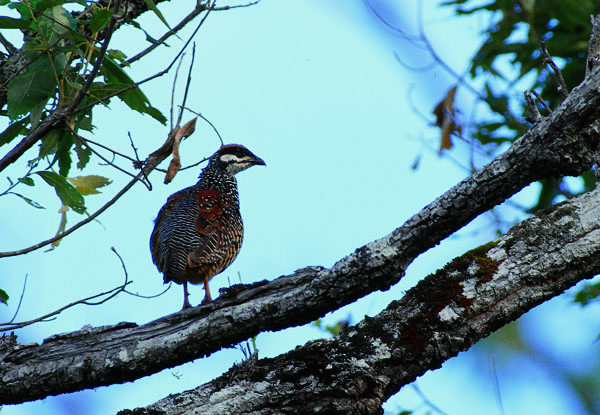
Page 87
Chinese Francolin Francolinus pintadeanus. Of some ten species of partridge in Thailand, this one prefers open grassland and scrub. Its call, “thi-tha-thaak-tha-thaa”, resounding but harsh, can be heard for many kilometers. It is a familiar and unmistakable sound around Thung Yai. Calling from the upper branches of trees, this bird is seldom seen.


Page 88-89
Chao Por Rue Si Spirit House in Thung Yai. This revered and holy place is in the central section along the road at the sanctuary’s highest point. The shrine, built in February 1960, is visited and worshipped by most people that pass by. Legend has it that Chao Por Rue Si is the spirit protector of all forests and animals. In his many trips to Thung Yai, the author always stopped to pay homage and rest at this wonderful place. Unfortunately, it burned down during the rainy season (1997) due to a lighted candle that was left burning carelessly. Amazingly, the statue is still intact. The spirit house is sadly missed by those who loved its serene and mystical beauty. It has since been rebuilt.

Page 90
Limestone outcrop in the central section of the sanctuary close to the road and visible from only one spot. This formation reminds one of a Buddha image. The author is always been arrested by this spectacle whenever he visits Thung Yai.

Page 91
Leopard Cat Prionailurus bengalensison. This small carnivore was on the road in the central section at night. This cat is out on the prowl for prey that includes lizards, amphibians, birds, rodents and mouse deer. Smallest of the wild cats, it will climb trees readily and ambush from above. It is also found in caves where it feeds on fallen bats, swallows and some snakes.

Stream Terrapin Cyclemys dentatain. A small reptile was found in a stream in the central section. This is the smallest of all the species of freshwater terrapin found in Thailand.

Page 92
Green Keelback Rhabdophis nigrocinctus. This little snake in a pond was looking for something to eat. These snakes hunt small lizards and amphibians.

Pope’s Pit-Viper Trimeresurus popeiorum. This is a common snake throughout Thailand. They are extremely poisonous but not that large, usually less than a meter in length. This one was photographed in Thung Yai’s grassland area.

Page 93
Bengal Monitor V. bengalensis. A rather large reptile hunting for prey at a mineral lick in the central sector. This female lizard is full of eggs. The photograph was taken very close to the photo blind. Monitor lizard hunt anything they can catch and are very adept tree climbers. They are also excellent nest raiders, stealing eggs from other reptiles and birds.

Page 94
White-handed Gibbon Hylobates lar. A common primate in Thung Yai close to Maekasa guard station in the northern section of the sanctuary. This particular buff-colored female gibbon came every morning with a black mate to feed on fruit, but the male was extremely elusive. These arboreal creatures usually mate for life.

Page 95
Sapium insigne. This poisonous tree growing in the forest close to the Karen village of Jakae in the northern sector of the sanctuary. It is the dark coloured heavily barked tree in the middle of the photograph, and its sap is highly poisonous. Just minute traces entering the bloodstream can kill a human. Old-time hunters tipped their crossbow arrows with it when hunting large mammals.

Page 96
Red Junglefowl Gallus gallus. This male was beside the road one evening within the sanctuary. They sometimes feed alongside silver pheasant. They are terrestrial birds but can fly very quickly over short distances to escape danger, though they will also run. They feed on seeds, fruit and insects.

Bluebottle Butterfly Graphium sarpedon. These beautiful butterflies were found on the road in the sanctuary near Tsesawoh stream. They are very common and can be seen taking in minerals along the road.

Page 97
Elongated Tortoise Indotestudo elongatanear. This reptile was found near the road in the sanctuary. Land tortoise are creatures of ancient origin. As they usually retreat into their shells when danger threatens, they are easy prey for man. Being extremely slow, they are also vulnerable to fire. However, most animals are easily defeated by the adult’s hard exterior. A remarkable creauture, they are regarded as the symbol of longevity. The saying, “slow but sure”, came from their deliberate but confident movement. The sargent butterfly hitching a ride is of the Nymphalidae family.

Page 98-99
Limestone formation, millions of years old, next to the village of Jakae in the extreme northern part of the sanctuary, highlighting both the permanent and impermanent aspects of Thung Yai. The long-term effect of the village, with its continuing population growth and nearby mining operation, poses a threat to the future of Thailand’s largest wildlife sanctuary. The flora and fauna have been here for thousands of years, long before any humans inhabited the area. Growth of the village needs to be contained, together with limited access to the sanctuary, if man and nature are to coexist in Thung Yai in balanced harmony.
++++++++++++++++++++++++++++++++++++++++++++++++++++++++++++++++
CHAPTER THREE
KHAO YAI YAI NATIONAL PARK:
Thailand’s first protected area at the
gateway to the Northeast

PAGE 100 – Photo by: Phairot Lenavat
Oriental Pied Hornbill Anthracoceros albirostris. Also known as the Indian pied hornbill, they are smaller than the great hornbill. These ostentatious birds with their extremely distinctive “gak-gak-gak-gak-gak” call can be found in evergreen and mixed deciduous forest. Like all hornbill, they are mainly frugivorous (fruit eating) but do take snakes, lizards and various other small animals. They nest in tree holes, and use mud and droppings to reduce the opening while the female raises the young inside the den. If the male food-gatherer is killed, the female and chicks are likely to perish. These forest birds with their huge bills and casques, and their long tails, dominate the forest with their presence.
Khao Yai is Thailand’s longest established national park. Set up in 1962, it is located in the southwest corner of the Korat Plateau, at the western end of the Phanom Dongrak mountain range. One of the Kingdom’s most popular national parks, it encompasses 2,168 square kilometers, with both moist and dry evergreen plus deciduous forest covering about 80 percent of the park. A single paved road runs completely through Khao Yai from Nakhon Nayok province to Pak Chong, Nakhon Ratchasima province. The increased traffic has greatly disturbed wildlife. The park is, however, a popular destination for those people who want convenient access from Bangkok to nature at its best. Thai and foreign tourists visit in great numbers throughout the year.
Several side roads within the park lead to various attractions such as the Haew Narok and Haew Suwat waterfalls, and several mineral licks with wildlife lookout towers. Khao Yai is one of the best places to see elephant, gaur, sambar, barking deer, monkey and gibbon in the wild. Occasionally a tiger is seen here. There are four species of hornbill that are easily seen. Over 300 species of bird have been recorded including Siamese fireback and silver pheasant. Guided tours are available in the park, covering approximately 50 kilometers of marked trails that splay out in all directions from the headquarters area. However, during the rainy season, leeches are a problem but tour operators, offer protective clothing and ointments to ward off the biting invertebrate.
There are 71 species of mammal recorded here including gaur, clouded leopard, Asian wild dog, Asiatic black bear, Malayan sun bear, wild pig, civet and mouse deer. Smaller species such as squirrel and bat are predominant.
In the old days, some 60 years ago, settlers within what is now the park hunted and practiced slash and burn agriculture. This left many open areas that are now grassland. The settlers were eventually evicted after the park was created but there have still been many problems with encroachment and poaching. Most recently, real estate developers have tried to ring the park with a new road along which new properties would be built.
In the 1970s, a golf course and resort was established by the Tourism Authority of Thailand (TAT) in the grassland area. It was quite easy to see wildlife from the links and I was able to play on this course. I lost a lot of golf balls in the dense thickets along the fairways. However, the Royal Forest Department have since closed this down but have allowed development only in the headquarters area. Nonetheless, many developers have encroached on the lower-lying boundaries of the park to build resorts and golf courses. This has had an adverse effect on the local environment and its wildlife. Many people also still live within the boundaries of Khao Yai and it would be extremely difficult to relocate them.
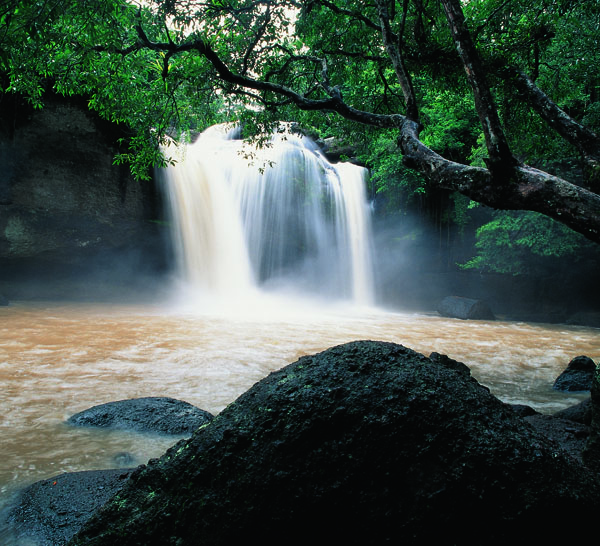
Page 101
Haew Suwat Waterfall. This very popular attraction is visited by tens of thousands of local and foreign tourists each year, either by car or on trail number one from the RFD Kong Kaew headquarters area.
Recently, an NGO worker was killed in a remote area that was known for poaching and encroachment. The man was cut down in a hail of bullets, thus joining the ranks of the many who have perished while trying to save the Kingdom’s forests.
Thailand’s first gazetted national park should be the role model for other conservation areas in the Kingdom. Given this important heritage, increased efforts by those responsible, need to be made to better manage and save the park from continued misuse, poaching and encroachment. The growing number of visitors and vehicles that pass to and through Khao Yai poses a threat to the wildlife that, instead of flourishing, may disappear, little by little. If this were to occur, it would be a sad outcome for the Kingdom’s earliest protected conservation area.

Page 102
Common Barking Deer M. muntjak. This doe is taking in minerals. They inhabit all types of forest and are the most common deer in Thailand. Their distinctive alarm call, like the bark of a dog but much louder, can be heard over long distances. When escaping from danger, they flip their tails erect in alarm. Solitary for most of the year, they form pairs during the rutting season.

Page 103 – Photo by: Saman Khunkwamdee
Asian Elephant Elephas maximus. It is uncommon to see elephant along the road during the day, but they can occasionally be seen at night with a spotlight. The Royal Forest Department operates night tours from the Kong Kaew headquarters area. Such tours allow one to see nature at work during the night and do no great harm if limited to only a few vehicles. Unfortunately, recently, it has become quite a tourist attraction and traffic jams are a common occurrence.

Sambar C. unicolor. This herd, including the stag and his harem of hinds, was photographed very close to the Kong Kaew headquarters area. The large-billed crow is feeding on ticks off the stag’s shoulder and the red junglefowl is feeding on insects disturbed by the grazing deer. At the time of this photograph, there were 19 animals in the herd separated into two groups. These largest of the deer family in Thailand are common here and can be seen quite easily from the road in the morning and evening as they graze in the grassland.
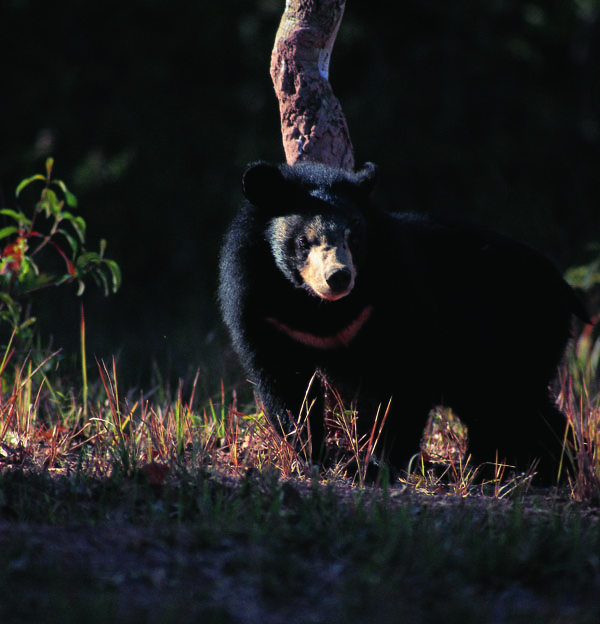
Page 105 – Photo by: Saman Khunkwamdee
Asiatic Black Bear Selenarctos thibetanus. This bear was strolling on the old golf course that the Tourism Authority of Thailand (TAT) once operated along with resort facilities and a restaurant. This open grassland is the result of slash and burn agriculture that occurred more than 60 years ago. Bear are rare in Thailand due to poaching for their paws, which are used in an Asian culinary dish, and for their bladder, which is used in medicines. These nocturnal and sometimes savage beasts are fast and agile. They can inflict terrible wounds on an attacker. They feed on fruit, buds, invertebrates, small vertebrates and carrion. When erect, the distinctive white vee marking on the chest stands out against the black pelage. This is a rare photo of one of Asia’s two bear species, the other being the Malayan sun bear, the smallest bear in the world.

Photo by: Saman Khunkwamdee
Siamese Fireback Lophura diardi.This beautiful male gallopheasant shows its magnificent colours. These extremely rare birds are difficult to see let alone photograph. Their range has been drastically reduced due to habitat loss. They are endemic to southeast Thailand and northwest Cambodia. Slimmer than the red junglefowl or silver pheasant, their habits are much the same. They nest on the ground and feed on seeds, fruit and insects.

Page 106 – Photo by: Saman Khunkwamdee
Siamese Fireback L. diardi. This gallopheasant is a female and has black and buff bars on wings and tail. The species is now quite rare, but can still be found in Khao Yai’s evergreen forests. Pheasant are normally very quiet but make noisy, wing-whirring displays.

Page 107
Clerodendrum paniculatum. This flowering plant can be found along side the road to Haew Suwat waterfall, and is common throughout the park during the rainy season. This flowering plant stands out against the green foliage.

Photo by: Saman Khunkwamdee
Greater Flameback Chrysocolaptes lucidus. Known also as the greater golden-back woodpecker. Their range and habitat are the same as the greater yellownape. They inhabit deciduous and evergreen forests. Like many other woodpecker, greater flameback drum with their beaks while perched vertically on a tree. They nest in cavities, usually excavated in trees, and are common residents in the forested areas of Thailand.
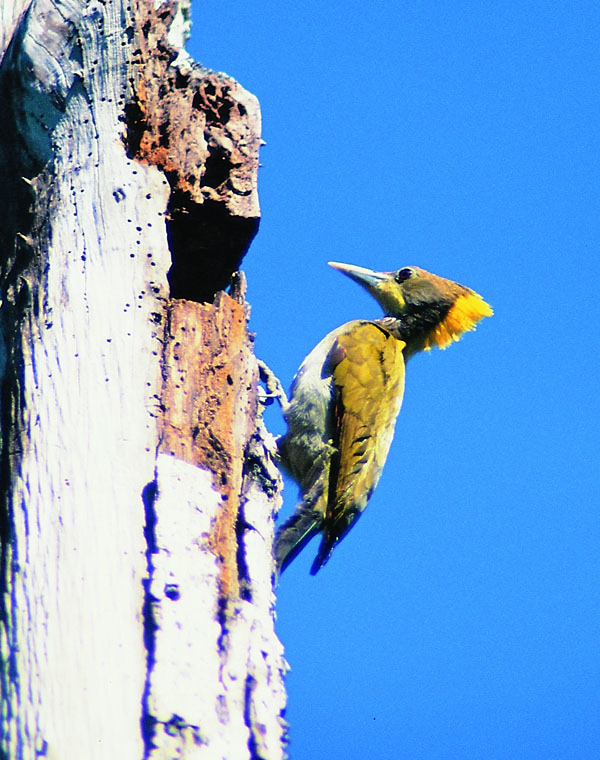
Page 108 – Photo by: Saman Khunkwamdee
Greater Yellownape Picus flavinucha. There are 36 species of woodpecker in Thailand, many with beautiful crests like this bird. Woodpecker are arboreal and usually cling to trees using their stiff tail feathers and sharp claws. They use their strong beaks to lift tree bark in order to reach insects underneath, and to drill holes when making their nests.

Photo by: Saman Khunkwamdee
Green-billed Malkoha Phaenicophaeus tristis. This mature bird is feeding its chick with what appears to be a grasshopper. The chick has narrowly escaped being taken by a monitor lizard, hence the wound to the neck. An unusual instance in nature where the weaker animal survives and the stronger one loses out.
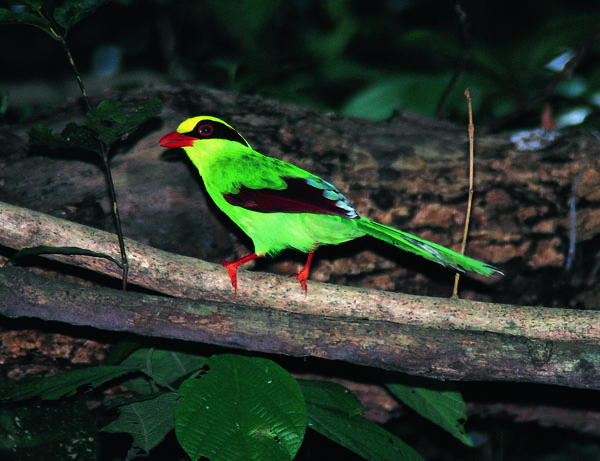
Page 109 – Photo by: Saman Khunkwamdee
Green Magpie Cissa chinensis. These beautiful coloured birds can be found on the forest floor foraging for insects. This beautifully marked, very noisy and gregarious bird lives in evergreen and deciduous forest. They construct a flimsy, cup-shaped nest. Its red bill, red feet and black eyepatch stand out against its striking chestnut-red wing and bright apple-green plumage.
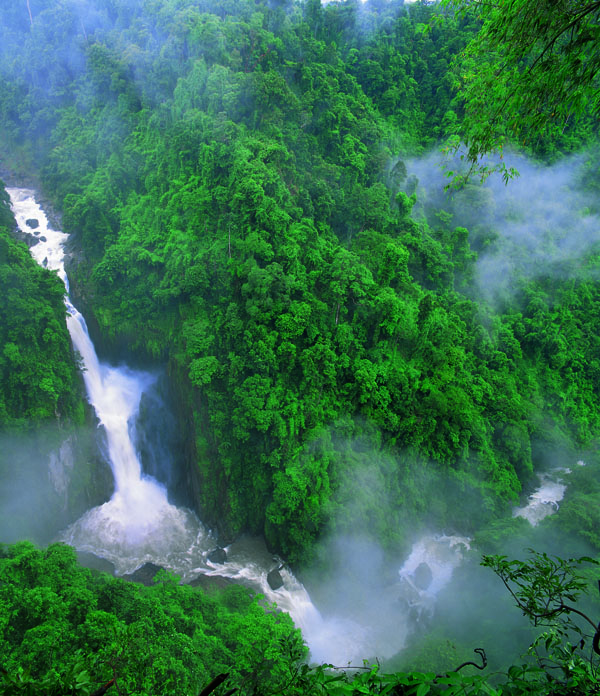
Page 110 – Photo by: Boonmee Thanomsuksan
Haew Narok Waterfall in the rainy season. It is Khao Yai’s most impressive waterfall. These falls have a reputation for dispatching elephant that try to cross upstream and are swept away by the powerful current.
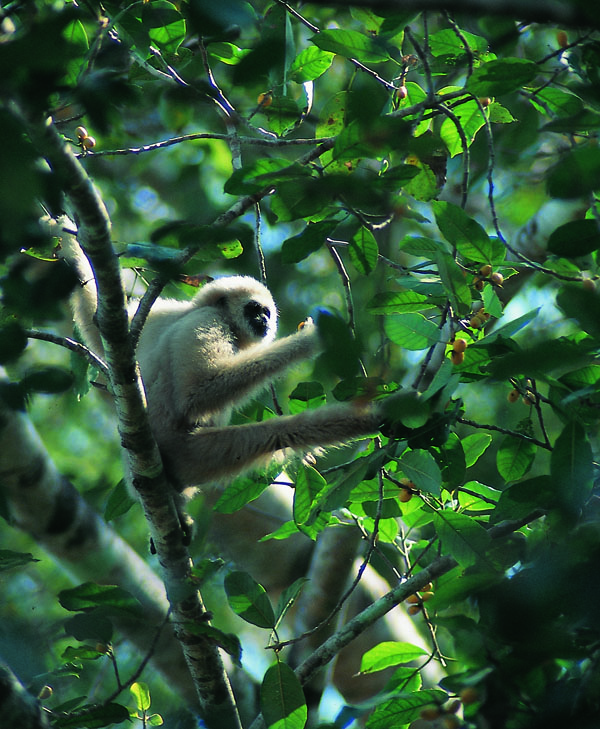
Photo by: Saman Khunkwamdee
White-handed Gibbon H lar. Living mostly in tall trees in evergreen forest, their whooping call as the sun comes up is unmistakable and can be heard from great distance and on most days in Khao Yai.

Page 111
Pig-tailed Macaque Macaca nemestrina. Thee primates are easily seen by the road to the Kong Kaew headquarters area. They are common throughout the park and, usually begging for food from passing motorists. Feeding forest animals is prohibited, but often occurs. Animals become quite dangerous as a result. This female’s pouch is full of food she has collected. She will chew it thoroughly later. Macaque are omnivorous and eat fruit, seeds, buds, insects, lizards, frogs, molluscs and crabs.
++++++++++++++++++++++++++++++++++++++++++++++++++++++++++++++++
CHAPTER FOUR
KAENG KRACHAN NATIONAL PARK:
A vast, relatively undisturbed
conservation area and Thailand’s
largest national park

Page 112 – Photo by: Boonmee Thanomsuksan
Serow Capricornis sumatraensis. This fairly large goat-antelope with long legs in proportion to its body, sharp black horns that sweep upwards and prominent glands below the eyes. Serow have black to grayish coarse hair along their short, thick bodies. These sure-footed Caprinae inhabit steep limestone mountains and cliffs, sheltering in caves. All their senses are acute, their eyesight especially so, which makes them difficult to observe. As long as there is sufficient moisture that they get from the vegetation they eat on the limestone bluffs, they are fairly safe from poachers.
Situated some 150 kilometers southwest of Bangkok in Phetchaburi province, Kaeng Krachan, at 2,915 square kilometers, is the Kingdom’s largest national park. Gazetted in 1981, this tremendous place contains mostly pristine tropical broad-leaved evergreen forests on extremely steep mountains in the Tenasserim Range. Most of its terrain is so inaccessible that it is still largely unexplored, especially along the border with Myanmar. This is a great area for bird watching and some 250-bird species have been recorded. Greater and pied hornbill is quite common here. Another rare bird seen quite easily here during the breeding season is the great slaty woodpecker.
About 40 species of mammal, including elephant, gaur, tiger, leopard, sambar, barking deer, serow and tapir, can be found here. Fea’s barking deer is extremely rare now in Thailand, and still reported in the interior of Kaeng Krachan. There have been unconfirmed reports that the Sumatran rhinoceros may still exist in the remote areas but this is now doubtful. None have been seen recently, but park staff claim to have seen footprints. These very rare mammals are extremely elusive and cover large areas making it difficult to see them. About 50 years ago, a report one was killed by a local Karen tribesman, in the interior. An extensive survey should be undertaken to determine whether they are here or not. There is a tremendous conservation area next door in Myanmar and if they do exist, they would most probably move back and forth across the border.
Like all conservation areas in the Kingdom, this vital watershed area has not been without problems. However, most of the damage has occurred at lower elevations where local Thais and Karen people have stripped away the forest to grow pineapple, papaya and other cash crops. These forests are mixed deciduous and lowland scrub, mostly in the eastern fringes of the park. The park headquarters area is situated on the Southeastern shores of the Kaeng Krachan reservoir that is the primary water source for lowland farmers.
A single 36-kilometer road enters the park at Khao Sam Yot and goes all the way up to Phanoen Thung mountain trailhead. This road can be very difficult to negotiate during the wet season and is sometimes closed during this period. There are very strict times for vehicles traveling up or down as the dirt road is steep and narrow in places, especially after Ban Krang, the halfway station. The 18-tier Thor Thip waterfall is a good three-hour walk from the 33- kilometer marker through some very steep forests. There are a few trails to the interior but hikers, must be accompanied by park rangers. This can be arranged at Phanoen Thung station.
One could surmise that Kaeng Krachan would be fairly safe in the long term due to its size, inaccessibility and strictly controlled areas. However, poaching does occur in some places. This needs to be addressed. Kaeng Krachan is a magnificent national park, only a couple of hours away from Bangkok. With the opportunity to see much of Thailand’s most beautiful flora and fauna, it should be on every naturalist’s list of places to visit.
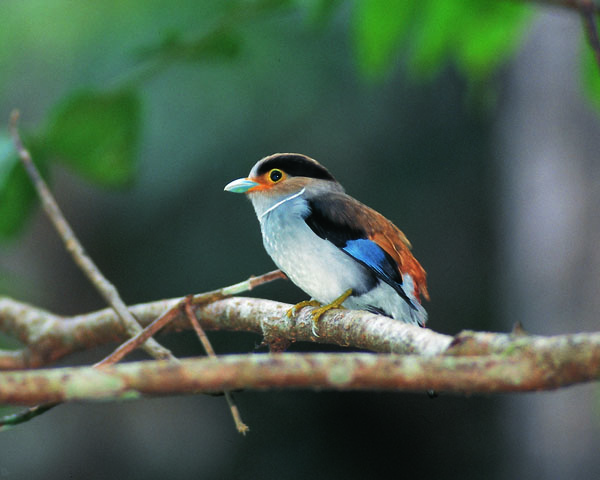
Page 113
Silver-breasted Broadbill Serilophus lunatus. This photograph was taken during the breeding season, on the road up from Ban Krang guard station. The thin silver necklace shows this bird is female. She is nesting. This wonderfully coloured bird species is very common here.

Greater-racket-tailed Drongo Dicrurus Paradiseus. These chicks, having outgrown their nest, and left the next day. The adult bird has beautiful elongated tail feathers that flitter as they fly. Of all the seven species of drongo found in Thailand, all have black plumage except the Ashy drongo which is slate gray. The greater-racket-tailed drongo has a very pronounced crest on its head. It is a prodigious mimic which can imitate the call of other birds, especially the blue-winged pitta and green magpie. It hunts from a perch and feeds on insects caught on the wing.

Page 115
Green Magpie Cissa chinensis. This female is on her nest during the breeding season. These beautiful birds are easy to see at this time as they build their flimsy nests around Ban Krang guard station. Out of the breeding season, however, they are difficult to observe.

Page 116
Common Tree Frog Polypedates leucomystax. This pair are spawning next to the road. They are so involved in their activities that the author is able to approach quite close. The female, clinging to a branch that overhangs a pool of water, produces hundreds of eggs, which the male fertilizes with sperm while they drop into water, eventually to become tadpoles. The male frog is smaller and darker than the female and, once fertilization is complete, it will leap off her back.

Photo by: Saman Khunkwamdee
Large Indian Civet Viverra zibetha. This female civet was photographed at night near Ban Krang guard station. This medium-sized carnivore is common throughout Thailand but, like the porcupine, is hunted for its meat. Civet breed twice a year. This female, heavily pregnant, is looking for a meal.

Page 117
Malayan Porcupine Hystrix brachyura. These rodents come at night, close to Ban Krang guard station looking for food scarped. This nocturnal burrowing animal’s natural diet consists of roots, tubers, bark and fallen fruit. It is common here, but heavily poached for its meat. Any tiger that attacks it may become permanently maimed as the porcupine’s quills can perforate the tiger’s paws and chest.

Page 118 – Photo by: Boonmee Thanomsuksan
Hill evergreen forest in Kaeng Krachan. This moss-covered stream is near Phanoen Thung mountain trailhead and is visited by many small animals like tiger, civet and porcupine.

Great Hornbill Buceros bicornis. One of Thailand’s largest birds, photographed in the lower branches of a tree near Ban Krang guard station. These large birds are very common in the park, along with their cousin, the oriental pied hornbill. The female, nesting in a tree hollow, stays with her chicks from the moment they are born until they are ready to fly. In flight, this species make a loud swishing noise. Hornbill are poached mainly for meat, and their bills are used as ornaments.

Page 119 – Photo by: Phairot Lenavat
Great Slaty Woodpecker Muelleripicus pulverulentus. These birds are the largest of the ‘Old World’ woodpeckers and are rather plain-looking unlike other brightly coloured woodpecker species. Found in only a few of Thailand’s forests, their remarkable call, a sort of whinnying or braying sound, is readily heard, though the birds themselves are rarely seen. They have very strong beaks like other woodpeckers, but do not drum looking for insects.
+++++++++++++++++++++++++++++++++++++++++++++++++++++++++
CHAPTER FIVE
SAI YOK NATIONAL PARK:
Hidden beauty in western Thailand
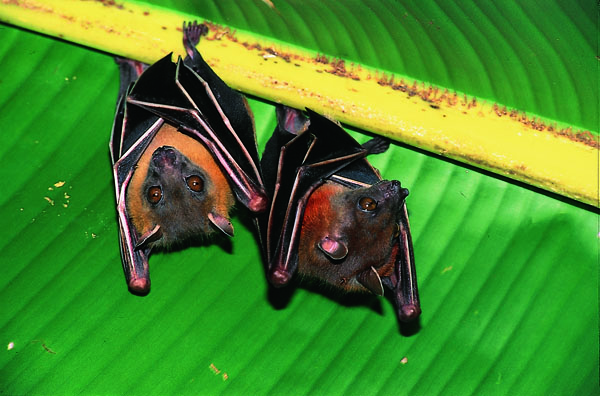
Page 120
Lesser Short-nosed Fruit Bat Cynopterus brachyotis. One of 109 species of bat in Thailand, this fruit eater also takes pollen and insects. They roost almost anywhere — in trees, under the eaves of houses, in caves, and under palm and banana fronds. This species is very common throughout the Kingdom.
A part from its popular waterfalls and river trips, this national park is not that well known. Situated in Kanchanaburi province, along Thailand’s western border with Myanmar, its interior is truly a magnificent wildlife paradise. It may not remain so for long, however, as poaching and forest encroachment continue unabated. The headquarters of the park is at Sai Yok Yai (big Sai Yok) waterfall, about one hundred kilometers upstream from Kanchanaburi on the Khwae Noi River. This area is visited by thousands of local and foreign tourists every year. They come to see this waterfall and the smaller Sai Yok Noi waterfall, both of which are only a short distance off Highway 323, going north. Activities on the river include swimming, rafting and boating.
Deep inside the park, however, the world’s smallest mammal, Kitti’s hog-nosed bat, is found in just a few caves along the remote Mae Nam Noi River. This creature is endemic to the area and probably neighbouring Myanmar. The bat weighs barely two grams. Aptly, it has been called the bumblebee bat and has an average wingspan of just three inches. It uses sonar to forage for insects during short periods each night — about 20 minutes — in the evening and again just before dawn. Its numbers are so small that it is highly endangered. This remarkable mammal has in fact been listed as one of the world’s twelve most endangered animals.
Also found in this same area is the ‘regal crab’ or ‘queen crab’, known locally as the ‘three-coloured crab’. With their white body, purple stripe down the back, and red legs, regal crab are truly a pretty sight. They live like most crab, in holes, which they dig along the banks of the Mae Nam Noi River. They come out at night to forage for food. Now small in number, this is yet another species that is seriously endangered and needs protection. Fortunately, the locals in the Mae Nam Noi district have stopped eating them since they were named after Her Majesty Queen Sirikit. They are now protecting the few crab that are left. This is a case of true conservation. Hopefully, the species will survive.
Elephant, gaur, tiger and leopard, plus many other species still survive here, but their numbers are dwindling. Sambar, serow, barking deer, tapir and wild pig are here too and constitute the main prey species for the tiger and leopard. Asian black bear and Malayan sun bear plus many smaller species like civet, porcupine, gibbon and monkey are all here but they too are threatened.
Like most national parks in Thailand, Sai Yok is a target for poaching and logging which seem to go hand in hand. Most of the wildlife is hunted for trophies and meat, primarily during the dry season when there is good road access. It is common to see poachers in the park, cruising along the roads in vehicles or on motorcycles, with long guns for all to see.

Page 121
Kitti’s Hog-nosed Bat Craseonycteris thonglongyai. The world’s smallest mammal, these little creatures live along the border with Burma in Thailand’s Western Forest Complex. Sai Yok National Park is one of 18 protected areas in the complex. They roost in total darkness, deep within a few caves along the Mae Nam Noi river. They are very rare and extremely endangered.
Illegal logging has been carried out along the Mae Nam Noi and Mae Nam Lo rivers. This has seriously eroded their banks. Consequently, during the rainy season, the area is extremely dangerous due to the tremendous power created by the torrential flow of water. Other forms of encroachment include cattle and buffalo corrals that are set up deep in the forest where fodder is easily available. Constant poaching and encroachment is affecting the status of the park’s wildlife and watershed.
The forests at Sai Yok are mostly tropical broad-leaved evergreen with much bamboo and mixed deciduous woodlands in the foothills. The highest peak, Khao Khewa, at 1,327 meters above sea level, is part of the Tenasserim Range that runs through the park from north to south. The area was formerly logged so the park has many thin patches where big trees were felled. However, heavy brush continues to grow back strongly in these areas.
During the height of the rainy season, between July and October, the wildlife in Sai Yok roams and feeds fairly safely due to the rough weather and the almost impenetrable terrain. The rivers and streams in the area become raging torrents that make crossing next to impossible. About the only way in is by motorboat, with a very skilled operator, near the beginning or end of the rainy season in June/July or October/November respectively. Many a boat and raft has been washed away in rapids on the Mae Nam Noi and Mae Nam Lo rivers. Occasionally, 4×4 off-road vehicles become stuck in the park after heavy rain. Some have even had to wait until the dry season to get out. Elephant love those vehicles left behind and will rip them apart for fun.
Another very important aspect of Sai Yok is that some gaur and elephant come across the border from Myanmar to feed on bamboo shoots in August and September, and then return to the safety of the other side prior to the dry season. Equally interesting, there are unofficial reports that a hybrid cattle, possibly a cross between gaur and banteng have been seen by locals. The numbers of all animals are dwindling, however, due to increased activity in the park. Just a decade ago, green peafowl could be found here but they have been neither seen nor heard for several years. The ever-shrinking wilderness area of Sai Yok is under a threat that must be addressed if its flora and fauna are to survive intact.
The future of Sai Yok as one of Thailand’s most beautiful and important national parks depends in great measure on the Department of National Parks and the Royal Forest Department, and their ability to enforce the law. Reportedly, greater efforts are being made to protect the park. Some poachers have recently been arrested but such campaigns can be difficult to sustain. The long-term effects will become clear over time. It is to be hoped that this magnificent wilderness and its wildlife will survive. In particular, the home of the world’s smallest mammal needs serious attention and protection. It would be sad for Thailand if this prestigious mammal were to be lost to the world forever.


Page 122-123
Regal Crab Thaiphusa sirikit. These fresh water crabs have just been recently found species of Thai crustacean, and is endemic to the Mae Nam Noi River in Sai Yok. Unfortunately, these beautiful little creatures are endangered. However, since being named after Her Majesty Queen Sirikit, the local people are now protecting them. Hopefully, they will survive. But their future also depends on how much of their habitat will survive. Severe erosion along this river and its tributaries threatens the species.

Page 123
Mae Nam Noi. This river is home to the Regal Crab and Kitti’s hog-nosed bat, not far from where the waterway joins the Khwae Noi River, close to RFD park headquarters. This gateway to Sai Yok’s beauty needs to be carefully guarded if the park and its wildlife are to survive into the future.


Page 125
Crab-eating Macaque Macaca fascicularis. Thses two primates were photographed by the Mae Nam Lo River in the southwestern section of the park. A troop of some 15 macaque came down to drink and feed on berries. They have the longest tails among the five species of macaque found in Thailand. They exhibit two color phases, grayish-brown and reddish, depending on age, season and location. They enjoy water and are expert swimmers. Their diet consists of fruit, seeds, buds, small reptiles, amphibians, molluscs and crabs. Like most primates, they continually groom each other, searching for pieces of dried skin, loose hair, ticks and fleas

Long-nosed Whip Snake Ahaetulla nasuta. This long, thin snake can actually stretch itself as it moves through the trees. Photographed on the Mae Nam Lo River in the southern section of the park, it’s a rear-fanged snake and slightly poisonous. Its diet consists of birds, amphibians and other reptiles.

Asian Barred Owlet Glaucidium cuculoides.These nocturnal birds are rarely seen in broad daylight but, occasionally, they come out looking for prey, late in the day. Of Thailand’s 19 species of owl, the Asian barred owlet is among the smallest and found almost everywhere in Thailand. Their diet consists of other birds, rats and mice, plus other small animals.

Page 126
Waterfall on the Mae Nam Noi River, close to the park headquarters. Most visitors do not get this far, but occasionally some do. A series of limestone caves in the forest, away from the waterfall, harbour Kitti’s hog-nosed bat, and the regal crabs is found along tributary streams. Both the crab and bat are seriously endangered.

Page 127
Hair-crested Drongo Dicrurus hottentottus. Photographed by the Mae Nam Noi River in the afternoon by her nest where she is incubating a clutch of eggs. Also known as the spangled drongo, these birds have a distinctive fishtail with curled rackets. The glossy metallic blue-green sheen on their upperparts can be seen clearly. They feed primarily on insects.

Page 128-129
Cave-dwelling Nectar-eating Bat Eonycteris spelaeain. This cave is close to the Mae Nam Noi River in the northern sector of the park, and is about 100 meters above the river. The bats have been seriously disturbed by humans wanting to eat them using mist-nets to capture the flying mammals on the way out in the evening and back in during the morning. But the cave still contains three or four species of bat, including the smallest mammal in the world, the Kitti’s hog-nosed bat.
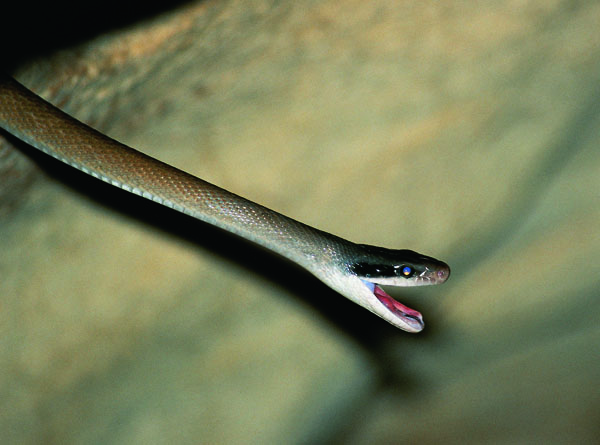
Page 130
Cave-dwelling Snake Elaphe taeniura. A reptile in a cave above the Mae Nam Noi River. This snake, about two meters long, is hanging from the cave ceiling, trying to catch roundleaf bat as they fly by.

Page 131
Roundleaf Bat of the Hipposideridae family. This one of hundreds of bats in a cave very close to the Mae Nam Noi River, in the northern sector of the park. These bats are insectivorous hunting insects at night and sleeping in the cave during the day.
TO BE CONTINUED
WILDLIFE in THAILAND: A Photographic Portfolio of Thailand’s Natural Heritage – Part One
++++++++++++++++++++++++++++++++++++++++++++++++++++++++++++++++
“In my opinion, we should not sit around and argue about the way we use the forest because very little remains“
Seub Nakhasathien
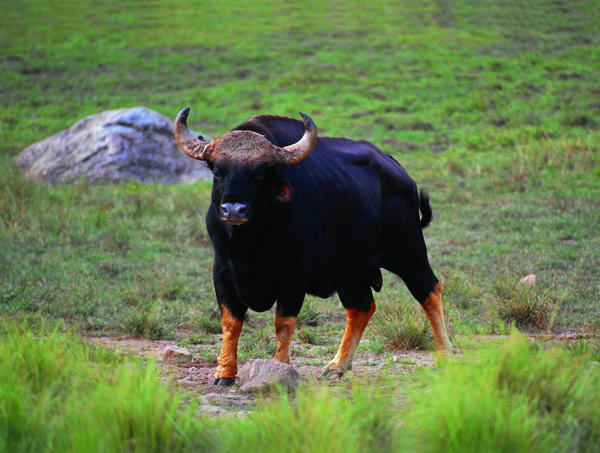
FRONT JACKET
Gaur Bos gaurus in Huai Kha Khaeng Wildlife Sanctuary. This magnificent solitary bull, estimated age about 12 years, has worn his horns down at the tips and damaged the bases by years of fighting with other bulls. Truly in his prime, he has survived danger all his life.

Back Jacket
Leopard Panthera pardus late one afternoon, just before disappearing into the forest. The author, from his vantage point in a photo blind up in a tree, hears langur monkey and barking deer call out as the cat passes by. Very few photographs of black leopard, also known as black panther, have been taken in the wild of Thailand.
Inside Jacket
About this book:
As one millennium passes and another begins, the world has lost much of its rain forests and their inhabitants in the destructive movement of progress. Human population growth, industrialization and man’s quest for money and power are the main culprits.
Recent surveys tell us that an area of tropical forest the size of New York’s Park is being destroyed every ten minutes, the size of New Orleans every month and that of the British Isles every year. Forests are being cut down for timber, livestock ranches, farms, food and housing. Wherever this devastation takes place, it contributes to climatic change through greater greenhouse gas concentrations in the atmosphere. In recent times, severe world weather conditions caused by the El Nino and La Nina phenomena, destructive typhoons, hurricanes, cyclones and their disastrous effects of drought and floods, plus earthquakes have wreaked havoc globally.
We are thus faced with an intractable dilemma. The destruction of our flora and fauna by this and previous generations will have severe consequences in the new millennium, affecting the weather, land and lives of people all over the country and the world.
At the end of the World War II, Thailand’s forests covered an estimated 75-percent of the country. Now, perhaps only 20-percent of forest cover remains, of which half to three-quarters is in protected areas. Many species of plant and animal life have already become extinct to be seen now only in text books, drawings and old photographs.
We are at a crossroads where education and a sense of awareness for all natural living things are the most important tools to save what is left of our forests and wildlife. We also need to communicate through photographic books like this one, and the news media, to those who are uneducated about wildlife so they may understand and see the beauty of the natural world.
Enjoy this photographic trip into the wild of Thailand. Put yourself into each photo as if you were actually there and see the magnificent wildlife that still survives in the Kingdom. This book makes a powerful statement; the photographs speak for themselves.
Wildlife in the Kingdom of Wildlife offers a photographic portfolio of the wildlife in this country, a journey into the realm of the natural world with camera and film to record a small part of what was once a great wilderness.
In order to collect as many images as possible in the four-year period this book allowed, some of the best national parks, wildlife sanctuaries and non-hunting areas were chosen as photographic sites. By learning about each area from continued visits, a considerable knowledge was gained of wildlife habits and habitats. This determined the best times and places for 100 percent photographic success. Wildlife is so wary of humans that it is extremely difficult to see or photograph them in their natural habitat.
Thailand’s flora and fauna are some of the world’s most beautiful. We all need to join together to save what little is left, not only for ourselves but for our children. Taking the inspiration given to us by His Majesty King Bhumibol Adulyadej, Her Majesty Queen Sirikit and the Royal Family, whose proactive concern for the environment continues unabated, may we all play our part in saving and protecting the magnificent wildlife in the Kingdom of Thailand.
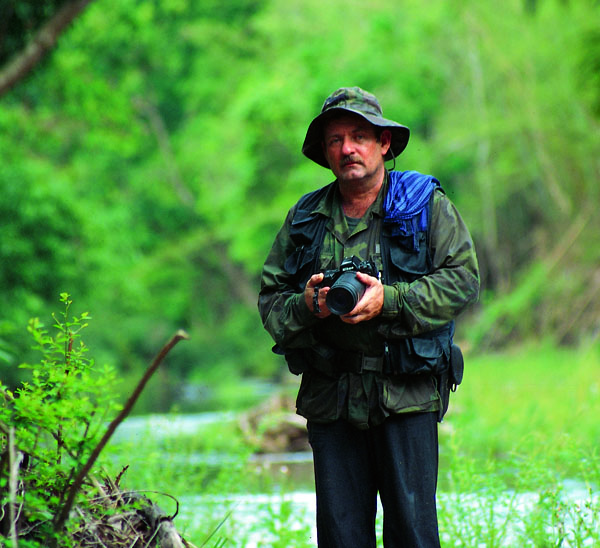
Lawrence Bruce Kekule, an American by birth, has lived in Thailand since 1964. Immediately upon arrival, aged 19, he went up to Chiang Mai to work in his father’s wood handicraft business. His lifelong love of being in the forest continues and, whenever he has the opportunity, ventures into the wild with his cameras. His dream to produce a pictorial book of Thailand’s wildlife began during the mid-1980s after he witnessed extreme changes to the country’s wild areas. Then, in 1995, with his trusty Nikon cameras, he started to visit as many protected conservation areas as possible in search of wildlife subjects to record on film. Wildlife in the Kingdom of Thailand is the fulfillment of his dream.
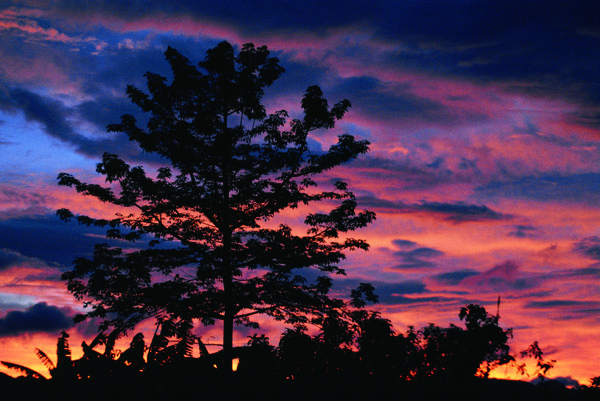
Page 2-3
Sunset in Sai Yok National Park in Western Thailand along the Kwae Noi River. This beautiful protected area has some very rare creatures including tiger, leopard, wild elephant, gaur and many other large and small mammals. The ‘Bridge on the River Kwae’ is not far from here and was made famous during WW II and the Japanese occupation in the 1940s.


Page 4-5
Asian Tapir Tapirus indicus in Huai Kha Khaeng Wildlife Sanctuary.There are many scars on the flank of this otherwise handsome animal (top), probably caused by a predator. Tapir have very thick skin that protects them from attack. Their colouring would seem to stand out, but in fact they are quite well camouflaged. The two-tone colouring breaks up its outline at night and in dark evergreen forests during the day. They are very quick while moving through the brush when escaping from a predator. This very rare mammal, still found in the sanctuary, is nocturnal and rarely seen in daylight. There are very few left here. It is hoped that they will continue to survive in this World Heritage Site.
CREDITS
Page 6
PUBLISHED in 1999 by WKT Publishing Co., Ltd 102/32 Soi Ronnachai
Setsiri Road, Phayathai Bangkok 10400, Thailand Tel: (66-2) 619-6774
Fax: (66-2) 619-6775 e-mail: lbkekule@mac.com
DISTRIBUTED in Thailand by Asia Books Co., Ltd 5 Sukhumvit Road Soi 61
Bangkok 10110, Thailand P.O.Box 40Tel: (66-2) 714-0740-2 ext. 221-223
Fax: (66-2) 381-1621, 391-2277 e-mail: asiabook@ksc.th.com
Photographs and text: Copyright © 1999 L. Bruce Kekule
Map: © 1999 David Unkovich
Editors: Keith Hardy, Tim Sharp
Technical Editors: Dr Sompoad Srikosamatara, Patrick Baker, Lon Grassman Jr.
L. Bruce Kekule would like to thank the companies and organizations whose sponsorship has made this book possible.
Paper Supplied: Advance Agro Public Co., Ltd, Bangkok, Thailand
Printed and bound: Sirivatana Interprint Public Co., Ltd Bangkok, Thailand
Re-Design and Desktop Publishing: L. Bruce Kekule WKT Publishing
Camera Technical Support: George Poole, Waranun Chutchawantipakorn and Sunthorn Teeratamtada
Film Processing: Green House Photo Lab, Bangkok, Thailand
FIRST EDITION – 1999, SECOND PRINTING – 2000, SECOND EDITION – 2001
All rights reserved. No part of this book may be reproduced, stored in a retrieval system or transmitted in any form or by any means, electronic, mechanical,without prior permission of L. Bruce Kekule, WKT Publishing Co., Ltd, Bangkok, Thailand.
For information about reproduction contact WKT Publishing Co., Ltd
Endorsed by the Royal Forest Department
ISBN — 974-87099-8-1
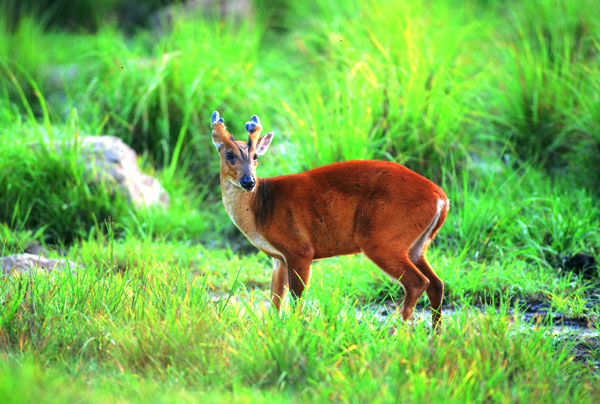
Page 7
Common Barking Deer Muntiacus muntjak in Huai Kha Khaeng Wildlife Sanctuary. This mature male with antlers in velvet, photographed on the same day as the old bull gaur on the front cover, is after a doe in heat. Some other photographs in this book, such as those of banteng, green peafowl and wild dog, were also taken at this remarkable mineral lick.

Page 8
Green Peafowl Pavo muticus at a mineral lick in Huai Kha Khaeng that is also used by elephant, gaur, banteng, barking deer, wild pig, crab-eating mongoose and monitor lizard. Other birds here include the vernal hanging parrot, red-breasted parakeet, thick-billed pigeon and mountain imperial pigeon, changeable hawk-eagle and hornbill.
CONTENTS
Page 9
Foreword – 11
Introduction – 12
Huai Kha Khaeng Wildlife Sanctuary – 18
Thung Yai Naresuan Wildlife Sanctuary – 74
Khao Yai National Park – 100
Kaeng Krachan National Park – 112
Sai Yok National Park – 120
Mountains of the North – 132
Beung Boraphet Non-hunting Area – 142
Wildlife Research – 156
Zoos and captive breeding stations – 162
The Dark Side of Nature – 170
Wildlife photography – 174
Map and List of protected Areas – 176
Acknowledgments – 177
Sponsor Profiles – 178
Bibliography – 180
Photographic index – 181
================================================================

Page 10-11
Huai Kha Khaeng Wildlife Sanctuary during the dry season when the river is at its lowest level. Many species thrive here including tiger, leopard, elephant, wild water buffalo, banteng, gaur and many other large mammals plus smaller creatures. It is the greatest wildlife sanctuary in Thailand.
FOREWORD
Dr Plodprasop Suraswadi – Director General of the Royal Forest Department
Wildlife in the Kingdom of Thailand is a photographic journey into the realm of nature, conveying to the world the magnificent beauty and diversity of Thailand’s natural heritage. Its purpose is to inspire increased conservation awareness in the minds of this generation, in both local and international communities. The extremely difficult but important need to protect and save Thailand’s surviving forests and wildlife is one of the Kingdom’s top priorities. Indeed, His Majesty King Bhumibol Adulyadej, during his continuing reign of more than 50 years, has been and remains at the forefront of many wildlife conservation and reforestation projects around the country.
Wildlife photography is one of the toughest tests of a photographer and this book contains some truly remarkable photographs of rare and endangered wildlife in their natural habitats. There are photographs here of elephant, gaur, banteng, wild water buffalo, tiger, leopard and many other wonderful creatures of nature. Most of these animals are seldom seen let alone photographed. For his outstanding work in putting this book together, both in text and photographs, L. Bruce Kekule is to be commended. The Kingdom will truly benefit from his excellent portrayal of its wildlife.
Over millions of years, the evolution of our flora and fauna has created an abundance that is truly astonishing, and we are all responsible for its continued survival. Enjoy this photographic portfolio of Thailand’s natural world, but never forget this book’s urgent message: Nature’s clock is ticking relentlessly as species after species disappears from the land. Only prompt action can halt this continuing tragedy and we should all work together to fight the man-made perils facing nature. Then, and only then, can we safely say that the children of today and tomorrow will enjoy the Kingdom’s natural heritage far into the new millennium. Finally, we must all learn to love, respect and live in harmonious coexistence with the wonderful world of nature.
INTRODUCTION: Thailand’s Natural Heritage

Page 12
Cycad Cycas pectinata in Thung Yai Naresuan Wildlife Sanctuary. The cycad is considered one of the oldest species of plant in Thailand, having been around since at least the days of the dinosaur some 120 million years ago. The plant at the back has died, hence the golden color of its fronds. Cycad are still common in the sanctuary and along the Tenasserim and Thanon Thongchai mountain ranges.
The Kingdom’s glorious wildlife
About 120 million years ago, one of the most gigantic carnivorous dinosaur the world has ever known, roamed in what is now part of northeast Thailand. Just recently discovered and named, this tyrannosaur Siamotyrannus isanensis, the predecessor of the famed North American Tyrannosaurus rex, adds to the sum total of knowledge that this mystic and majestic land has always been a haven for some extremely interesting and diversified wildlife.
Thailand is one of the wealthiest countries in the world in terms of biodiversity. As just one example, Doi Suthep-Pui National Park, an area of only 261 square kilometers, near the city of Chiang Mai, contains more species of plant than the whole of Europe. The country was once so rich in flora and fauna that a movie named ‘Chang’ (Thai word for elephant) was made in Nan province in the 1920s, using real wildlife and the jungle as props. This movie was recently rediscovered in the West and shown on national television.
Thailand owes its extraordinary natural wealth to its location at the heart of Southeast Asia. With an area of 513,115 square kilometers, it is at the crossroads of several major bioregions and covers almost 15 degrees of latitude in the tropics. These conditions, together with the country’s vast range of land- forms, weather patterns, vegetation types that derive from its geographic location, generate this astonishing natural wealth.
Some idea of this richness can be gained by looking through this book. Tragically, much of what you will see is now seriously endangered. As recently as the beginning of the twentieth century the whole of the country, from the mountains of the north to the coastlines and islands of the south, and from the eastern plateaus across the central plains to the thick jungles of the west, was covered by a lush green carpet of forest that teemed with life. Today, this once vast natural domain is now sadly depleted.
Consider, for instance, the world’s smallest mammal, the Kitti’s hog-nosed bat, named after its discoverer. This bat was found in the 1970s within a few caves along the western border with Myanmar (formally known as Burma) in Sai Yok National Park. Although it still survives, it is endangered throughout its range. The International Union for the Conservation of Nature (IUCN) lists this bat among the most endangered animals in the world.
The Asian elephant is the second largest land mammal on earth, surpassed in size only by its African cousin. Elephant live here in the wild, and in the cities and towns where many of them are abused and exploited for the tourist trade and open-air restaurants. Their numbers in the wild diminish year by year due to habitat loss that basically affects all wildlife. Some are hunted for their ivory but there are very few big tuskers left. Probably no more than 5,000 wild and domesticated elephant remain in Thailand, a sad situation indeed.

Page 13
Bengal Monitor Varanus bengalensis in Thung Yai Naresuan Wildlife Sanctuary. This female lizard is full of eggs, ready to lay. When the author’s presence was detected, she dashed full tilt across the mineral lick. These carnivorous reptiles are still common in Thailand.
Thailand has gaur — the great forest ox and world’s largest bovine. There are also banteng, a slightly smaller species of red cattle, in some areas. Asian wild water buffalo, akin to domesticated buffalo, also exist here but in very small numbers and found only in Huai Kha Khaeng Wildlife Sanctuary. Only one herd remains, comprising less than 50 animals. Other wild herds still exist in India and Nepal. Prior to the long Indochina conflict, Vietnam and Cambodia also had wild water buffalo but their status today is not known. All wild bovine in this region are seriously endangered.
The world’s largest cat, the tiger, is here, albeit critically endangered throughout its range. Other cats include Asian leopard (black and spotted), golden cat, clouded leopard and marbled cat, along with several other smaller species of feline. There are two species of Canidae, Asian wild dog and Asiatic jackal. They are all in serious jeopardy due to poaching of their prey species and habitat loss.
There are five species of deer in Thailand comprising of sambar (the largest), hog deer, brow-antlered (Eld’s) deer, common barking deer and Fea’s barking deer. There are two species of mouse deer (greater and lesser). Hog deer have been reintroduced into Phu Khieo Wildlife Sanctuary and brow-antlered deer were reintroduced into Huai Kha Khaeng and doing well.
Other ungulates (hoofed animals) are tapir, wild pig and two species of goat-antelope, the serow and goral. Goral live in several small pockets in Om Koi and Maelao-Maesae wildlife sanctuaries and a few other areas in the north, where their existence is under threat from poachers. They are therefore extremely endangered. There are a few unconfirmed reports of Sumatran rhinoceros along the western border with Myanmar and southern border with Malaysia. They have not been sighted officially for more than 30 years.
Asiatic black bear and Malaysian sun bear can be found in a few forested areas but are highly endangered by the illegal market for bear paws and bladders. Seven species of civet cat, including the binturong and large Indian civet, as well as many other mammals like badger, weasel, pangolin, porcupine, mongoose, marten, otter, bat, squirrel and other rodents are found here. Primates include slow loris, gibbon, macaque and langur.
Thailand also has a fascinating array of birdlife. Over 1060 species have been recorded (ten per cent of the world’s birds!), with new ones added to the list all the time. During the winter months, thousands of birds migrate to Thailand and some pass through on their way even further south. Unfortunately, many species of flora and fauna have disappeared from the land due to poaching and severe encroachment on their habitat.
Insect species number in the hundreds of thousands. In Huai Kha Khaeng alone, thousands of beetle species have been found in one hectare. Many species continue to be discovered.
A coastline stretching for thousands of kilometers affords an unparalleled marine habitat that includes coastal areas covered with moist evergreen, swamps and mangroves.
Clearly, this book could not hope to record more than a fraction of this wealth. Therefore the author has chosen to concentrate on a select few of the major national parks, wildlife sanctuaries and non-hunting areas. By learning about each area through repeated visits, it has been possible to capture unique moments in the lives of some of this country’s most beautiful wildlife.
It is important to understand just how severely threatened much of this superb wildlife really is. As recently as the turn of the 20th century, and just north of what is now Bangkok, elephant, tiger, deer and other animals roamed. In the 1920s, Bangkok was still a sleepy riverside town with almost no roads. Even in the 1940s, any journey over 100 kilometers from Bangkok meant travelling very slowly along deeply rutted dirt tracks that were passable only in the dry season.
Although serious deforestation began as long as 100 years ago, it was not until Thailand was caught up in the mad rush of modernization after World War II that its flora and fauna came under attack. At that point, modern mechanized transport and weapons started to take their toll.
Two notable species that have become extinct, now to be seen only in textbooks, are the white-eyed river-martin and Schomburgk’s deer. Others like the Javan rhino, brow-antlered deer and water birds like the sarus crane, black-neck stork and giant ibis have also disappeared from Thailand’s wilderness areas. They are just surviving in other Asian countries and some zoos. The kouprey, a species of wild cattle that once roamed a small section near the Phanom Dongrak mountain range along the Thai-Cambodian border has probably become extinct. Last confirmed sightings in Thailand were in 1949. The war in Indochina probably sealed its fate.
One result of this drastic depletion has been that white-rumped and red-headed vulture, which were common, have all but disappeared due to lack of carrion. Poisoned bait meant for tiger was another problem. The vulture would swoop down, feed on the carcass and then perish alongside. In the early 1990s, this was recorded and photographed in Huai Kha Khaeng, a sad sight indeed.

Page 14
Leopard Panthera pardus in Huai Kha Khaeng Wildlife Sanctuary. The area attracts many different species of mammal including elephant, gaur, banteng, tapir, pig, sambar and barking deer. As these are prey species for leopard and tiger, the carnivores often come looking for a meal. Also known as panther, the leopard’s spots are clearly visible in the light of the setting sun. On of my best wildlife photographs ever..!
Certainly there is only one creature to blame and that is the human being. Mankind is primarily responsible for this carnage that continues to this day. Although the process has slowed in some respects and accelerated in others, the consequences continue to devastate the Kingdom year after year.
As one example of the wider consequences, Thailand some years ago experienced devastating floods. These were the direct result of damaged watersheds destroyed by excessive logging with no forethought for reforestation when trees were cut. And although some reforestation is now being undertaken, it is already too late for many areas that have been damaged beyond repair. The suffering by the Thai people as a result of these floods has been appalling.
The bright spot in all this doom and gloom is that much of Thailand’s diverse wildlife can still be found in more than 250 protected areas. Altogether, some 14 per cent of the Kingdom’s land area is now reserved, and although most of the protected areas have severe problems, fresh areas are being set aside all the time. Vigorous attempts are now being made to improve park management.
Two pioneers of this dramatic growth deserve to be remembered. Back in the 1950s, one man’s love for this country’s superb forests turned the late Dr. Boonsong Lekagul from a hunter into Thailand’s foremost conservationist. He was also the country’s leading expert at the time on wildlife. He wrote several books, including ‘Mammals of Thailand’ and ‘Guide to the Birds of Thailand’ that are still used today by students of biology. He founded the Association for the Conservation of Wildlife and successfully lobbied for the passage of the first wildlife and national parks legislation.
The other man who richly deserves a place in the roll of honor of Thai conservation is the late Seub Nakhasathien. He was co-author of the nomination by UNESCO of Huai Kha Khaeng Wildlife Sanctuary and Thung Yai Naresuan next door as a World Heritage Site. His untimely death shook the country and put these two protected areas on the map as a place to save at all costs and be admired by everyone.
Thailand’s present system of protected areas consists of some 89 national parks, 47 wildlife sanctuaries and 53 non-hunting areas. Among the national parks, the first to be gazetted (in 1962), and one of the most visited conservation areas in the country, is the 2,168 square kilometer Khao Yai National Park in the province of Nakhon Ratchasima (Korat), near the most westerly part of the Phanom Dongrak mountain range. Bordering it to the east is Thailand’s second largest national park, Thap Lan, at 2,239 square kilometers. The 845 square kilometer Pang Sida National Park lies to the south within the former range of the kouprey. Further east along the border with Kampuchea in Si Sa Ket province there is Khao Phanom Dongrak Wildlife Sanctuary (316 square kilometers) and in Ubon Ratchathani province, Yot Dom Wildlife Sanctuary (225 square kilometers) and Kaeng Tana National Park (80 square kilometers).

Page 16
Kreung Krai, at the mouth of the Huai Kha Khaeng (huai meaning stream), is home to Asian wild water buffalo. Due to the close proximity to the Sri Nakharin dam and reservoir, they are extremely endangered. Barely 50 creatures survive, if that. This gateway to the sanctuary can be penetrated quite easily. This needs serious attention if the area’s wildlife is to survive.
Two pioneers of this dramatic growth deserve to be remembered. Back in the 1950s, one man’s love for this country’s superb forests turned the late Dr. Boonsong Lekagul from a hunter into one of Thailand’s foremost conservationist. He was also the country’s leading expert at the time on wildlife. He wrote several books, including ‘Mammals of Thailand’ and ‘Guide to the Birds of Thailand’ that are still used today by students of biology. He founded the Association for the Conservation of Wildlife and successfully lobbied for the passage of the first wildlife and national parks legislation.
The other man who richly deserves a place in the roll of honor of Thai conservation is the late Seub Nakhasathien. He was co-author of the nomination by UNESCO of Huai Kha Khaeng Wildlife Sanctuary and Thung Yai Naresuan next door as a combined World Heritage Site. His untimely death shook the country and put these two protected areas on the map as a place to save at all costs and to be admired by everyone.
Thailand’s present system of protected areas consists of some 89 national parks, 47 wildlife sanctuaries and 53 non-hunting areas. Among the national parks, the first to be gazetted (in 1962), and one of the most visited conservation areas in the country, is the 2,168 square kilometer Khao Yai National Park in the province of Nakhon Ratchasima (Korat), near the most westerly part of the Phanom Dongrak mountain range. Bordering it to the east is Thailand’s second largest national park, Thap Lan, at 2,239 square kilometers. The 845 square kilometer Pang Sida National Park lies to the south within the former range of the kouprey. Further east along the border with Kampuchea in Si Sa Ket province there is Khao Phanom Dongrak Wildlife Sanctuary (316 square kilometers) and in Ubon Ratchathani province, Yot Dom Wildlife Sanctuary (225 square kilometers) and Kaeng Tana National Park (80 square kilometers).
Thailand’s southeast encompasses a system of mountain parks and sanctuaries that also borders Cambodia and whose mountains are known in Thai as khao. These begin with Khao Ang Ru Nai Wildlife Sanctuary (1,030 square kilometers) and Khao Chamao-Khao Wong National Park (83 square kilometers). They are situated in the smallest section of the Kingdom along with Khao Soi Dao (745 square kilometers). At 1,670 meters, this is the highest peak in the area and a wildlife sanctuary. It is linked to Khao Khitchakut National Park (59 square kilometers), whose peak at 1,633 meters, together with Khao Soi Dao, forms a saddle. This system also incorporates Khao Khieo Wildlife Sanctuary (144 square kilometers) in Chonburi province and an open zoo. All the mountains are vital to the region as a watershed, delivering water to lowland farmers. This pattern holds true all over Thailand and the importance of the reserved areas cannot be overstressed. The region receives as much as 3,000-4,000 millimeters of rain a year — more than anywhere else in mainland Thailand.
Shortly after Khao Yai was established, Salak Phra Wildlife Sanctuary was gazetted (1966) in Kanchanaburi province as Thailand’s first protected area set up specifically for biodiversity conservation and wildlife research. Of Thailand’s wildlife sanctuaries, the most important are Huai Kha Khaeng (2,780 square kilometers) and Thung Yai Naresuan (3,622 square kilometers), both World Heritage Sites. Jointly, they form one of mainland Southeast Asia’s largest nature reserves. The diversity of their flora and fauna is unrivalled. Split into two administrative sections (east and west), Thung Yai is the single largest protected area in the Kingdom. Salak Phra, Thung Yai and Huai Kha Khaeng are part of the Western Forest Complex which also includes Umphang Wildlife Sanctuary to the north, Khlong Wang Chao, Khlong Lan and Mae Wong National Parks to the northeast, Sri Nakharin, Chalerm Rattanakosin (known as Tham Than Lot), Erawan and Sai Yok National Parks to the south, and Khao Laem National Park to the southwest. The total protected area in Thailand’s largest forest complex is more than 15,000 square kilometers.
Further south, in Phetchaburi province, Kaeng Krachan sits along the border with Myanmar and is, at 2,915 square kilometers, the country’s largest national park. Down the coast in Prachuab Khiri Khan province, Kui Buri National Park where wild elephant and gaur have the largest herds in Thailand. Khao Sam Roi Yot (meaning mountain of three hundred peaks) National Park contains some of the best shoreline habitat in the Kingdom. This small 98 square kilometer park is the breeding ground and wintering home for many species of water and shore birds.
Thailand’s peninsular coastline of some 1,000 kilometers on both the Andaman Sea and Gulf of Thailand contains many national parks, wildlife sanctuaries and non-hunting areas. Several of these are marine zones or offshore islands designated as protected areas. In Krabi, Phuket and Phangnga provinces, the most notable of several reserves is the newly gazetted Khao Phra Bang Khram Wildlife Sanctuary (183 square kilometers) that is home to Gurney’s Pitta, one of the world’s rarest birds. With less than 25 pairs, this bird is highly endangered. Phangnga Bay, where the famous “James Bond Island” is located, is in fact the southernmost tip of the Tenasserim mountain range that stretches all the way from an area in Myanmar next to Tak province in the north of Thailand. Thaleban National Park (102 square kilometers), and Ton Nga Chang and Khao Banthad Wildlife Sanctuaries can be found in this extreme southern part of Thailand.
However, perhaps the most important reserved area in the south is Hala-Bala Wildlife Sanctuary (433 square kilometers) in Yala and Narathiwat provinces. On the southern border with Malaysia, this area is reported to contain Sumatran rhinoceros, elephant, gaur and many other large mammals like tiger, clouded leopard, black panther and bear. But the rarest, most wonderful residents of all are the Sakai nomad hunter-gatherers who live within the sanctuary. They are rarely seen and not much is known of their numbers or habits. On the western side of the peninsula, in Satun province, the Sakai have unfortunately been introduced to modern ways and in this area have lost their natural heritage as true forest dwellers. Adjacent to Hala-Bala Wildlife Sanctuary, Queen Sirikit Reserved Forest, with a total area of 1,337 square kilometers, was recently established.
Further north, on the gulf coast in Songkhla and Phatthalung provinces, three linked lakes or lagoons have been gazetted as non-hunting areas. These extend for 80 kilometers along the coast and cover an area of some 1,500 square kilometers. The furthest lake inland is the Thale Noi which has fresh water. Thale Luang and Thale Sap Songkhla are brackish. The most shoreward lake, Thale Sap Songkhla is protected by a sea wall. Large concentrations of shore and water birds can be found on all three lakes.
Another conservation area, in Ranong, Surat Thani and Phangnga provinces, contains Khao Sok, Sri Phangnga and Kaeng Krung National Parks along with Khlong Nakha, Khlong Saeng and Khlong Yan Wildlife Sanctuaries. Their total area is 3,690 square kilometers. Khao Sok is one of the most visited parks in the country.
Probably the most important non-hunting area is Beung Boraphet in the central plains near Nakhon Sawan, the gateway to the northern region of Thailand. At 212 square kilometers, this is Thailand’s largest freshwater lake and is its most important wetland for resident, migrant and winter visiting birds. This magnificent bird sanctuary is experiencing severe problems with overcrowding by people and excessive fishing activities, both of which are detrimental to the balance between the natural environment and the bird population. There are many other smaller marshes and water bodies in the Kingdom but most of these have been encroached upon by rice, vegetable and duck farming, roads, housing and industrial estates. The status of resident and migrant water birds is critical to say the least!
A small system of parks exists in the eastern part of the northeast, adjoining Laos. They include Phu Phan National Park (664 square kilometers), Huai Huad National Park (828 square kilometers) and Phu Si Tan Wildlife Sanctuary (250 square kilometers) in Sakon Nakhon, Kalasin and Mukdahan provinces respectively. They straddle the Phu Phan mountain range.
Doi Inthanon National Park (482 square kilometers) in Chiang Mai province contains, at 2,595 meters, Thailand’s highest mountain (doi, as well as khao and phu, meaning mountain). Other protected areas in the north include Doi Suthep-Pui National Park (261 square kilometers), and Doi Chiang Dao Wildlife Sanctuary (521 square kilometers), both in Chiang Mai province, Doi Khun Tan National Park (255 square kilometers) in Lampang and Doi Luang National Park in Chiang Rai (1,170 square kilometers).
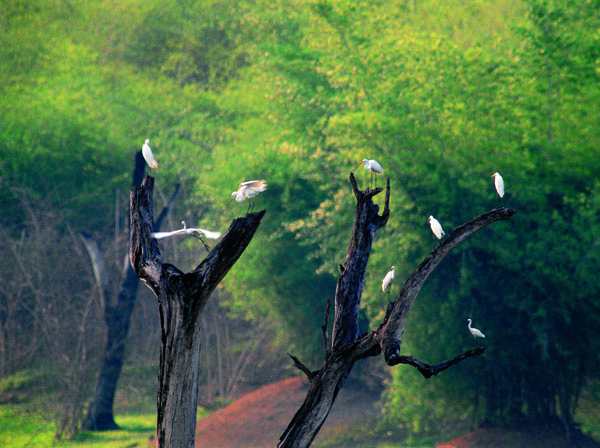
Page 17
Great Egret Egretta alba near the mouth of the Huai Kha Khaeng. There are quite a few around the area and they can be seen here quite easily. These large birds survive on many types of food but fish and insects are their main diet.
In the western area of Esarn, the Thai name for the northeast, within the Dong Phaya Yen and Phetchabun mountain ranges, there is some spectacular scenery, including beautiful forests, and a large system of parks and sanctuaries. The most famous are Thung Salaeng Luang, Phu Hin Rong Kla, Nam Nao and Phu Kradeung National Parks plus Phu Luang and Phu Khieo Wildlife Sanctuaries. These together cover some 5,339 square kilometers. Several smaller parks are interspersed between them. Phu Luang Wildlife Sanctuary is extremely important as it has some fascinating well preserved footprints of the carnivorous Allosaurus dinosaur that roamed here. Phu Luang is also one of Asia’s most crucial sanctuaries for orchids. It harbors some 160 different species.
The largest single reserved area in the north consists of the Om Koi and Mae Tuen Wildlife Sanctuaries with, to the east across the Ping river and Bhumibol dam and reservoir, Mae Ping National Park. They constitute some 3,400 square kilometers of protected area and are situated in Chiang Mai, Tak and Lamphun provinces. These are the last areas in the north that support a few herds of banteng, gaur and goral, the goat-antelope which lives in the lofty crags of Doi Montjong.
Mae Hong Son province in the extreme northwest contains the important Salawin Wildlife Sanctuary (875 square kilometers) and, adjacent to it, Salawin National Park (722 square kilometers). In the same province are Lum Nam Pai Wildlife Sanctuary (1,181 square kilometers) and Nam Tok Mae Surin National Park (396 square kilometers). A new 1,252 square kilometer national park that adjoins Myanmar has been established in Chiang Mai province at Huai Nam Dang. Lampang province contains Namtok Chae Son National Park (592 square kilometers), while Mae Yom National Park (454 square kilometers) in Lampang and Phrae provinces supports the largest natural teak forest in Thailand, the remainder having being decimated by overlogging. Of note is the fact that the Mae Yom River is the only one in the north that has not been dammed.
There are many other smaller areas not mentioned here but the total area of national parks, wildlife sanctuaries and non-hunting areas around the country is about 70,000 square kilometers. Most of them, sadly, are being or have been encroached upon at one time or another by members of society at all levels. Thailand’s future as a nation that cares about the natural world depends on many factors. Hanging in nature’s fine balance, only time will tell whether this country’s superb natural heritage will continue to survive. The Royal Forest Department has a tremendous load on its shoulders to save and protect the Kingdom’s remaining forests and wildlife. It is hope they will succeed in this extremely difficult task.
CHAPTER ONE
HUAI KHA KHAENG WILDLIFE
SANCTUARY:
A magnificent World Heritage Site

Page 18
Sambar C. unicolor down at the river one afternoon for a refreshing drink. Wild water buffalo have just been here, so the mother is very alert, watching for any predator that might be lurking nearby. The young buck’s antlers are in velvet. The other sambar, a very young doe, then watches its mother drink. These deer then play in the river for a few moments before disappearing into the forest. They still survive in good numbers throughout the sanctuary.
Thailand’s most famous wildlife sanctuary, and World Heritage Site, is nestled in the eastern foothills of the Thanon Thongchai Range. Huai Kha Khaeng is a 2,780 square kilometer (1,073 square mile) area located in the central province of Uthai Thani and lies adjacent to Thung Yai Naresuan Wildlife Sanctuary, another World Heritage Site. To the north of Huai Kha Khaeng is Mae Wong National Park and Umphang Wildlife Sanctuary. These are all part of one of the largest conservation areas in mainland Southeast Asia.
Wildlife sanctuaries differ from national parks in that they are not open to the general public and have been set aside for research and biodiversity conservation. Huai Kha Khaeng was gazetted a wildlife sanctuary in 1972 and became a UNESCO World Heritage Site in 1991. This status was achieved through the efforts of several people, the most notable being that of the late Seub Nakhasathien who at that time worked for the Wildlife Conservation Division of the Royal Forest Department. He took his life in the cause of nature and conservation after fighting a losing battle against poachers and encroachment. The impact of his untimely death in September 1990 really shook the country and the area has now become a place to admire and save at all costs.
At the sanctuary headquarters, a museum has been dedicated to the memory of Seub and portrays his work and dedication to conservation. In the surrounding area, one can enjoy wildlife in its natural habitat. Sambar, barking deer, civet cat, porcupine and rabbit can be seen during the night and occasionally during the day. There are 355 species of forest bird in Huai Kha Khaeng and the sanctuary is truly a bird-watchers paradise. As an example, 22 of 36 species of woodpecker found in Thailand are reported in the sanctuary.
The interior is where the sanctuary really lives up to its name as a World Heritage Site. This is where Huai Kha Khaeng’s biodiversity is truly unsurpassed. The diversity of flora and fauna is something that one has to see to believe and understand. The sights and sounds of peafowl in the morning and evening, the doglike call of barking deer evading a predator and the dawn chorus of gibbon, along with hundreds of songbirds, are a true wonder of nature. Huai Kha Khaeng has mixed deciduous forests that still harbour many rare species like tiger, gaur, banteng, wild water buffalo and elephant. Of Thailand’s 297 mammal species, 67 are recorded here. The sanctuary is one of the last wild riverine habitat ecosystems left in Thailand.
Despite this beauty and richness, the wildlife is being poached at an alarming rate by indiscriminate hunting. Poachers slip into the sanctuary, hunting large mammals such as elephant, gaur, banteng and sambar for their trophies and skins. These end up in homes and business establishments as wall trophies and ornaments. The tiger is hunted for its bones and pelt, the bear for its gall bladder and the serow for its head that is supplied to the Asian medicine trade. Some animals are also taken alive for sale in wildlife markets.
The market for wild meat, supplied to some restaurants offering wildlife on the menu, such as deer, wild pig and bear paw, to mention just a few, is another major problem for Thailand’s fauna. Smaller animals like civet, porcupine and monkey, plus many others, are also menu items in these restaurants. It is without doubt that this onslaught to supply the black market has pushed many species to the brink of extinction, a situation that needs serious attention.
Huai Kha Khaeng also has serious problems with forest fires every year. They are usually started outside the sanctuary by unscrupulous people to open up the forests so that poaching and movement is made easier. These people once lived off the land deep in these forests and were evicted by the Government when Huai Kha Khaeng was gazetted.
However, brush fires are thought to help regenerate new grass and feeding grounds for large herbivores, thus the benefits of fire should also be recognized. These fires should be controlled at an early stage after being detected to prevent serious damage to the evergreen forests that can be permanently damaged.
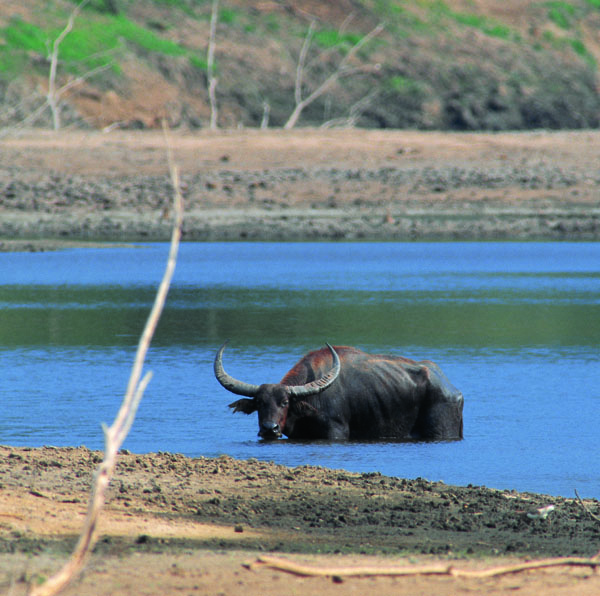
Page 19
Wild Water Buffalo Bubalus bubalis. This old cow’s horns are huge and estimated at some two meters around the curves. Her dorsal ridge is very prominent. Sadly, she limps in and out of the water, probably due to an old wound. She stays in for an hour after the herd leaves, just chewing her cud and enjoying the coolness of the river. With less than 50 individuals remaining, they are extremely endangered.
There are many mineral licks in the sanctuary that are visited by elephant, gaur, banteng, sambar, barking deer, Asian tapir and wild pig. These animals take in trace elements as a natural and important part of their diet. Occasionally, a glimpse of tiger, leopard and Asian wild dog preying on large mammals is possible. Smaller carnivores like the Asian golden cat and crab-eating mongoose are seen from time to time, and carnivorous reptiles like the forest monitor lizard also come looking for prey. Many birds such as the vernal hanging parrot, thick-billed pigeon, mountain imperial pigeon and green peafowl also visit the licks to take in the mineral-rich soil.
One of the most endangered animal species in Thailand at present is the wild water buffalo. Surviving only in the southern reaches of the Huai Kha Khaeng valley close to the Sri Nakharin dam and reservoir, they are in serious jeopardy from poachers. There are probably no more than 50 buffalo left and they are inbreeding now due to low numbers. They are not long for this world unless some extremely tough sanctions can be brought to bear on those who dare enter the sanctuary to poach these dwindling animals.
Some of the old bulls and cows are extremely dangerous when encountered. They will charge instantly in a direct line to pulverize the enemy. They can ceash through tree saplings and bamboo like a bulldozer, but at great speed, to gore the intruder. Their eyesight is fair, but like all wild bovine their senses of smell and hearing are acute. However, it is the buffalo’s determination that makes it the most dangerous animal in the forest. A big solitary bull can weigh a ton and produce footprints eight inches across, the size of dish plates. They can use their huge horns with great accuracy to gore and throw a poacher or other unfortunate person who happens along into the trees as they charge past. They will continue the attack until the enemy is completely annihilated.

Photo by: Whutipong Tongpeen
Page 20
Asian Elephant Elephas maximus in Huai Kha Khaeng at a mineral deposit during he dry season. This mature female is taking care of her three young ones. Full-grown elephant need more than 200 liters of water a day to survive. These majestic animals are increasingly endangered. Probably no more than 2,000 remain in the wild of Thailand.
It will be a great tragedy if these magnificent bovines become extinct. They need absolute protection with total enforcement if they are to survive and, even then, their future is still bleak. The impact of losing this tremendous animal forever is real and it would be a sad day for the Thai people and the conservation movement if such an impending tragedy were allowed to happen.
The sanctuary is also one of the last strongholds for green peafowl, commonly known as peacock. Although their numbers are increasing at present, they are still considered endangered. Peafowl are breeding and resident here, and can be seen along the banks of the river, side by side with buffalo, sambar, barking deer and crab-eating macaque, especially during the mating season in November to January. These beautiful birds have acute eyesight so it is difficult to get close, but with patience and a good blind they can be observed and photographed quite easily.
All of this beauty depends on maintaining nature’s own balance. The area needs total protection and therefore should be off-limits to all except those engaged in wildlife conservation research and those officials responsible for protecting and managing the area. It is without doubt that Huai Kha Khaeng is Thailand’s greatest wildlife sanctuary. It lives up to its status as a World Heritage Site but now, more than ever, needs absolute protection and good management if it is to survive. The Department of National Parks and the Royal Forest Department has recently adopted new measures to stop illegal hunting and to combat the fire perpetrators. It is to be hoped they will succeed.


Page 21
Gaur Bos gaurus is Asia’s magnificent wild forest ox. The herd bull at the top and on the right in the lower photograph, is fully mature and weighs close to a ton. The older bull on the left is at the peak of his life. Both bulls are extremely powerful and alert. The short legs and bulk of these two bulls are typical of the species. They have tremendous speed when running and jumping. One of the world’s most majestic bovid species!


Page 22-23
Gaur B. gaurus showing their explosive power as they bolt. The old bull leaping in front was probably making passes at the herd females. The younger herd bull is close on his heels as they both disappear into the forest within seconds. A common trait of these tremendous beasts is to jump over any obstacle while moving through the forest at great speed. They may go for quite some distance before slowing down or may stop short to look back at their trail. When wounded by a poacher, they will flee into dense bush, circle back around to wait and listen for the approaching perpetrator, and then attack from a distance of only a few meters. Their determined charge is all but unstoppable. Some rare photos of the world’s largest bovid in action.

Photo by: Theerapat Prayurasiddhi

Photo above by: Saman Khunkwamdee

Page 24
Banteng Bos javanicus herd at a mineral lick that is also visited by many other animals needing its important minerals. These wild cattle are mostly rufous-brown though some are fawn-coloured. The mature bulls are either chestnut or almost black. All banteng have a white rump and white-stocking feet. They are smaller than gaur and have different shaped horns. These wild cattle have become nocturnal due to poaching pressure but can occasionally be seen in the daytime.

Page 25
Wild Water Buffalo B. bubalis in the lowland river habitat of Huai Kha Khaeng. One of Thailand’s rarest mammals, these buffalo are just surviving only in this wildlife sanctuary. A century ago, they could be found in many large forests countrywide. A small herd of buffalo leaving the river where they cool themselves at midday when they also need a drink. This herd does not stay out in the open or in the river for very long, retreating within minutes for the safety of the bush. They will later wallow in mud to create a protective coating to prevent insects from biting. This is the last stronghold in Thailand for these magnificent creatures. Serious enforcement and protection of the area is needed for their survival. New research on their status should be implemented. Note the severe degradation caused by the Sri Nakharin dam and reservoir.

Page 28
Leopard P. pardus posing on a fallen log late one afternoon at a hot spring. This magnificent black cat came for a drink at the water hole above and stayed for more than an hour. Smaller than the tiger, with shorter legs and body, leopard readily climb trees to rest and wait for prey that may pass by, or to get up to safety from a tiger, wild dogs or a human poacher. One of Thailand’s rarest carnivore species, these cats are hardly ever seen, let alone photographed.

Photo by: Kwanchai Waitanyakarn
Page 29
Indochinese Tiger Panthera tigris corbetti. The world’s largest cat, the tiger, has become endangered throughout its range from Siberia down through Thailand, Malaysia and Sumatra and across to Burma and India. It is now extinict in China, west to the Caspian Sea and down to Java and Bali. It was also found in Korea and Japan some 12,000 years ago. Due to extreme hunting pressure for the Asian medicine and trophy trade, less than 250 of these magnificent cats are estimated to remain in Thailand. Tiger are true carnivores and prey on pig and deer primarily. However, they also have been known to take fish, big insects, tortoise, porcupine, banteng, gaur and baby elephant. On very rare occasions in Thailand, they become maneaters. This happens when old age, sickness or wounds make the tiger unable to hunt its natural prey.

Page 30
Leopard P. pardus in bamboo, photographed from the author’s truck one afternoon, not far from the headquarters area. This mature carnivore is on the prowl for prey and crosses in front of the author. It then jumps up the bank and watches for a few moments before disappearing into the bamboo. A quick glimpse and rare photo of the second largest cat in Southeast Asia.


Page 34
Asian Wild Dog Cuon alpinus hunting for prey. The pack comes very close to the author’s photo blind on two separate days, moving very quickly through the area. These carnivores usually hunt in packs of six to 20 animals. They prey on herbivores like sambar and barking deer and have been known to take prey as large as banteng and gaur. When in packs, they are probably the most feared of all the predators in the forest and will occasionally even take on a tiger.

Photo by: Theerapat Prayurasiddhi

Page 35
Asiatic Jackal Canis aureus. A small carnivore doglike animal, the jackal is nocturnal, sleeping in a hole during the day but sometimes comes out in the late afternoon. It has been known to hunt alongside the larger Asian wild dog. It is omnivorous but prefers carrion, often following a tiger to feed on its kill after the cat has left it. It also hunts for small mammals, birds, amphibians and reptiles. Unlike the wild dog, it normally runs alone or in pairs during breeding season. Both photos taken during the afternoon.


Page 36-37
Sambar C. unicolor herd during the mating season in December (top). After several failed attempts to entice females in the herd, the stag (lower) takes his frustration out on the ground. These are rare photos of nature in action. Sambar are Thailand’s largest deer and their colouring differs with age and sex. Like most of the deer species, the males have antlers whereas the females have none. They are more browsers than grazers, preferring areas of secondary growth.

Page 38
Common Barking Deer and Sambar taking in minerals. These deer, the most common in Thailand, inhabit all types of forest. Their distinctive alarm call can be heard over quite long distances. When escaping from danger, they flip their tails erect. Smaller than sambar, barking deer are solitary for most of the year. They form mating pairs during the rutting season only. Sambar tend to stay in herds but the bucks become loners until the rut.
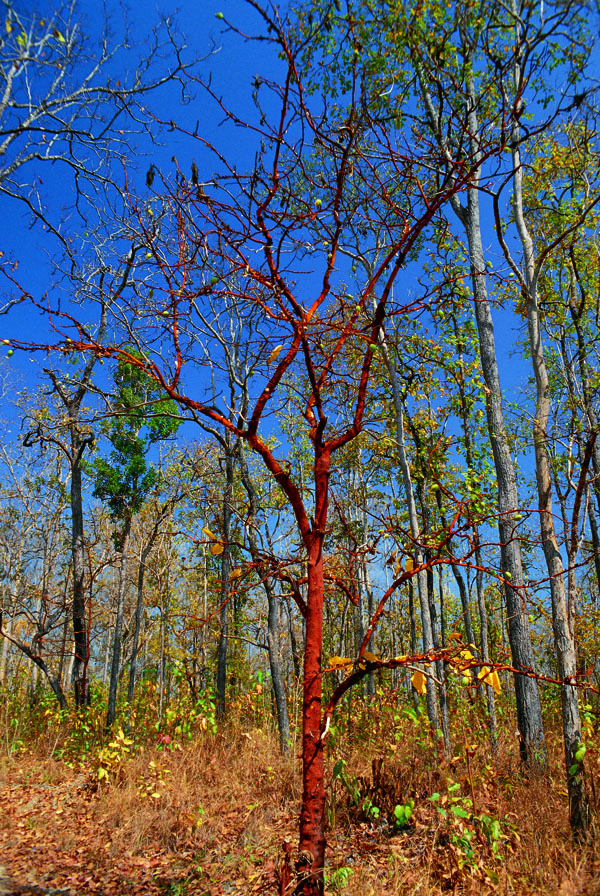
Page 38-39
Dry deciduous dipterocarp forest that is common in the sanctuary. The red tree, Gardenia erythroclada, in the foreground is found all over this forest. Many species of wildlife thrive here. From the road inside the sanctuary, it is quite common to see barking deer and wild pigs, and sometimes a leopard.

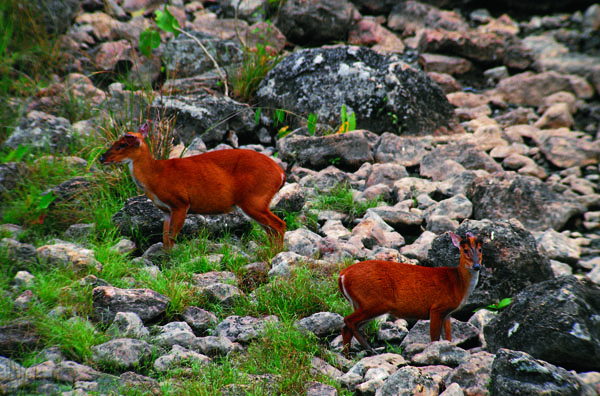
Page 39
Common Barking Deer at a hot spring to take in minerals. The mature male (above) has a perfectly shaped set of antlers whereas the females (below) have none. Although common throughout Thailand, these deer are hunted for their meat. They can coexist with man but are mostly nocturnal in their feeding habits and hide during the day.Many other animals visit this area including gaur, banteng, tapir, sambar, wild pig, leopard and tiger.
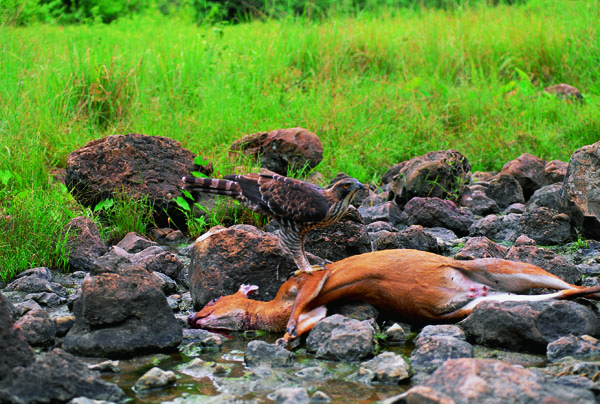
Changeable Hawk-Eagle Spizaetus cirrhatus on a barking deer carcass at a hot spring. The deer was probably killed by a pack of Asian wild dog and then abandoned, a common trait of these predators but also may have succumded to nature. These large birds have broad wings and long tails. They glide and soar, always looking for a meal. Hawk-eagles are predatory and sometimes scavenge.
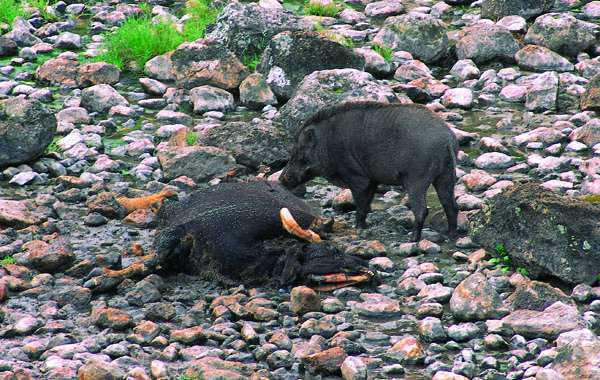
Page 40
Wild Pig Sus scrofa (above and right) at a mineral lick. Pig is a prey species of tiger, leopard and wild dog, but they have also been known to be killed by a large solitary boar. Wild pig are omnivorous and feed on fungi, roots, bulbs, shoots, snakes, invertebrates, rats, carrion, and many different types of fruit and vegetables cultivated next to forests. The carcass (bottom left) is that of a gaur. The wild pig is quite common in Thailand’s forests but is poached for its meat and trophy tusks.


Page 41
Wild Pig Sus scrofa at a mineral lick. Pig are prey species of the tiger, leopard and wild dog, but they have also been known to be killed by a large solitary boar. Wild pig are omnivorous and feed on fungi, roots, bulbs, shoots, snakes, invertebrates, rats, carrion, and many different types of fruit and vegetables cultivated next to forests. The carcass (top) is that of a gaur. The wild pig is quite common in Thailand’s forests but is poached for its meat and trophy tusk.

Page 42
Crab-eating Mongoose Herpestes urva hunting for aquatic animals in a hot spring. This animal can squirt an odoriferous fluid from an anal gland with great force, much like the North American skunk. It weighs about 3-4 kilograms and is much larger than the more common Javan mongoose that is found all over Thailand. The crab-eating mongoose is a fearless little carnivore that does not hesitate to enter water in pursuit of prey and is an excellent swimmer.
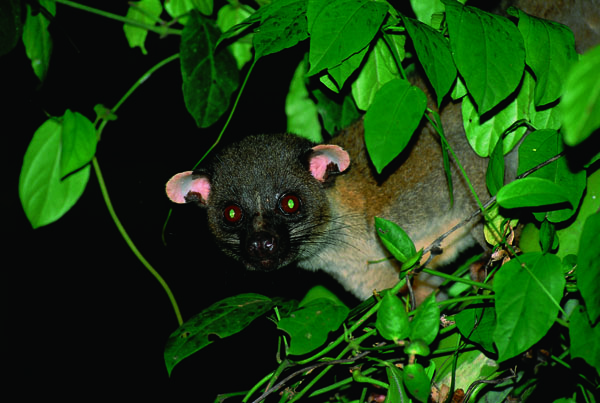
Three-striped Palm Civet Arctogalidia trivirgata. This little carnivore gets its name from the three longitudinal stripes along its back. It also has a thin stripe on the nose and distinctively shaped ears. This creature is nocturnal and arboreal, preferring deep forest away from humans.

Hog Badger Arctonyx collaris. This nocturnal carnivore has a piglike nose, short tail, white throat and sharp claws. It is terrestrial and sleeps in burrows during the day. Notoriously savage when attacked, and gifted with a tenacity for life, it is one of Thailand’s many strange-looking mammals.

Page 43
Large Indian Civet Viverra zibetha. This magnificently marked civet is sturdily built. Being a carnivore, it eats fish, birds, lizards, frogs and insects, and has been known to scavenge garbage dumps and raid poultry farms. They have a strong distinctive scent that comes from its perineal gland.
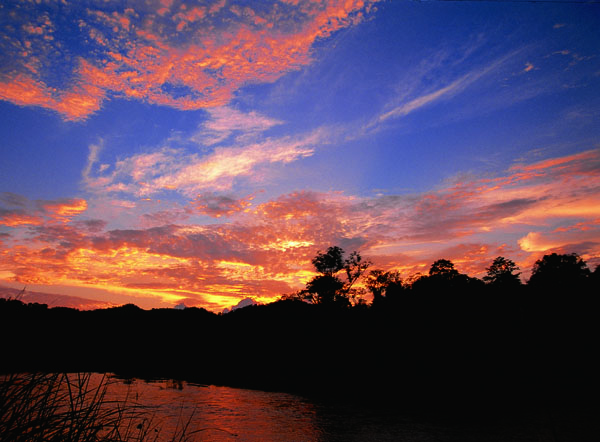
Page 44
Sunset at Khao Ban Dai guard station in the central sector of the sanctuary. The area often affords some magnificent sunrises and sunsets as moisture in the atmosphere, drawn from the forests, creates a superb array of colours and hues.

Page 45
Huai Kha Khaeng and Huai Mae Dee junction at Khao Ban Dai ranger station. Sambar, green peafowl and crab-eating macaque come to the river almost daily. Occasionally a tiger or wild pig will cross.

Page 46
Phayre’s Langur Presbytis phayrei. Two langurs feeding on a berry tree in Huai Kha Khaeng. Groups of these long-tailed leaf monkeys, ranging from about a dozen to more than 40 animals, have been seen, as well as solitary creatures that have left the troop. They come down from the trees to drink at mineral springs that cause gallstones that are used in Asian medicines. This, and the fact that their meat is considered a delicacy by some, means that they are heavily poached in the west and north of Thailand.
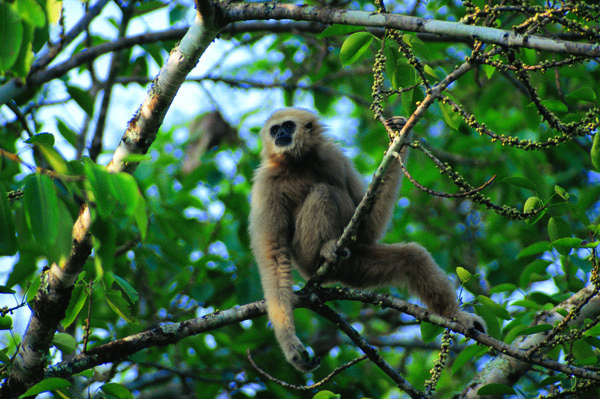
White-handed Gibbon Hylobates lar in a fruit tree (top). They have white hands and feet, hence their name, and a white ring around the face. Gibbon are dark brown to black or blond to very light brown. The musical “whoop-whoop” call of the species when the sun comes up is a reassuring sign that the forest is more or less intact.
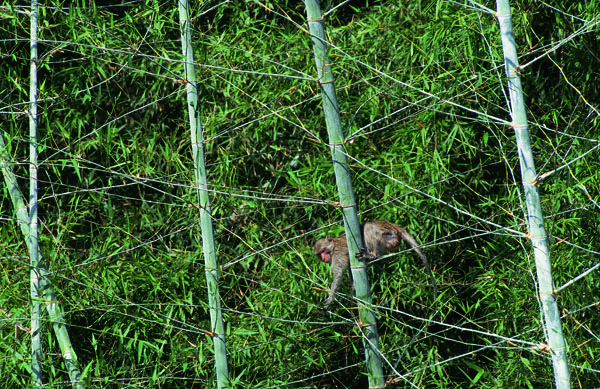
Page 47
Crab-eating Macaque Macaca fascicularis in bamboo ((lower). This monkey is feeding on the tender shoots in the early morning along the Huai Kha Khaeng. Macaque, a prey species of the leopard, are constantly on the alert for the feline.

Page 48
Black Giant Squirrel Ratufa bicolor. This is Thailand’s largest squirrel. It usually comes out midmorning to feed on fruit and nuts. Black with yellow under-parts, its tail is over a foot long. Extremely wary, it will disappear into the trees at the slightest hint of danger.

Page 49
Belly-banded Squirrel Callosciurus flavimanus. This little mammal was photographed at the sanctuary’s headquarters area. Many squirrels can be seen quite easily in the morning, feeding on fruit and nuts. Thailand has some 27 species of squirrel including flying squirrel.
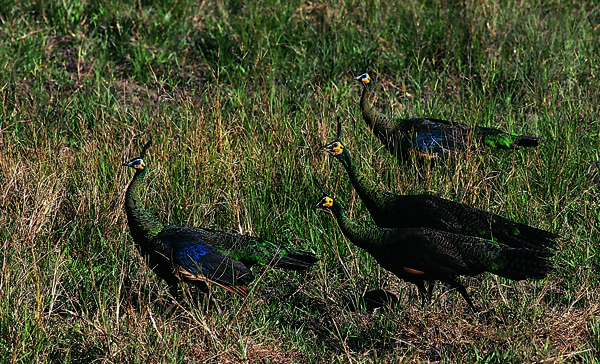


Page 50

Page 51
Green Peafowl P. Muticus in November, during the breeding season. The females (top) are being shown magnificent courtship by the male (below). The male’s trumpet call is very distinctive and can be heard over long distances at early morning and dusk.The male, female and two chickswere photographed at midmorning near Kreung Krai, close to the mouth of the Huai Kha Khaeng. Peafowl are breeding here and their numbers are stable at the moment. However, they have disappeared from all other areas of Thailand with the possible exception of a few in Mae Yom National Park, Phrae province, and the Salawin Wildlife Sanctuary in Mae Hong Son province.

Photo by: Loong Waitnayakarn
Brown Hawk-Owl Ninox scutulata. This group is comprised of two young chicks with the parents on either side. They often stay together for some time after leaving the nest, eventually splitting up to live solitary lives until the mating season. Like all owls, they are nocturnal and have forward-facing eyes, with a facial feathered disc to locate prey at night.

Photo by: Kwanchai Waitnayakarn
Page 52
Collared Scops-Owl Otus lempiji. These birds of prey are seldom seen as they roost in deep cover during the day and only come out at night to feed on various birds, rodents and other small animals. Occasionally, they can be seen during the day but those occurrences are rare.
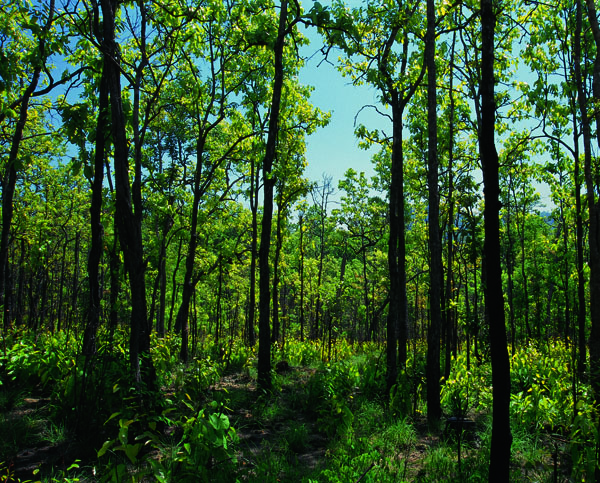
Page 53
Dry deciduous dipterocarp forest, in the central area, that has just turned green after the first rains in May. This area catches fire during the dry season, almost every year. Areas of evergreen forest are also damaged by fire. Animals often perish in such fires. The underlying danger is posed by the excessively dry seasons that have recently become common. The apparent trend towards a drier climate in Thailand may well be part of global warming and climate change, itself caused in part by forest destruction.


Page 54-55
Blue Magpie Urocissa erythrorhyncha at Khao Ban Dai guard station (lower). This beautiful bird is also very noisy, flying through the forest with a resounding cha-chak, cha-chak. It is a common forest bird, especially in Thailand’s western and northern deciduous and open evergreen woodlands. The photo (top) shows a parent removing chick droppings from the nest. Housekeeping is common among many species of bird, keeping nests clean, and free of insects. Both male and female magpie parents look after the chicks.

Page 56
Blue-bearded Bee-eater Nyctyornis athertoni. This rather large bird nests in dirt banks. Having long, curved and narrow bills, slender bodies and long pointed wings, they feed on bees and other insects caught in flight by hawking from an exposed branch.

Black-naped Monarch Hypothymis azurea. This male is incubating the eggs. With their bright blue plumage, black nape and gorget, these birds are common residents and partial migrants during winter. Their habitat includes deciduous and evergreen forests, secondary growth and open woodlands up to 1,200 meters.

Page 57
Green-billed Malkoha Phaenicop-haeus tristis. This adult is removing chick droppings. The red eyepatch is the bird’s most striking feature. Its plumage is a drab gray-green. This large bird is quite common throughout the country, but the five other species of Malkoha are restricted to the rainforests of the southern peninsula.

Page 58
Brown Hornbill Ptilolaemus tickelli. This large bird is on the ground, feeding an insect to its mate inside the nest. It is rare to find hornbill this far down within the forest canopy. Its size is comparable to the oriental pied hornbill, and feeding habits are similar. They eat fruit, insects and small animals like frogs and snakes.
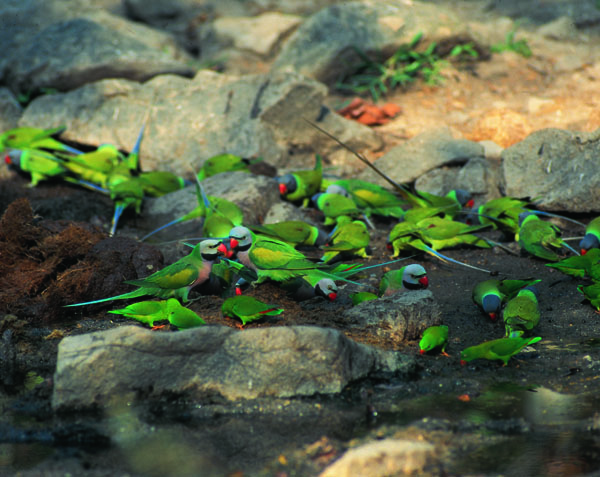
Page 59
Red-breasted Parakeet Psittacula alexandri and the smaller Vernal Hanging Parrot Loriculus vernalis. This mixed flock is at a mineral lick in the central area of the sanctuary. These two species and some pigeon visit the lick daily, sometimes twice, to take in pebbles and minerals.

Page 60
Banded Broadbill Eurylaimus javanicus with an insect. This is probably the most striking of the seven species of broadbill, with its beautiful crimson breast, black with yellow spotting on the wings and a turquoise bill. Difficult to observe and an uncommon resident, this broadbill is one of the loveliest examples of an arboreal bird.

Page 61
Crimson Sunbird Aethopyga siparaja. The 15 different species of sunbird in Thailand are found from sea level all the way up to the highest mountains. Basically like the New World hummingbird, they are not as vigorous in hovering and flight. These very small birds use their curved beaks to eat nectar and insects. They flit about the forest with endless energy.

Page 62
Lineated Barbet Megalaima lineata feeding on a berry tree at Khao Ban Dai guard station. This barbet is one of the most common of the 13 species found in Thailand. It is frugivorous and normally stays in the upper canopy of the forest. Barbet are heavy-bodied birds with large heads and stout bills.
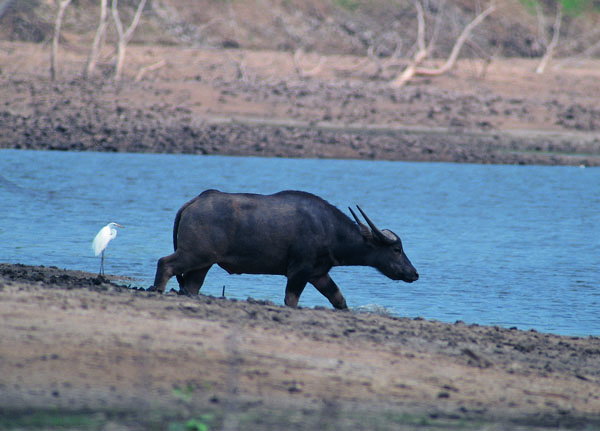
Page 64
Great Egret and Wild Water Buffalo bull on the river near Kreung Krai, close to the upper reaches of the Sri Nakharin dam and reservoir. Innocent and unaware of the man-made perils around them, they face an uncertain future at the hands of poachers and encroachment.

Page 66
Red Junglefowl Gallus gallus hen with her two chicks at the river. These wild chicken, the ancestors of the domesticated variety, are always extremely wary and can fly away out of danger very quickly, flapping their wings and squawking loudly. Red junglefowl are found all over Thailand but are heavily poached for their meat.

River Lapwing Vanellus duvaucelii of the plover family. This medium-sized wader lives along the lower reaches of the Huai Kha Khaeng. They act as sentries for the wild water buffalo that also live in the area. An uncommon water bird seen only in a few rivers around the country. Very wary and difficult to photograph.

Page 67
Hoopoe Upupa epops. This medium-sized bird with its long beak, crest and striking colors can be found in many countries around the world. Feeding mostly on grubs, it nests in cavities of trees and in earth banks.

Page 69
Water Monitor Varanus salvator swimming along the Huai Kha Khaeng. Water monitor lizards live in a riparian habitat and are very good swimmers. They eat anything they can catch, including fish, birds, other reptiles, small mammals, and any carrion they find. They grow up to two meters in length and can weigh more than 50 kilograms. These reptiles are still found in many places in Thailand, even in the khlongs (canals) around Bangkok.

Page 70-71
Gaur B. gaurus in mid-afternoon at a mineral lick. This magnificent solitary bull, estimated at 12 years old, has worn his horns down at the tips and damaged the bases from years of fighting with other bulls. Truly in his prime, he has survived danger all his life. Gaur are the world’s largest bovid species.

Page 71
Banteng B. javanicus and Gaur B. gaurus bulls grazing on lush grass during the rainy season. This photo of two different species of bovid is rare as normally they are not seen together. However, banteng and gaur have been seen together in Huai Kha Khaeng on occasions at several mineral licks in the sanctuary. Mature banteng bulls have a slightly smaller body size, hooves and horns then gaur bulls of equal maturity. These two bulls probably keep together for added security against tiger attack.
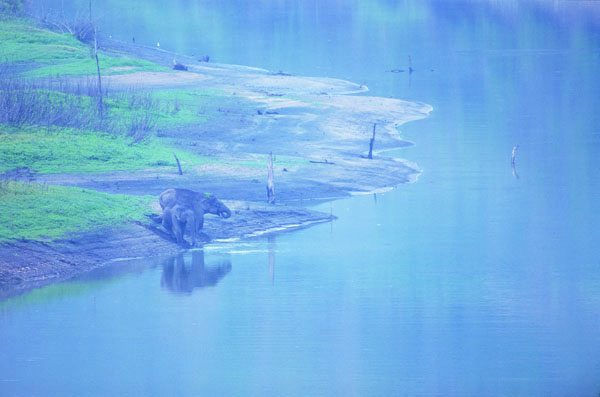
Page 72-73
Asian Elephant E. maximus drinking water in the late afternoon at the mouth of the Huai Kha Khaeng, unaware of their uncertain future. These two and others are seen regularly around the Kreung Krai station. Note the desolation at the drawdown area of the Sri Nakharin reservoir.
To be continued in Part Two..!
Natural splendor in the East
THIS POST IS THE FIFTH IN A SERIES OF WILDLIFE STORIES THAT WERE PUBLISHED IN THE BANGKOK POST. Test and photos by © L.Bruce Kekule
Thailand’s largest remaining tract of lowland evergreen rainforest

A male Siamese crocodile in Khao Ang Rue Nai Wildlife Sanctuary, Eastern Thailand…!
During mid-morning at a secluded murky stream deep in the Eastern evergreen rainforest, a single reptile glides effortlessly through the water to a favorite basking spot. Lying on the bank some three meters long, this freshwater Siamese crocodile warms-up in the bright sunlight. Judging from the many photographs taken of this individual, it is a mature animal. It is thought to be male as no egg nests have ever been found here. Actual age is not known, but it has been here for quite sometime. The habitat consists of several connecting deep pools with abundant fish stocks. The crocodile occasionally takes small mammals and birds. It is a lucky but lonely survivor.
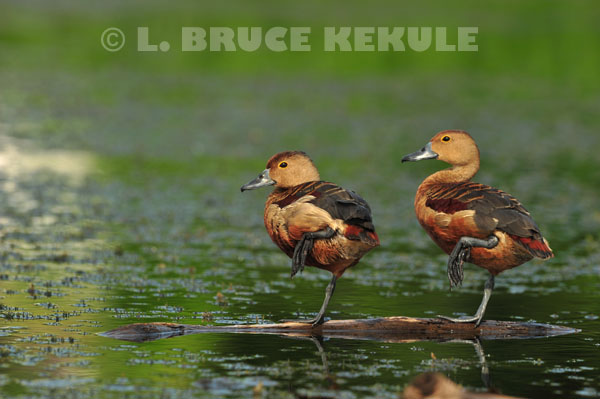
A pair of Lessor whistling ducks showing off on a floating piece of wood…!
Khao Ang Rue Nai Wildlife Sanctuary is home to probably the last truly wild Siamese crocodile in eastern Thailand. There are just a few surviving in nearby Cambodia but their future is threatened by the construction of hydroelectric dams. Since Siamese crocs can live for 60-70 years, it is hoped this individual will be in Khao Ang Rue Nai for some time to come.
Kitti Kreetiyutanont, a forest official working in the sanctuary years back, recorded the first sighting of this individual in 1987 by photograph. The croc still survives to this day, and is a tribute to the tenacity and longevity of the species. However, it is a case in point where humans are to blame for the disappearance of these remarkable creatures, from the lowlands all the way up into deep forest; by encroachment, poaching and logging that went on for decades.
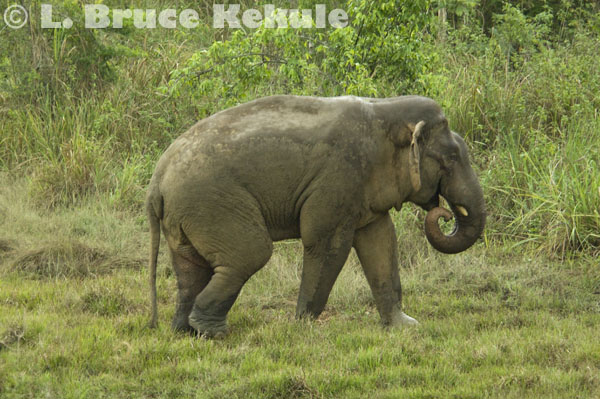
Bull elephant on the move…!
Some 230 million years ago judging from fossil evidence, the first crocodilians evolved from the Archosaur. Crocodiles have outlived the dinosaur but here in Thailand, the demise of the wild species is close at hand. In the past, crocodiles were found in just about every main river system throughout the Kingdom. Modernization has brought these mystical creatures to the brink of extinction. They were mainly captured to stock crocodile farms, and were also killed by the people who mostly feared these shy reptiles. With no laws in place at the time to protect them, extinction was imminent.

Banteng herd moving to a waterhole in Khao Ang Rue Nai…!
However, a reintroduction program could be implemented here, and with increased protection, could work to save the remarkable Siamese crocodile from extinction in the wild. There are several other sites that can also be used for reintroduction such as Yot Dom National Park in Ubol Ratchathani province, and Phu Khieo Wildlife Sanctuary in Chaiyaphum province where crocs were once common. Over in the west of Thailand in Kaeng Krachan Natonal Park, one female is found in the Phetchaburi There are thousands upon thousands of crocodiles in farms, mostly by crossbreeding and hybridization. A wild population is the only option. A few of the crocodile farms still have
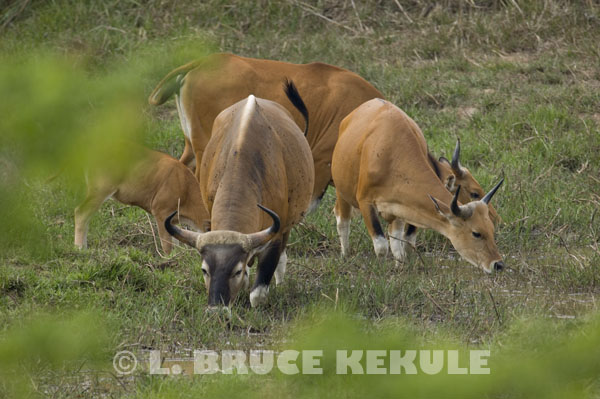
Banteng herd at the waterhole…!
Siamese crocodiles taken from the wild and could easily start a program to save the species. There has been one attempt at a national park to release crocodiles but it apparently was abandoned. Also, several Siamese crocodile have mysteriously showed up at Khao Yai and Thung Salang Luang national parks and believed to have been released clandestinely. These crocodiles should be captured and DNA checked to see if they are truly wild crocs.
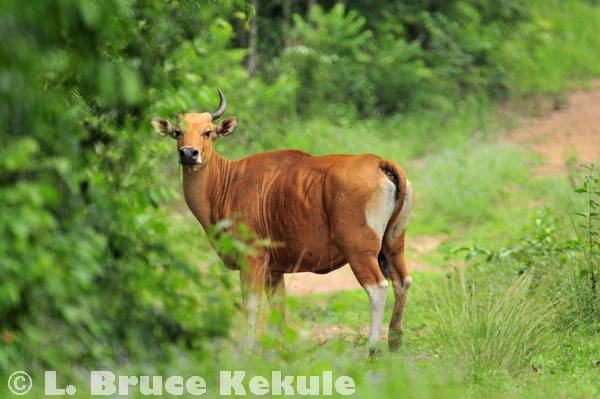
Banteng cow with a lame right rear leg…!
Khao Ang Rue Nai is situated in the provinces of Chanthaburi, Prachin Buri, Chachoengsao, Chon Buri and Rayong. The sanctuary headquarters is located about three hours drive from Bangkok and was established in 1977 by Royal Decree. The protected area consists mainly (80 percent) of dry-evergreen forest with moist and hill evergreen, dry dipterocarp and mixed-deciduous forests interspersed with many streams, and are eastern Thailand’s largest remaining tract of lowland evergreen rainforest in the country. An annual rainfall of some 3,000 to 4,000 millimeters (118-160 inches) has been recorded.
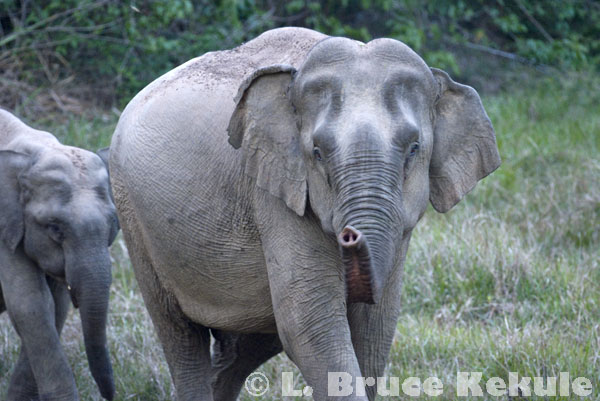
Mother elephant and her young infant…!
The sanctuary is 1030 sq. km (398 sq.miles) in area and is part of the Prachinburi floodplain. It is the largest protected area of the Eastern Forest Complex, which includes four national parks and three wildlife sanctuaries: included are Khao Chamao – Khao Wong, Khao Khitchakut, Namtok Phlio and Khlong Kaeo national parks, and Khao Soi Dao, Khlong Khrua Wai Chaloem Phrakiat and Khao Ang Rue Nai wildlife sanctuaries. Unfortunately, these protected areas are mere islands in a sea of humanity.

Red jungle fowl (Eastern sub-species) breeding pair…!
In the old days, the Eastern Forest Complex was known as the Phanom Sarakham forest, and was one of the richest forests in Thailand famed for its abundant flora and fauna covering an area of about 8,000 square kilometers. Just a short 50 years ago, this dense, lush and vast jungle was home to large herds of elephant, gaur and banteng. Tigers and Asian wild dogs were common as were most of the smaller mammals like sambar, serow, wild pig, and muntjac (barking deer). Hornbills and gibbons, indicator species of an intact forest, thrived. But that quickly shrank as the human population expanded in causing irreversible damage to the ecosystems.
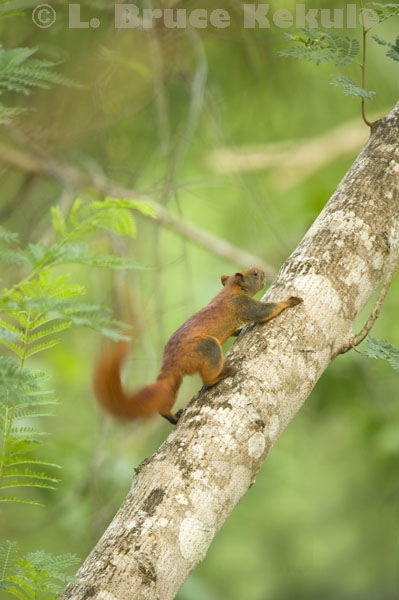
A Variable squirrel early one morning in the sanctuary…!
Due to its close proximity to Bangkok and other cities, many city hunters entered this forest at night spotlighting, either on foot or by jeep. This decimated the wildlife as everything was taken without regard for species, sex or age. The most damaging was the eight 30-year logging concessions carried out by logging companies that cut many roads into the forest. This alone-allowed easy access to virgin forest and it was not long before most everything vanished. In the meantime, this wilderness was also completely surrounded by agricultural land, which also took its toll.

Crab-eating macaque eating ‘mama’ dried noodles found in a trash can…!
Fortunately, and before it was too late; enough forest was saved so that the mammals and others were able to survive to the present. Although populations of the large herbivores have declined, they can be still be seen at various sites within the sanctuary. Unfortunately, the tiger has disappeared but a few Asian wild dogs still roam the interior and are at the top of the food chain.
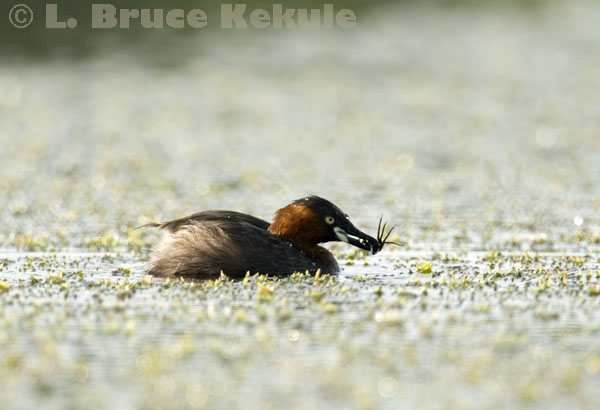
Little grebe foraging for food in the reservoir…!
In 1967 when the Vietnam War was in full swing, the government cut many new roads through the forests in eastern Thailand supposedly to facilitate movement of US personnel and equipment from Utapao Airbase to other airfields in the Northeast. At the end of the Cambodian civil war in 1986, the Thai Army made one such road through the top half of Khao Ang Rue Nai. The impact of the road on this forest and the animals has been devastating and many creatures have been killed or maimed by vehicles on this thoroughfare.
The research unit stationed at Khao Ang Rue Nai on road-kill, deer and bovid population, elephant management and jungle fowl has carried out much research. Most accidents happened from 6pm to 6am. After much publicity, the road is now closed from 9pm to 5pm everyday and road-kill has dropped 70-80 percent. This is a plus for conservation where like-minded people have taken action to help prevent further carnage of wild animals.

Lessor whistling ducks…!
A total of 132 mammal, 395 bird, 32 amphibian and 107 reptile species have been recorded. Thousands of plant and insect species are found. Birds such as the black-and-red broadbill and the Siamese Fireback thrive. The rare woolly-necked stork and lesser adjutant once lived in these forests but have not been seen for sometime and are presumed extinct locally.

Oriental darter drying out its wings…!
Rare water birds like the Oriental dater and great cormorant migrate here and stay for several months at a reservoir built near the headquarters. This water source was created for the elephants during the dry season hoping to help eliminate human-elephant conflict. The marauding giants in search of food and water have killed and hurt many people. There are also recent reports of foraging gaur attacking farmers outside the sanctuary by mostly young bulls kicked out of the herd.
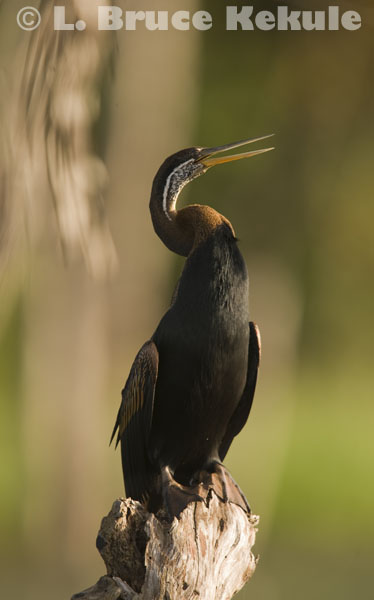
Oriental darter resting on a tree stump…!
The dangers facing Khao Ang Rue Nai are now severe as poachers and farmers snare indiscriminately. Cheap and simple rope snares have killed many elephants, gaur and banteng plus many other mammals. The villagers say they are protecting their crops. But many areas are in close proximity to the forest and interaction between wild beast and humans is a serious problem for the National Parks, Wildlife and Plant Conservation Department, who are constantly under pressure from these conflicts. More personnel and protective management plus a bigger budget are needed to protect these forests.
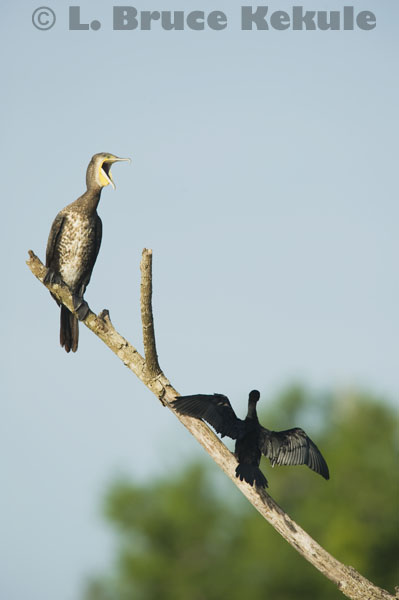
Great cormorant and little cormorant…!

Great cormorant…!

Little cormorant…!
But it must also be understood by the general public that wildlife sanctuaries are not open to the general public and have been set aside for species conservation, protection and bio-diversity research. Unlike national parks, recreation is not encouraged although it does occur, especially at waterfalls and viewpoints. Needless to say, the future of all conservation areas in the Kingdom is in the balance, and only increased protection, conservation awareness and education are the keys to sustain Thailand’s wonderful natural heritage.

Sunrize at the resevoir in Khao Ang Rue Nai Wildlife Sanctuary…!
Notes from the field:
For capturing images of such elusive creatures like crocodiles and elephants, infrared camera-traps are a very productive alternative to endless days of sitting in a hot photo-blind. Crocodiles are creatures of habit, so I set a camera-trap at its favorite basking spot by Klong Takrow. The croc was caught on film many times during a two-week session. One frame shown below was taken in early morning light. It seems as if the crocodile is smiling, and saying, “I’m right here”. I was elated to get such a lucky shot.
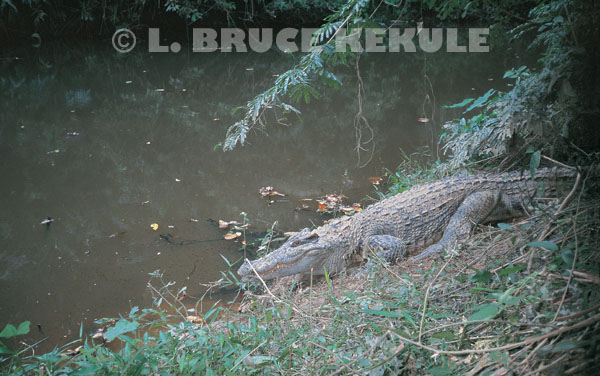
Siamese crocodile camera-trapped at Klong Takrow deep in the sanctuary…!
Khao Ang Rue Nai is currently home to about 130 wild elephants. The road transects the northern part straight through old elephant habitat. The narrow road was widened and resurfaced allowing faster speed. In 2002, a man and woman in a pickup truck barreling through the sanctuary at high speed did not see the elephants on the road until it was too late. The truck crashed head-on into a 5-year-old tusker. The truck’s driver was killed on impact but the woman survived. The young elephant died shortly after.

This unfortunate little tusker was killed on the road two-weeks after this camera trap shot at a waterhole in the interior…!

A tusker camera trapped at a waterhole in the sanctuary…this huge bull has killed a few poachers and villagers…!
The ironic circumstances of this accident – ancient animal and modern machine – weighed heavy in my heart. I had set camera-traps near the crocodile pond in the sanctuary a couple of weeks before. When the film was retrieved and processed, I was elated that a herd of elephants had triggered one of the cameras producing several frames. One frame showed an inquisitive little tusker looking straight at the camera. My elation quickly subsided a few days after the terrible news on TV and newspaper reports that a small tusker had been killed in the sanctuary. My worst fears were confirmed after consultation with Royal Forest Department officials and comparing photographs. A scar on the dead calf’s forehead proved it to be the same animal that I had ‘camera-trapped’.
Such accidents are a terrible blow to the conservation of Thai elephants, because tuskers are particularly vulnerable, being subject to hunting for their ivory. This young tusker was not the first and probably not the last elephant killed by reckless driving on this road. However, the Royal Thai Army and the Department of National Parks should be commended for taking the initiative by partially closing the road at night.
It is hoped that one day the time will be extended from 6pm to 6am to increase the animal’s chances for survival. This is the logical step and humans using this road would have to adjust to the new times for the sake of saving the wildlife.
Published in the Bangkok Post on May 25, 2009 in OUTLOOK – Nature section…’THE WILD SIDE’….!
The River Runs Wild…!
THIS POST IS THE SECOND IN A SERIES OF WILDLIFE STORIES THAT WERE PUBLISHED IN THE BANGKOK POST. IT IS ABOUT THE FIRST EDITION OF MY THIRD BOOK TITLED ‘WILD RIVERS’
Photographic book focuses through the lens of Thai national heritage on five rivers
By: PANYAPORN PRUKSAKIT
A culmination of 12 years work and including a selection of more than 300 photographs, Bruce Kekule’s Wild Rivers is truly a photographic odyssey. From the front cover, graced by the Asian tapir, an animal so rare it is considered a living fossil, one feels like this will be a truly special read. Kekule’s 20 years’ experience as a wildlife photographer, trekking and again through Thailand’s jungles, is invaluable to his epic undertaking, this his third book.

An old banteng bull and cow at a waterhole in the Western Forest Complex of Thailand
Kekule calls this a continuation of his dedication to the “Thai Natural Heritage” with Wild Rivers dedicated to His Majesty the King on his 80th birthday anniversary. On why he chose these particular rivers – the focus of this book is on fiver rivers: The Phetchaburi. Huai Kha Khaeng, Mae Klong, Khwae Noi and the Mae Ping – Kekule remarks the main reason was that they still have wildlife left, he says, as humans have been relentless in their expansion and development plans on other waterways.
Having lived in Thailand for over 40 years, he says that these rivers and the surrounding jungles are some of his favorite places in the country. A rather spiritual man, he recalls how the inspiration for his series of wildlife photography books came to him in a dream. Kekule’s passion for his career of choice is evident – one of his favorite quotes is by the Chinese philosopher Confucius, that one should choose a job you love and you will never have to work a day in your life.

An Oriental Dwarf Kingfisher in Kaeng Krachan National Park, Southwest Thailand
From the opening pages of Wild Rivers, it is clear that Kekule not only seeks the natural beauty of Thailand’s rivers with the reader, but also to inform and educate about these “natural treasures”, as he calls them. As Kekule states in his forward, “without water, there would be no life.” The book begins with a history of Thailand’s formation, and the importance of Thailand’s rivers – what Kekule calls “the lifeblood of the nation”…(as) plants, animals and humans carry out (their) daily lives dependent on water.”
Kekule’s extensive experiences is evident in the clarity, sharpness and vivid colors which define all of his photographs. But what makes Kekule’s shots truly spectacular is that the animals he captures on film are truly in their natural habitat, almost unaware of his presence.
Equally as rivetingas the photographs, which fill the book is the narration from Kekule himself, about his adventures while writing the book. Entitled “notes from the field”, he tells of his encounters with rare creatures such as the king cobra. These stories are both endearing and amazing at the same time – he recalls how he “felt extremely happy at helping to save this beautiful bird of prey from dying,” upon finding an “owl going into shock from hypothermia” and using the campfire to warm-up this creature from a certain death.

Wild pig along the river in Huai Kha Khaeng Wildlife Sanctuary
Kekule seems to have had more than his fair share of luck – indeed he concedes that he has been luckier than most other wildlife photographers, in coming upon rare animals such as the Asian tapir in the daytime. They are primarily nocturnal and hardly seen in the day, let alone photographed with good light. But he believes strongly in the “spirits of the forest”, whom he believes guide and help him. He writes how he pays his respects to the spirits – always before eating.”
However, Kekule’s career as a wildlife photographer has not been without its occupational hazards. He recalls in his book how he “became ill with the deadly Plasmodium falciparum (celebral malaria) that almost killed [him].” Kekule states that only a “medical procedure practiced here in Thailand for patients with severe malaria called a blood exchange transfusion” saved him. While he comments that he was lucky to survive”, even this experience has not kept him from capturing the wildlife of Thailand. However, he now takes some wise precautions that he did not previously adhere to, such as not photographing in the monsoon season.

Wild Rivers – 1st Edition dedicated to His Majesty the King on his 80th birthday anniversary
Kekule states how he will continue with his career for as long as he “can hold a camera and walk”, such is his determination. The most gripping and urgent message of Wild Rivers is found in the penultimate section of the book, entitled “Wildlife in Peril: Dangers threatening the natural world”. Kekule writes about how Thailand’s ecosystems are being progressively destroyed by encroachment, poachers, the black market and the traditional Asian medicine trade. He also writes how education and aid for local village Thais and hill tribe people is needed as middlemen “flash money at the people who are mostly poor and easily persuaded to break the law in order to feed this voracious [black market] trade.” Kekule outlines a step-by-step plan for the government, for “taking care of the natural resources” of Thailand, which included suggestions about budgets and addressing grassroots problems.
Kekule’s love of Thailand as a nation, and the setting for his wildlife photography adventures, is evident in every page of Wild Rivers. He hopes that his books will serve as part of education, which must be implemented in Thai schools to change the mentality towards wildlife and nature, and promote their conservation rather than their destruction. The stunning beauty of Kekule’s book and its important message can certainly not go unnoticed, if only because of the great artistry it showcases. But perhaps the reader can also take away Kekule’s message that “all humans have a right to exist, but unfortunately, not at the expense of the natural world.”
Published in the Bangkok Post’s Outlook Section on November 10, 2008. The photos shown were actually used in the newspaper article when it was published.
LAST OF WILDLIFE TRIOLOGY
THIS POST IS THE THIRD IN A SERIES OF WILDLIFE STORIES THAT WERE PUBLISHED IN THE BANGKOK POST. WRITTEN BY USNISA SUKHSVASTI
LAST OF WILDLIFE TRIOLOGY
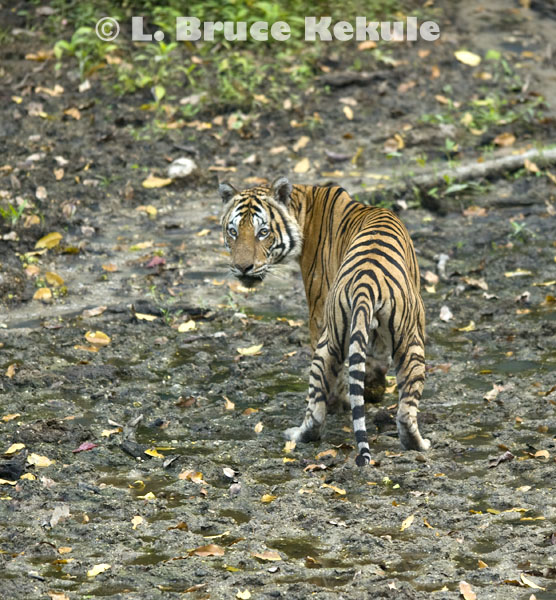
Male Indochinese tiger at a water hole in the Western Forest Complex
Wild Rivers: A Photographic Odyssey in Thailand is the third in a series of wildlife books — the first two were Wildlife in the Kingdom of Thailand and Thailand’s Natural Heritage – by L. Bruce Kekule, respected wildlife photographer and long time resident of Thailand. His books follow a pattern; First is an English-language edition, followed by a Thai language one.
Wild Rivers (1st Edition) was published in 2008, as dedication to His Majesty the King on the auspicious occasion of his 80th birthday, and the Thai edition (2011) recently out at the same time as the second-edition of the English version, dedicated to His Majesty the King on his 84th birthday, with the aim of sharing the beauty of the country’s natural heritage and its wildlife with the Thai people.

Wild Water Buffalo in the Huai Kha Khaeng River
The book covers six of Thailand’s major waterways: The Phetchaburi River, Khlong Saeng River (a new addition to the first edition), Huai Kha Khaeng, Mae Klong River, Khwae Noi River and the Mae Ping River.
The introduction describes the geographical locations of each river, emphasizing as always the importance of preserving these watersheds and the habitat for resident wildlife.

Black-and-red broadbill in Kaeng Krachan National Park
Each river is illustrated with photographs that he has collected from his forays into the wild over the past 12 years, allowing readers to admire the country’s wild animals in their natural habitat.
The book also includes a chapter on Thailand’s nature photographers where 1o Thai photographers and one foreign photographer have shared some of their most cherished images.
In the ‘Wildlife Photography’ chapter, Kekule shares tips and personal experiences gained from his decades in the field, his choice of equipment, the need for patience, the art of stealth, camera techniques, and even computer skills. He also mentions the hazards and dangers of being in the field, not only threats from large animals but also from the tiniest of creatures like ticks, ants and mosquitoes…!
He ends with a plea for nature conservation in ‘Wildlife in Peril’ to create awareness among readers to the diminishing numbers of animals in the wild due to human ignorance or greed.
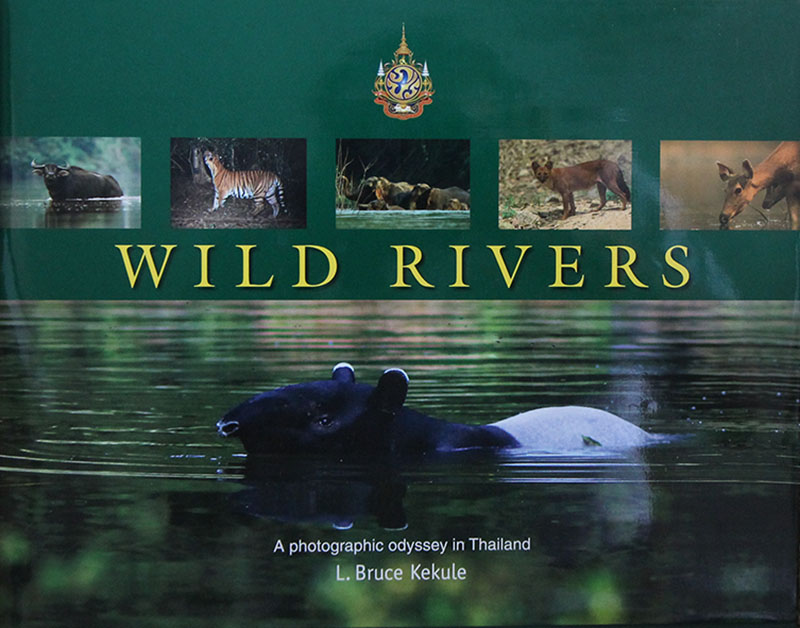
Wild Rivers – 2nd Edition dedicated to His Majesty the King on his 84th (7th Cycle) birthday

Wild Rivers – Thai Version (1st Edition) also dedicated to His Majesty the King on his 84th (7th Cycle) birthday
Readers can be sure of a visually pleasing read. Wild Rivers received a gold medal for the “Best in Sheet-fed Offset” and another gold award for “Best 4-color Printing” at the Thai Printing Association’s 4th Thai Print Awards in 2008.
The Thai version titled ‘Sai Natee Haeng Pong Prai was translated by Capt. Araya Amrapala, PhD.
Note: The photos shown here were actually used in the newspaper article when it was published.
A bad ‘hair-ball’ day….!
Every once in awhile, I make a serious mistake and drive badly. With my good friend Kevin Denley in the passenger seat driving into Huai Kha Khaeng Wildlife Sanctuary on Aug. 15th. 2016, I did not see a huge ditch by the side of the road and ended up falling into said ditch with my truck lying on it’s side. The passenger window was completely shattered and the whole left side of my truck was bashed in. Everything in the truck was on that side with Kevin wedged down. I was absolutely dumbfounded. We were stuck badly and it took some serious effort for Kevin to climb over me as I could not lift my door to get out. If I had been alone, I would have been in serious trouble. We finally climbed out and took stock.
Luckily, a ranger on a motorbike came along and I was able to get to the nearest village (20 kilometers away) to arrange a tractor (5 hour round trip) in order to pull us out. It took some time but we finally got up on 4-wheels. Luckily, neither of us were hurt but my pride took a beating. It was late at night by the time we got back to civilization, some food and a hotel with a hot shower. All I can say is: it was a bad ‘hair-ball’ day…!!
Vultures in India…important birds for the habitat…!
While I was on safari in April 2016, I was lucky to get some nice vulture shots on a carcass at Corbett Tiger Reserve and then at a cliff-face in Panna Tiger Reserve.

Himalayan Griffon , Red headed and Cinereous vultures plus a crow on a carcass in the Dikhala grassland in Corbett Tiger Reserve…!

A Himalayan Griffon vulture flying into a spotted deer carcass…!

Long-billed vultures an a cliff-face in Panna Tiger Reserve…!

A vulture on the wing in mid-morning in Panna Tiger Reserve…!
The Big Six: Large Dangerous Mammals of Africa and Asia
Africa’s Big Five…!
The ‘Big Five’ was coined by colonialists in East Africa by the big-game hunters sometime in the 1850s, and was trophies collected from large dangerous mammals taken with a gun. Photography was in its infant stage and very few photographs of wild animals in their natural habitat were around other than pictures of downed animals on the ground with the trophy hunter and gun bearers standing by its side.

Bull elephant in Tsavo West National Park, Kenya, during the late afternoon. This huge bull came real close to the car but passed by without incident. This was the largest tusker I had ever seen on my four safaries through 11 protected areas. Truly, a ‘wildlife icon’ of Kenya’s natural heritage. Taken with a Nikon D7000 and a 70-300 VRII lens @ 116mm. Offhand through the window.
Many rich and famous people went on safari to the ‘Dark Continent’ as it was called back then including Theodore Roosevelt, President of America and Queen Elizabeth II of Britain, plus many Hollywood movies stars like Clark Gable, Ava Gardner, Grace Kelly and Stewart Granger. Going on safari was big business just after the turn of the 20th century, and usually only the ‘well-to-do’ could afford such a journey. They came from all around the world to hunt the large animals that were thriving in great numbers on the savannas and in the bush.
The ‘Big Five’ list consisted of the elephant, rhino (black and white), Cape buffalo, lion and leopard. Most hunters used large caliber rifles to bring down these mighty beasts as trophies to be hung on a wall, or a rug on the floor in the office or home. Other parts of some creatures ended up as trash cans, ashtrays, lampshades and jewelry to name just a few. This was way before cameras came into vogue to capture these animals on film and eventually digital.

White rhino mother and calves in Lake Nakuru National Park not far from Mount Kenya in the central region. This species is identified by their wide mouth and were reintroduced from South Africa as Kenya had lost most of its rhinos to legal hunting and illegal poaching for the horn. Taken with a Nikon D3s and a Nikon 400mm ƒ2.8 on a beanbag.
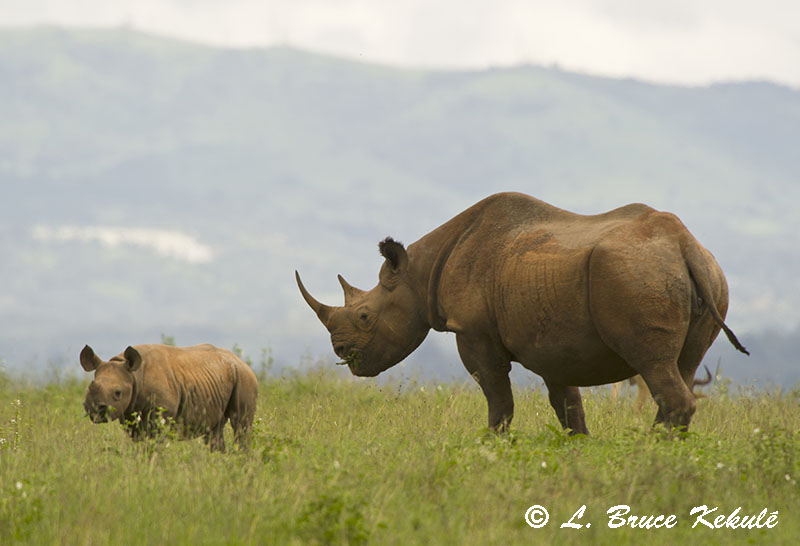
Black rhino mother and calf in Nairobi National Park, Kenya. Part of the city of Nairobi is in the background and there are about 60 black rhinos trans-located from South Africa to this park. Taken with a Nikon D3s and a Nikon 200-400mm @ 650mm on a monopod…!

Cape buffalo in Tsavo East National Park, Southern Kenya. Note reddish color of this very mature bull due to red clay found in the area. Buffalo found in other areas of Kenya are mostly black. Taken with a Nikon D7000 and a Nikon 70-300mm VR II lens @ 220mm on a beanbag.

A black-maned lion in Taita Wildlife Sanctuary near Tsavo West National Park. This big cat was caught in the grassland just before the park closed for the day around 5:50pm. It was a lucky encounter. Taken with a Nikon D3s and a Nikon 200-400 VR II lens and a 2X teleconverter for 800mm on a bean-bag.

Leopard in the Masai Mara National Reserve in western Kenya. This big cat was seen and photographed on my very first day while on safari in this protected area. This was a real good start to capture the ‘Big Five’ of Africa as the leopard is the hardest to photograph in the group. Taken with a Nikon D3s and a Nikon 400mm ƒ2.8 lens on a beanbag.
Thailand’s Big Six…!
For the last twenty years, I have photographed all of Thailand’s large mammals including elephant, gaur, banteng, wild water buffalo plus tiger and leopard. It has been an excellent journey and experience for me, and I feel fortunate to have been at the right time and right place to capture these wild animals with my camera.

A tusker by the river in Sai Yok National Park in the Western Forest Complex. This shot was taken while he was fanning himself more than a decade ago and it is doubtful this big elephant is still surviving. Poachers chase after these elephants for their ivory just like everywhere else jumbos live. Taken with a Nikon F5 and a Nikon 500 P manual lens using Fuji Provia 100 slide film.

A small herd of gaur in Khlong Saeng Wildlife Sanctuary in Surat Thani province down in Southern Thailand. These herbivores thrive quite well here in this protected area along the shoreline of Khlong Saeng reservoir. This was taken with Nikon D3 and a Nikon 400 ƒ2.8 lens on a tripod setup in a boat.

Very mature banteng bull and cow at a mineral deposit in Huai Kha Khaeng Wildlife Sanctuary in the Western Forest Complex. These herbivores thrive very well in this protected area and there are estimated that more than 350 are found here. Taken with a Konica Minolta Dynax 7D and a Minolta 600mm lens from a photo blind across the river.

A wild water buffalo cow charging me by the river in Huai Kha Khaeng in the Western Forest Complex of Western Thailand. This female was part of a small herd wallowing in the waterway. Taken with a Nikon D2x and Nikon 400mm ƒ2.8 lens on a tripod mount from a boat-blind.

An Indochinese tiger at a waterhole in Huai Kha Khaeng Wildlife Sanctuary in the Western Forest Complex of Thailand. There are about 200-250 tigers left in the forests in the East and West and some in the South. They are highly sought after by poachers for tiger body parts, bones and pelt. This male tiger was caught by Nikon D700 and Nikon 400mm ƒ2.8 lens from an elevated blind.
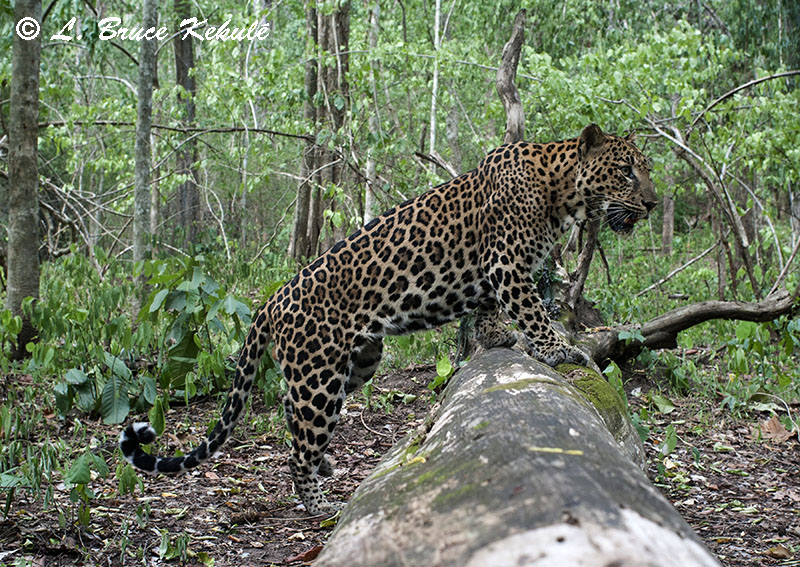
An Asian leopard crossing a fallen log in Huai Kha Khaeng Wildlife Sanctuary in the Western Forest Complex of Thailand. This male cat was captured using a Nikon D700 trail camera with a Nikon 35mm lens and two Nikon flashes. These big cats are fairly common in this protected area and both color phases (black and yellow) can be found here.

A black leopard walking in the afternoon sun catching its spots at a hot spring in Huai Kha Khaeng Wildlife Sanctuary in the Western Forest Complex. This mature cat stayed for more than an hour waiting on prey. This was taken with a Nikon N90s with a 500mm ƒ4 lens using Fuji Provia 100 slide film.
Africa’s Big Six…!
Then in 2010, 2011 and 2012, I made four trips to Kenya in Africa and collected images from ten protected areas including the Masai Mara National Reserve that was first on the list, followed by Lake Nakuru, Samburu, Amboseli, Tsavo East and Tsavo West national parks, Taita and Shimba Hills wildlife sanctuaries, Sweetwaters private reserve and finally, Nairobi National Park capturing the ‘The Big Six’ which includes the elephant, rhino, buffalo, lion, leopard and hippo while on safari. The hippo is included in this list because they take a serious toll on humans that get in their way and are one of the most dangerous animals in Africa. Kenya has done a great job in preserving its wildlife heritage and hopefully one day I will return.

Elephant in Taita Wildlife Sanctuary in Southern Kenya between Tasvo East and West national parks. The large mammals in this area are mainly red colored due to the red clay found here. Taken with a Nikon D3s and a Nikon 600mm ƒ4 lens on a bean-bag.

Black rhino male in Nairobi National Park just outside Nairobi city in Kenya. These odd-toed ungulates were introduced from South Africa and now there are about 60 of them found here. Taken with a Nikon D700 and Nikon 200-400mm lens on a bean-bag.

White rhino in Nairobi National Park close to the Nairobi city in the background. These herbivores are now found in good numbers and were also introduced from South Africa. Taken with a Nikon D3s and Nikon 400mm ƒ2.8 lens on a bean-bag.
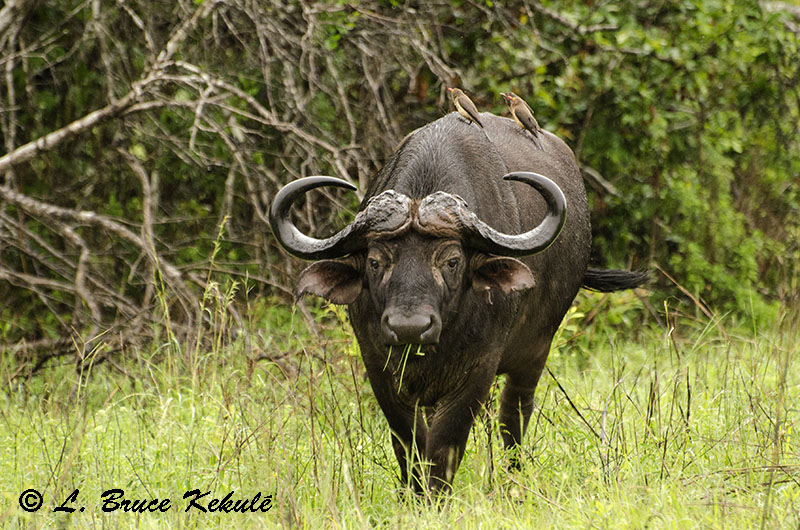
A Cape buffalo down in Shimba Hills Wildlife Sanctuary near Mombassa, Kenya. Due to the moist evergreen forest with loads of rain found here, the large mammals like buffalo and elephants are dark in color compared to their cousin further north that take on a red hue. Taken with a Nikon D7000 and a Nikon 70-300mm lens on a bean-bag.

A lion cub close to the road at dusk in Tsavo West National Park. These carnivores are found in good numbers here as the prey base is also good. Taken with a Nikon D3s and Nikon 600mm ƒ4 lens on a bean-bag.

A mother leopard in the Masai Mara National Reserve in Western Kenya. These carnivores thrive as prey species is very good in this protected area. Taken with a Nikon D3s and a Nikon 400mm ƒ2.8 lens on a bean-bag.

A male hippo in Tsavo West National Park in Southern Kenya. These huge herbivores live around large waterholes found in the park. They are dangerous mammals and more people die from hippo attacks then all the other big animals put together. Taken with Nikon D3s and a Nikon 600mm ƒ4 lens on a bean-bag.
India’s Big Six…!
India was next on my radar and my first trip happened in April 2013, then again in November 2014 and two trips last year (Feb-Mar & November, 2015). So far, I have visited the most famous protected areas in India consisting of Kaziranga, Ranthambore, Bandhavgarh, Corbett, Tadoba, Kanha, Pench and Satpura national parks and tiger reserves. The ‘Big Six’ list includes elephant, Indian rhino, wild water buffalo, gaur, tiger and the leopard were photographed.
Hunting back in the old days was carried out primarily by the British and India’s Royal Maharajahs, which almost wiped out many species especially the tiger. However, the country has done an amazing job of saving this species from the brink of extinction for people from around the world to see and enjoy. The balance of nature is still fairly intact and these creatures still thrive on the sub-continent in good numbers.

Bull elephant at a waterhole in Kaziranga National Park and Tiger Reserve in Assam State, Northeastern India. There are some 1,000 of these herbivores found in the park. Taken with a Nikon D3s and a Nikon 200-400mm lens on a mono-pod.
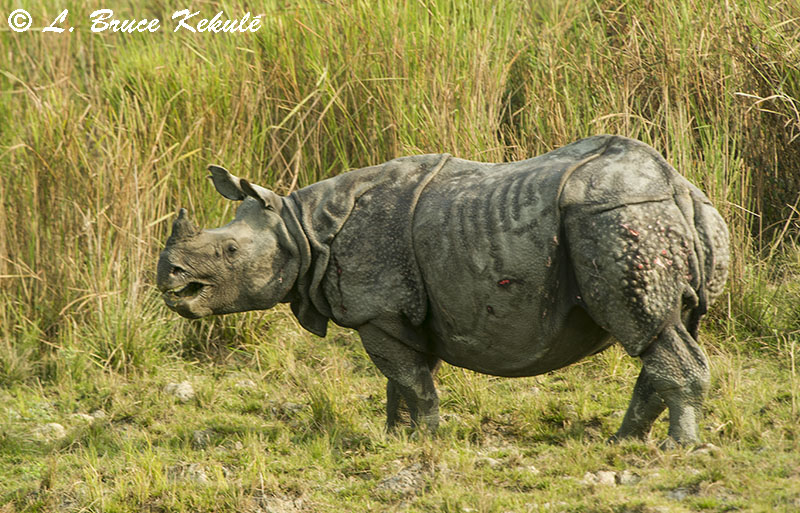
A male Indian one-horned rhino in Kaziranga National Park and Tiger Reserve. There are roughly 2,400 rhinos now and is one of the greatest conservation success stories in the world. Some 80 years ago, there were a mere 12 remaining and the Assamese government established a ‘shoot-to-kill’ policy for any poachers found in the park. Taken with a Nikon D3s and Nikon 200-400mm lens on a mono-pod.
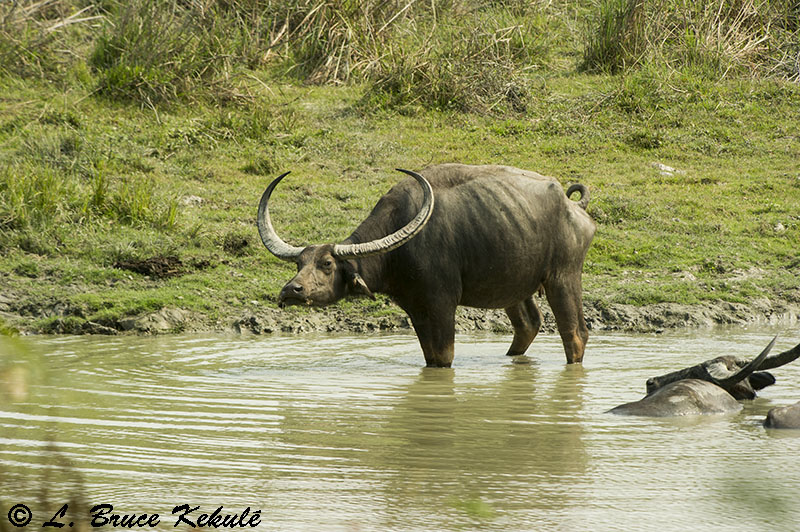
A wild water buffalo in a waterhole in the park with huge horns. These herbivores have the largest horns in the world. There are some 1,300 buffalo found here and is one of the largest herds in the world. Taken with Nikon D3s and a Nikon 200-400mm lens on a mono-pod.

A bull gaur in Kanha National Park and Tiger Reserve, Central India. These even-toed ungulates are the largest bovine in the world standing 1.7 meters at the shoulder. Taken with a Nikon D3s and a Nikon 200-400mm lens on a mono-pod.

A male tiger named ‘Wagdoh’ (one-eye) in Tadoba Anhari Wildlife Sanctuary in Central India. There are about 2,400 tigers in India’s protected areas and is the largest population in the world. Taken with a Nikon D3s and a Nikon 200-400mm lens on a mono-pod.

A female leopard in late morning in Tadoba Anhari National Park, Central India. For the most part, leopards are tough to spot in the forests of India. However, luck does come and this beautiful girl posed for my camera on my first morning safari in March 2015. Taken with a Nikon D3s and a Nikon 200-400mm lens on a mono-pod.
In 1995, I began what will be my last profession in life when I picked up a camera some two decades ago. Photographing wildlife is the greatest thing I have ever accomplished in my 70-odd years on the planet. It has been a journey of discovery and rediscovery, and sometimes I wish I could have started wildlife photography when I first came to Thailand in 1964. The jungles and teak forests were absolutely teaming with wild creatures from Asian elephants down to tree shrews. Birds, reptiles, amphibians plus insects and spiders were also found in great numbers.
Conclusion: It is my opinion and utmost worry that some of these ecosystems and large mammals found in Thailand, Kenya and India are in jeopardy from human influences. Certain species have gone into serious decline or have even become locally extinct due to the human population explosion, and expansion into these wild places. Therefore, more is needed to protect and save the natural wonders of ‘Planet Earth’ from annihilation by the human element before it is too late. A thousand percent increase in preservation, forest management, more personnel and rangers on the ground plus more funds is the only answer. But with so many obstacles in the mix, I remain optimistic about wildlife in many forests of the future. As the natural biospheres undergo serious threats and changes to their integrity by humans, the road to extinction is at hand for many.
However, saving wildlife and the protected areas where they live with good security and enforcement must be implemented and is the key to the animal’s future survival in places like Kaziranga National Park in Assam, northeast India. Here, most guards are armed with a .303 service rifle and extreme measures are upheld to the letter; poachers are dealt with swiftly and in a deadly manner in some cases. Because of the stringent rules and protection, there are 2,400 Great Indian rhino, 1,300 wild water buffalo, 1,000 elephant and one of the highest tiger densities in the world with over 100 big cats living in a smallish (840 sq. kilometers) park. Kaziranga is the true role-model for real wildlife conservation around the world in desperate times. As more and more creatures disappear from the wild, tougher rules and regulations is the only way to guarantee their future survival…!