

Archive for the ‘Camera Trapping’ Category
Land of the Argus Pheasant

Colossal limestone massifs in Khlong Saeng Wildlife Sanctuary, Surat Thani province, southern Thailand.
Down in southern Thailand, the Khlong Saeng River flows from the Phuket Mountain Range into the Gulf of Thailand at Surat Thani province on the eastern side of the peninsula. Up in the highlands, many tributary streams flow into the Rajaprabha Dam (formally know as the Cheiw Larn Dam) permanently flooding this forest in the upper reaches of this once magnificent biosphere. Some of that natural heritage still remains to this day.
Khlong Saeng is part of the Khlong Saeng-Khao Sok Forest Complex that has been a protected area since 1974 way before the destructive dam was constructed on the river in the 1980s. This large waterway flows east known as the Mae Nam Tapee flowing through the city of Surat Thani. The watershed is an immense wet tropical rainforest with many wild Sundaic and Himalayan species still thriving here.
Colossal limestone massifs some as tall as 900 meters rise up from the reservoir and dominate the landscape. These were laid down more than 200 million years ago during the mid to late Permian. Then they were thrust up when India crashed into the Asian plate that began 50 million years ago. The Indian plate had separated from the ancient continent of Gondwanaland and moved north on a tetonic plate resulting in the formation of the Himalayas and causing a north-south uplift across Southeast Asia in a ripple effect.
Unfortunately, the tiger and the leopard have already disappeared from the sanctuary but many other beautiful predators such as clouded leopard, golden cat and marbled cat still thrive here. This habitat unfortunately has been seriously degraded by the construction of the dam. However, some of this forest still harbor rare and unique Asian creatures like tapir, gaur, elephant and the magnificent Argus pheasant that continue to thrive in the thick vegetation made up primarily of moist evergreen forest.
There is a permanent reservoir 60 kilometers long and 20 kilometer at its widest point, and dammed near the Khlong Saeng Wildlife Sanctuary headquarters. Many people live on floating rafts and fishing is allowed. However, some fisherman in the past used devious methods like electricity or explosives plus trap-lines to catch fish and stocks plummeted. The Fisheries Department regularly release certain species to boost the local economy. Next door to Khlong Saeng is the world famous Khao Sok National Park. However, this has been very detrimental to the environment with extreme tourism that seems to be increasingly damaging to the biosphere.
There are many noisy boats and loads of tourists that visit Khao Sok National Park everyday next door. The Department of National Parks (DNP) manage the lake, and due to poor policies and low budgets, has had an enormous impact on the wildlife and ecosystems in the Khlong Saeng valley. The Electrical Generating Authority of Thailand (EGAT) who own the dam unfortunately gave responsibility to oversee the reservoir to Khao Sok. The national park’s mandate is to get as many people in as possible and make money for the park and its officials, and the local venders. Protection and enforcement is not part of their program. This of course has had a serious impact on the scheme of things.
In Early 2013, I became friends with Greg McCann with Habitat I.D. on Facebook. We decided to do a camera trap survey in the forests of Khlong Saeng as I knew it well having worked there photographing wildlife for two years in 2008-2009. It took us sometime to put a program together but we finally made the first foray into this forbidding and mysterious forest back in July of 2014. Habitat I.D. provided four Bushnell Trophy Cam (video/stills) camera traps plus some financial funding. I also threw in three Bushnell cams and a Nikon D90 DSLR cam.
In September 2014, I went back to Khlong Saeng to check our camera traps and make an assessment of this forest and its inhabitants. It was the middle of the rainy season and the water level in the lake was full. Accompanied by rangers from the sanctuary and research station, we moved up into the forest and serviced all the cams changing out batteries, memory cards and desiccant (silica gel). All the cams were left in place to further record any animal traffic on the wildlife trails down several ridge lines.
After downloading all the cards, imagine my excitement to find so many rare animals on video including elephants, tapir, clouded leopard, golden cat, sambar, Fea’s muntjac and common muntjac plus many others. My DSLR Nikon D90 produced an amazing shot of a clouded leopard.
In mid-January 2015, I made my 2nd visit to Khlong Saeng as scheduled to close-out the camera trap program. Once again this forest did not disappoint. Due to problems with flash on my Nikon D90, I changed it out for a Canon 400D with three flashes. I got some terrific shots of an old female tapir (she looks pregnant) that was totally unexpected on the Canon, plus some absolutely amazing behavioral videos of Argus pheasant. This beautiful creature did ‘wing displays’ in front of a Bushnell Trophy HD Cam and video quality is quite good as this bird came in daylight. In the future, I will be setting higher quality video cams here again as it looks like this male uses this opening in the forest for his display area…!
Khlong Saeng Wildlife Sanctuary needs new direction in management plus better protection and enforcement. However, it’s doubtful that any major changes will happen anytime soon. Making money has taken precedence over everything else and that alone will be its downfall. After years of abuse, the future is uncertain as we move into the 21st Century. These wonderful animals and ecosystems are in serious jeopardy…!

Canon 400D catches two male leopards: But poor camera placement affects the image..!
A black and yellow phase leopard caught on trail cam
After the dry season when the first monsoon rains arrived here in Thailand this year, I decided to go back to my old stomping grounds where tigers, leopards and other Asian species travel back and forth down a wildlife trail deep in the Western Forest Complex of Thailand. Last year, a bull gaur charged me not too far from this location and it still brings shivers down my spine when I look back on that incident. However, it is one of my favorite sites to catch the denizens of the Thai forest on camera traps.
Spotted leopard caught in the afternoon.


A couple months ago, I pulled out my first DSLR trail cam that had been rumbling around in my truck for sometime. It’s a Canon 400D with a Nikon 50mm manual lens that uses an external hard-wired SSII (Snapshotsniper) sensor and three hard-wired Nikon SB-28 flashes. The camera is housed in a Pelican 1150 encased in one of my ‘elephant proof’ aluminum boxes and firmly bolted to a tree just by the trail. When I set the cam, it was pointing a bit high and the framing was off. Of course I did not notice it at the time of installation. I recently posted somewhere that sometimes if takes a little experimentation and adjustment to get the composition just right. This is one of those times…!
Black leopard caught in the morning.


The cam has been on that tree for almost two months now, and I decided to go and service it. A female muntjac (barking deer) had passed but on August 22nd at 3.40pm, a yellow phase leopard passed the Canon that ripped off six quick shots. Then on August 28th at 8.26am, a black leopard got caught going the other way and tripped the cam for another 6-shots. Funny enough, both cats are males. For some reason, the flashes were not powerful enough and the images of the black leopard are underexposed with loads of noise. I have tweaked them a bit but they are what they are; good record shots.
Common red muntjac or barking deer female

A female on the run…!

I have re-adjusted the cam for better framing and put in another flash near the sensor down low (switched to radio flash triggers). Hopefully that will lighten things up a bit in the target area. Replaced the batteries, card and desiccant, and tested the system. Seems to be working OK. This highway in the forest should produce more mammals as they go about their daily lives. I now have four DSLRs working in this forest: a Nikon D700 at the ‘tiger log’ and a Nikon D90 just up the trail a bit, plus another Canon 400D at another location and then this Canon. Hope to get one of my Canon 600Ds and a couple Sony DSLRs going soon with different locations and composition. Enjoy…!
Male leopard crosses ‘tiger log’…!
Last month, I had a hamburger at a joint close to my house up-north in Thailand. The next day, I was admitted to hospital with a ‘acute’ food poisoning. It has taken almost a month to get back to normal, hence not much camera trap work from my end. However, I finally got to my only Nikon D700 DSLR trail camera and got a pleasant surprise.
A male leopard (can just see his family jewels) crossing my ‘tiger log’…this is in the ‘Western Forest Complex’ of Thailand…! Daytime shots of leopard are rare for the most part but it does happen here where I work from time to time…Enjoy…!
Camera settings: 1/160 sec; f/8; ISO 400
Nikon D700 – Nikon 35mm manual lens – Two Nikon SB-28 flashes – SSII external sensor

Asian leopard crossing ‘tiger log’ in Huai Kha Khaeng, western Thailand
The Asian Leopard – Thailand’s 2nd largest wild cat…!
This film is a culmination of videos and still photographs of leopards captured by video and DSLR camera traps in the ‘Western Forest Complex’ of Thailand. The first black cat video was taken just a few months ago. Enjoy..!
Canon 400D catches an old Asian tapir and clouded leopard
Southern Thailand’s natural heritage – an odd-toed ungulate and a carnivore

A mature Asian tapir caught by a Canon 400D trail cam…!
Just returned from Khlong Saeng Wildlife Sanctuary in the south of Thailand and pulled my Canon 400D camera trap. These shots are of an old Asian Tapir and the best ones in this set as shown here. Being odd-toed ungulates and strictly vegetarian, these large herbivorous mammals thrive quite well in this unique ecosystem made up of moist evergreen forest. These unique creatures have been on the planet for about 40 million years. They are the largest of the world’s four species with the other three in South America…!


This tapir almost looks pregnant…!

A clouded leopard in daylight…!
This cam also caught a clouded leopard but the cat came in a bit low. These cats are not normally out in broad daylight but I guess they do sometimes prowl during the day. That was the trade off for the full-frame tapir shot. This sanctuary is simply amazing and I look forward to future visits…! Enjoy…!
An ISO Blunder
Sony A500 catches a tiger and poachers at ISO 12,800
Sometimes, mind lapse is a serious problem for a senior citizen like myself. I set my Sony A500 on a trail just inside the boundary of my favorite protected area in Thailand. This location has already produced some amazing shots of black leopard and tiger plus many prey species like elephant, banteng, barking deer, sambar and wild pig.
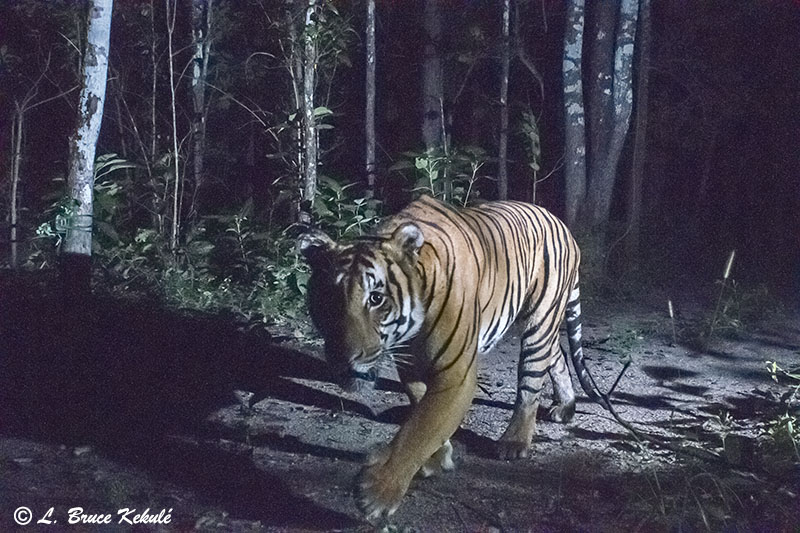
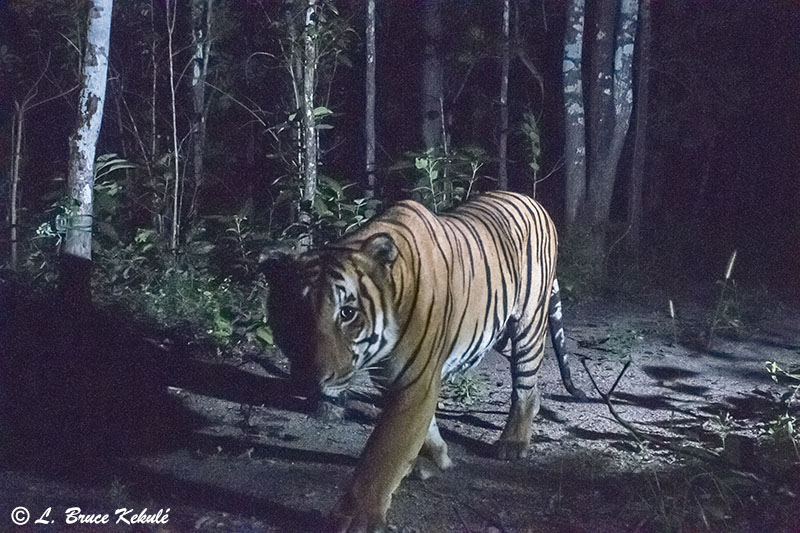


Tiger passes the Sony A500…!


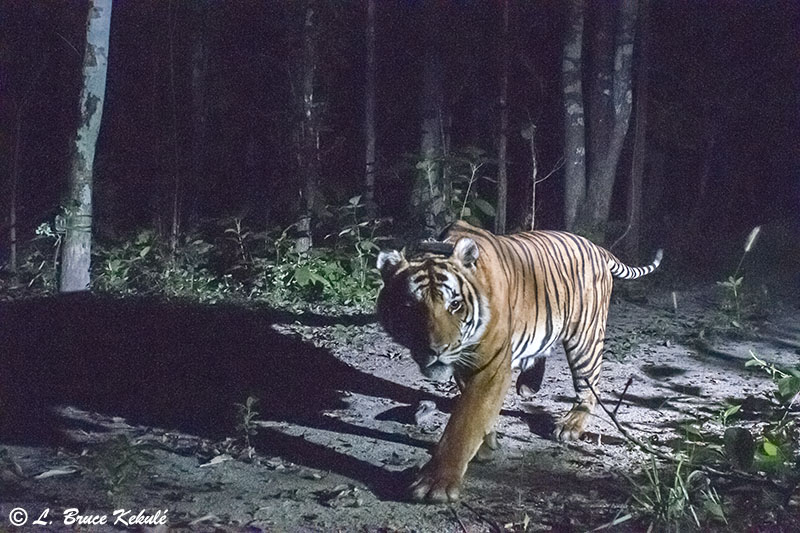
Tiger with a radio collar passes the Sony…!
On the negative side of things, this cam has also caught poachers and gatherers as they illegally sneak into, and exit the sanctuary. Poor patrolling and enforcement with many loopholes allow these undesirables to penetrate and poach animals and forest products for sale or personal use. It is a serious threat to all of Thailand’s protected areas and is on-going problem for the Department of National Parks (DNP)…!
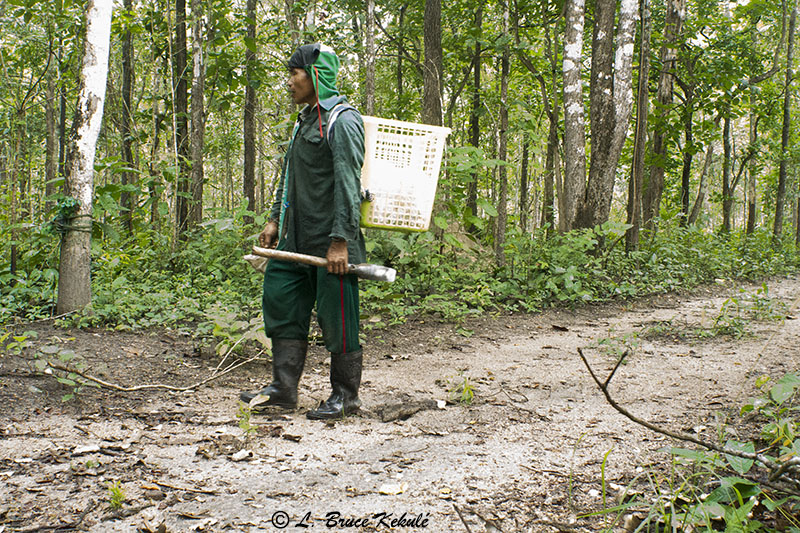


Poachers with baskets and digging tools after bamboo shoots during the rainy season…!

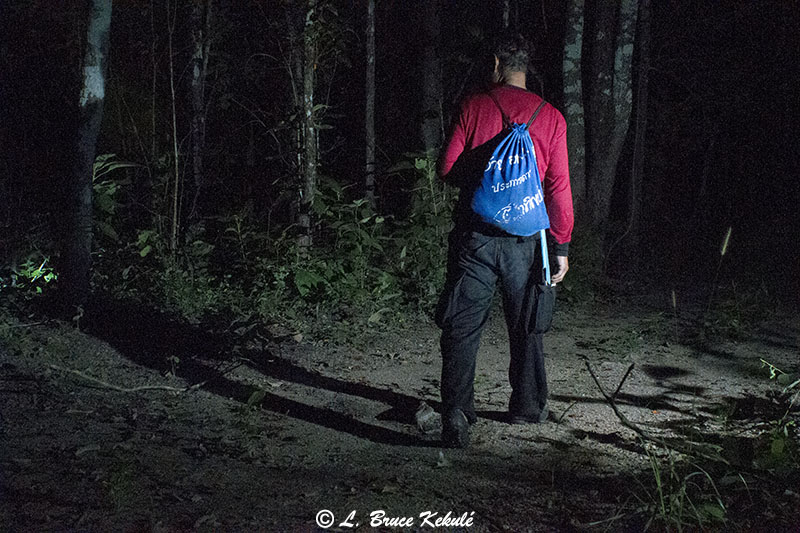
Wildlife poachers with no basket…!
This Sony has been working very well catching a male tiger with a radio collar at night several months ago. I noticed that several people on the forum were setting their cams at ISO 200 and thought I would give it a try. When I left the cam, I thought it was at the 200 setting.
A month or so later, I went back to change out batteries, card and desiccant, and saw the same tiger with a collar had visited twice plus some poachers caught using the same path. When I downloaded the images, I was shocked to see the ISO at 12,800…what the heck happened here…?
I don’t know but it looks like I did not save the settings before buttoning up the cam and somehow pushed the 12,800-button. This was of course another disappointment. The shots are cluttered with noise and I have tweaked the images but it’s a fact: photos with ISO this high is absolute rubbish and can only be counted as record shots.
Another thing: only one flash on the right was working hence the deep shadow. I found a broken wire on the other flash so brought the whole unit in for repair. I will be setting another Sony (A55 with a 55mm lens) DSLR cam with 4 flashes (hard-wired) to see what might pass-by.

The ‘Tiger Hunter’ setting a Bushnell Trophy Cam…!
The A500 cam is now back in the forest but at a new location with settings at ƒ8 – 1/125 – ISO 200. It was working well firing off 4-shot strings during walk test and hopefully it will produce some good shots now. Leopards and tiger plus all the other denizens of the Thai forest use this trail so I can only wait till I get back to the cam in a couple weeks.……!
Nikon D90 catches a rare ‘clouded leopard’…!
One of the most beautiful of all the Asian wild cats

Once upon a time, the clouded leopard (Neofelis nebulosa) was found all over Thailand when some 75 percent of the country was covered in forest. At the end of WWII, the human population really began to explode and these magnificent biospheres were cut down for agriculture and settlement taking all the natural resources in its wake. Modern transportation, weapons and logging on a grand scale began to quickly shrink this once remarkable heritage.
Barely 20 percent forest cover is now surviving in an ever-shrinking wilderness. The clouded leopard has been exterminated primarily for its pelt and now survives in all but a few protected areas throughout the Kingdom. It is one of the most beautiful marked creatures in the world. The marbled cat (Pardofelis marmorata), another wild feline is similar in coat pattern but smaller in size. Both of these cats have become extremely rare throughout their range.
In July of this year, I decided to make a trip down to Khlong Saeng Wildlife Sanctuary in southern Thailand in conjunction with Greg McCann and Habitat I.D. (NGO to monitor wildlife in Southeast Asia) to set some camera traps in the moist evergreen forest to see what was still thriving here. Three years ago, I did a camera trap and photographic survey of this protected area and got a marbled cat up on a ridgeline in the interior, plus a clouded leopard in a cave entrance at another location. I knew there was still good possibilities that I would get these cats again.
I decided to set my Nikon D90 DSLR trail cam along with a couple Bushnell Trophy Cams at this same location. Unfortunately, the hard-wired slave flashes were not working due to wiring problems and so left the cam with its single hot-shoe mounted Nikon SB-400 flash. I knew then if the cam caught any creature, I would get images with ‘eye-shine’ but decided to leave it anyway.
I have just returned from Khlong Saeng to collect the data from these cams. Imagine my surprise to see a clouded leopard on the D90’s card. It was an absolute joy to see this cat had passed the cam and even though the ‘eye-shine’ was there, the markings and beauty of this carnivore is truly remarkable. I have pulled the D90 and put a Canon 400D with three Nikon SB-28 slaves which was working very well when I left it. The Bushnell cams also recorded many other species and I will be doing a video post soon. Enjoy…!
Indochinese tiger male caught on video and DSLR
A video and still photos of an Indochinese tiger in the Western Forest Complex of Thailand. This male cat was camera trapped in the afternoon and then in mid-morning…a beautiful carnivore.
The message is the same: these magnificent cats need 100% increase in protection and enforcement as they have become extremely rare in the wild. Unfortunately, some bad people chase after them for bones to be sold on the black market…! The main worry is that help will come too little and too late to really save the tiger and other creatures of the Thai forest…! Enjoy the beauty of raw nature but never forget this message: We need to work hard to change things so these magnificent cats will continue to roam the forest…!
Canon 600D catches a big male tiger
A lucky catch in late afternoon…!

I was finally able to set my Canon 600D with two Nikon SB-28 flashes on a trail where I previously set my BFOutdoors P41 and captured tiger, yellow and black phase leopards plus many other creatures found in this forest. It has been a great location and the set has been very productive.
However, the sensor was not working properly (old #5 with refresh) and run the batteries down. I recently got the #5 program without refresh (many thanks to Johnnydeerhunter on Camtrapper.com) and installed the new chip. It worked like a charm and the Canon will fire off 6 shots a second and wake-up the flashes. The cam and flashes were working great when I left it. I also set up a DXG 567 ‘blackflash’ homebrew video cam close to the Canon to record any animals that passed by (I’ll be posting a video of this cat passing the cam twice).
It has been extremely wet and for some odd reason, the flashes stopped working but the camera continued to crank along. I was pleasantly surprised when I visited the location a couple days ago. On the card was a male tiger that walked past the cam at 4:40PM on October 4th but the flashes did not trigger which created some undesirable noise in this image. This shot is the best of the lot with some highlights on his family jewels and legs, plus a superb back-lit forest. Needless to say, I was still happy with the results and will put this Canon back ASAP…the location certainly has potential and my hope for that black leopard continues…one of these days….Enjoy…!
Sony A500 catches a male tiger with a ‘radio collar’
A male Indochinese tiger in the Western Forest Complex of Thailand..!

What are the odds that my DSLRs would capture two different tigers sporting radio collars within one week of each other..? These are real fluke camera trap shots taken some twenty kilometers away from my Nikon D700 that caught a female also with a collar at the ‘tiger log’. I just posted this on this website a couple of days ago. http://brucekekule.com/camera_trapping/nikon-d700-catches-an-indochinese-female-tiger-sporting-a-radio-collar/

The Sony A500 was triggered by a male tiger on Sept. 17, 2014 at 10:26 PM while the D700 got a female on Sept. 24 at 5:45 AM. I only captured two tigers this trip and it seems weird that they both have collars. Maybe the ‘spirits of the forest’ wanted me to really show and tell the world what is actually going on in this forest concerning tigers. Who knows..?
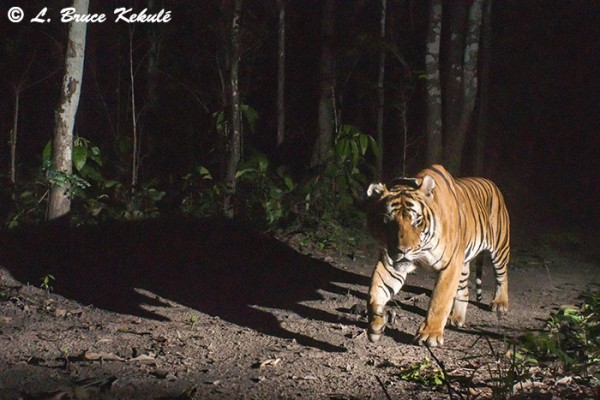
Needless to say, I’ve already vented my feelings about tigers and radio collars in my recent D700 post so there’s no sense in going there again. However, the A500 got a nice string of shots of this male with a huge collar. I think the battery is on the bottom and transmitter on top. This monstrosity surely looks heavy..!
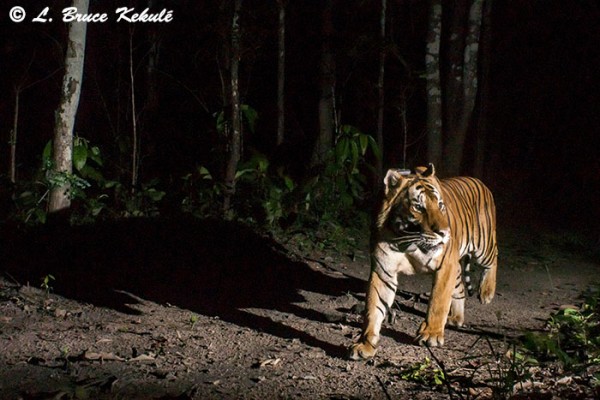
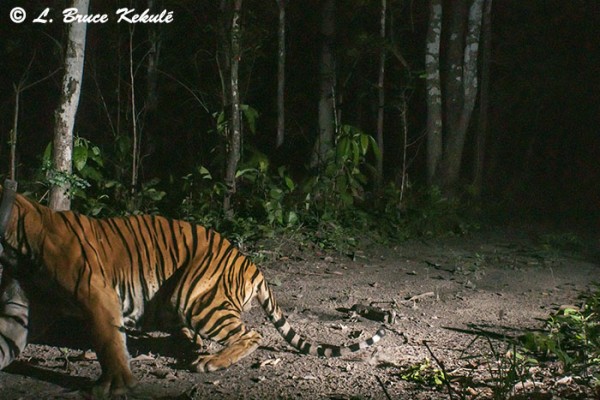
Unfortunately, only one flash on the right triggered which was a bit of a let-down. The other flash was up high on the tree pointing down at the tiger and would have cancelled that shadow. It was one of those things and there’s always next time. The A500 fired four quick shots and as the big cat jumped forward, triggered another five as he leaped to the right. All in all, I was still pleased with the results and look forward to a ‘black cat’ that I once videoed in broad daylight at this very location.

Noise is also a problem with these images, as I had to do some heavy tweaking in Camera Raw and Photoshop to get them to acceptable levels. If I had been shooting in JPG. format, there would be no chance to bring these back. RAW capture is the only way to revive images when things get dark with not enough light.

I’m not sure if this is inherent to Sony but I think most makes and brands with low light means serious noise although the newer pro-cameras handle noise quite well. The settings are: ƒ8 – 1/80th – 400 ISO…flash set to ¼ power, and lens was a Minolta 28mm (old lens I have had for years). It’s a wonder I got these shots at all..!
Oh well, back to the drawing board on flash standby power. I’m putting together a couple Nikon SB-28 and SB-600 flashes that will work with hard-wire or radio triggers with four Eneloop AAs in the flash and four rechargeable ‘Ultracell ‘D’ cells with 11,000 mAh capacity as externals to add more power for longer soaks. This will all fit in a lockable ‘Tupperware’ type box as shown.

I will try these on the A500 first to see if there is a difference with staying power. I also believe that three or more flashes are the ticket for well-lit shots…I know Steve Winter with N.G. sometimes uses from 4-5 flashes depending on terrain.

It’s a never-ending battle with the DSLRs but I guess that’s what I like about using them: the challenge to get tigers and leopards on digital camera plus all the other cryptic animals in Thailand’s forests…it all becomes worthwhile when I do get a shot or shots…! Enjoy.