

Archive for the ‘Camera Trapping’ Category
Nikon D700 catches an Indochinese female tiger sporting a radio collar…!
Tiger research in the Western Forest Complex (WFC) of Thailand

Indochinese tiger female sporting a ‘radio collar’ at the tiger log…!
First off, I want everyone to know that I’m not against research that is extremely important for knowledge of the natural world. The practice of studying animals and behavior is needed to understand how Mother Nature’s beings and biospheres live in a complex world. Some people might take offence to the relevant facts stated below but things need to change quickly in order to really save the tiger, and other creatures and ecosystems of Thailand’s natural heritage.

Close-up: A serial numbered tiger and the number can be seen written on the collar.
Frankly, there are some projects that are on-going and not up to standard that have caused many tiger deaths, directly and indirectly. Such is the ‘tiger research’ carried out that is mediocre to very poor to say the least. The researchers working on tigers here have a track record that simply is not acceptable…!
Many problems have come to the forefront about the system of capturing the big cats with snares and then shooting them with darts to sedate them. Some tigers have escaped the snare and ended up with a limp because of pulled joints, tendons and ligaments. This is a serious problem as the cat now cannot chase down its normal prey like deer and pigs, and quickly dies of malnutrition. Botched tiger captures using wrongly administered drugs to sedate tigers has also been noted. The tigers could not be revived and the animals were simply buried and the news suppressed.

Serial numbered tiger – #164 900 – 2014
Another problem of making broad statements about the amount of tigers in certain areas and broadcasting this plus other pertinent ‘radio collaring’ information on national TV channel is like sounding the death knoll to come and get these magnificent creatures. There are still many bad elements in our society and these cold-blooded killers think nothing about dispatching a tiger for its bones used in the making of Chinese medicine and wine. It’s all about money and human greed…!
This has also happened in India where researchers published their work in the local newspapers, and on the radio and TV how many tigers were in Panna Tiger Reserve and within one year, the cats completely disappeared as poachers moved in and systematically killed them all in one quick swoop. Tigers like all big cats, come to carrion and if a carcass is tainted with poison, it’s just a matter of time before the whole local wild feline population is wiped out. They disappeared under the forestry staff and researcher’s noses. Because it is in open forest, other animals like bears, civets, all the cats, wild pigs. vultures also perish. How could this happen..?
Other stories on the Internet can be found about tigers with collars not breeding very well was also documented in India. Finally, researcher’s laptops have been hacked into and important GPS data on tiger whereabouts was stolen. These high tech poachers can kill a population in a jiffy.
Putting collars on young tigers is a serious no-no but this has been done here in the name of research with the researchers finding the collar had stopped moving and the cub found dead having quickly out-grown the leather strap suffocating it. Another serious occurrence of taking tiger cubs out of their den for research data gathering purposes, and then coming back a second time to photograph the researchers holding the cubs. The mother tiger abandon the den and the cubs ended up dead. This is a serious breach of protocol and the National Parks law…!
Needless to say, these people continue to carry on like nothing has happened but these are facts backed-up by reliable sources and boots on the ground. And what is really worrisome is the fact that several international NGOs and a U.S. university are backing this program.
Other tribulations like bringing domestic cattle to act as ‘tiger bait’ was ongoing until recently, and who knows if any disease like ‘foot and mouth’ or ‘anthrax’ was introduced into the sanctuary during this time. The cattle were purchased locally (sometimes, diseased cows are illegally imported from nearby Burma). This baiting technique was used for several years and the researchers brought these domesticated cattle in by the truckload. A cow was then tied to a stake and a bamboo enclosure built around it with only one opening and they built scores of them in the forest. Of course hay and water were provided to the cow. A tiger would step in and maybe get snared. This practice fortunately has been suspended. This is just another breach of the law where domesticated animals are not allowed in wildlife sanctuaries that have been set aside for biodiversity and research.
The researchers already have loads of data including identifying individuals and home-range information through camera trapping, plus the data from the 8-10 collared tigers. My feeling is that the collaring process should cease as there are far to few tigers left in the wild. No amount of research can justify even one tiger getting killed in the name of science. There are only about 3,200 left in the world, and maybe less than 250 in Thailand. It is time to seriously concentrate on protection and enforcement only and less emphasis put on research. We already know there are tigers in WFC, one of the greatest tiger reserves in the world.
Most unfortunate are the old laws that apply to wildlife and protected areas that seem to perpetuate lawless people from being put away in jail. Most poachers and forest product gatherers get light fines and a slap on the wrist when apprehended in national park land, even with solid evidence. The park officials must bring all poachers to the local police station, which then starts another wheel of corruption at a higher level. If the case gets into the courts, pay-offs are used to get light sentences and sometime off ‘Scott-free’. There are very few convictions and long-term jail sentences although once in awhile, some do end-up in jail as a consequence but the ratio of convicted poachers to released offenders is small.
The biggest problem is simply there are not enough ranger personnel to look after these remaining tiger reserves and, budgets are slim and sometime non-existent. My biggest concern is that everything will come too late to save the tiger from extinction. Lawmakers and budget people need to get their head out of the sand but that will take an act of god (AOG) to get going in a culture that thrives on corruption.
One of the most important things to get established in Thailand is a dedicated ‘ranger school’ so that the ranks can be filled with well trained and equipped personnel. The present ranger numbers need to be increased by over 100%. Several revolving 5-man teams need to patrol with men always in the forest from their respective ranger stations. This is the only way to keep the poachers at bay. Again, this will basically need an AOG to get done.
Once again, I’m not against research, but a line must be drawn in the sand. Too much money and effort goes towards this activity and very little into protecting the wildlife and biospheres here that the researchers are researching. This is just not right and I for one, want to try and change things here so that wildlife at least gets a fair shake.
At the end of the day, the only thing that will help Thailand’s tigers in the long run is also a serious look into the middlemen and end-users of tiger bones and other forest products. These people must be apprehended and the masses educated to see the fallacy in using wild animal parts to cure ailments. The Asian medicine trade is still in full swing and will be next to impossible to stop.
But this practice has been going on for hundreds to thousands of years in China where the tiger first evolved two million years ago. The Chinese tiger is extinct in the wild but they now have loads of ‘tiger farms’. Unfortunately, wild tigers are the most sought after for the black market trade. It is a bad situation out there that seems to be getting worse and on the increase due to the ever-increasing population explosion. Sadly and in the long-run, the tiger will simply disappear if things do not change..!

Sony P41 catches tiger and black leopard
Last month I posted some photos collected from my BFOutdoors P41 trail cam and decided to leave it for one more set. The following pics are what the great little trail cam has captured. Of note: I got four captures of a black leopard which is simply amazing….plus I two Indochinese tigers…I have moved this cam to another location further up the road and have installed my Canon 600D on the tree across from the daytime black leopard shot so that could also be interesting when I visit in a few days…two deer species and a banteng also crossed in front of the P41…Enjoy..!

A black leopard in the afternoon: A Canon 600D is setup on the tree opposite the leopard…!

A female tiger at night.

A male tiger in late afternoon.

Another black leopard capture.

Back again.
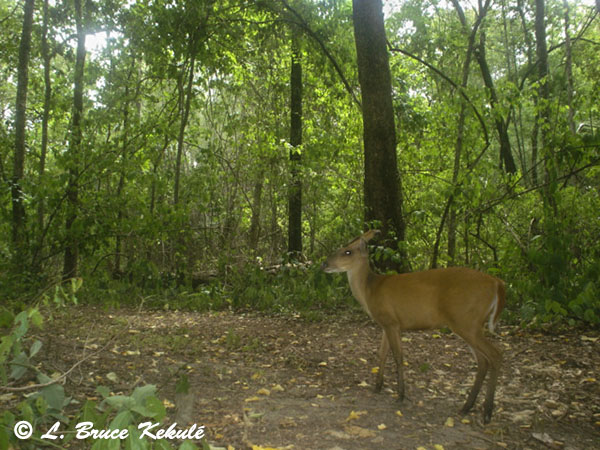
A male muntjac (barking deer).

Male muntjac again.
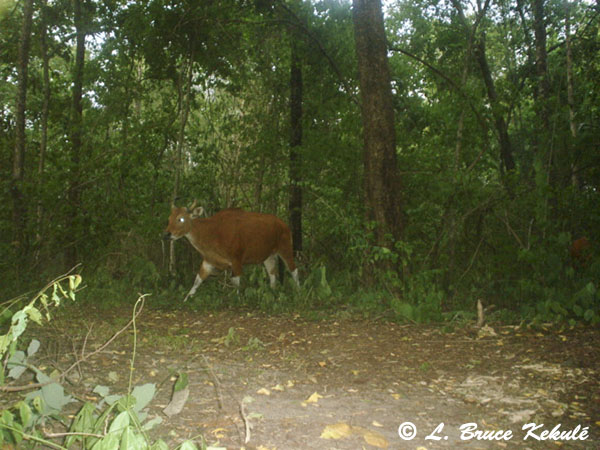
A banteng crossing in the daytime.

A young sambar stag in velvet.
My smallest DSLR camera trap…!
A ‘Hybrid’ trail cam – Sony A55 DSLR/Minolta 50mm macro lens
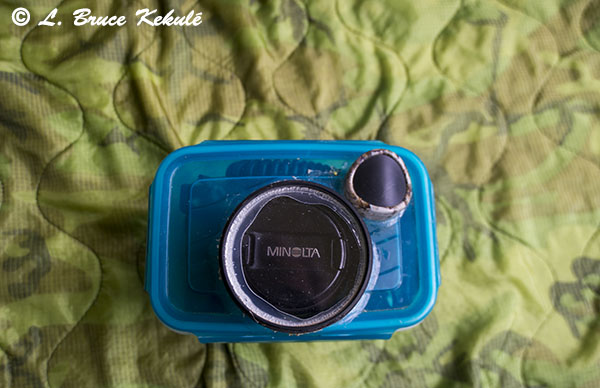
Sony A55 DSLR – Minolta 50mm Macro lens.
DSLR trail cameras for the most part are pretty big. Camera-trappers have built them mostly using the Pelican 1200 and even the 1300 case, and other makes like Plano and Seahorse large cases have also been used.
I have built a few now and like the smaller Pelican 1150 for my Nikon D700 and D300s plus a Canon 400D and 600D with 8-volt SLA battery packs, and even a smaller Pelican 1120 for a Sony A500 but they are still pretty big and standout sitting on a tree in the forest.

Top view of a Sony A55/Minolta 50mm in a ‘Tupperware’ type box.
In my case, elephant’s will home in on strange objects and strength plus rigidity is the No: 1 priority. With my ‘elephant proof’ boxes and three to four lag bolts, these hard and sharp edged external aluminum boxes have survived the forest giant stomping test many times…!
But I wanted something smaller. After some sole searching, I found this lockable plastic box (a Tupperware type) that would allow a small Sony A55 DSLR to just sit in the box with a Minolta 50mm ‘macro’ lens (just happen to have this lens from my old days when I used Minolta cameras). A pair of 18650 Lithium 4.2 volts for externals is used. The A55 is a 12 megabyte camera and is perfect for a camera trap.
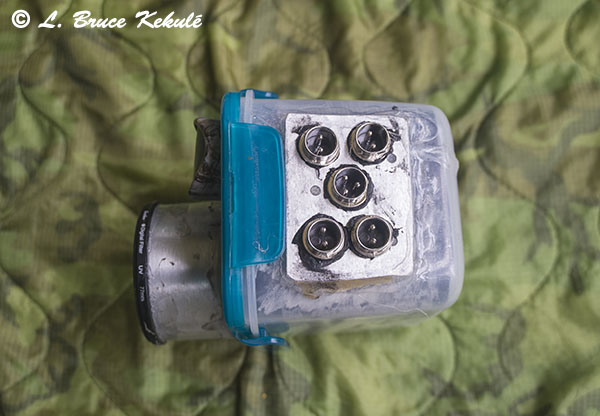
Side view showing connections for flashes (two-pin) and sensor (three-pin).
The Minolta lens works in the Sony perfectly. The snorkel is a length of 77mm diameter thin aluminum tubing secured to the box with Goop. I prefer this to the large, thick and heavy PVC tubing. Goop is also used to attach a 77mm UV filter to the snorkel.
A dedicated ‘elephant proof’ box was built to house the fragile plastic box and camera. I have incorporated a cover to protect the wires and plugs from probing elephant trunks. Four stainless steel lag bolts and a 10mm Python cable secure the box to a tree.
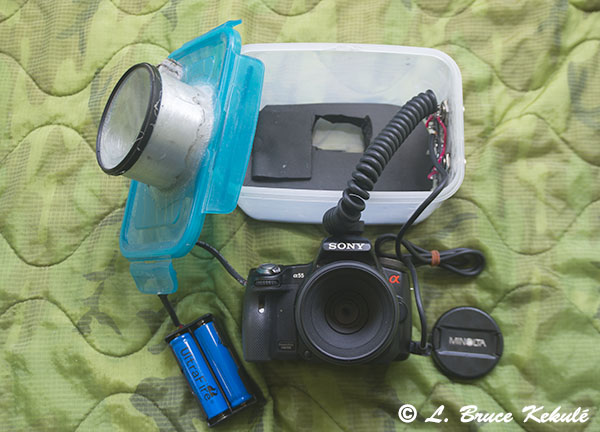
Sony A55/Minolta 50mm showing 18650 4.2-volt externals.
As I won’t be using the flip-up flash or a dedicated hot-shoe flash, I’m using a TTL head and hard-wire everything using two-terminal quick-disconnect plugs for the flashes. A three-terminal plug is used for the sensor, and I seal the plugs with 3M-silicon sealant as shown in the photos. I’ve installed a thin aluminum plate to beef-up this area.
Three flashes are on 10-meter lengths of two-conductor shielded wire with gland fittings on the flash boxes. The fourth flash is on a 15-meter wire to be placed across from the cam hoping to get backlighting of some sort (the set-up and location will require experimentation). I’m using three SB-28s and one SB-80 Nikon flash. All flashes are in ‘Tupperware’ type boxes with elephant proof shrouds made up.

Sony A55 with hard-wired Nikon flashes and SSII hard-wired sensor.
The sensor is a Snapshotsniper SSII with a #5 chip, also on a 10-meter hard-wire cable to be installed on a trail about 6-8 meters from the cam. This way I can focus precisely at the sensor.
I have the perfect place for this cam…to replace the Sony P41 that has captured tiger and leopard plus many other creatures. I will be setting it up in a few days. The rainy season has started and there are not many people around in this area. I’m hoping for some dramatic shots of a black leopard and the other cryptic animals that pass by.

Sony A55 trail cam and ‘elephant proof’ box.
A Sony P41 post with tiger and black leopard to follow…!
A pair of Canon DSLR trail cams…!
A Canon 400D-Nikon 55mm and a Canon 600D-Nikon 20mm

Canon 400D with a Nikon 55mm ‘Macro’ lens on the left, and a Canon 600D with a Nikon 20mm lens on the right.
Working in the Western Forest Complex in Thailand has been extremely satisfying with loads of wild animals passing my cams. This forest is one of the greatest tiger reserves in the world and I look forward to every visit checking my DSLRs…! After the great results from my Canon 400D last month catching a tiger plus yellow and black phase leopards, I decided to finish off these two cams that had been on the bench for sometime.

Both cams in Pelican 1150s with 8-volt SLA external batteries.
As I wanted to leave these cams in the forest for several months over the rainy season, I added an 8-volt SLA battery and hacked into the battery grip (I will do a post on this mod very soon). It was a fairly easy task and both cams fit in the Pelican 1150 with ease plus the SLA battery lying horizontally in the case. After charging up the cam’s batteries and hooking up the externals, they will stay on for months, and just what I needed for a long soak. Time will tell and the 600D is now set-up on a known wildlife trail frequented by the big carnivores including black leopard.

600D showing connections to external sensor and flashes.
I’m using a Snapshotsniper SSII external sensor on the 600D and 400D with both cams set on ‘continuous’ mode. Both sensors are on 10-meter 4-conductor shielded wire housed in ‘Tupperware’ type boxes and hooked up to the cam with 3-prong quick detachable plugs and the sensor boxes with cable glands.

400D showing connections to external sensor and flashes.
The flashes are a mix-pot of Nikon SB-26s and 28s also housed in Tupperware type boxes and hooked up to the cam with 2-prong quick detachable plugs and 10 meters of 2-conductor shielded wire and cable gland on the sensor box. I am standardizing all my flashes with two-conductor shielded-cable and eventually, will be able to inter-change my flashes with all my DSLRs in the field. That way, if I have a problem with a flash (stomped by elephant or some other failure), I will be able to quickly change one out and replace it. That will also go for the three-conductor external sensors…!

600D with external 10 meter hard-wired sensor and flashes.
As usual, I built ‘elephant proof’ boxes that I have made-up for these two Canons. Python 10mm cable locks are used and 3” stainless steel lag bolts are screwed into the tree from inside the box. The faceplate is bolted to the box using six power-torque 10mm machine screws. Camouflage is made up of spray paint (earth brown and army green) plus ‘morning glory’ plastic leaves wrapped with thorny branches to keep the elephants at bay.

400D with external 10 meter hard-wired sensor and flashes.
Hope this helps those people on the forum wanting to build a long-soak Canon ‘Rebel’ sized DSLR home-brew trail cam. I normally don’t use Canon but really like these cams for capturing wildlife. They are quiet and quick enough. The 600D has good file size so cropping is a plus.

600D and ‘elephant proof’ aluminum box.
Actually (don’t tell anybody), I’m changing out two Nikon D300 bodies for Canon 550D or 600Ds…they just seem to work better. But, I’m still sticking to my Nikon lenses with a Canon adapter. Real glass and metal materials are the best lenses for trail cams…but that’s just my opinion…!!
‘Battered’ Banteng Bull
A short video and camera trap photos of a banteng bull in the ‘Western Forest Complex’ of Thailand. My Nikon D700 and a Bushnell Trophy Cam captured this seriously injured creature. This is ‘raw’ nature and could be disturbing to some…but this is the natural world and how it really is……!
Nikon D300s catches an Asian Leopard
A male cat shows off its family jewels…!

A male leopard with its reproductive organs in full swing…Shot No: 6.
Back at the end of June, I pulled a card from my D300s DSLR trail cam at the ‘big cat trailhead’ and when I looked, I did not see anything so I threw the card in the with the rest of my CF cards.
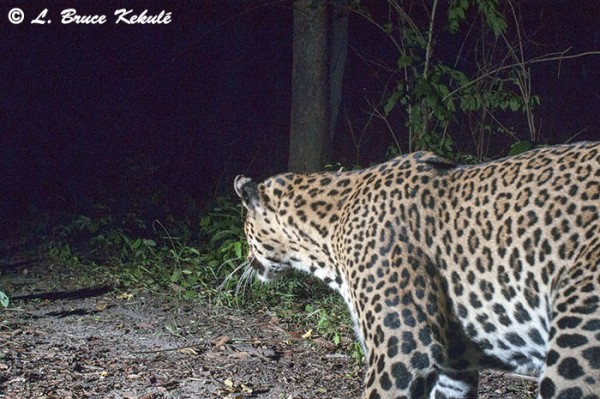
Shot No: 1
It was somehow put into my D3s but fortunately I did not format it. After doing some work while in the forest last week, I pulled both cards (Nikon D3s had two CF card slots) and downloaded them.

Shot No: 2
Imagine my surprise…! There was a male leopard and he had been captured at night while walking past the D300s. Where the heck did that come from…?
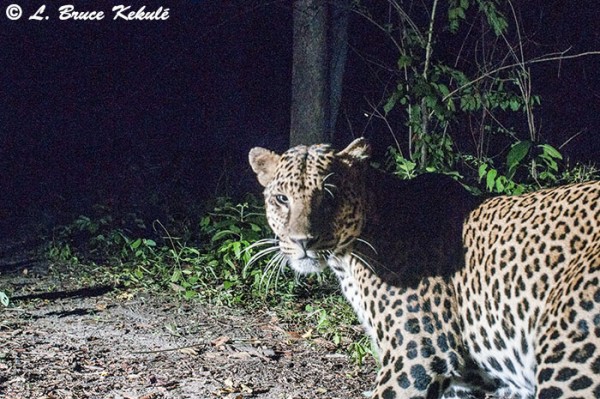
Shot No: 3
I guess my short-term memory is on the blink. Unfortunately, the other two flashes were dead creating a horrible shadow…!

Shot No: 4
Needless to say, I’m lucky I did not lose these shots and of course, shot No: 6 is my favorite…enjoy…!
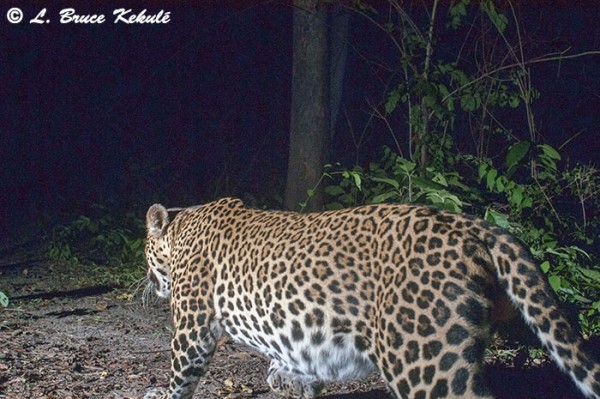
Shot No: 5
Nikon D300s set to low continuous.
Nikon 35mm manual lens.
ƒ11 @ 1/125 ISO 400
Single SB-28 set to full (the other two flashes did not fire and were dead).
SSII sensor #6 chip – Pelican 1150.
Indochinese tiger ‘eye lash’ speed…!
A Canon 400D trail cam catches a male tiger
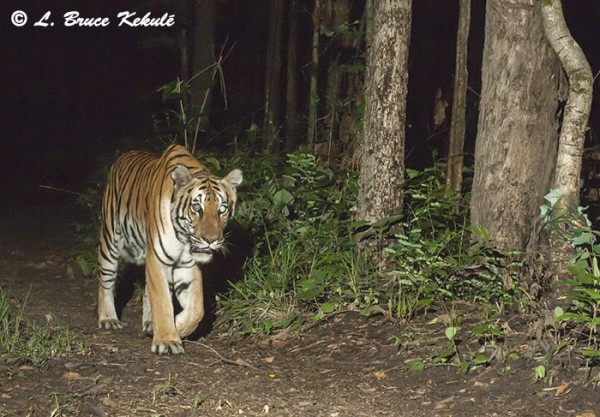
Old green eyes’…out on a ‘night prowl’…1st shot…!
A couple of days ago, I was checking my cams and got to my Canon 400D on a forest road somewhere in the Western Forest Complex of Thailand. When I got to the cam, it was still working but only one flash three feet above the cam was firing hence the ‘eye-shine’ . The other two flashes were dead…! Life on two Canon Lithium batteries in 30 second power save mode is excellent so I left them just to see how long they would really last….!
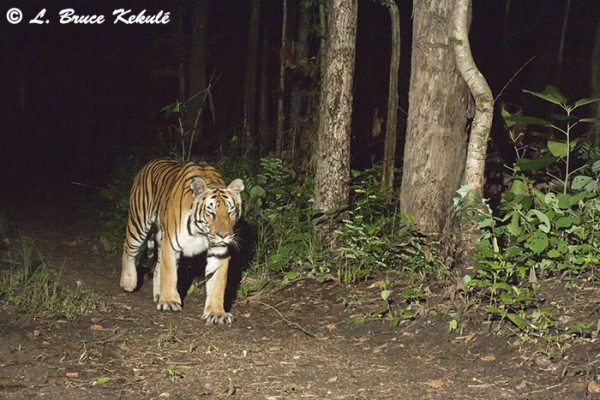
Tiger squinting…..2nd shot.
The flash that fired was a SB-26 which I normally set for slave but somehow the settings was on full-power…needless to say, I was delighted and did back-flips when I saw a tiger again, in about the same position as the female back in June in two shots. In both instances, the tigers had their eyes open on the first shot and squinted by the second in almost the same positions. This reaction time is measured in milliseconds…!
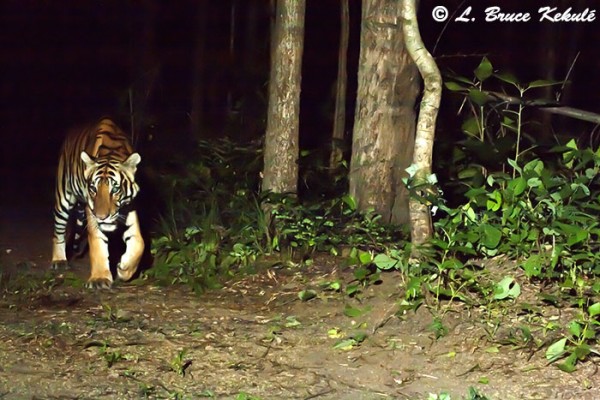
Last month’s female tiger…..1st shot.
Then they both jumped out of the frame before the camera could shoot again. This is 100% luck….also shifted the 400D over a tad to the left for better composition. I have included last month’s female tiger shots so a comparison can be made without having to flip back to the old post.

Female squinting…..2nd shot.
All I can say, it boggles the mind but shows how fast tigers can react……Enjoy…!
Canon 400D set to continuous
Nikon 50mm ƒ1.4 manual lens
Nikon SB-26 set to full power.
1/125 – ƒ8 ISO 400.
SSII sensor #6 chip – Pelican 1150
1st shot – cropped and the rest normal size.
Revisit: Khlong Saeng Wildlife Sanctuary
Some old camera trap shots of wildlife in Southern Thailand

Limestone ‘karst’ mountains at sunset in Khlong Saeng Wildlife Sanctuary.
In 2009, I decided to go down south to a wildlife sanctuary that was still teaming with animals common to the wet tropical forests found here. Khlong Saeng Wildlife Sanctuary in Surat Thani province is some 500 miles from Bangkok and is one of the top protected areas in the country.

Flooded forest near the headwaters deep in Khlong Saeng.
Once upon a time, this forest was a magnificent natural watershed that provided water throughout the year to the inhabitants of the lowlands on the eastern side of the Thai peninsula.
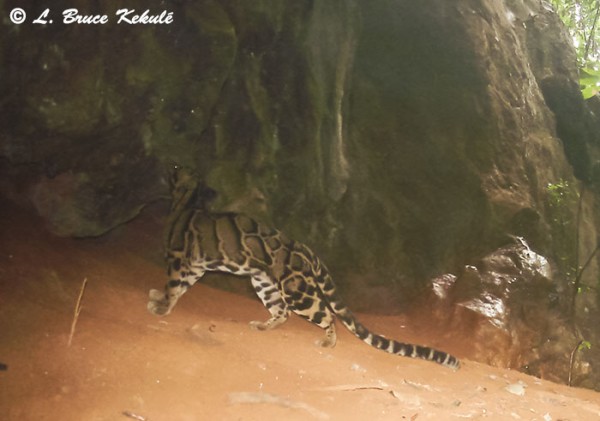
Clouded leopard at the entrance to a limestone cave probably searching for dead bats.
It still harbors some very impressive animals such as elephant, gaur, tapir, serow, sambar, clouded leopard, sun bear, Great Argus (second largest of the pheasant family in Thailand), and the mighty king cobra to name just a few – and the list goes on.

A serow (goat-antelope) at the same cave.
Probably the most impressive scenic site in the sanctuary are the massive limestone ‘karst’ formations that were formed sometime during the mid to late Permian over 200 million years ago. Thailand was part of Gondwanaland that was still attached to Pangaea, the ‘Supercontinent’.

A serow at another location at the top of a limestone ‘karst’ mountain.
These colossal outcrops, some reaching as high as 960 meters (3,150 feet), look almost ‘architectural’ in design. These configurations were thrust up when India crashed into the Asian plate some 60 million years ago, and are the remnants of a prehistoric coral reef that once thrived here.
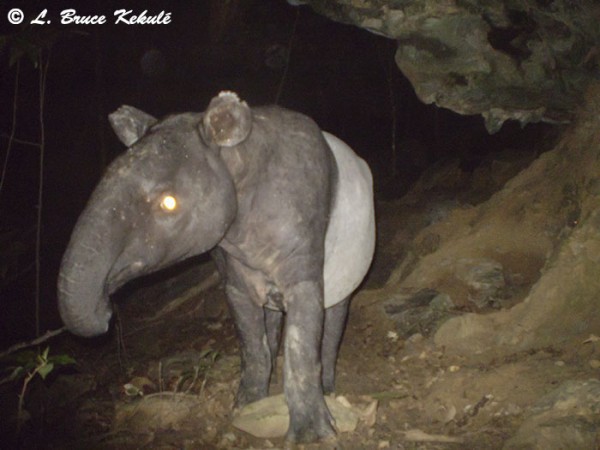
An old tapir up near a cave at the top of a limestone massif.
But in the mid-1980s, a drastic change to the Pasaeng River was to come about. To increase Thailand’s electrical power needs, and back when building hydroelectric dams was in vogue, it was decided by the Electrical Generating Authority of Thailand (EGAT), a state enterprise, and the government, to construct the Rajaprabha Dam that eventually inundated a total of 165 square kilometers (65 sq. miles) of the Khlong Saeng valley to become the Chiew Larn reservoir in 1986.

A tapir calf with its mother in the forest near the headwaters.
The water body extends into the sanctuary for more than 50 kilometers (30 miles) but is only about two kilometers at its widest point. As the reservoir filled up, thousands and thousands of trees and animals perished in the rising waters. It was destruction of a natural habitat in the name of modernization.

A tapir with clipped ears; probably nipped by a mature female chasing the young one out.
Awhile back, my friend Greg McCann, founder of ‘Habitat ID,’ a NGO setup to investigate forests in Southeast Asia contacted me. He was interested in starting a camera trap program somewhere in Thailand and Khlong Saeng was chosen as the first forest to see what is still thriving there.
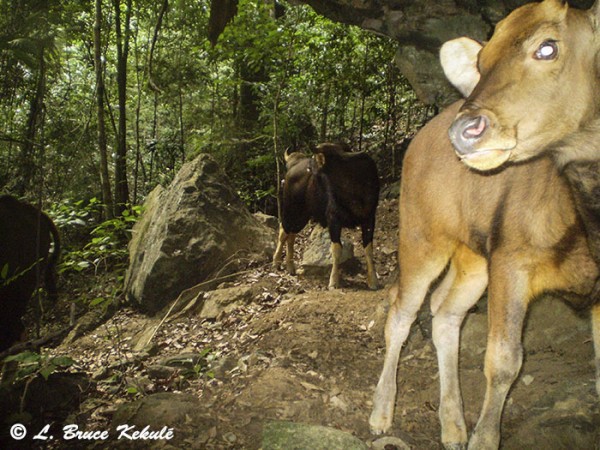
A gaur calf on the trail up on a limestone mountain.
We have just returned from the sanctuary where eight cameras including one DSLR (Nikon D90), a Sony W55 ‘home brew’ and six Bushnell Trophy Cams were set-up in some of the areas where I previously captured some amazing animals.

A very old bull gaur with its hooves in poor condition…!
We will let these cams soak for two-three months and I will be going back then to see what has transpired. It should be interesting…!

A couple of young gaur in the mountainous forest.
When I first began visiting the area, I took my boat-blind (kayak with pontoons and electric trolling motor as a stable shooting platform) to navigate the waters and shoreline.

Another young gaur on a trail up in the limestone mountains.
Over the course of two years, I was able to get some really neat images of the wildlife that had adapted to the new environment. I also began a camera trap program to see what cryptic animals were thriving up in the evergreen forest.

A mature sambar stag on a trail in the forest.
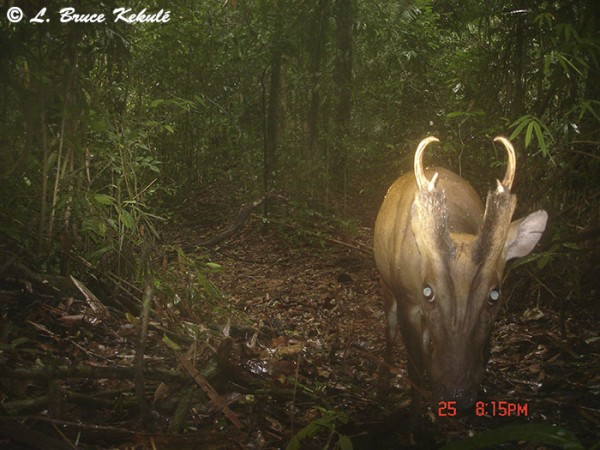
A mature male muntjac (barking deer) on a wildlife trail.

A female muntjac with white spots along the spine and rear torso: a strange anomaly…!

A stump-tail macaque (monkey) up in the limestone crags with its jowls full of food.
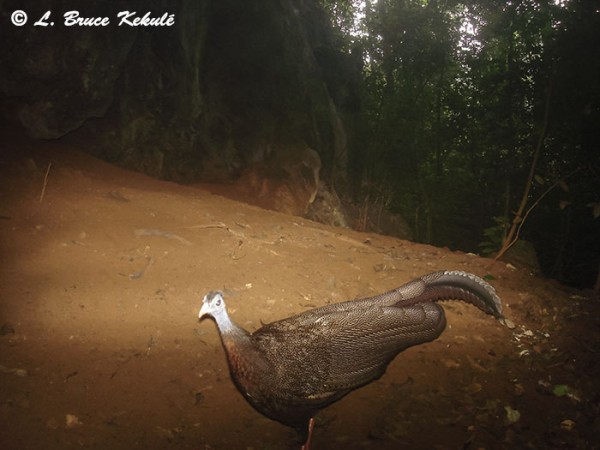
An Argus pheasant at the mouth of a cave.
This gallery of shots is just some of the creatures collected over a two-year period (2009-2010). Some of these images are not the greatest but do show the biodiversity of this amazing place. I plan on setting up several DSLRs at these old camera trap locations and will post any new images down the road. Enjoy…!
Sony P41 trail cam catches Asian wildlife
Leopard, bear, elephant and other rare creatures caught by a home brew ‘point and shoot’ camera trap

A black-phase leopard.
As I was in the forest checking my DSLRs last month, this little area where I park my truck looked like it might be promising and most likely used by some cryptic wildlife. I decided to setup my old Sony P41/BF board/Pelican 1040 with two ‘C’ cell externals (built for me by Dave, the old owner of BFOutdoors.com).

A yellow-phase male leopard.

An Asian black bear.
The cam is encased in an ‘elephant proof’ box attached to a tree and locked down with a Python cable. I’ve had this cam since 2008 and it’s still working very well. I usually carry a few of my old ‘point-n-shoots’ in the truck in case I need to survey a new trail or location like this.

A female muntjac (barking deer).

A green peafowl.
A couple weeks later, I was back and found a whole slew of animals had come by. A black leopard was the first through followed by a yellow-phase leopard, a muntjac (barking deer) and then a black bear. Other creatures that also came were green peafowl, elephant, large Indian civet, porcupine, several smaller civets and finally the tail end shot of a leopard again in daytime.

An Asian elephant – some strange flare.
Even though some of these photos are not the best, they are a good indication of what passes through. I previously got a tiger 50 meters from here. I have already decided to set-up a DSLR across from this tree and worked out where the flash and sensor positions would go…it looks very promising….I just gotta get back there…to be continued…!

A large Indian civet.
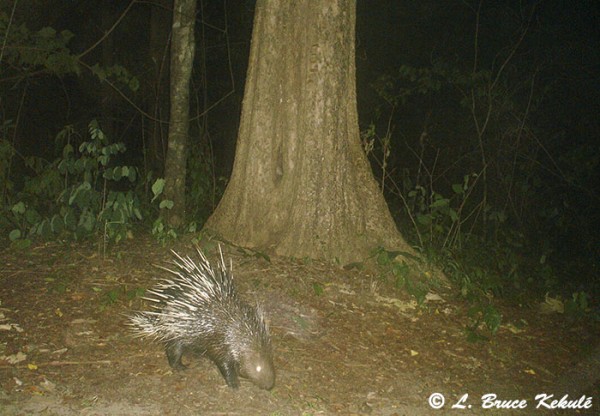
An Asian porcupine.
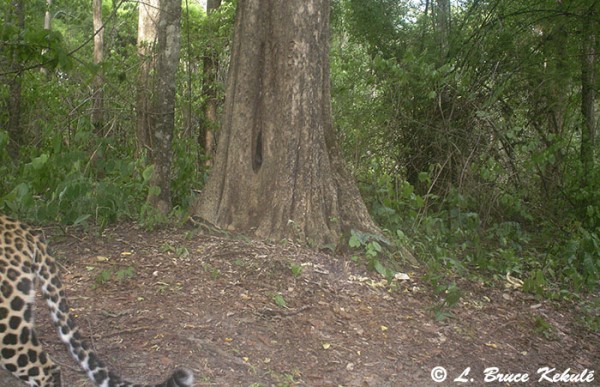
The tail-end of a leopard.
Canon 400D/Nikon 50mm lens captures some big cats…!
Female tiger plus black and yellow phase leopard pass by the old cam

My squinting female tiger – 2nd shot with good flash coverage. Image has been cropped.!
It has taken this Canon 400D quite awhile to capture some good images of the big cats. I have had so many negative issues with this trail cam (sensor, broken glass, full of water, bad cam batteries, leaking case, poor radio triggers for the flash, etc.) and I thought it was jinxed. I then decided to go with hard-wired flashes and sensor and a new case to see if there would be any improvement. I knew that this road in the forest was a good spot as the tree lay-out was perfect for the setup and the cats were walking past out on their hunting forays. Also, found some tiger foot prints further down the road. This set was captured over a three-week period in June-July.
The Canon is still there with fresh batteries for the camera and flashes, and I look forward to visiting this cam at the end of July. Hopefully these cats will be walking this way….Enjoy…!
Due to low flash out-put, this image has been heavily manipulated to show her eyes were open on the 1st shot..!

Female tiger during the day meaning few people around this location. Note front paw…!

Same female: Note rear paw…!

A black-phase leopard…!

A yellow=phase leopard in daylight…!
Camera: Canon 400D.
Lens: Nikon 50mm ƒ1.4.
Sensor: SSII.
Flashes: 2 SB-28s and one SB-26 all set to manual mode.
Camera settings: ƒ8 at 1/125 – ISO 400