

Posts Tagged ‘Thailand’
Nikon SB-600/SB-800-900/SB-28 DSLR slave flash
Nikon remote flashes
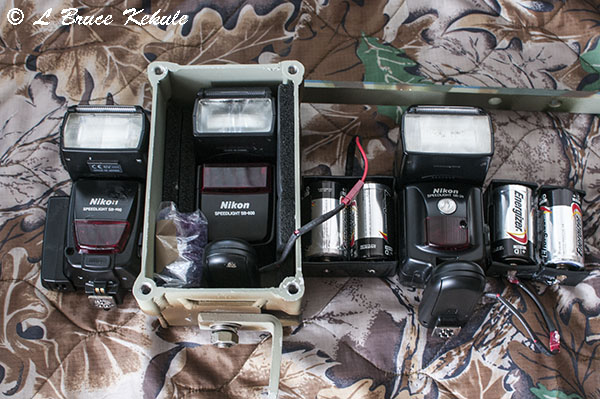
Nikon SB-600 (middle), SB-800 (left) and SB-28 (right) remote flashes.
After installing and testing my D700 trail cam with several remote SB-28 flashes in the forest, it was apparent I needed another flash closer to the cam on the right side of the fallen tree to eliminate the shadow.
I had an old SB-600 that has been one of my mainstay flashes for some time and since I don’t shoot much flash now, thought I would regulate this one to camera trap duty.

SB-600 and SB-28 with Yongnuo Wireless flash triggers and ‘D’ cell externals.
I will be setting this flash with four brand-new ‘Enelope’ rechargeable batteries to see how long they will last on standby.
A Yongnue 602n wireless flash trigger and two ‘D’ cell externals is used and the assembly is housed in one of my ‘elephant proof’ aluminum boxes. I have now tested the ‘D’ cells and getting more than a month on stand-by…!
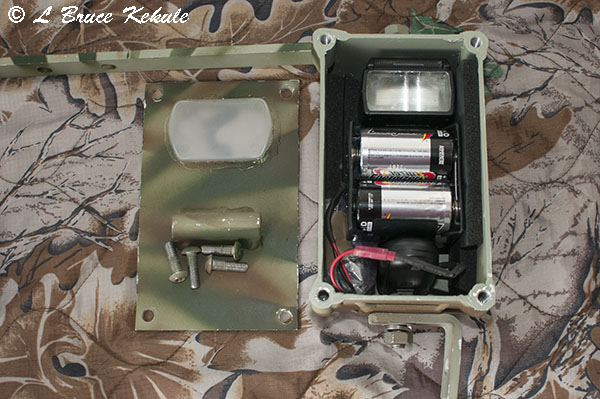
‘D’ cells in place.
On this box, I beefed-up the ends and drilled and tapped for 10mm machine screws and set with epoxy to act as pivots, and a ‘L’ bracket on the bottom and a 1” x ¼” x 14” aluminum strap across the top of the log. I can aim the flash straight at the trail and lock it in place. A generic flash diffuser is shortened to about 1/4″ and then ‘Goop’ is applied after camouflage painting.
By using two or three 3” x 3/8” stainless lag bolts, the flash will be tight, and elephants or bears would have hard time breaking these flashes. However, a bear-tooth through the diffuser could be a problem. Of course the proof is in the pudding and we shall see because the big elephant herd will come through one day, and they will surely have a go at destroying the whole set…!
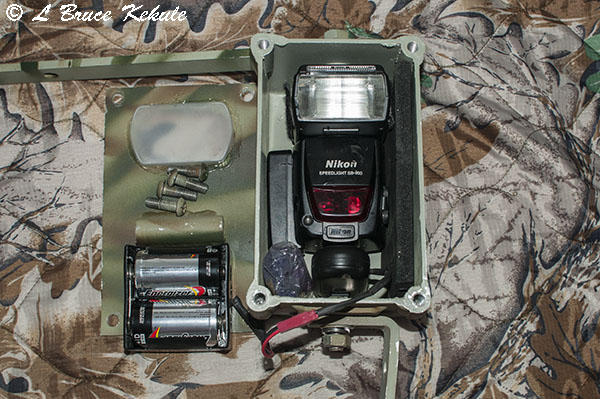
SB-800 with an extra AA battery pack (5 AA cells).
In this box, I can also use a Nikon SB-28 flash that has a great stand-by feature, and is fairly cheap and readily available on the second hand camera market. A SB-800/900 can also be used.
I’m also working on a couple of SB-800s that will have extra Nikon battery packs (5-AAs) set to remote plus the 6-pack. During testing, they work extremely well but are still not TTL. Still working on that. Hope this helps those who need some tough slave flashes for your DSLR trail cam.
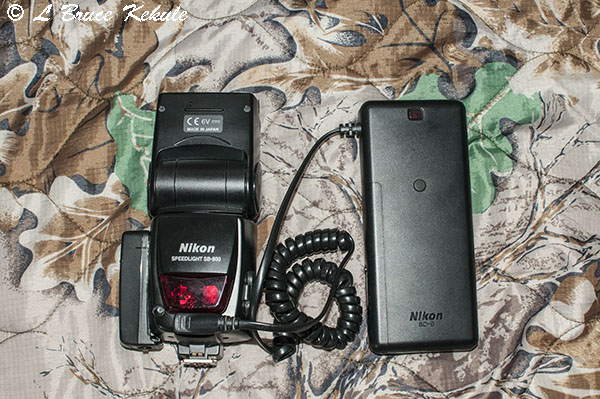
SB-800 with Nikon 6-AA battery pack.

A ‘Trails End’ camera trap comes my way
A neat trail cam: Sony P41/Snapshotsniper SS board/Pelican 1040/2 AA externals by Trails End
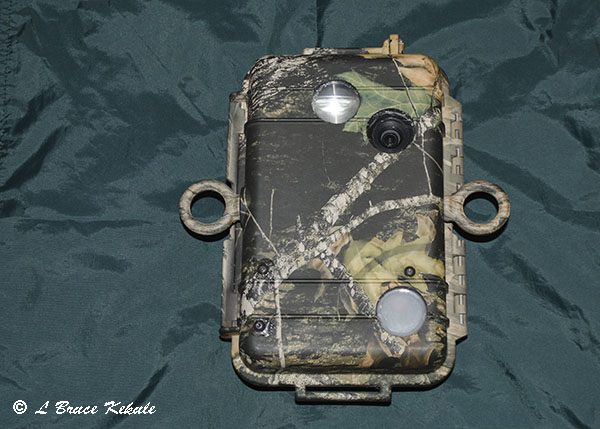
Last week, I visited my old buddy Suthad Sappu, a forest ranger in Kaeng Krachan National Park down in southwest Thailand along the border with Burma. We worked together along the Phetchaburi River deep in the interior of the park for some 10 years back during the 90s, and we got many tigers and leopards on camera trap plus loads of other cryptic creatures like elephant, tapir, gaur, bear (both species), fishing cat, banded palm civet, banded linsang and many more.

As we were chit chatting over dinner and drinks about our favorite subject, camera trapping, Suthad pulled out a very nice camera trap from his bag. It is a homebrew that was made up by ‘Trails End’ using a Sony P41/Snapshotsniper SS board/Pelican 1040/2 AA externals. It is very well built and looks new, and is unused. The case and eyebolts are dipped in a woodland type camouflage.

He says I can have it if I can get it working. Took me a few minutes with some fresh batteries and reset the date on the Sony. Flipped the toggle switch down and it fired up, and was working normally in a few minutes. I said thank you very much and smiled.
He has two more and I said I could get them going too. Does anybody know who ‘Trails End’ is and are they still in business? They certainly do very good work. I’ll be taking this cam along with a Bushnell Trophy Cam to India on April 3rd after tiger. The lodge I’m staying is reported to have leopards walking through the camp. Can’t wait to get there.
Some days are better than others….especially when a nice trail cam comes your way for free…!
The ‘Little Elephant Slider’
A 3-month old baby elephant slides in on the trail to a waterhole deep in the forests of western Thailand. This family unit is also made-up of several mature females and younger juveniles.
Living Fossils – A video of Asian tapir
Rare daytime footage of Asian Tapir
Tapir are considered living fossils as the genus has been traced back as far as Early Oligocene times. These remarkable mammals have been on the planet for about 40 million years. The first tapirs are named Miotapirus judging from fossil evidence found in North America. Tapiridae, a sub-family belong to the Order Perissodactyls, or odd-toed ungulates that goes back to the Late Paleocene 55 million years ago including rhinoceros-like creatures evolving in North America and eastern Asia from small animals similar to the first horses.
The Asian tapir Tapirus indicus, also called the Malayan tapir, is the only one native to Southeast Asia. It has an unmistakable black and white two-tone pattern distinguishing it from the other three tapir species of Central and South America. The Asian species is the largest, and is the only ‘Old World’ tapir with the females usually slightly larger than the males. They live in the rainforests of Thailand, Myanmar, Malaysia and Sumatra.
This old male and female tapir visited this site more than once over two days. Most of the footage was captured by a Bushnell HD Trophy Cam, and the IR clip by a Ron Davis DXG 125v IR homebrew cam.
Photogenic Indochinese tiger
This series of camera trap images of a young tigress was collected in Huai Kha Khaeng Wildlife Sanctuary with a Sony W55 homebrew trail cam during May of this year. This particular tiger does not seem bothered by the flash and I have caught her several times prior to this set. Some animals don’t mind flash while others do. I have a tiger on video growling and back-tracking after seeing the red-LEDs on a Bushnell Trophy Cam. I tend to believe it all depends on the individual animal.

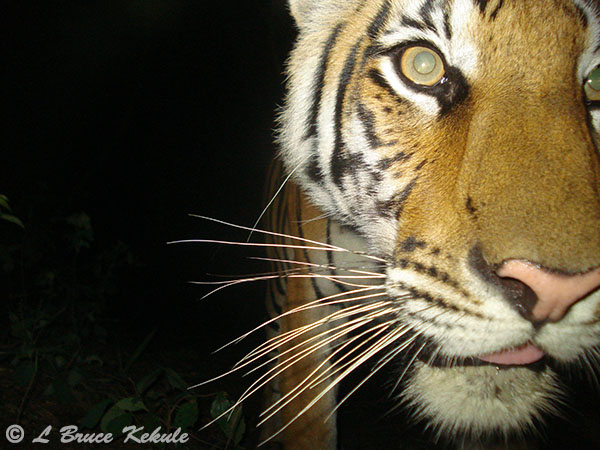

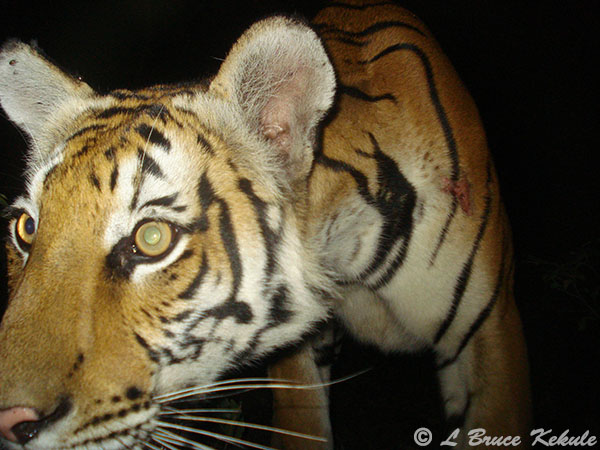
Note the wound on her left flank and ticks in her ears.
Huai Kha Khaeng: A birthday tiger and leopard
A new Sony W55 trail camera catches the big cats
On May 19th (my birthday) 2012, I decided to celebrate in the forest after returning to Thailand from a two-week photographic safari in Africa. It was once again a great trip to the Dark Continent and I managed to photograph the ‘Big Five’ (three times now) plus a multitude of other animals including some rare species like black-mane lion, black rhino, striped hyena, sable antelope and bush baby. I also got many other common animals like elephant, buffalo, giraffe, zebra, warthogs and antelopes. I also managed to catch Mount Kilimanjaro when the clouds lifted. Kenya is absolutely one of the greatest natural spectacles on the planet and I look forward to returning next year.
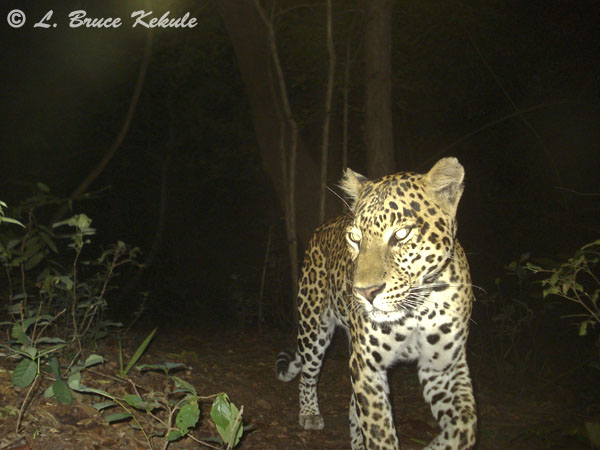
A male leopard caught by a Sony W55 homebrew trail camera trap
However, there are still a few wild places in Thailand that harbor many magnificent Asian creatures such as tiger, leopard, elephant, gaur, banteng plus many other mammals, birds, reptiles, insects and plant species. Huai Kha Khaeng is one of the top wildlife sanctuaries in Southeast Asia, and the world for that matter.

Leopard caught again checking out the camera
To get there, it takes about five hours by vehicle from Bangkok and is tucked away in the forested mountains of central-western Thailand in Uthai Thani province. I have written many stories about this place and its wildlife, and it never fails to live up to its status as a ‘World Heritage Site’ but this time it turned out even better than my wildest dreams.

A young female tiger caught by the Sony w55 trail cam
My birthday wish to catch a tiger and leopard up-close with one of my camera traps was granted by the ‘spirits of the forest’ and all the hard work building the cams, setting them up, waiting while they soaked and then the pain-staking collection was truly worthwhile.

My favorite shot of this young tiger
Arriving early in the morning, I got everything ready and went out to check the cams. One location has been extremely productive and had been very lucky catching tiger and leopard almost every time (three months in a row). When I went through the photos on my new Sony W55/SSII/1020/3 AA externals, I could not resist shouting out loud with one big hurrah. A leopard had stopped at the cam for a few shots and a night later, a tiger posed for a whole series of close-ups from the low-down set-up. I was speechless for a few seconds.

Check-out the ticks and markings on the right ear
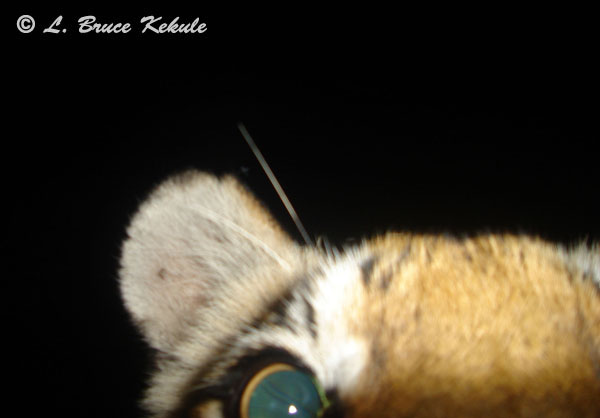
Remember this tiger eye and ear
This game trail is situated deep in the protected area and many animals use it to get to a mineral lick and waterhole. The balance of nature is in full force here and ‘eat or be eaten’ carries on everyday. There is a fallen tree right across the trail about 500 meters from the dirt road some 15 kilometers in the sanctuary.

More ticks and note the wound on the left shoulder
Both of these big cats jump this log as they hunt for prey but usually a few days or two apart. The leopard is a very mature male but the tiger is a young female that seems to may have finally left her mother. I have a close-up shot of this same cat captured together in March and identified it as the same tiger two months ago by markings on the right ear. What a coincidence!
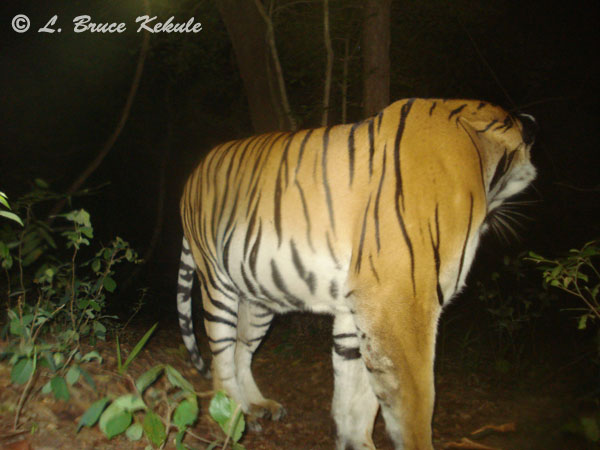
Stripe-pattern on right side used to identify this cat
All I can say is: this has been the best birthday in many moons and I know that my prayers are really answered from time to time. It is hoped this young tiger will continue to live out its life in safety and carry on its legacy as the world’s largest cat. Huai Kha Khaeng is truly a remarkable place and I have not even scratched the surface of this amazing wilderness!
Huai Kha Khaeng ongoing camera trap saga
New camera trap gets a leopard and tiger first time out
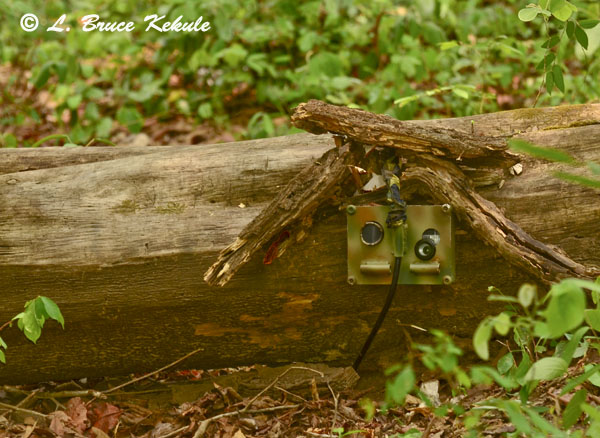
Sony W55 in Otter 2000 case with a Snapshotsniper SSII board and 3 AA externals
The feeling of accomplishment is the best part of building a ‘homebrew’ trail camera and then sharing the photos with others. I am extremely lucky to be working in a place that is one of the top tiger reserves in the world, and is extremely productive for camera trapping. It is not only the tigers, but also other predators like leopard, wild dog and jackal, and their prey species such as deer, pig and wild cattle that makes Huai Kha Khaeng Wildlife Sanctuary truly special.
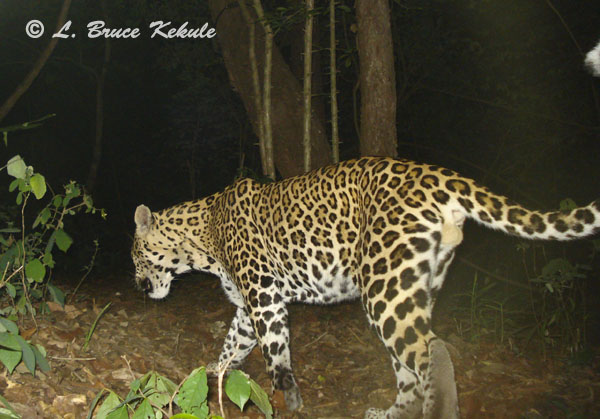
A leopard caught by the Sony W55 camera trap
When I first built this unit, I had one fallen tree across a trail in mind and it proved to be the right choice. I designed the cam to slip the 10mm ‘Python’ locking cable around the horizontal log. One of the first animals to jump over was a mature male leopard several nights after the setup. This frame filling shot is what I was hoping for.

Leopard caught again as it went down the trail
Several nights later, a tiger went over and the W55 caught its rear end as it disappeared down the trail. A female muntjac (barking deer) was also caught. This was after only a 15-day soak and shows the tremendous biodiversity of this amazing place. This unit definitely worked as designed: to scout a game trail with a low-down set-up.
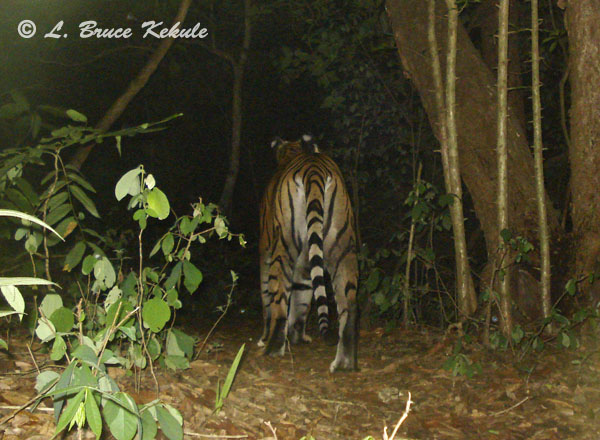
Tiger caught going down game trail several nights later
The next order of business now is to build a Nikon ML-3 ‘active-infrared’ controlled SLR Nikon F5 film camera using Fuji Provia 400 ISO slide film, and a Nikon D2x DSLR and both can fire five shots a second in ‘continuous mode’ with several wireless SB600s or SB28s. These two cameras are my old prime camera bodies that I have kept over the years (they were really expensive), and I have resurrected them for this project. The Nikon D2x is now in the Nikon shop for an overhaul but will be finished real soon.
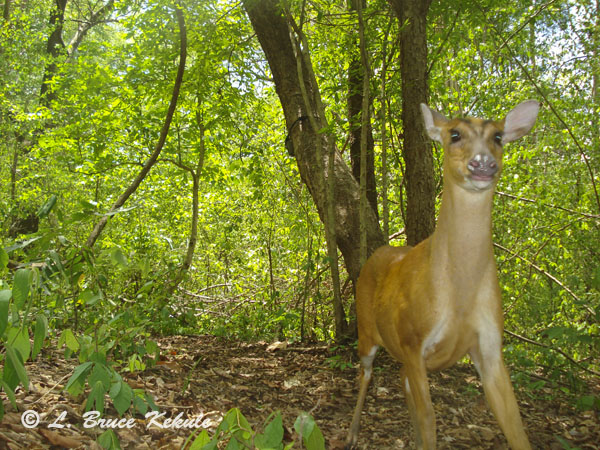
Female muntjac (barking deer) caught by the camera trap
My main objective is to catch the cats making the jump. I will eventually be installing both units close together on either side of this log about a meter or so away from the trail. The sensors need to be slightly angled away so as to activate them a bit early. Both cameras will be using an 18-35mm wide-angle lens (the zoom setting of the lens will be adjusted when installed) and that should help to catch these quick-acting animals. The units have to be precise and fast, and fire off a good string of shots with several flashes.
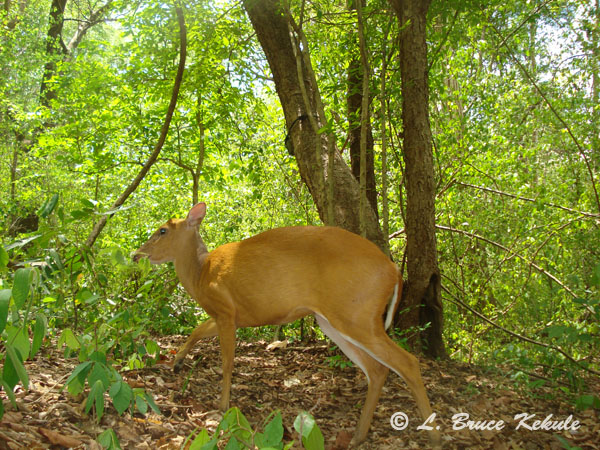
Muntjac spooked by the camera’s flash
The only negative aspect with active infrared at night; the first shot will not trip the flash but follow up shots will be OK. But I can also hard wire a flash for each cam with a sync-cable in conjunction with the wireless flashes and that should be enough. I will also experiment with a ‘passive infrared’ system that can wake-up the flashes in time for the shot. However, this is a hit and miss situation whereas active infrared is usually spot on and will trip immediately after the beam is broken.
The system will be modular so sensors and camera are separate, and they will be ‘plug and play’ units. That’s the plan anyway for this absolutely amazing wildlife game trail. I have all the parts ready; just finding time to put it all together is the next trick.
Got a very busy schedule with a trip to Africa and the States for the next couple of months. But I will be getting the SLR and DSLR camera traps up and running shortly after getting back to Thailand, and of course will post the builds. Most important: they have to be ‘elephant proof’ but I have that covered as usual.
Posted from Tsavo National Park, southern Kenya, Africa
HD Video Infrared Camera Trap
High-tech ‘homebrew’ video trail cam
A joint camera trap video program using a DXG 125r/1060/BF board-array video camera trap

Ron Davis DXG 125 video unit in a LBK elephant proof box
After seeing some of my posts, Ron Davis, a lawyer from Florida offered to send me an High Definition DXG 125R/BF board-array/IR/exchanger video unit housed in a Pelican 1060 (monster case) to put in Huai Kha Khaeng Wildlife Sanctuary where I’m presently doing a camera trap (presence/absense) survey. I gladly accepted the offer and waited patiently for the unit.
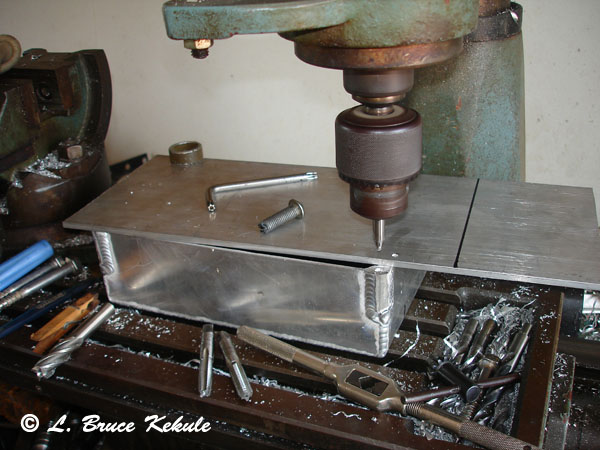
Machining elephant proof box
I have been running three Bushnell Trophy Cams (2009 & 2011 models) and was getting some amazing clips of large mammals like elephant, gaur, banteng, tiger and tapir plus other creatures at night, but also in broad daylight that was quite a surprise. I plan to share these videos with the forum soon. Most Asian animals are nocturnal for their own safety and have evolved this way due to centuries of human poaching pressure.

Drilling out LED ports on elephant proof box
However, as this World Heritage Site is being look after much better than any other protected area in Thailand, and its biodiversity is tops, wild creatures are beginning to feel more at ease about showing themselves during the day. It is a fact they will propagate and move freely in the day if undisturbed for the most part.

Video unit and elephant proof box before camouflage paint
I never have had a big Pelican 1060 and when it arrived in the post, my immediate reaction was it would be quite visible in the forest, and is also quite heavy with all the components including a 12v battery to run the array. However, I went to work building an elephant proof security box from aluminum.

Video unit and elephant proof and ‘Python’ locking cable ready for the field
I got my Tig-welder to make it up and did all the machining required. It was just in the outer limits of travel on the table of my small milling machine but it was OK. I had to do some juggling but I got it done using precision drilling with a center drill first followed by a drill bit, a hole-cutter and milling cutter. The LED ports took awhile to get all 12 finished.
I then painted it with a new camouflage technique for me. Using four colors (black primer coat, then khaki, army green and earth brown in conjunction with bamboo leaves (idea from my friend Chris Wemmer – the Camera Trap Codger), I painted the box in succession until I was satisfied. It looked pretty good to me and it certainly would blend in with the surrounding vegetation.

Ron Davis/LBK video unit at a waterhole in Huai Kha Khaeng
I made my monthly trip on April 15th to the sanctuary and the first night set the unit over a really bad smelling bag of rotten chicken (a previous bait and two weeks old)…whew! This was quite close to the ranger station I always stay at and early the next morning about 4am, I heard an Asiatic jackal barking close to the cam that could possibly mean a leopard. The bait was gone the next morning but I did not check the files deciding to wait.
I then moved it to a very productive water hole where it is now. When I return from Africa, I will be going straight in to check all my traps including this unit. Can’t wait to see what it has captured and will of course share any videos later on this website. I would like to thank Ron Davis for the use of his video unit and let’s see what it gets.
Huai Kha Khaeng: A camera trap saga
Thailand’s amazing forest with some beautiful, elusive and rare Asian creatures
Huai Kha Khaeng Wildlife Sanctuary is situated in central western Thailand, and is a World Heritage Site. It is the top protected area in the Kingdom. In January 2012, I began a camera trap program to determine the status of wildlife found here. In just a short two months, all the large mammals including elephant, gaur, banteng, tapir, tiger, leopard and many others have been caught by ‘homebrew’ digital camera traps set at various mineral deposits, water holes and game trails situated in the interior of the sanctuary. I have ten trail cams working through till March 31st, 2012. These are the best series. The following photos shows this amazing biodiversity, and this place is truly worthy of its ‘World Heritage Site’ status.
Set-up Number 1: A S600/1010/SSI was set above a water hole close to a ranger station. This cam turned out the most wildlife photos over a two month period. This mineral deposit and waterhole is visited daily by many animals and is one of the best in the sanctuary.

A Sony S600/Pelican 1010/SSI in an ‘Elephant proof ‘ box with a ‘Python’ locking cable
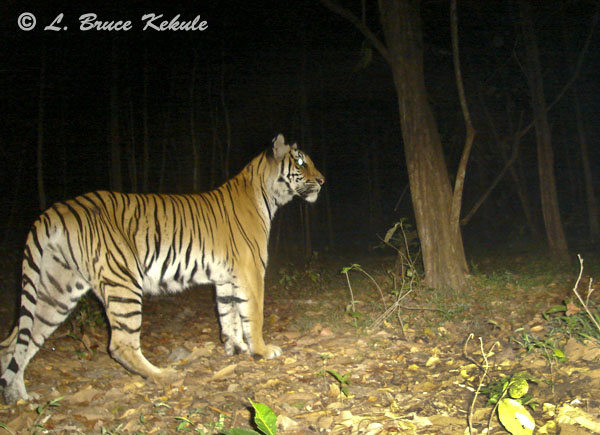
Mature female tiger
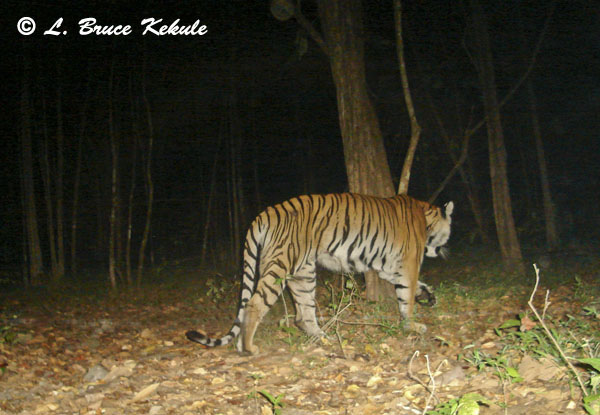
Tiger follow-up shot
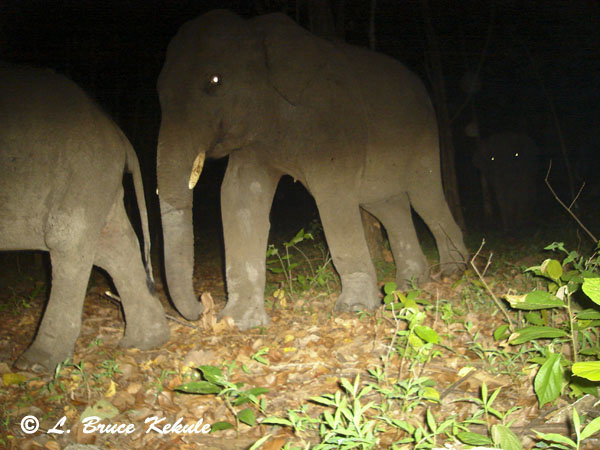
Young tusker elephant in a herd

Tusker close-up

Tusker about-face
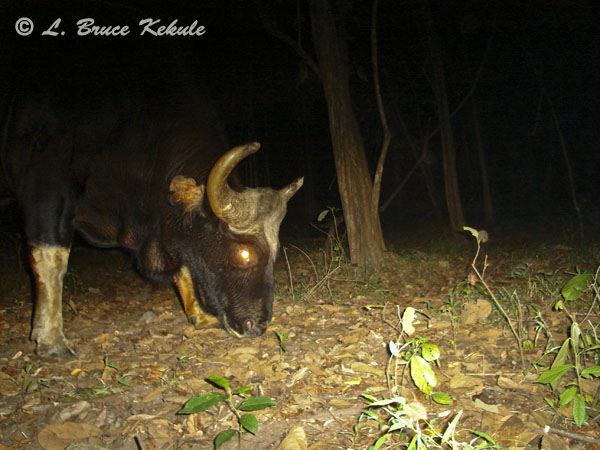
Mature gaur bull
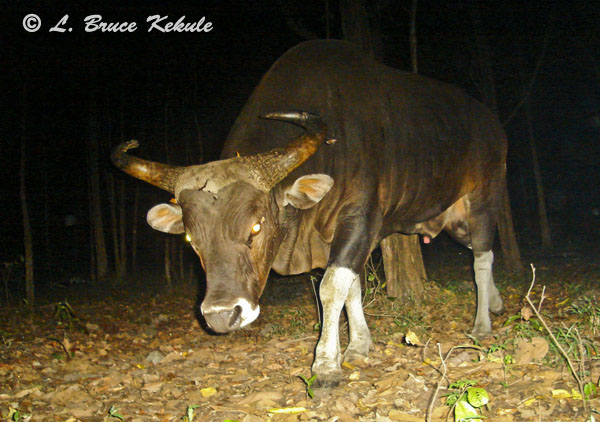
Mature banteng bull

Younger banteng bulls

Mature banteng cow
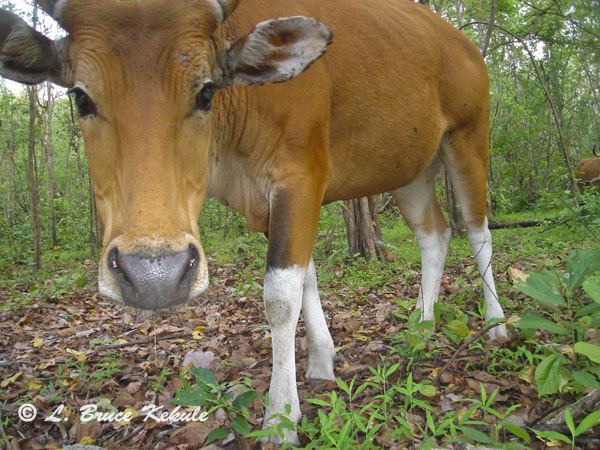
Banteng cow close-up

Macaque monkey

Camera trapper
Set-up Number 2: Another S600/1010/SSI was set close to the ranger station and a bag of large rotten fish heads was strung up to prevent being taken by a scavenger like a water monitor. Amazingly, a leopard and a big wild boar, both scavengers, came to the bait. The bag can be seen in the boar picture. Boy did it smell..!
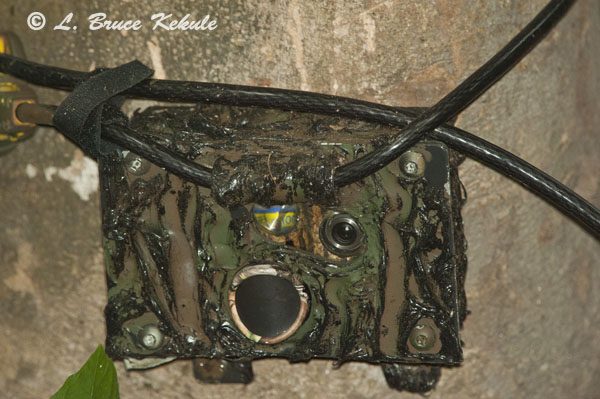
S600/1010/SSI in ‘elephant proof’ box with python locking cable.
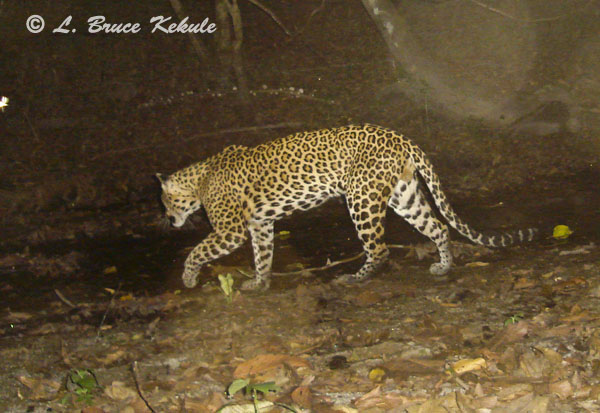
Leopard male in the stream attracted by the ‘fish head’ bait.

Wild boar hoping for some carrion.

A crab-eating mongoose in the stream after the bait had been cut down.
Set-up Number 3: An old Sony S600/1040/BFOutdoors/2 ‘C’ cell externals in an ‘elephant proof’ box and ‘Python’ locking cable with 3D camouflage was used to catch this tiger mother and her cub (also caught by Bushnell Trophy Cam video twenty meters away). Other shots collected from this cam were deer at night not included here.
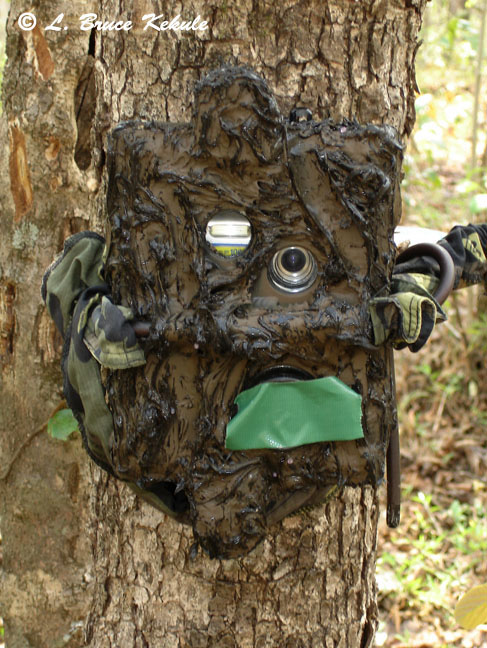
Sony S600 in a Pelican 1040 and BFOutdoors board with 2 ‘C’ cell externals
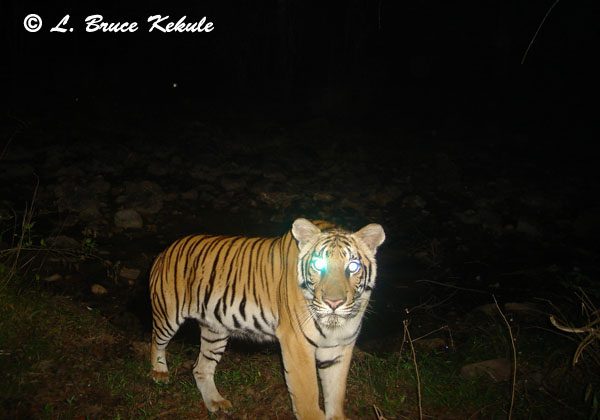
Tiger mother caught close to Subkaow mineral deposit and water hole
‘Eye of a tiger’ as this young cub has a chew on the cam…remarkable shot…!
Set-up Number 4: An older S600 with a Yeticam board in a 2nd generation LBK aluminum boxed cam plus tools for installation. Tiger, tapir and a sambar stag came along this trail about a day’s walk from the ranger station I stay at. This site will be covered by long-range cams with ‘C’ and ‘D’ cell externals for a three-four month period during the rainy season.
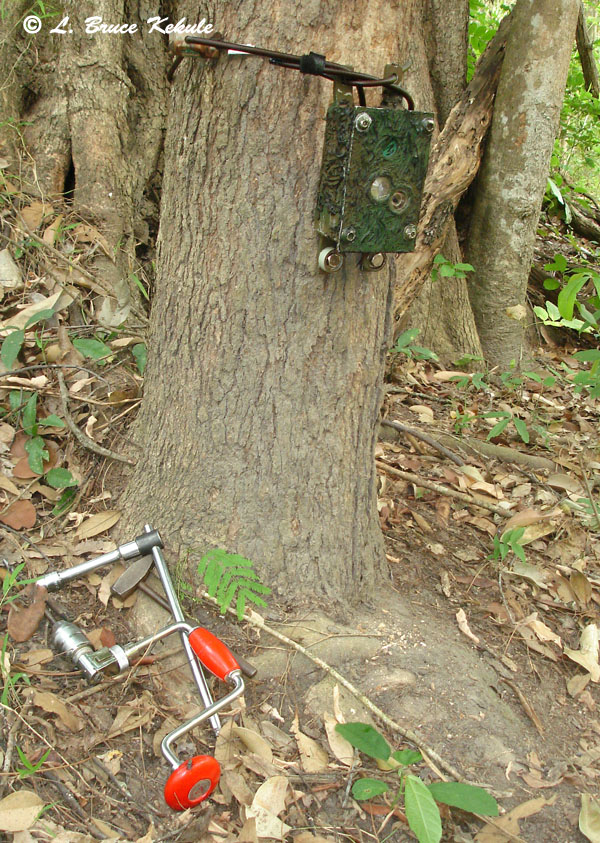
Old 2nd generation LBK trail cam in an ‘elephant proof’
housing firmly bolted to a tree with a ‘Python cable and 2 lag bolts.
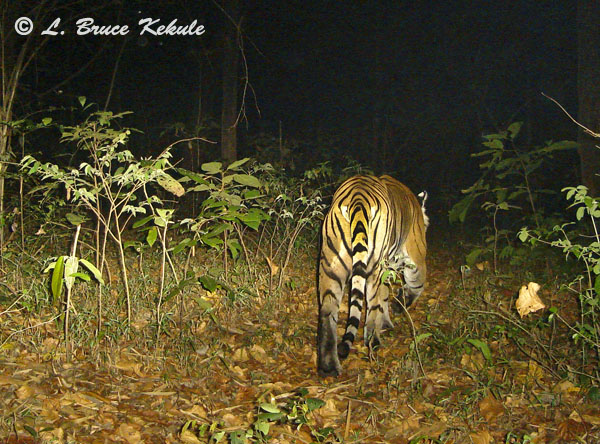
Rear-end of a tiger along a game trail
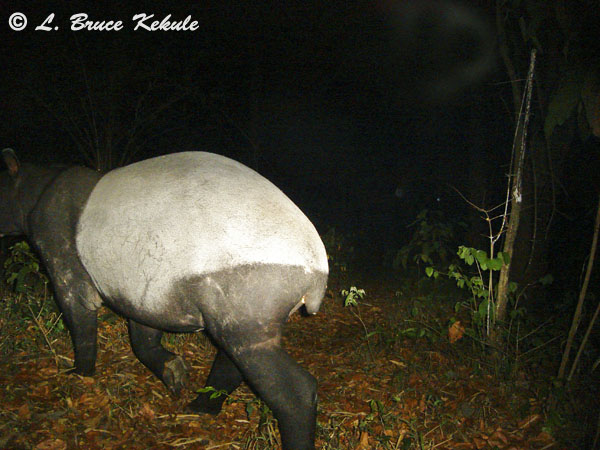
Asian tapir at night

Tapir up-close and checking out the cam
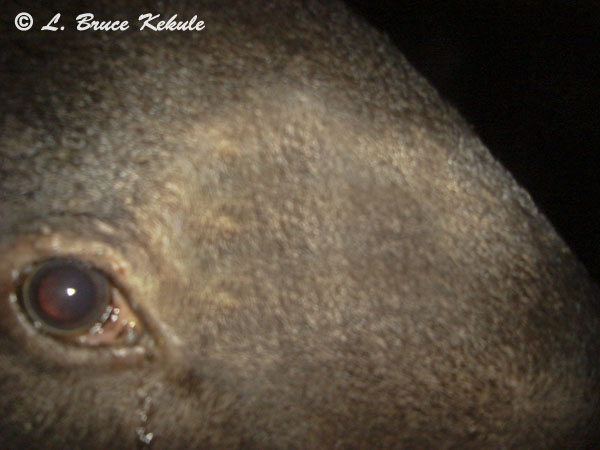
‘Eye of a tapir’….not as dramatic as a tiger’s eye..but OK for government work..!
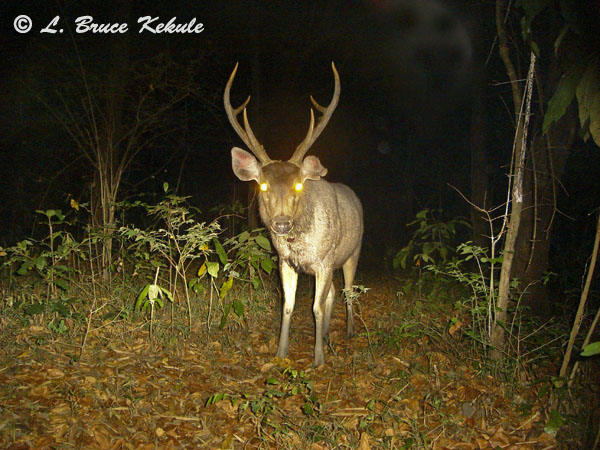
A mature sambar stag, Thailand’s largest cervid
Note: I still have more then ten trail cams working here at the moment including my new Canon DSLR 400D with three wireless flashes, and two of my new W55s. I will also be setting up a homebrew video very soon. I surely will be posting many more camera trap photos of this truly wonderful and magical wildlife sanctuary in the near future.
The Siamese Crocodile – Update 2011
Critically endangered crocodilian species
Thailand’s last few remaining wild crocodiles
Two hundred and thirty million years ago, the first crocodilians evolved from archosaurs or ‘ruling reptiles’ during the mid-Triassic period of the Mesozoic era when primitive dinosaurs also roamed the planet. Crocodiles have changed little in body structure since then. Apart from birds, these reptiles are the only living archosaurs.

My first Siamese crocodile in Khao Ang Rue Nai Wildlife Sanctuary
“Note forest fly on the eye node; these insects take saline from the croc’s eyes”
In 1909, J.B. Hatcher discovered a few fossilized bits and pieces of a giant alligator in Montana from the late Cretaceous period 80 million years ago. Deinosuchus was also found in Texas by Barnum Brown of the American Museum of Natural History in New York in the 1940s. The skull of this huge crocodilian is two meters long and body length estimated at about 12 meters with a weight of 8.5 tons.
Sarcosuchus was another crocodile some 12 meters long and weighing up to 10 tons. Fossils were first found in Central Africa from the early Cretaceous 112 million years ago by French paleontologist Albert-Felix de Lapparent in 1964, and then by France de Broin and Phillip Taquet in 1966. Later in 1997, Paul Sereno discovered more fossils in the sub-Sahara desert and then tagged the beast as ‘Super-Croc’.
This huge crocodilian was also unearthed in Brazil by a British geologist, and described by Eric Buffetaut and P. Taquet in 1977 as the same species found in Africa. These ‘super-crocs’ pulled dinosaurs and other large animals into the water and devoured them.

The same crocodile camera trapped in Khao Ang Rue Nai
In 1979, Nares Sattayarak, a geologist for the Department of Mineral Resources working in the northeast province of Nong Bua Lamphu discovered the lower jaw of a huge crocodile in a road-cut excavated from the Phu Kradung Formation of the late Jurrasic 150 million years ago. Named Sunosuchus thailandicus, it was described as a new species by Eric Buffetaut and Rucha Ingavat. Estimated to have been at least eight meters in length with a lower jaw over a meter long, it was Thailand’s ‘super-croc’.
Then in 2005 a fossil several million years old of a ‘gavial’, a large fish-eating crocodilian was unearthed by Dr Yaowalak Chaimanee and her team from the Department of Mineral Resources. This discovery was made on the Khorat Plateau at Ban Khok Sung in Nakhon Ratchasima province. The species still exists in Burma and India.
Sometime in 2006, Komsorn Lauprasert, a scientist at Mahasarakham University discovered another species of crocodilian 100 million years old that had longer legs than modern-day crocodiles and probably fed on fish, based on the characteristics of its teeth.

My second Siamese crocodile in Kaeng Krachan National park
According to Komsorn, “They were living on land and could run very fast”. The 15cm. long fossil-skull was originally retrieved from an excavation site in Nakhon Rathchasima province and then found in a museum. The species has been named Khoratosuchus jintasakuli after the province and the last name of the director of the Northeastern Research Institute of Petrified Wood and Mineral Resources, Pratueng Jintasakul.
Some 50 years ago, Thailand had three species of wild crocodiles found in a host of environments: the sea, estuaries, rivers and marshes. The most common species was the Siamese crocodile (Crocodylus siamensis) and was considered a pest by village folk who lived near waterways that had the reptiles.
Another thin-snouted freshwater crocodile was (Tomistoma schlegelii), also known as the ‘false gharial’ found only in rivers of the southern peninsula.

Crocodile river in Khao Ang Rue Nai
The estuarine ‘saltwater’ crocodile (Crocodylus porosus) today is the largest in the world also known as the ‘Indo-Pacific’ crocodile. The species was very common in river estuaries and islands in the Andaman Sea and the Gulf of Thailand. Huge saltwater crocs have been sighted swimming in open-ocean.
Unfortunately, both the saltwater and false gharial has disappeared from the wild of Thailand, and the Siamese is technically extinct with only two individuals left; one in the East and one in the West of the Kingdom. This is truly a sad state of affairs concerning the crocodile after having outlived the dinosaurs for more than 65 million years.
The Siamese crocodile was once very common in Southeast Asia including Thailand, Vietnam, Cambodia, Indonesia, Malaysia, Laos and possibly Burma. Populations throughout the region have seriously declined and exact numbers of wild crocs are not known in any of the range countries.

Wild Siamese crocodile in southern Cambodia
There is a small population still thriving in Cambodia. However, their habitats are under serious threat from hydroelectric dam construction and could be wiped out very soon.
Conservationists from ‘Flora and Fauna International’ and ‘Wildlife Alliance’ are capturing wild Siamese crocodiles and plan to use these to launch a conservation breeding-program in partnership with the Cambodian Forestry Administration. My close friend and English wildlife photographer Allan Michaud has photographed a Siamese crocodile in southern Cambodia.
Crocodilians for most of their 230-million-year history have been large, long-bodied, aquatic carnivores. Armor plating (in the form of bony scutes set in their hides), extended tails, short strong limbs, and powerful sharp-toothed jaws make them formidable predators.
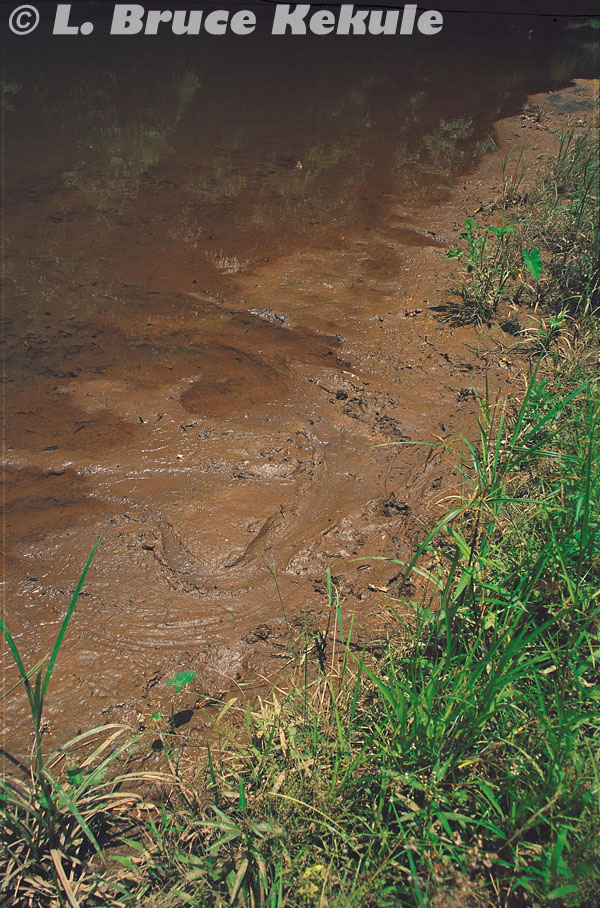
Crocodile tracks by the Phetchaburi River
Crocodiles come onto land to defecate and, being cold-blooded, to bask in the sun to regulate their body temperature. Female crocs come ashore to lay 20 to 40 eggs in mound nests on land near the water’s edge. These streamlined submarine predators glide through water with ease, surfacing and submerging at will.
Siamese crocs grow broad and heavy, and mature individuals have distinct bony ridges behind the eye socket. Historical records report specimens of up to four meters in length but three meters is the average for a mature adult. They feed primarily on fish but also take frogs, small mammals and birds. Undulating their powerful tails while tucking in their legs, crocs can glide through water without making a ripple.
Stealthily stalking prey along the water’s edge, they can snatch in an instant with powerful jaws pulling it below to drown their victim. Some crocs lay in wait on the bottom of a river or pond in order to grab fish and can stay underwater for an extended period of time.

Crocodile pond in the Phetchaburi River
If the carcass is too large to swallow whole, they stash it under water until ripe and then tear it apart. Adults can survive for many months without a meal and thus are one of nature’s most efficient predators in terms of consumption proportionate to body size.
Man is the crocodile’s only enemy, and the wild Siamese crocodile is probably the most endangered crocodilian species in the world wiped out by man’s greed.
At the end of World War II, crocodile farming came into vogue in the Kingdom, and wild crocs were captured for breeding stock. Thousands upon thousands were caught in the booming trade. Habitat loss and crocodile farming started the countdown to extinction for these ancient creatures. With no laws to protect them, crocs were eradicated from every river and swamp in the country.

River carp at the crocodile pond in the Phetcahburi River
Farming crocodiles is big money business in Thailand. The false gharial and saltwater crocs are farmed along with the Siamese. A quick growing crocodile has been produced by crossbreeding the Siamese with the ‘saltwater’ species producing a ‘hybrid’ found in most of the farms throughout the country. This human ‘quick-growing’ creation is farmed for its meat and hide, and continues to be a brisk business.
The recent floods in the Central Plains have allowed hundreds of legally and illegally farmed crocodiles to escape into the environment. Many have been shot, some captured and some are still on the loose. The danger to humans is probably nil. However, farmed crocs are much more aggressive than wild ones and if one is sighted, the authorities should be notified immediately.
During my career as a wildlife photographer, I have had the great fortune to photograph two crocodiles in the wild: the first one in 2001 at Khao Ang Rue Nai Wildlife Sanctuary in the East, and in 2003, the second one in the Phetchaburi River in Kaeng Krachan National Park in the Southwest. I also camera trapped the first one in 2002 shown in the lead photograph.

Siamese crocodile in the Samut Prakan Crocodile Farm
One thing has been determined about these two creatures: The old croc in Khao Ang Rue Nai is probably a male (no egg nests have ever been found here), while the mature individual in Kaeng Krachan is more likely a female as many nests have been found up-and-down the river over the years but the eggs are never fertile. Female crocs lay eggs regardless of fertilization by a male or not. The possibility of bringing the two together to mate is absolutely zero.
Some old reports suggest that Siamese crocodiles could still exist in the northeast in several other protected areas: Pang Sida National Park (Sa Kaeo province), Phu Khieo Wildlife Sanctuary (Chaiyaphum province) and Yot Dom Wildlife Sanctuary (Ubon Ratchathani province) but with no actual records, it is doubtful if they still survive in these locations.
My good friend Kitti Kreetiyutanont of the National Parks, Wildlife and Plant Conservation Department (DNP) wrote a paper on Siamese croc sightings in 1993 and, indeed, photographed one at Khao Ang Rue Nai. It is thought to be the same animal I photographed. In 2003, poachers in Yot Dom near the border with Cambodia killed a female crocodile with eggs, and its skull and skin are on display at the park.

Siamese crocodile photographed in Khao Ang Rue Nai
The DNP and other organizations should support surveys to see if any other wild crocodiles still exist in Thailand. Restocking a few carefully selected sites with yearling purebred Siamese crocodiles seems to be the only solution.
But that raises questions about the suitability of the farmed crocs available for release. Have captive animals been excessively inbred? Even more critical, have they been crossbred with other species? Only good genetic DNA analysis can unravel this intricate problem of the species’ integrity in the farms.
In 2004, the DNP in conjunction with a local crocodile farm started a pilot project to reintroduce Siamese crocodiles at Pang Sida National Park. Seven juveniles were being kept in a holding pen for future release close to Pang Sida waterfall. However, it is reported that a few escaped and the farm abandoned the project.
Over the last few years, newspaper reports of crocodiles seen in Khao Yai and Thung Salang Luang national parks were probably released without the DNP’s knowledge, and more likely to create media frenzy by someone.
The croc in Khao Yai is aggressive as several tourists found out one day standing by the banks of the river where the croc is living. The reptile rushed up to the people probably looking for food. The chief then roped off the area by the waterway. Siamese crocodiles are very secretive and avoid people period, and are difficult to see in the wild. The department should capture this croc and remove it being alien to this place above Haew Suwat waterfall.
Serious efforts are required to save Thailand’s remaining wild crocodiles. No matter how many crocodiles are kept in farms, only an intact natural population can truly save these ancient creatures from total extinction.
Thailand should serve as a role model for wildlife conservation in Southeast Asia, and the Thai people and the government should join hands to save and protect the Siamese crocodile for present and future generations. Action needs to be undertaken now to ensure that a creature of 230-million year evolution continues to survive.