

Posts Tagged ‘Thailand’
Nikon D90 DSLR trail cam catches a ‘Large Indian Civet’
The ‘Big Cat Trailhead’ has proven to be a real wildlife haven with loads of cats plus other carnivores walking past on almost a daily/nightly basis. Because of so much interaction, I decided to set-up my Nikon D90/SB400/Yeti/Plano 1460 case facing the other way opposite my Canon 400D.
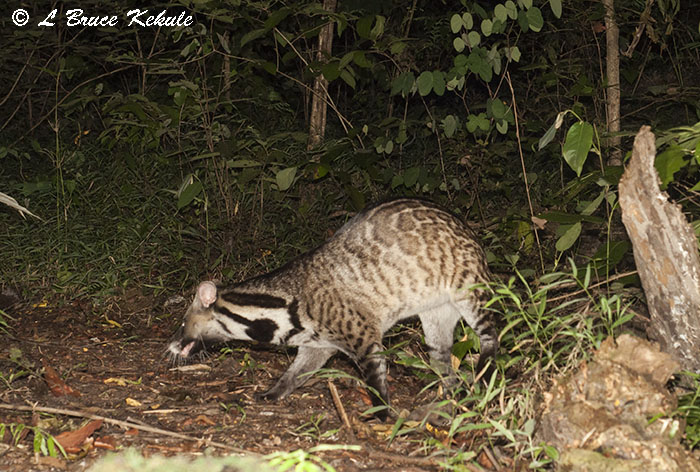
The Yeti board was very old and not working too well. I tried to adjust distance and sensitivity but it still would only trip the cam from about a meter away. However, the cam did get one shot of a ‘Large Indian Civet’ shown here. The markings on this medium sized carnivore are unique and these creatures are very common in this forest.
I have since brought the cam home and replaced the board with a Snapshotsniper SSII #5 board and it is now ‘rocking and rolling’. Look forward to checking both cams in a couple of weeks and I’m confident there will be some interesting creatures walking past…! Enjoy.

Nikon D300s trail cam: A multi-purpose DSLR
A camera trap with two sensors and two flash systems

A Nikon D300s trail cam in a Pelican 1150.
My latest cam is probably the most versatile DSLR trail cam I have built so far specifically put together for the varied conditions and camera trap setups found in Thai forests. With fantastic opportunities for the big cats, wild cattle and other amazing creatures, I decided to build this unit for several reasons.
My choice of a Nikon D300s was three-fold: I found one in used condition at a fair price. I already had a Nikon ML-3 ‘Modulite Remote Control’ trigger that works with the Nikon D200 up to the D800 plus the pro-size Nikon bodies with the 10-pin plug. The D300s is a medium sized camera that just fits in a Pelican 1150 case that I also had. I prefer this size for most of my DSLR trail cams.
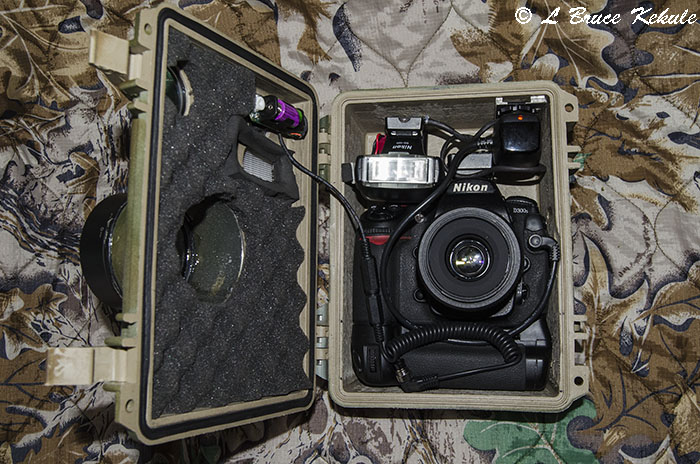
The Pelican 1150 opened showing internal components.
Another motive for the D300s was its ability to produce very little noise at high ISO settings. The cam has a Nikon ‘DX’ fixed 35mm ƒ1.8 lens and uses a MB-D10 battery grip with two EN-EL3e batteries. I will be starting out with ISO 400 and if I get too many dark daytime images, will go up a notch or two and probably stay at 800.
This unit has two sensors: the active infrared ML-3 and a passive infrared Snapshot Sniper SSII board that can be easily switched from one to the other. A special aluminum holder was made-up for the ML-3 receiver attached to the case with three 8/32” button head machine screws at the top on the right. The SSII was placed on the left over the flash.
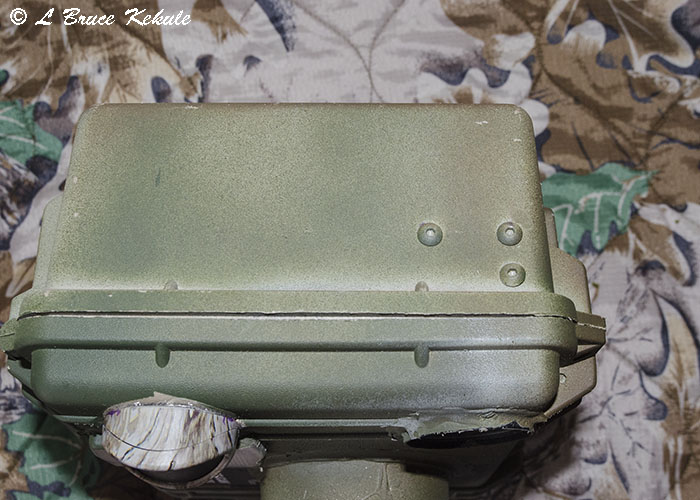
The top end showing three screws holding the ML-3 receiver.
The ML-3 transmitter is housed in an ‘elephant proof’ aluminum box and has 10mm pivot bolts and L-plates. A laser pointer fits in the tube at the top to help in alignment and the box is adjustable for all angles. A 10mm ‘Python’ locking cable 10mm runs through a pipe welded to the faceplate.
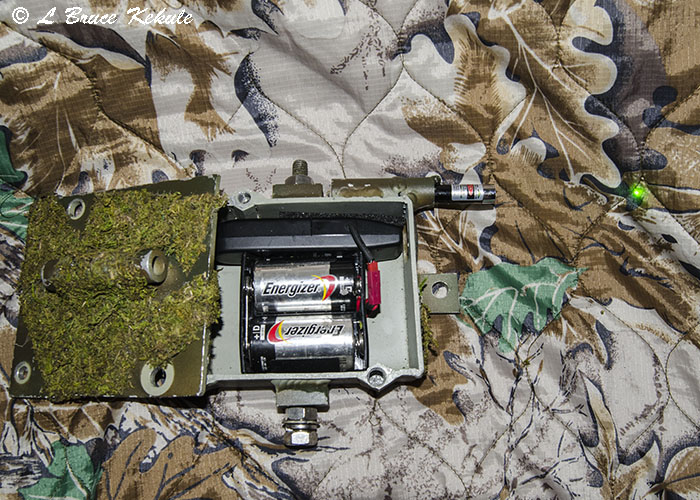
ML-3 transmitter with the ‘laser pointer’ in an ‘elephant proof’ aluminum box.
There are two flash systems: a Nikon SB-400 with two AA externals and SC-17 sync cable (shortened) to fit upside-down next to the cam on the left, and to fire off on every shot tripping a Nikon SB-80 with two 4-pack AA externals (either new Eneloop or AA Lithium) with the flash set to remote. An ‘elephant proof’ box houses the SB-80 and battery packs with stainless steel 10mm pivot bolts, nuts, lock washers and L-plates and is adjustable for most angles. Another ‘Python’ cable secures the flash.

Slave flashes to be used with the D300s; Nikon SB-80 (right)
and National’ generic slave flash (left).
The other system is a PT-04NE FM Radio Speedlite trigger (transmitter and a couple receivers) mounted to an SB-80 and a SB-28 as slaves. I will explain my reason below for the ‘two in one’ system on both the sensors and flash. Another slave flash was built using a ‘National’ generic flash with two 2-pack AA externals for a total of eight AA batteries. A ‘Nissin’ flash trigger I had for more than a decade and recently found along with a ‘National’ sync cable to control the flash, works very well. This all fits nicely in a clear Pelican 1030 and I built my ‘elephant proof’ box as shown that is also adjustable.
Unfortunately, the Nikon ‘wireless flash system’ using the pop-up flash is not viable because the cam will only fire once (even in continuous mode) and then wait a second or two before tripping again. I need multiple shots in continuous mode (5-6 shots) to catch quick stepping animals more than once. The Nikon SB-600, 700, 800 or 900 can be tripped with the pop-up flash (line-of-sight) but it’s just too slow for this cam.
The reason I’m using a SB-400 is simple; it will fire on the first trigger and follow-up shots specially with AA Lithium batteries. It also has loads of power (better than the flip-up) to fill the frame and is TTL. A few remote slaves strategically placed will reduce ‘eye-shine’. I have made up a simple mirror system to direct light straight into the flash sensor as an experiment.

Experimental mirror to be angled directing light into the flash sensor
and attached to the tree above the flash unit.
The camera was a tight fit actually expanding the case a bit but after some serious sanding with a drum sander on both the case and cam, it now slips down nicely to the bottom and it closes easily. The sides of the case are slightly thinner but will not be a problem. However, a notch had to be cut for the shutter cable but that’s all.
The snorkel is thin aluminum tubing with a 77mm UV filter. The flash hole is covered with a shortened Nikon diffuser and the ‘ML-3 receiver’ is covered by a 40.5mm UV filter on the right, and the SSII and HPWA are fitted on the left. Marine ‘Goop’ is used on all ports.

D300s trail cam in an ‘elephant proof’ aluminum box.
As usual, an elephant proof box was made up for the cam to just fit and is installed on a tree using four 3” x 3/8” stainless lag bolts from inside the box. Four 12mm socket and two 10mm ‘power torque’ machines screws attach the faceplate and two 10mm (3/8”) ‘Python locking cables’ slip through pipes welded to the front for extra security. Camouflage paint in my usual ‘no two alike’ pattern. I will also be using dried moss glued on to the faceplate and sides of the box. Plastic leaves are wrapped around the box and locking cables to conceal everything.
The reason for the ‘two in one’ system: When there is heavy insect activity during the rainy season (now), large beetles, butterflies and moths will trip an active infrared sensor shooting an empty forest. I would use the passive infrared during this time. But during the dry season and for exact tripping, the ML-3 active infrared is more precise.
On the flash: some setups that can use light sensitive slave flashes, the SB-400 would be activated. Others sites that would require radio transmitted flash control due to tree or root placement, the radio trigger would be used. I can be selective on both systems and everything stays in the 1150.
I really look forward to setting this cam and will post the first set-up when done. Hope this helps those with ‘DSLR’ madness (like me). Just kidding…! Enjoy.
Thailand’s Vanishing Giants

A family unit in Khao Yai National Park.
Increasingly dangerous environment for wild elephants: An indicator species of a pristine forest
Of all the mammals in Thailand, the wild elephant is probably the most important indicator species of a disappearing wilderness. A century ago, there were more than a hundred thousand elephants found in the country when 75 percent of the Kingdom was still covered by forest. Just north and east of Bangkok, these huge mammals thrived in the marshlands and forests near the city.
But as time passed and humanity expanded creating cities and towns, roads and highways, railways, agriculture farmlands, golf courses and resorts, the home of the wild elephant began to disappear leaving many forests fragmentized and degraded. Populations of wild elephants went into serious decline. Humans are directly responsible for this loss with encroachment and poaching at the forefront. Forests and wildlife continue to disappear as we move into the 21st Century.
When Khao Yai, the first national park in Thailand was established in 1962, the Royal Forest Department (RFD) was in charge of protecting the forest. Prior to that, they controlled logging concessions and huge swathes of forest were felled in the timber business. Finally, the government stopped all logging in 1989. However, illegal tree felling is still going on to this day but on a smaller scale.
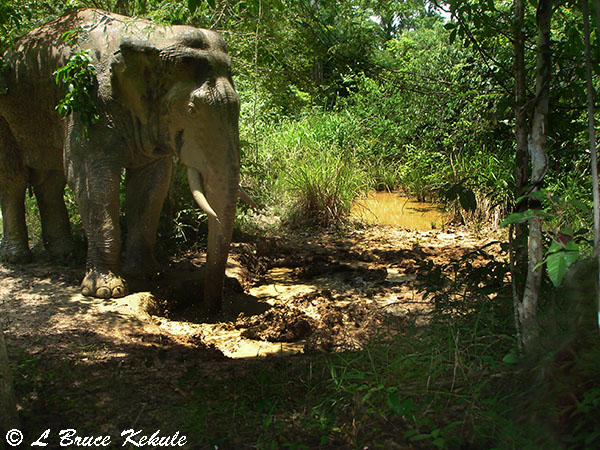
Tusker camera trapped in Khao Ang Rue Nai Wildlife Sanctuary, eastern Thailand.
Then in 1992, the Department of National Parks (DNP) was established to look after the national parks, wildlife sanctuaries, non-hunting areas and marine national parks. There are now over two hundred protected areas nation-wide.
Since then, it has taken many, many years for the department to establish some form of protection and enforcement. Patrolling of the forests has been minimal due to many factors. Unfortunately, things have been difficult for them to look after these biospheres because of low budgets and not enough personnel. Laws are seriously outdated especially when it comes to elephants.
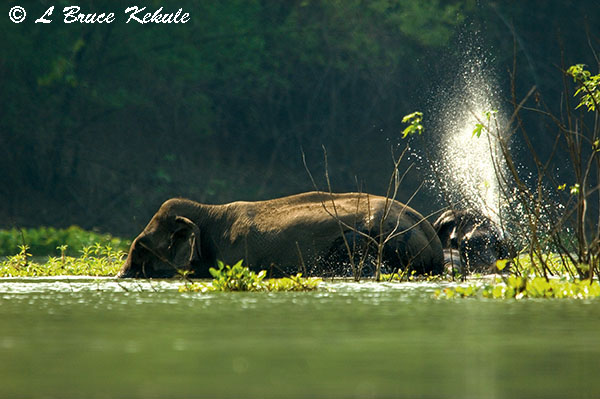
Elephants in the Huai Kha Khaeng river blowing water.
The history of man and elephants in Asia has been intertwined for several thousand years. These majestic creatures taken from the wild have been part of human culture and beliefs. Elephants played a major role in the wars with Burma of the past. Until recently, the elephant was not only used for logging but for transport and baggage. More recently, they are used to attract tourists at camps and in cities where people use them for begging. The domestic elephant has been abused, and very badly in some cases.

Begging elephant in Chiang Mai – Abstract.
Probably the most appalling fate for a domesticated elephant is to become a streetwalker. These magnificent creatures are forced to walk hot, dusty and polluted streets of Thai cities ‘begging’ for food and money. Stories about elephants hit by cars and falling into drainage ditches, plus other accidents have been documented.
Ten years ago, it was guesstimated that 2,000 wild and 3,000 domestic elephants were thriving in the country. Due to an increased DNP and NGO interaction in the parks and sanctuaries, wild elephants have made a bit of a comeback in some protected areas. There are now (still guesstimated) to be about 3,000 wild elephants and more than 4,000 domesticated animals. Population density surveys have been carried out in some parks but exact numbers of the wild population are still uncertain.

Elephants on a truck bound for Chiang Mai.
The biggest threat to wild elephants is still the same. Poaching males for their ivory and females for their babies. Recent kills in Kaeng Krachan National Park in the Southwest have gone on for quite sometime due to poor protection and enforcement, and numbers of elephants have dropped.

Elephants in the savanna of Kui Buri National Park.
It is quite possible that they have migrated to Kui Buri National Park further south along a thin corridor along the Burmese border. Numbers in Kui Buri have increased 100 percent in the last five to ten years, and evidence of elephants in Prak Tha Kor Reserve Forest between the two parks has been documented. This area needs to be established as a protected area.

Elephant herd in Kui Buri National Park.
The following is a typical scenario of baby elephant snatching. Gunshots reverberate explosively through the forest, panicking and scattering a herd of wild elephants. The huge beasts instinctively flee as fast as they can through heavy foliage away from the cacophony. In minutes, the forest returns to normal. But the sad fact is that humans have just disrupted the herd permanently.
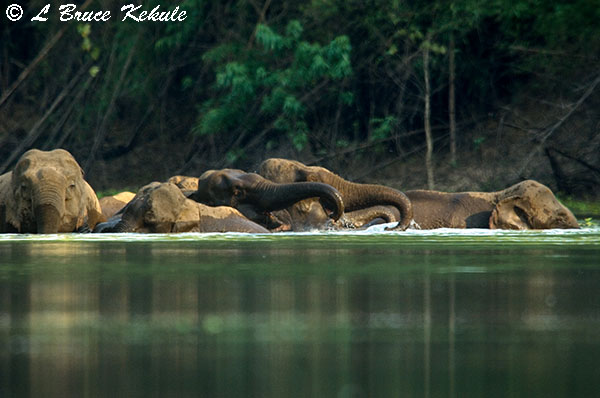
A large herd in Huai Kha Khaeng Wildlife Sanctuary.
A baby elephant mills aimlessly around its mother lying dead on the ground. The confused calf has no sense of danger as poachers move in to capture it to be sold on the illegal black market. The calf will likely be forced to wander city streets or work in tourist camps.
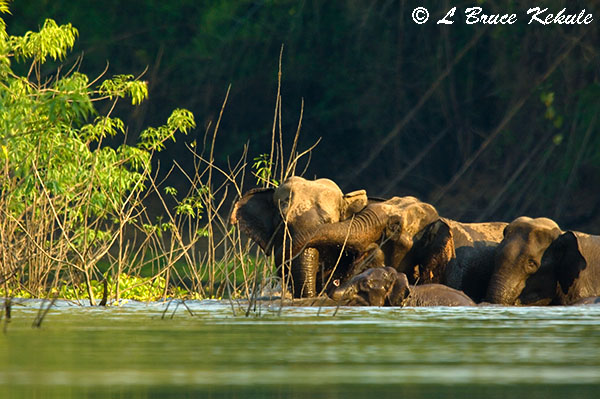
A small herd including a calf in the Huai Kha Khaeng river.
Such atrocities are still practiced by unscrupulous people intent on killing the mother solely to capture the baby. Many other animals are also hunted down in much the same way. Middleman, the ‘big-fish’ and end-use buyers perpetuate this market and seem to evade the law. When will this horror story ever stop?
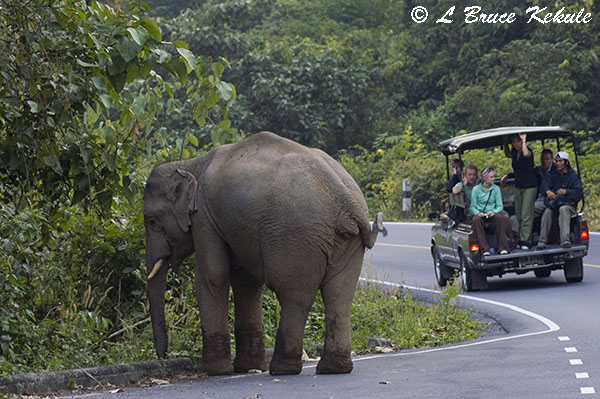
A tusker and tourists in Khao Yai.
In another real-life scenario, a young tusker is killed on the road that transects the northern part of the elephant’s range in Khao Ang Rue Nai Wildlife Sanctuary in eastern Thailand. It is home to about 170 wild elephants. The road had been widened and resurfaced to enable faster speed.

Tuskless bull in Huai Kha Khaeng.
During late-evening one day in May 2002, a man and woman in a pickup truck barreling through the sanctuary at high speed did not see the elephants on the road until it was too late. The truck crashed head-on into a 5-year-old tusker. The truck’s driver was killed on impact but the woman survived. The young elephant died shortly after.

Tusker on the road in Khao Yai NP.
This young tusker was not the first and definitely will not be the last elephant to be killed by reckless driving on this road. Eventually, the local government ordered the road closed through Khao Ang Rue Nai from 9pm to 5am. The elephants come out of the forest usually only at night and can now roam safely in their own habitat. Accidents and road-kill have dropped drastically. Definitely a role model for other protected areas with elephant-human conflicts.
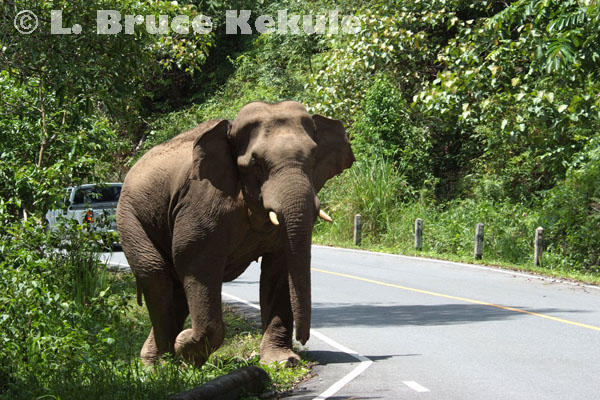
Another tusker on the road in Khao Yai N.P.
Such accidents are a terrible blow to the conservation of Thai elephants, because tuskers are particularly vulnerable, being subject to hunting for their ivory. Asian ivory is finer-grained than African ivory and prized for carving into trinkets and Japanese hanko (signature seals).

Herd in Kui Buri N.P.
Much of their habitat has been taken over, mainly by pineapple, sugarcane and cassava. Villages spring up in old elephant habitat, and the trespassers expect the giants to simply fade away into the forest. But elephants can develop a taste for crops grown by farmers, and they often take what they want. Countless conflicts have arisen between villagers and the real owners of the land, whose ancestors have lived there for many thousands of years.

Herd in the Huai Kha Khaeng river.
Elephants have been maimed and killed by poisoning waterholes, pungee stakes, gunshots, and electrocution. They have been chased out of rice paddies, mango orchards and farmlands. People use fireworks, bright lights and guns to scare them away temporarily, but the elephants are intelligent enough to lose their fear of such ruses.

Elephant on the highway north of Bangkok.
These giants grow bolder and go on the rampage, sometimes killing people, tearing up villages and damaging RFD and DNP facilities. Some conservation organizations have erected new signs warning of the danger of elephants in the area.

Elephant and handler begging near ‘700 Years’ Stadium in Chiang Mai.
A trip at night around some cities, one can still be greeted by a huge gray beast with a red light attached to its tail. Continuous calls for change go unnoticed by mahouts and the owners of these elephants who sneak them into tourist sites. Legislation concerning domesticated elephants remains old and out-dated, and law enforcement has also been very poor. On the positive side of things, the authorities have finally moved them out of Bangkok, but they still roam on the outskirts in some places.

Elephant in a mineral deposit in Kaeng Krachan N.P.
It is hoped that the RFD, DNP and other government organizations will draw attention to the dire situation of Thai elephants, both wild and domestic. These noble beasts have featured prominently in almost every important historical event in the Kingdom. They are a national symbol of pride and joy. The Thai elephants’ future survival lies in the hands of the government who are responsible for these amazing giants….!
Special Note:
I would like to thank Andy Merk, German wildlife photographer for the lead photograph. He has been hanging around Khao Yai for the last 20 some years and has a huge collection of elephant photos from the park. He is doing a survey of trying to get a estimate of the population by identifying individual elephants by their ears, specially the male tuskers and mature females.
Forgotten memory stick..!

Leopard passing a S600 after a rain.
Awhile back, one of the members on Camtrapper.com forum (zaj56) posted on June 22, 2013 ‘some bear pics’ and had forgotten to put a memory card in his cam but the internal memory (10 shots) was able to get some very nice bear shots.
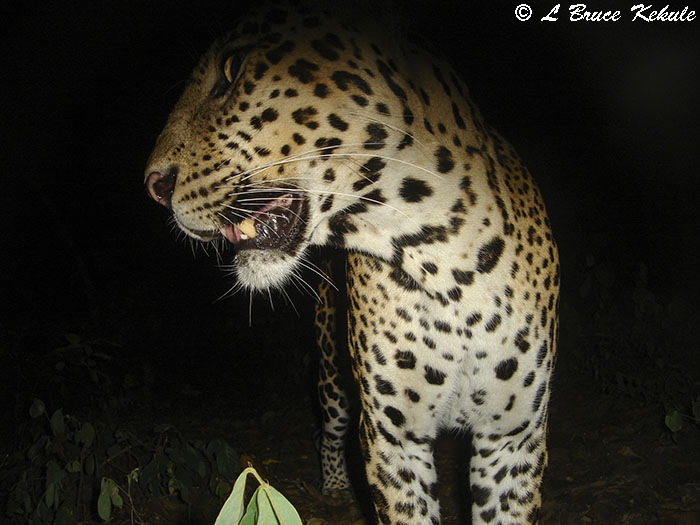
A leopard up-close to the S600.

A night predator passing-by.
Going through my S600s recently fixing on/off switches (just posted on the forum), I found some shots on the internal memory from November 2012 on one cam and decided to have a closer look.

A tiger up-close to the S600.
Imagine my surprise when I saw 10 shots including a tiger and leopard close to the cam. This means I had forgotten to put a memory card in the cam and just lucked out getting the two big cats.

A tiger passing by the S600.
The moral of this blurb: Try not to forget your memory card before deploying the cam…!
A Sony S600 on/off button fix
The single most aggravating thing about Sony S600s is the on-off button. These cams are really one of the best for homebrew trail camera traps and I really enjoy using them. For some reason the switch tends to bottom out and the cam cannot be turned on. I have seen so many where someone previously used their fingernail to turn it on and off, and after awhile it just collapses and will not work.

Sony S600 on-off switch repair
I like to turn my S600s on before deploying in the forest to check the time, date and other things like mode, ISO, flash on, etc, and trying to turn it on with the sensor can be iffy. There is not enough time to check anything before the sensor tells the cam to shut down…!
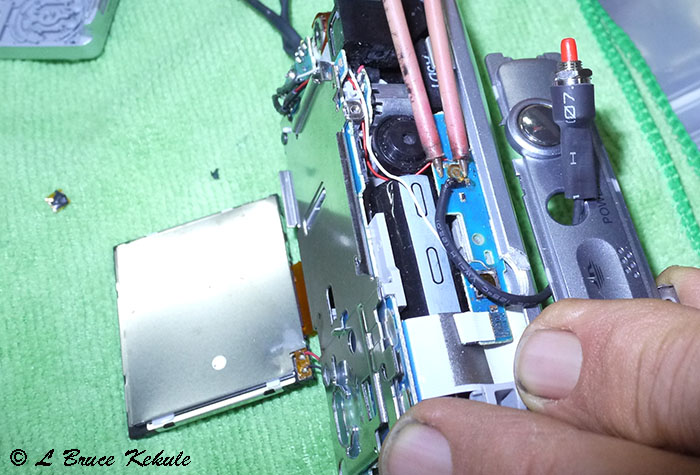
Solder points for switch repair
All the Sony P and W-series cams usually do not have this problem and even the S40 button is good. As most of my 600s had this problem, I came up with a simple trick to fix this. A small push-button switch and short wire is soldered onto the pad as shown in the photos. Run the wire through the buttonhole and ‘Goop’ in place. I have now fixed all my S600s like this and they are working very well.
Hope this helps those on the forum with this S600 affliction.
A Canon 400D trail cam
A new/old Canon 400D: An easy DSLR in cost and production

Canon 400D with battery grip/Pelican 1150/Snapshot Sniper SSII board/Yongnuo wireless flash trigger plus two ‘D’ cell externals.
Back in march 2012, I built and posted my first DSLR trail cam around a Canon 400D with 18-55mm kit-lens and a Yeticam board (EOS chip) in an old recycled aluminum box I had made up for Minolta 800 si SLR film camera years ago.
I was using Yongnuo wireless flash triggers tripping three Canon 270EX flashes and it was working OK when I left it. Elephants bashed the thin-tube aluminum snorkel breaking the front glass, and then it rained. And that was that…!
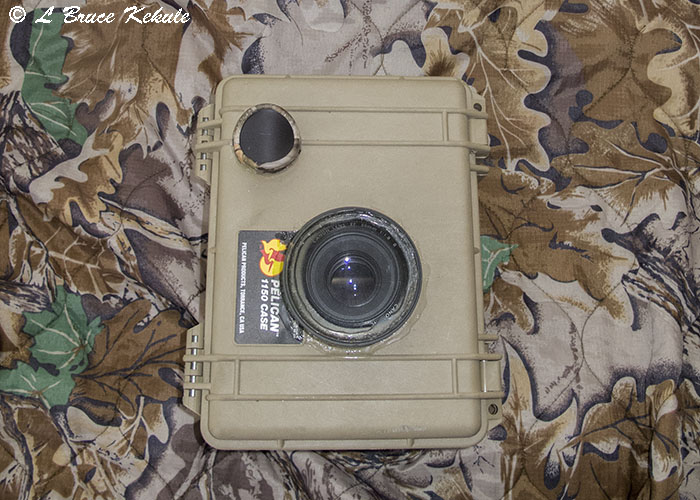
Canon 400D in the box.
I then picked up a Canon 350D with the 18-55 kit-lens and got another Yeti board rebuilding the cam. The snorkel was busted again by the forest giants but it did not rain this time and I was able to get it going again with a new replacement glass (77mm UV filter) and an ‘elephant proof’ snorkel protector. This cam is presently working very close to where I camera trapped and was charged by a bull guar.
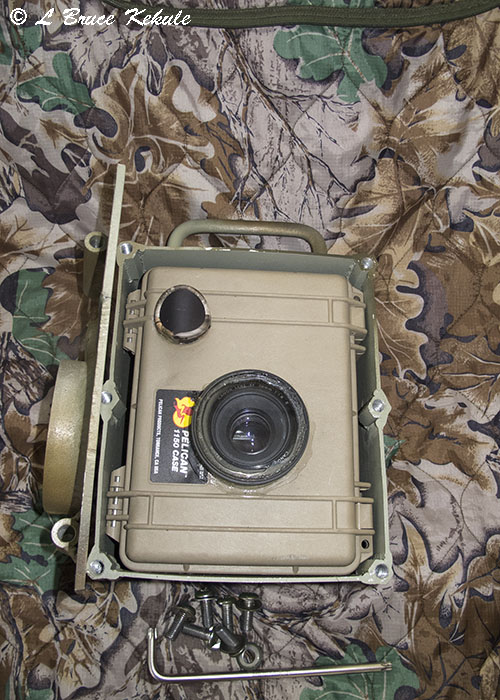
The 400D in an ‘elephant proof’ box.
I decided to buy a second-hand Canon 400D (Rebel XT-i) body only but this time went with a fixed Canon 50mm ƒ1.8 lens. I picked up a Pelican 1150 box and one of Snapshot Sniper SSII #5 boards and hooked it up with a Canon shutter release (button removed and it has a good 90-degree plug). A 77mm aluminum tube and filter is glued to the case with Goop. A Snapshot Sniper HPWA with a black Fresnel is used with the sniper board.

Canon 400D ready for the field.
The shutter release shielded wire is ground and white is shutter and red is power. The camera is set to ‘Continuous’ and the board to trail mode. I’m getting 5-6 frames per trip and can trip as many as four-five flashes at once. I have several different locations planned for this cam. With a Yongnuo 603C wireless flash trigger with two ‘D’ cell externals and everything fits nicely in the 1150.

Flashes to be used with the Canon 400D.
I have two recycled flashes (a Canon 270EX and a Nikon SB-28) that will make up the group. Another two Nikon SB-26s on ‘stand-by’ mode will also be put into service (one with four ‘C’ cells and one with four ‘D’ cells) to see how long the respective batteries will last. A special modification is made to the SB-26s to allow regular 6-volt 4-cell packs to be used. Another mod is to unhook the ribbon to the monitor after the flash has been set-up (mostly half-power). This will reduce power consumption on the SB-26s.
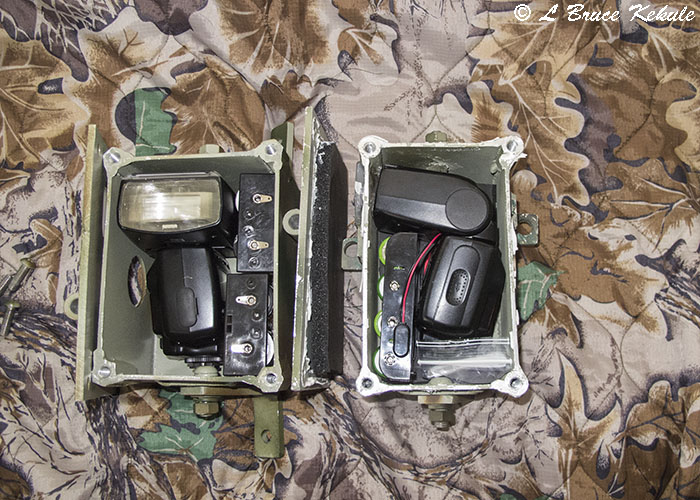
Nikon SB-26s: one with four ‘C’ cells and one with four ‘D’ cells.
The Canon 400D (300, 350 or 450Ds) are not that big or expensive. There is plenty of room for a pipe through and Python locking cable. It will shoot in ‘Raw’ mode that will allow some latitude in post-processing.
As usual, I have made up an elephant proof aluminum box that will be bolted to a tree with three 3”x 3/8” stainless lag bolts from inside the box plus two 10mm Python cables. The front cover is bolted to the box using six 10mm power-torque machine screws. The flashes are in aluminum boxes with 8mm power-torque machine screws bolted to trees with the same lag bolts and Python locking cables for security.

A Canon 400D with an adapter for Nikon 50mm ƒ1.4 lens.
I have another 400D that will be getting the same treatment except I have an adapter to use an old Nikon 50 ƒ1.4 manual lens. We will see what the difference is in using a plastic lens versus a glass lens. I’ll put my money on the glass out-preforming the plastic…!!
Cost of materials – cost can vary:
Canon 400D………………………………………………….. about $150 (used)
Battery pack grip……………………………………………… about $32 (new)
Canon fixed lens 50ƒ1.8 ……………………………… about $80-90 (used)
Canon Shutter release……………………………………………….. $13 (used)
Pelican 1150 case……………..……………………………………….. $30 (new)
Yonguo 603c flash triggers (a pair)……………………………… $33 (new)
Snapshot Sniper SSII board (#5 chip) & HPWA Fresnel.. $50 (new)
Total cost: about $398 plus labor and essentials (Goop, extra cam battery, drill bits, soldering tools, etc).
Hope this will give some of you camera trappers out there an incentive to build a DSLR…! The cost for some cams is not that expensive and the Canon 400D is a good choice for a first cam.
A BIG CAT TRAILHEAD
Nikon D90 DSLR camera trap: Almost a year in the making
A new DSLR camera trap
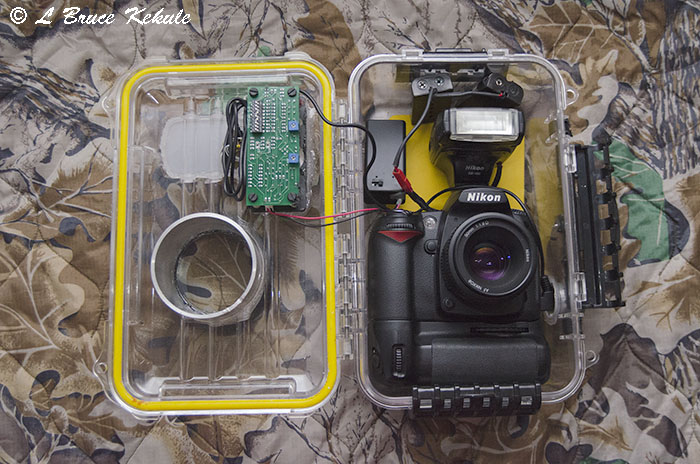
A Nikon D90 and battery pack with a 50mm ƒ 1.8, SB400 flash and a Yeticam board in a Plano 1460.
Last year in September, I made a post about a Nikon D90 with a 50mm ƒ1.8 lens and a SB-400 flash in conjunction with a Yeticam board in a Plano #1460 clear case.
It was in pieces at the time and sat on my bench until last month when I decided to finish it off. I have two sets but will test this one first to see the results. The SB-400 has four AA externals plus two in the flash for (six). I use either Lithiums or Enelopes.
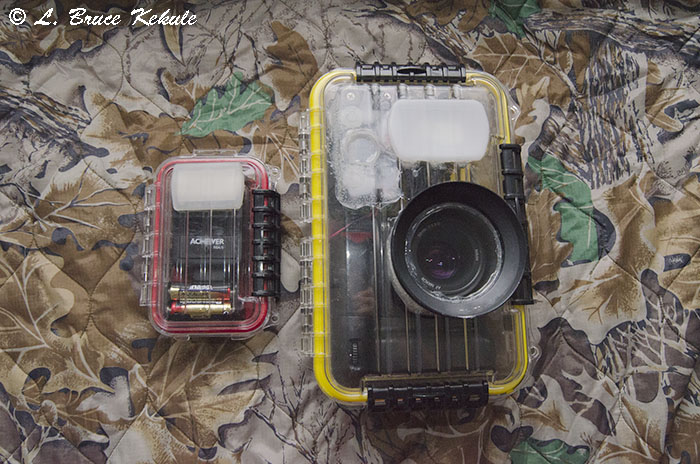
D90 and an ‘Achiever’ slave flash in a Plano 1499.
The D90, battery pack and SB-400 sits nicely in the case but a relief hole was needed on the side to allow a little more room for the shutter cable. I found some ‘Meike N3’ electronic shutter release for Nikon (90 degree plug) and just cut the button off and attached the wires to a Yeti board. I used a piece of ‘plastic tubing’ and a 10 Baht coin and ‘gooped’ it all in sealing the tube.

D90 in an aluminum ‘elephant proof’ box.
A 3” X 2.8” X 1/8” aluminum tube is used for the snorkel and a 77mm filter is gooped on. No other modifications are made to the case and everything fits perfectly. The Yeticam board is set in the vertical position and an EOS chip was installed.
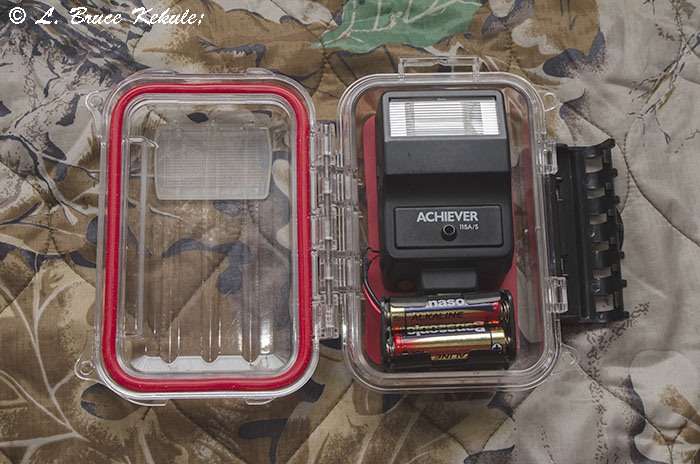
Achiever slave flash and ‘AA’ externals.
A huge ‘elephant proof’ aluminum box was made up to protect the cam. As this one is really large, I had my welder attach a plate on top at a 45-degree angle to keep the jumbos at bay by not allowing them to get a grip on the top.

Nikon SB-26s with ‘C’ and ‘AA’ externals.
Four 3” X 3/8 stainless lag bolts set the cam tightly on a large tree and I can use two 10mm (3/8”) Python locking cables for extra security.

SB-26s and externals in ‘elephant proof’ boxes.
In the meantime, I added two Nikon SB-26s with 6-volt externals in ‘elephant proof’ aluminum boxes run as slaves. The flashes were modified to take straight 6-volt packs and plugged into the pos. and neg. pins as shown. Real Nikon battery packs cost a fortune. This is an alternative that works very well.
The ‘elephant proof’ boxes were made for the SB-26s that have flash diffusers gooped on the front and 40.5mm UV filters on the back in line with the light sensor.

SB-26s slaves showing diffuser and 40.5mm UV filter.
I also built a small ‘Achiever’ slave flash with 4-AA externals in a clear Plano 1499 case. An old 1020 ‘elephant proof’ box was recycled for this flash. This will be used depending on some locations.
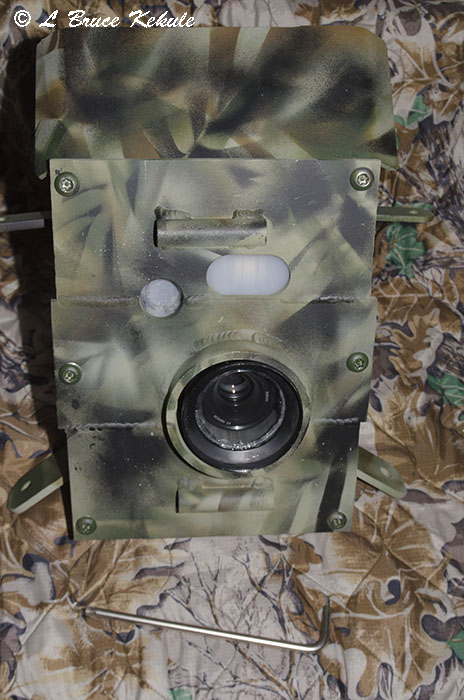
D90 in an ‘elephant proof’ box ready for the field.
I look forward to setting this cam and slaves. I probably will put it close to where I was charged by that bull gaur.
A Close Encounter: The saga of a charging bull gaur
Gaur: Thailand’s magnificent mega-fauna
A truly close call with the largest bovid in the world…!

A bull gaur camera trapped at the trail-head a week before about 100 meters from where I was charged. Probably the same old bull that tried to kill me…!!
About two weeks ago, I hit the jackpot out of all my 48 years in Thai forests. I was alone and it was raining in the Western Forest Complex. I had just set a Bushnell Trophy Cam set to video at a trail-head where I previously got a big bull gaur, a bull banteng, elephant, black leopard, wild dog, tapir, wild pig and barking deer.
As I was walking in to set a few more traps, I saw some fresh gaur tracks and judging from the size, noted it was a big mature bull. I went in a little bit more and decided to turn back as the bush was really thick and it was getting late.

A mature bull banteng on the trail.
I had gone about 50 meters and all of a sudden, a bull gaur no more than six meters away, snorted at me. I snorted back thinking he would run away. In the next moment, this huge beast punched through the bush with its head down in the classic position to hook bad people and throw me into the trees.
I saw the right horn base for a fraction of a second and it took me another fraction of a second to do the only thing possible and that was to drop down to the left flat on my stomach with my head down. The bull jumped over my legs and then circled around to do more business of trying to kill me.
What seemed like a lifetime, I heard him thrashing around breaking saplings and stamping on the ground some 10 to 15 meters away. A second charge was imminent and could be disastrous if he used his hooves to trample me. Only one thing would save me now.

Banteng bull close-up.
I quickly pulled out my pistol (.45-ACP ‘Para-Ordnance’ alloy frame), loaded it and let off a shot in the air all the while still lying down. After the report a few seconds later, the bull high-tailed it crashing off into the forest behind me. WOW, that was a close encounter and truly a heart-stopper. I stayed on the ground for quite awhile to make sure he was really gone.
In all my years in the forest, I have never been this close to a gaur or had the experience of a charging bull. No telling if this old bovid had been shot and wounded previously by poachers, and that he really hated humans. Or was he just an old guy with a bad temper and considered me a threat when I barked back at him. I will never really know how close I came to instant death…!
Many a Thai hunter has been killed by gaur because they froze in their tracks and just stood there not reacting in time. I have read in several books that the only way to avert death is to drop flat on all fours with your head down, or to have a very large caliber rifle (minimum .458 caliber) on ready. I had a Nikon D7000 and a 70-300 VR lens. I was lucky to be packing a sidearm..!!

A black leopard close-up.
How did I react so fast and survive? I have one man to thank. He is my dear old friend Gordon Young, author of the book ‘Tracks of an Intruder’, a classic tome about hunting in northern Thailand in the 1950s. He talks about the evasive action needed in this urgent situation in a chapter about a man-killer bull gaur in Mae Salak in Chiang Mai, Northern Thailand. I certainly thought of him right after this…!
I feel extremely lucky to have survived this attack and it was absolutely the most exciting experience that I have ever had, bar none! I have been two meters away from a black leopard just outside my blind, and that did not even hold a candle to this charging solitary bull. I certainly did not have time to take a photo.
Maybe being born under the star ‘Taurus’ (May 19th) had something to do with it, or maybe the ‘good old spirits’ of the Thai forests took care of me and pushed me down at the right moment. This incident surely has me thanking my lucky star.
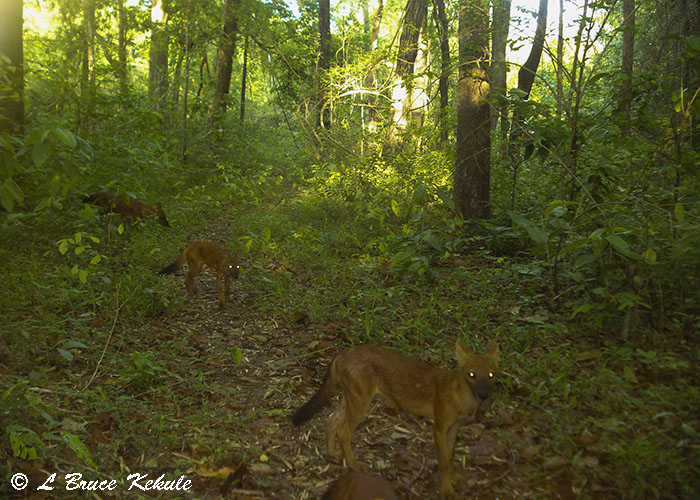
Asian wild dog pack out hunting.
Gaur are wild forest ox and the largest bovid in the world standing 1.7 meters at the shoulder weighing close to a ton for mature bulls with a distinctive dorsal ridge and a large dewlap, forming a very powerful appearance. Cows are only about 10cm shorter in height, but are more lightly built and weigh 150 kilograms less.
These beasts have stout limbs with white or yellow stockings from the knee to the hoof. The tail is long and the tip is tufted to ward-off biting insects. Newborns are a light golden color, but soon darken to coffee or reddish brown. Old bulls and cows are jet black but south of the Istamas of Kra, some take on a reddish hue.
All bovine share common features, such as strong defensive horns that never shed on males and females, as well as teeth and four-chambered stomachs adapted to chewing and digesting grass. Their long legs and two-toed feet are designed for fast running and agile leaping to escape predators. They are gregarious animals, staying in herds of six to 20, or more. A large herd of 50 was recorded in Thung Yai Naresuan Wildlife Sanctuary but that was a long time ago.
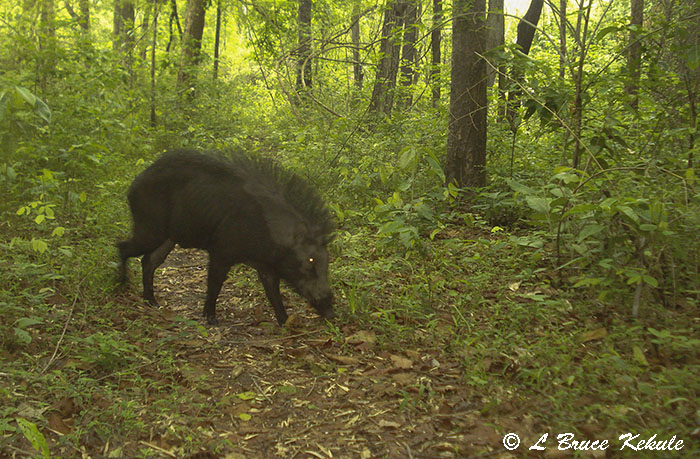
Wild boar in the morning.
Due to their formidable size and power, gaur has few natural enemies. Tiger, leopard and Asian wild dog packs occasionally attack unguarded calves or unhealthy animals, but only the tiger has been reported to kill a full-grown adult. Man is their most dangerous adversary.
These herbivores graze on grass but also browse edible shrubs, leaves and fallen fruit, and usually feed through the night. They also visit mineral licks to supplement their diet. During the day, they rest-up in deep shade.

A male muntjac (barking deer) with a serious wound on its hind quarter.
Gaur still survive in some protected areas but are in serious decline. It is now estimated that maybe 1000 remain in Thailand. However, some reserves where gaur are breeding in fairly good numbers allowing them to actually increase in number if there is adequate protection.
These enormous beasts live in herds but also become solitary, primarily the males. But I have also seen and photographed several mature females by themselves. Mineral deposits play a very important role in the lives of these wild cattle as does thick forests and steep mountainous terrain with abundant water resources. Their future depends whether they are protected to the fullest extent. Unfortunately, their beautifully curved horns are highly sought after by poachers and people who covet trophies.

A unarmed researcher a day before the big gaur passed by.
Budgets, better funding, more rangers and personnel are needed now. Transparency is a must with the national parks and wildlife sanctuaries so money is used properly and efficiently, and corruption stamped out completely. Now that will be a tough nut to crack. It is hoped this draconian situation will change, so the Kingdom’s natural heritage and the majestic gaur will continue to survive in today’s world.
Additional photos of gaur:
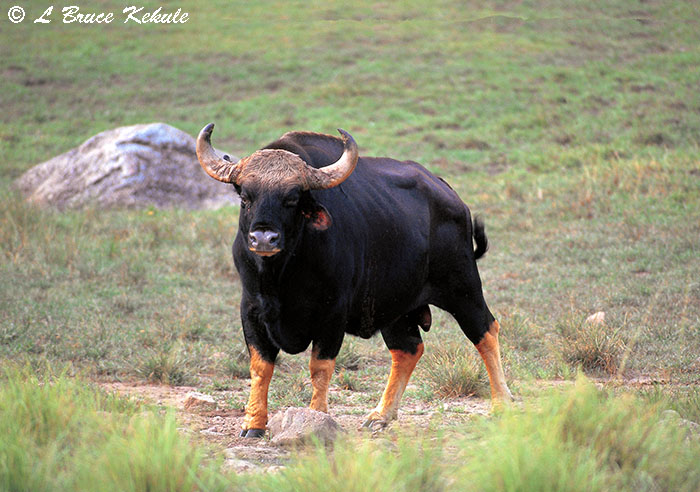
My first encounter with a bull gaur some 15 years ago.

The older bull being chased by a younger one.
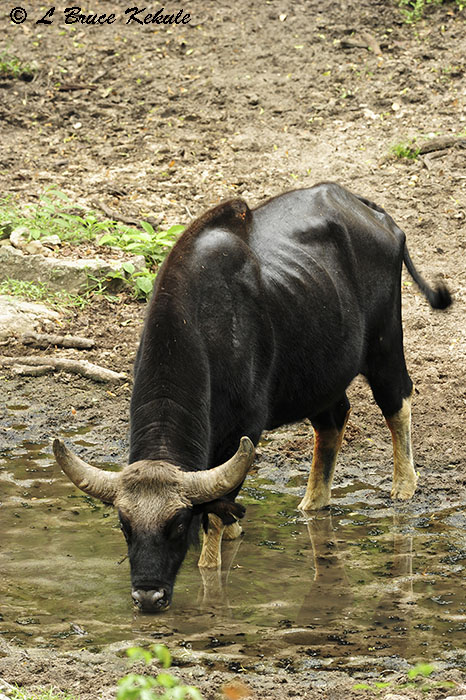
Another old bull gaur at a waterhole.

A single gaur cow at a mineral deposit.

Gaur herd including a bull, cows and three calves.

A gaur herd including two banteng in Kui Buri National Park.

A bull gaur track on the right and cow track above.
A Black Leopard in Broad Daylight
A rare encounter: A black cat appears deep in the interior of the Western Forest Complex
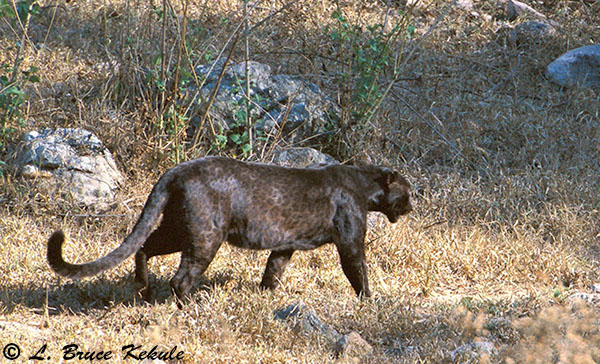
My first black leopard in the late afternoon sun showing its spots some 15 years ago.
It is late April in the forests of the Western Forest Complex, one of my favorite places in Thailand. The first rains have come and doused the dangerous forest fires that spread throughout the area during the dry hot season starting in March and ending in May.
As usual, I’m setting-up camera traps at a hot-springs (mineral deposit) not far from a ranger station some 50 kilometers deep in the interior accessible only by a dirt road.
This natural seep is visited by all the large mammals including tiger, leopard, elephants, gaur, banteng, tapir, sambar and many other smaller creatures, and provides excellent opportunities for some great animal shots.
As I was going through a few of my camera traps changing out cards and batteries, I decided to have a quick look at a 2GB card that was in one of my cams.

A black leopard in mid-afternoon camera trapped on a trail to the hotspring.
Imagine my surprise to see a shot of a ‘black leopard’ in mid-afternoon walking up a trail shown in the story. Other denizens caught in this series include elephant, tapir, sambar, wild pig and muntjac (barking deer) over a month period back in February of this year. The leopard was truly a bonus and I had actually closed out the program with this cam.
This black leopard brought back fond memories of this place more than 15 years ago. I was sitting in a tree blind up by the hot springs when a black leopard walked out into the open about 4pm and posed for me at several places for over the next hour.
Those were in the old days of slide film, and I did not know how good the shots were until the film was processed. A few images are shown here from that lucky sequence many years ago. The sun was low and the black leopard showing its spots is one of my best wildlife photographs ever.

Posing on a fallen tree at the beginning of my career of wildlife photography.
Sometimes things happen in succession that boggles the mind. On May 6th, I posted the ‘black leopard’ camera trap image on my website. The next day I left Bangkok very early in the morning and arrived at the hot springs. I was back to reset camera traps, and this time to sit at the base of the old tree for some through-the-lens work. Who knows what might show-up.

Resting in the late afternoon and scoping out the area for prey, May 2013.

This black cat stayed for about 10 minutes.

A rare carnivore still surviving in Thailand.

Another once in a lifetime encounter as it leaves the mineral deposit.
I was with my good friend Sarawut Sawkhamkhet, a Thai wildlife photographer. We arrived and set-up a temporary blind about 3pm. The weather was warm and balmy with nice clear-blue skies.
At 5:45pm, the unthinkable happened! A ‘black leopard’ appeared out of the forest near the springs and walked over for a drink, and then disappeared for a short while. Then this magnificent creature came back and flopped down on all fours twitching its tail looking straight at us and staying for about 10 minutes before going back in the forest where it had come from.
The leopard (Panthera pardus) described by Linnaeus in 1758 is the second largest cat in Thailand. Once upon a time, leopards could be found in most forests of the Kingdom. These felines are still surviving quite well in protected areas in the West, and many forests in the South. The central, eastern and northeastern regions have no reports of leopard for long time now.
Pound for pound, the leopard can take on some seriously large animals several times its size. The leopard is closely related to the jaguar of South America. Both have a spotted coat pattern and incidence of ‘melanism’ or black phase. Many people have a misconception about the black leopard (also known as the black panther) as a separate species but in fact, it is the same as the yellow phased leopard.
The present distribution of the leopard is restricted to Asia Minor, India, Southeast Asia, the Himalayas, Tibet, China, Siberia, and Africa. Fossils of leopards have been found in Pleistocene deposits throughout Europe, the Middle East, Java, and Africa, some 1.5 million years old, indicating the leopard arrived after the tiger which has been around for about two million years.
These secretive cats are mainly nocturnal but in some localities, they are active in the day too. Their populations and ranges are difficult to determine but radio tracking of collared animals has shed new light on their movements and areas they live in.
Sighting a leopard in Asia is extremely difficult, and even catching a rare glimpse of this very essential top predator is tough due to its solitary and stealthy behavior. However, luck can sometimes play an important part in viewing the leopard and I feel lucky to have seen and photographed them on quite a few occasions.
My most thrilling or heart stopping adventure with a black leopard happened in Huai Kha Khaeng about five years ago while I was sitting up on a bluff overlooking the river. A photographic blind was erected on the rock-face about 20 meters up with a small trail that enabled me to get into the hide. The sun was bright and the weather was warm during the dry season.
About 9am, several monks down by the river passed on but did not see the camouflaged structure as they went their way. After that, I came down for lunch and set some camera traps at a mineral deposit nearby. At 2pm, I settled back in the blind and began a vigil of the river. I started to feel a bit groggy as the sun was beating down on my position. I moved my camera in to save it from the direct sunlight.
All of a sudden, I was startled by a guttural growl outside the enclosure. I stood up peering out the window and came face to face with a huge round black head and yellow eyes about two meters away that penetrated my soul. My first instinct reaction; it was a big black dog. But that quickly changed as the creature stared intently at me before bounding down the trail it had come up. The big cat was gone in a split second. Of course there was not enough time to get any photographs. The incident surely is etched in my memory.
Without doubt, the future of the leopard depends on one thing only – the complete protection of the remaining forests where they live. If the national parks and wildlife sanctuaries remain intact with a high number of prey species, the big cats will survive. But if over-development, poaching and encroachment are allowed to continue, the large cats will eventually disappear.
Unfortunately, too much time and money is wasted by too many organizations talking about saving wildlife and their habitats, with very little actually being done. Human population growth will eventually destroy most wild places. Only true protection by some dedicated people will slow the destruction of nature’s precious wildlife and wilderness areas. It is hoped the leopard, and the tiger, will continue to survive as they have for millions of years.