

Posts Tagged ‘Thailand’
Goral in Mae Lao-Mae Sae Wildlife Sanctaury – Northern Thailand
From June to August 2011, I set a Bushnell Trophy Cam on video mode at the top of ‘Mon Liem’ mountain in the sanctuary. After collecting the camera, many clips of goral were taken, both during the day and at night. This is just a few of those clips.

Asian tuskless bull elephant in Huai Kha Khaeng
A huge tuskless bull elephant at a mineral lick in Huai Kha Khaeng Wildlife Sanctuary
This bull has been involved in a few close encounters with rangers, and actually killed one man while he was riding his motorcycle along the road in the sanctuary. These old elephants are to be avoided at all cost. I certainly stay out of their way when I’m working in this World Heritage Site which means slow and deliberate movement is essential and ears and eyes on high alert when walking through this forest.
Poacher camera trapped in Mae Lao-Mae Sae Wildlife Sanctuary
Silent video is not noticed by a low-land village man scouting for game or forest products
This hunter/gatherer was caught by a very sensitive Bushnell Trophy Cam set on video mode during May-June 2011 up the mountain in this protected area. He was probably Hmong or Karen hill-tribe but had no gun. But this does not mean he did not have rope or wire sling, and poison in his backpack, or had already set some snares near wildlife concentrations like mineral licks. These are the main tools for poachers now-days. More camera trapping of this sanctuary is needed to get face recognition of people who illegally entering this place. Look for future posts of this nature.
Pig-tailed Macaque in Mae Lao-Mae Sae Wildlife Sanctuary
A mature pig-tailed macaque up on a ridge-line in the sanctuary
This monkey showed-up in front of a Bushnell Trophy Cam set to video, and then made an amazing leap to a tree overlooking the lower valley. As a loner or solitary primate, he must have been pushed out of the group by a larger male. But the big question: What was he doing all the way at the top of this mountain?
Asian Wild Dogs in Mae Lao-Mae Sae Wildlife Sanctuary: Part Two & Three
Wild dogs pass a Bushnell Trophy Cam a few days later:
These videos once again demonstrate Thailand’s beautiful and amazing natural heritage, and the fact these carnivores are still thriving in the North formally thought to be extinct.
Keang Krachan: Rare creatures surviving in the park
A collection of photographs taken from 2001 to 2008
of some rare Asian animals still thriving in this amazing forest

Fea’s muntjac camera-trapped at Kilometer 33 on Phanern Thung mountain

Male muntjac also known as common barking deer at a mineral lick
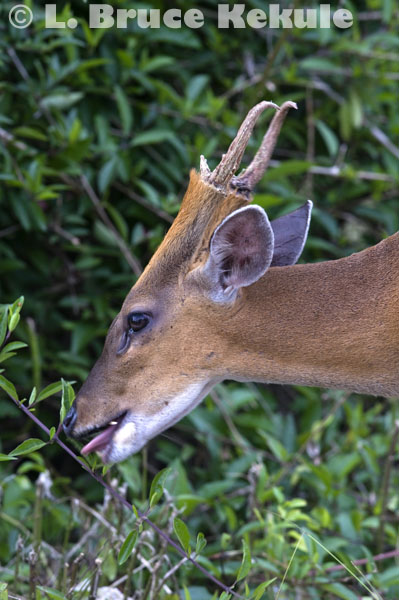
Male muntjac feeding on leaves

Gaur cow at a mineral lick in the interior

Small gaur herd at another mineral lick

Gaur bull and cow footprint compared to my hand

Asian tapir swimming in the Phetchaburi River
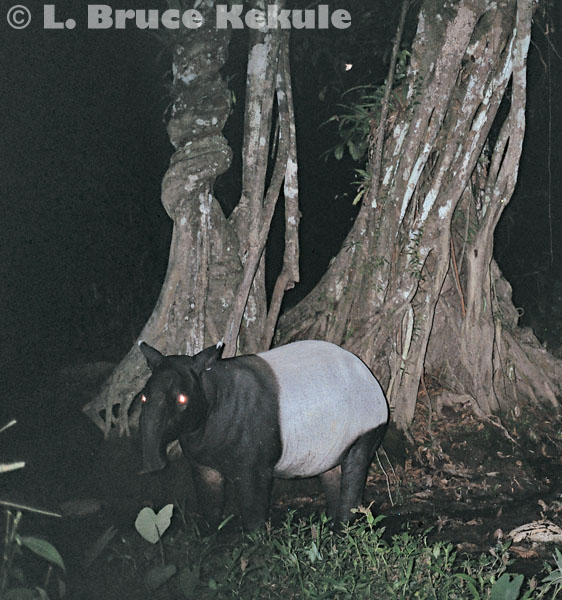
Tapir camera-trapped near the Phetchaburi River

Serow camera-trapped on old logging road

Tusker camera-trapped at a mineral deposit at kilometre 12
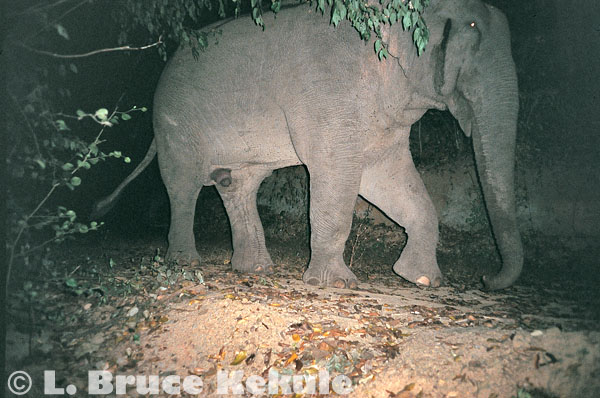
Tuskless bull elephant in ‘musth’ camera-trapped on an old logging road
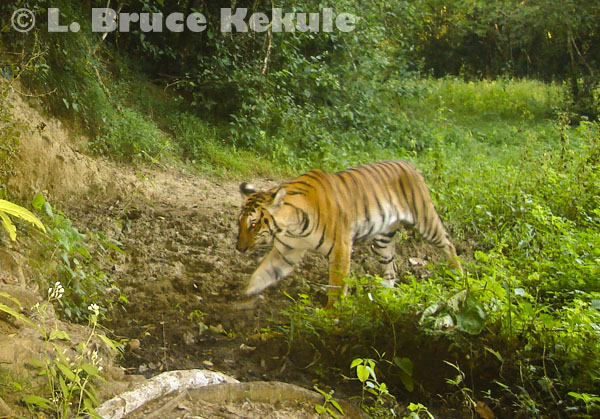
Tiger camera-trapped at a mineral lick in the interior
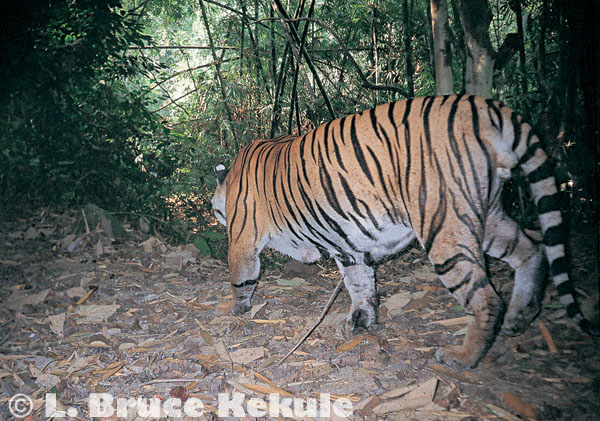
Indochinese tiger camera-trapped by the Phetchaburi River

Asian leopard camera-trapped on a nature trail

Indian civet caught near Ban Krang campground in the park
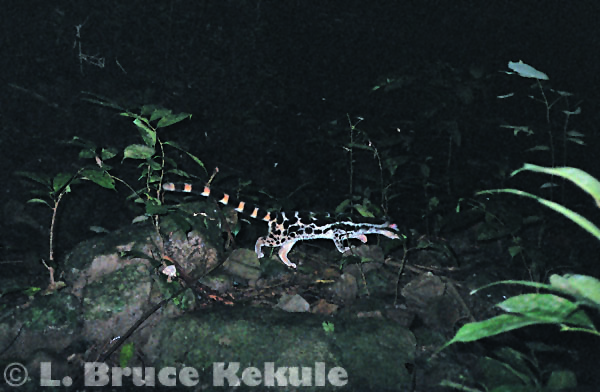
Banded linsang camera-trapped on a dry streambed
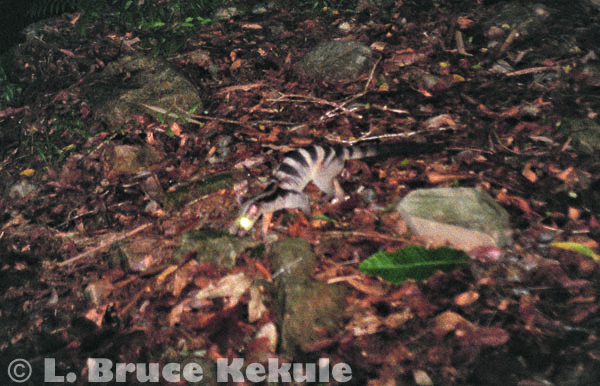
Banded palm civet camera-trapped by a stream deep in the interior

A king cobra hunting for prey by the Phetchaburi River
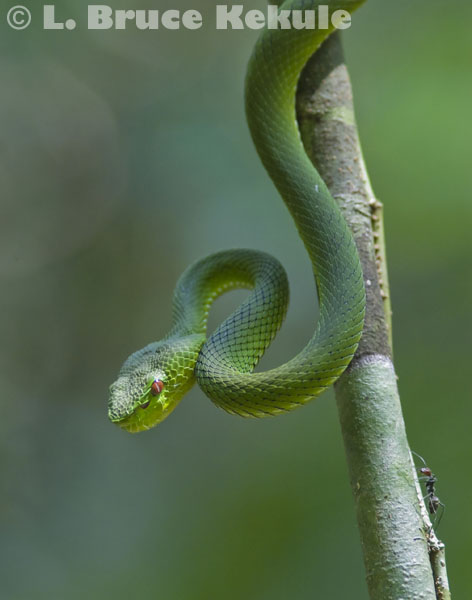
A green pit-viper and carpenter ant on a small tree
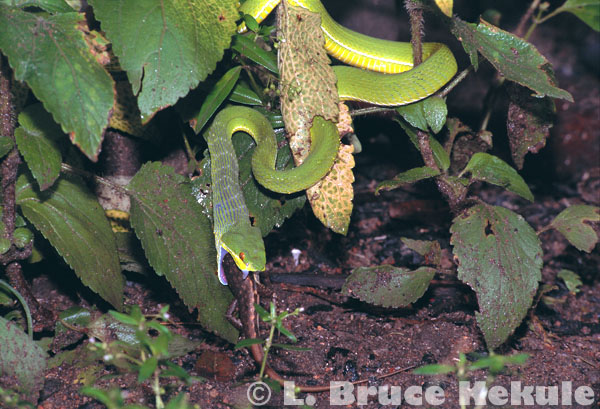
A green pit-viper swallowing a skink
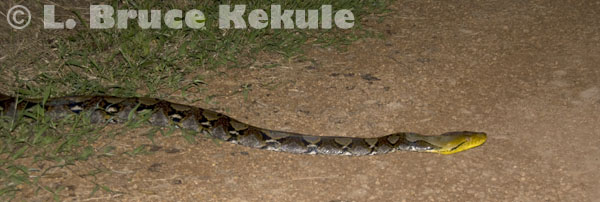
Reticulated python on the road in Kaeng Krachan
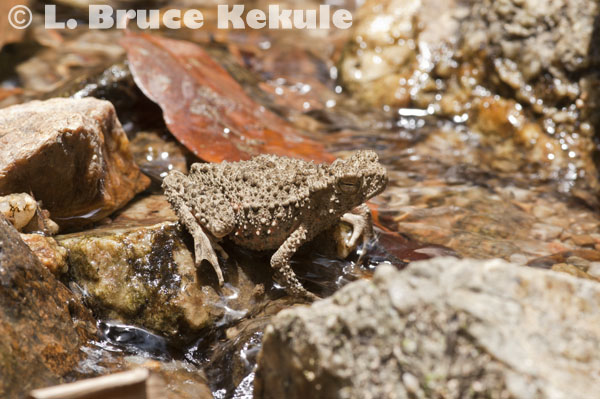
Horny tree frog in a stream deep in the park

Giant tree frog further upstream

Great hornbill flying out of a fruit tree

Oriental Pied hornbill feeding its chicks at the nest

Wreathed hornbill at a nest
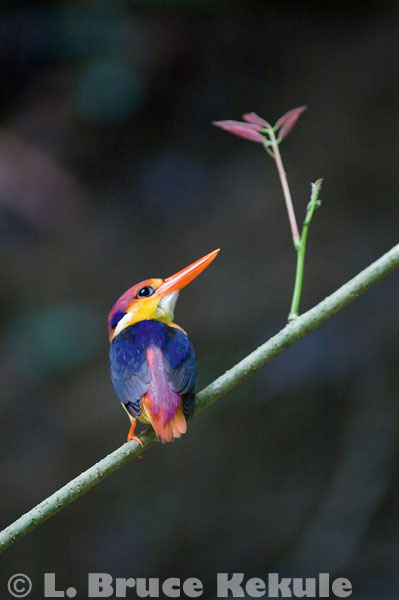
Oriental dwarf kingfisher near it nest

Pied kingfishers with a fish on a tree branch
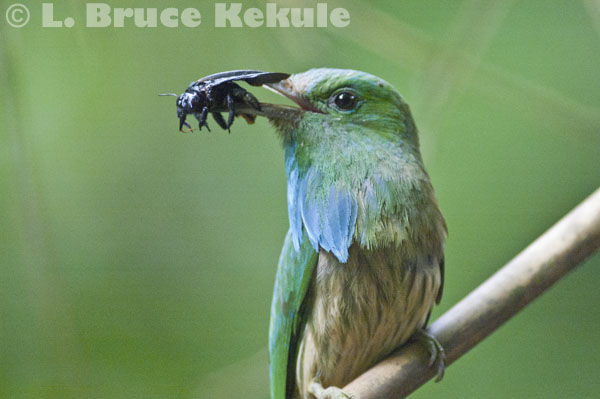
Blue-bearded bee-eater with a beetle for its chicks

Red-bearded bee-eater close to its nest in a sandbank
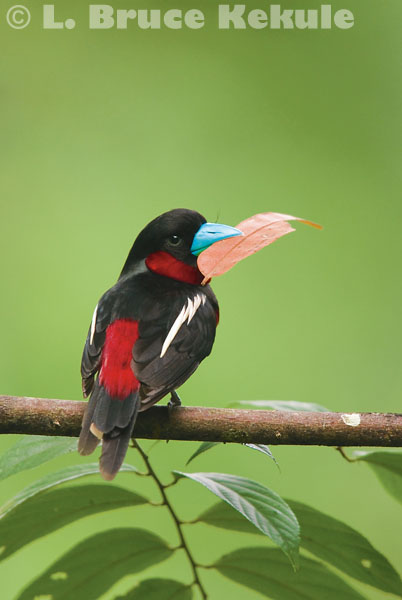
Black-and-red broadbill with a bamboo leaf
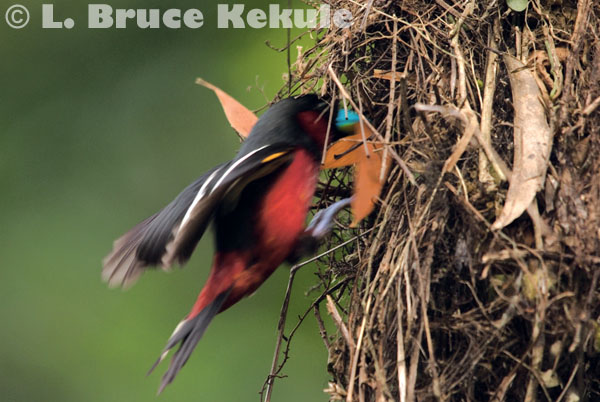
Black-and-red broadbill building a nest

Javan Frogmouth by the Phetchaburi River
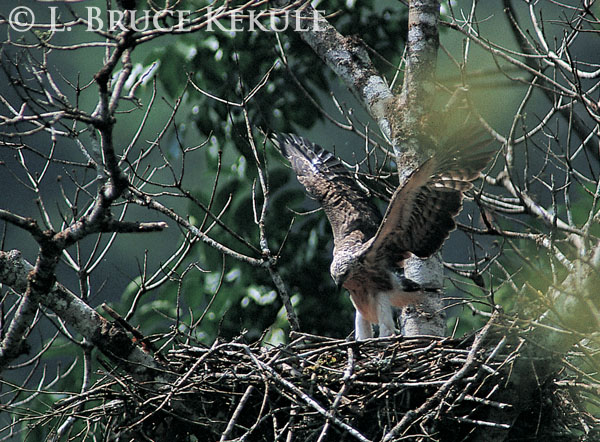
Lesser fish-eagle chick exercising its wings high up a very tall tree

Lesser fish-eagle mother and chick on the nest above the Phetchaburi River
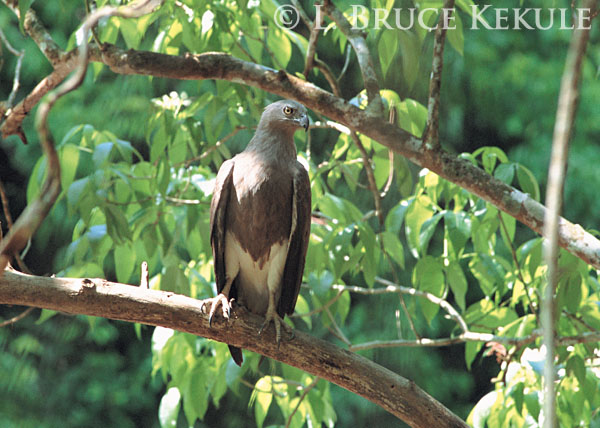
Lessor fish-eagle on a tree branch behind my blind over the Phetchaburi River

River carp in the Phetchaburi River

Gibbon hanging from a bamboo on Phanern Thung mountaintop

Dusky langur near the Phanern Thung ranger station
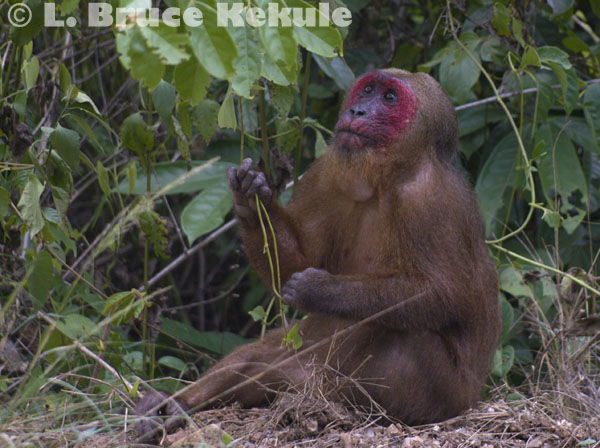
Stumped-tailed macaque by the river

Rainbow over the Phetchaburi River
Kaeng Krachan National Park is an amazing place but is fraught with poor management and protection. There are many other animals and ecosystems not shown here but this place is truly one of Thailand’s greatest protected areas.
It takes lots of hard work to get down to the river and collect photographs of the creatures thriving there. But diligence, determination, the right equipment, money and with good guides, is also within the reach of serious amateur photographers or naturalists who just want to look.
The opportunities are endless. It is hoped these photographs will create awareness and help this place survive into the future, so that generations to come can also enjoy the beauty of nature in Thailand’s largest national park.
My next post will be a collection of photographs from Huai Kha Khaeng like this of that amazing World Heritage Site, and hopefully sometime before I travel to Africa for a safari to Kenya in mid-August.
The Asian Tapir – Living fossil and bizarre mammal
Odd-toed ungulate and strictly vegetarian
The Asian tapir still thrive in Thailand’s dense evergreen forests in the West and South
It was an amazing day in March 2005 near the headwaters of the Phetchaburi River deep in Kaeng Krachan National Park situated along the border with Burma in southwest Thailand. One morning, a buffy fish-owl found stuck in a fishnet was going into shock from hypothermia. I luckily saved this creature from certain death.
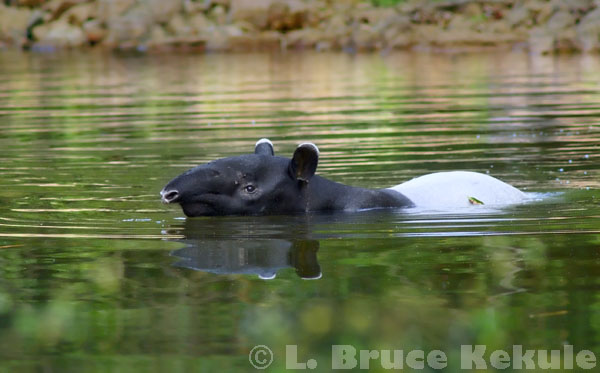
Asian tapir posing in the Phetchaburi River
The campfire was going well and I used it to warm up the bird of prey. When it could stand by itself, I placed it on a tree branch and then played wildlife photographer for a short while. I then left the confused animal in peace and it eventually flew across the river and disappeared into the forest. I felt good saving the owl. Under other circumstances, it might not have fared too well.

Buffy fish-owl saved from certain death
Later in the day as we were up-river and just about ready to turn back, a huge king cobra showed-up hunting for prey along the riverbank. I was able to catch a few photographs of the largest venomous snake in the world before it U-turned and disappeared into the forest.

King cobra hunting by the Phetchaburi River
That definitely got the blood flowing as I checked out my shots on my brand new Minolta D7 D-SLR digital camera, the first with anti-shake technology in the camera body. I shot off-hand and was getting some acceptable digital captures. When the smoke cleared, I had only two shots left on the card and decided not to delete any poor exposures as I felt nothing would show after the big snake.
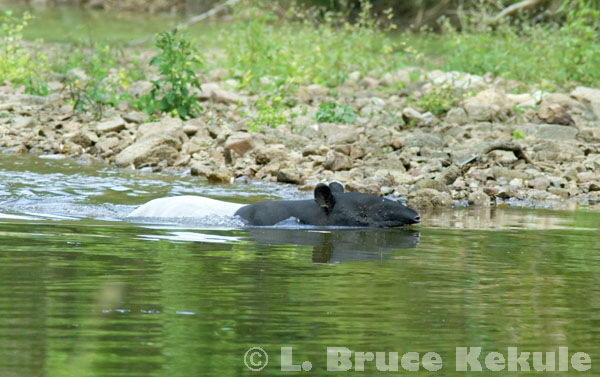
Asian tapir swimming in the Phetchaburi River
It was about 4pm and the light was nice and warm as we headed back to camp more than an hour away. Just then, an Asian tapir bounced out of the forest and dived into the river. It submerged for a short time probably trying to evade a swarm of biting forest flies before surfacing and swimming towards us. I took a shot waiting for the ungulate to get closer. It stopped in the water about twenty meters away.
The tapir has very poor vision and it took a few seconds before the unusual creature saw five humans standing out in the open. Just as I snapped my last shot shown in the lead photo, it swam away and jumped back into the forest it had come from. Seeing one of nature’s remarkable animals, even though briefly, is the ultimate thrill for me.
I know I missed quite a few shots because of old age forgetfulness (not having spare memory cards), but then again, the two shots I captured were more than enough. I was thrilled to capture the world’s largest tapir in broad daylight offhand. If I used a tripod that day, I might have missed it. These creatures are mainly nocturnal and rarely seen during the day. This event was truly the beginning of a new dream and this tapir made the front cover of my third book Wild Rivers. It certainly was special for me, and is etched in memory.
In Thailand, photographing three separate species in one day is surely a rare occurrence as most animals are now tough to see and photograph, especially the tapir. It must have been something about saving the owl earlier in the day and the ‘spirits of the forest’ made up these magical sightings. I will never know. It had been a dream of mine to photograph a tapir in the Phetchaburi River in Kaeng Krachan National Park after seeing a painting in a book produced by the Tourist Authority of Thailand (TAT) about the park.

My first tapir from a tree-blind in Huai Kha Khaeng
Years ago when I made regular trips to Huai Kha Khaeng Wildlife Sanctuary in western Thailand, one visit stands out as a lucky tapir sighting. There is a hot spring deep in the interior that attracts all sorts of large mammals including the tiger, leopard, elephant, gaur, banteng, and the tapir among others. This mineral deposit is part of a complex natural seep several hundred meters long. I was sitting at the bottom-end in a tree blind about eight meters up and waited throughout the day until about 5pm. A few sambar stags came for a drink followed by a doe. A barking deer nervously stepped in but somehow was spooked by something on my right and departed.

My first tapir moving in the forest under the tree-blind
A few minutes later, a black and white creature plowed through the brush and popped out into the clearing. I quickly snapped off a bunch of frames with my Nikon camera and 600mm lens as the tapir took a long drink filling the frame with the large mammal. The tapir then moved under the tree I was in and I managed a couple of shots with a smaller lens as the tapir disappeared into the forest behind me. In those days I was shooting film and was not sure my photos were good until I processed the film back in Bangkok. Shooting black and white mammals is fraught with exposure problems but most of the shots were OK. It was my first lucky sighting of an animal known for its secrecy and nocturnal habits.
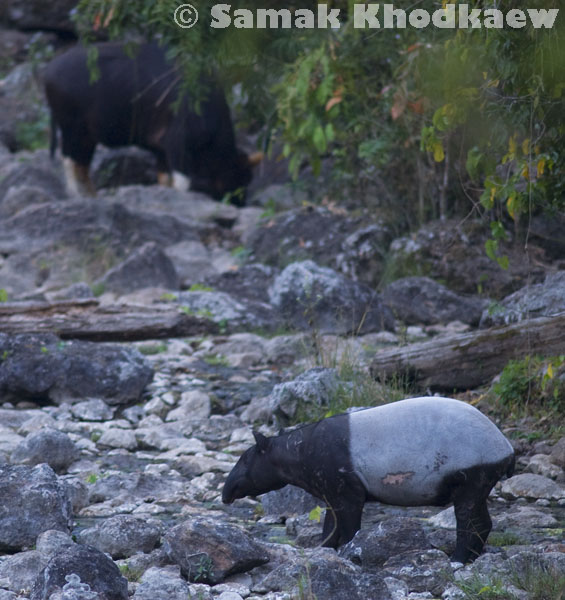
Tapir and gaur photographed at a hot-spring in Huai Kha Khaeng
Another memorable tapir sighting was not by me but my close friends, Samak Khodkaew, Amonsak Sirwichai, Sarawut Sawkhamkhet and Ajarn Prapakorn Tarachai. These gentlemen are nature photographers and have helped me in the past with my book projects. I set the four of them up in a permanent photographic blind about noontime at the top-end of the hot spring mentioned above. I then waited for them back at the truck.
Just as darkness arrived, a bull gaur and a tapir arrived almost together. I have never seen a bunch of excited photographers like this group when they finally came out. Two species in one photo is also quite an achievement. I was happy and glad the ‘spirits of the forest’ had smiled on them.

Asian tapir camera trapped in Kaeng Krachan
When I began a photographic and camera-trap program in 2005 along the Phechaburi River in Kaeng Krachan, it was not long before I caught a mature tapir at a mineral deposit late one night. They are thriving there as are other large mammals like tiger, leopard, sun bear, wild dogs, elephant, gaur and sambar.

Asian tapir mother and calf camera trapped in Khlong Saeng
In early 2009, I started a new program in Khlong Saeng Wildlife Sanctuary in Surat Thani province down South. I now have quite a few camera trapped tapir photos where the species is proliferating. The flooded forest of Cheiw Larn reservoir habitat is now unnatural for them but they have adapted to the changed landscape. These amazing herbivores are surviving quite well in the mountains of Khlong Saeng-Khao Sok Forest Complex.

Tapir calf camera trapped in Khlong Saeng
However, tapir numbers have decreased in recent years, and today, like all of the species, is in danger of extinction. Because of their size, tapirs have few natural predators, and even reports of killings by tigers are scarce.
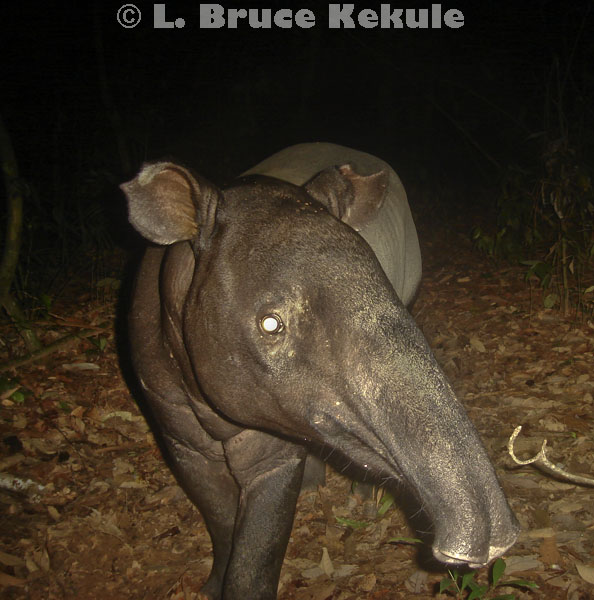
Young ear-bitten tapir camera trapped in Khlong Saeng
The main threat to the Asian tapir is human activity, including hunting for meat, deforestation for agricultural purposes, flooding caused by the damming of rivers for hydroelectric projects, and illegal trade. Protected status in Thailand, which seeks to curb deliberate killing of tapirs but does not address the issue of habitat loss, has had limited effect in reviving or maintaining the population.
In closing, this remarkable wild animal is just another cog in the wheel of Mother Nature’s wonderful array of species adapted to living in the evergreen forests of western and southern Thailand. Their survival depends on one thing: protection and enforcement of the protected areas where they live. Over the long run, it is up to the Ministry of Natural Resources and Environment, and the Department of National Parks to insure that the tapir and all the other beautiful creatures get the best possible safeguards for the future. It is hoped the powers to be will take action to prevent further destruction of the Kingdom’s natural resources.
Tapir up-close
Tapir are considered living fossils as the genus has been traced back as far as Early Oligocene times. These remarkable mammals have been on the planet for about 40 million years. The first tapirs are named Miotapirus judging from fossil evidence found in North America. Tapiridae, a sub-family belong to the Order Perissodactyls, or odd-toed ungulates that goes back to the Late Paleocene 55 million years ago including rhinoceros-like creatures evolving in North America and eastern Asia from small animals similar to the first horses.
The Asian tapir Tapirus indicus, also called the Malayan tapir, is the only one native to Southeast Asia. It has an unmistakable black and white two-tone pattern distinguishing it from the other three tapir species of Central and South America. The Asian species is the largest, and is the only ‘Old World’ tapir with the females slightly larger than the males. They live in the rainforests of Thailand, Myanmar, Malaysia and Sumatra.
The general appearance and characteristics of the Asian tapir is easily identified by its markings, most notably the white “saddle” which extends from its shoulders to its rump. The rest of its hair is black, except for the tips of its ears, which, as with other tapirs, are rimmed with white. This pattern is for camouflage as the disrupted coloration makes it more difficult to recognize it as a tapir at night, or in the dark jungle during the daytime that they prefer. They are mainly nocturnal but do show sometimes in the late afternoon at the river or mineral deposit. Other animals like tiger may mistake it for a large rock rather than a form of prey when it is lying down to sleep.
The Asian tapir grow to between 1.8 to 2.4 m in length, stand 90 to 107 cm tall, and typically weigh 250 to 320 kg, although they can weigh up to 500 kg. The females are usually larger than the males. Like the other types of tapir, they have small stubby tails and long, flexible proboscises. They have four toes on each front foot and three toes on the back feet.
The tapir has very poor eyesight, and making them rely greatly on their excellent sense of smell and hearing to go about their everyday lives. The tapir has small, beady eyes with brown irises on either side of their face. Their eyes are often covered in a blue haze, which is corneal cloudiness thought to be caused by repetitive exposure to light. Corneal cloudiness is when the cornea starts to lose its transparency.
The gestation period of the Asian Tapir is approximately 390-395 days, after which a single offspring, weighing around 6.8 kg, is born. Young tapirs of all species have brown hair with white stripes and spots, a pattern that enables them to hide effectively in the dappled light of the forest. This baby coat fades into adult coloration between four and seven months after birth. Weaning occurs between six and eight months of age, at which time the babies are nearly full-grown, and the animals reach sexual maturity around age three. Breeding typically occurs in April to June, and females generally produce one calf every two years. Asian Tapirs can live up to 30 years, both in the wild and in captivity.
Tapir are primarily solitary creatures, marking out large tracts of land as their territory, though these areas usually overlap with those of other individuals. Tapir mark out their territories by spraying urine on plants, and they often follow distinct paths that they have bulldozed through the undergrowth.
Exclusively vegetarian, the animal forages for the tender shoots and leaves of more than one hundred species of plants (around 30 are particularly preferred), moving slowly through the forest and pausing often to eat and note the scents left behind by other tapirs in the area. They tend to eat soon after sunset or before sunrise, and they will often nap in the middle of the night.
However, when threatened or frightened, the tapir can run quickly despite its considerable bulk. They can also defend themselves with their strong jaws and sharp teeth, and have thick hides protecting them from predator attack. They communicate with high-pitched squeaks and whistles. They usually prefer to live near water and often bathe and swim, and they are also able to climb steep slopes.
Photographing three wild species in one day
The beginning of my 3rd book project entitled Wild Rivers
Three species on one lucky day in March of 2005
Like most of my mornings in the forest, getting out of the hammock before dawn is a routine affair for me. Sleeping by the pristine Phetchaburi River in Kaeng Krachan National Park in southwest Thailand is a peaceful and soothing experience with the sound of rushing water flowing down to the lowlands. The night creatures fade into their abodes and daytime is greeted by singing birds and insects. As the sun comes up, gibbons call and hornbills honk from the treetops. It is nature at its very best.

Buffy fish owl by the Phetchaburi River in Kaeng Krachan National Park
I adhere to an old saying; “an early bird get’s the worm” to sometimes work wonders. This was the case one particular morning in March 2005. After a quick cup of coffee, I got my cameras ready for the days’ shoot. I was about to embark on my third book project capturing some extremely lucky wildlife photographs of three different species in one day.

The mighty Phetchaburi River during the dry winter season
About 6am, one of the Karen porters went upstream and found a buffy fish-owl stuck in his fishnets. I was upset at them to say the least but had to think quickly. The bird was going into shock as hypothermia took control over the owl. It was on the verge of dying and only quick thinking saved this creature from certain death. The campfire was going well so I placed the bird close to warm it up and get its blood flowing. I’m sure the creature had no idea what was going on but the bird was calm and collective as I assured it everything would be OK.
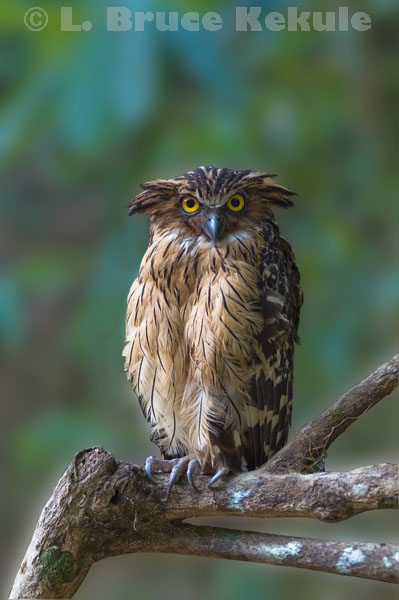
Buffy fish owl just after being saved from certain death
The owl began to perk up and I knew then it would survive. I placed it on a tree branch by the river and it locked its talons into the bark. The bird of prey just sat there while I played wildlife photographer. After shooting almost an entire memory card and without further ado, I left the owl in peace.
As I sat down to eat breakfast, it left its temporary perch and flew across the river disappearing into the dense forest. The bird was not seen again. I felt pleased at having saved this beautiful creature’s life. I had just switched to a Minolta digital SLR camera and was able to double-check all my shots for exposure, color and focus. Everything looked good and I was excited at having photographed this owl during the day as they are nocturnal.

King cobra hunting along the Phetchaburi River
After breakfast, we packed up our gear for a day trip headed upriver. In March, the water level is low, and the riverine habitat easy to transverse. The team and I crossed the river several times till about 4pm when I decided to turn back to camp. Just then, my research companion Detchart “Top” Saengsen sighted a large snake and called out. I reached for my camera with a 280mm lens and found a slithering black reptile in the underbrush. Its head appeared and I started shooting, not thinking about the danger. The king cobra – the world’s largest venomous snake – moved into an overhang so I flipped up the flash and took a few more shots. The reptile did a u-turn and was gone in a split second.

The big snake just before it made a u-turn and disappeared in a split second
The rest of the team had already retreated, leaving the crazy photographer to his own devices. It certainly was an exciting experience. I was elated that I had just photographed the true king of the forest. It is said large mammals like elephants, gaur and tigers stay out of the king cobra’s way. I checked my camera and had two shots left on my card. I decided not to delete any poor images until later as I felt nothing would show itself after the big snake.

Asian tapir swimming in the Phetchaburi River
The team and I were in good spirits as we headed back to camp. Suddenly, an Asian tapir bounced out of the thick forest on the opposite bank about a hundred meters away. It dove into the river and started swimming towards us, now fifty meters off. Tapir have fair eyesight but this black and white creature did not notice five humans standing out in the open up on a sandbank. I took one shot of the swimming tapir then waited, knowing very well I only had one frame left. The creature got closer and then stopped in the water about 20 meters away. I centered the focusing ring on the eye and took the shot. Then we watched this elegant animal go back the way it had come.

Asian tapir posing for me in the late afternoon sun
I know I missed quite a few shots because of old age, forgetfulness (not having spare memory cards), but then again, the two shots I had were more than enough. I was thrilled to photograph the world’s largest tapir in daylight. These creatures are mainly nocturnal and rarely seen. That day was truly the beginning of a new dream and my last shot of this tapir made the front cover of my third book Wild Rivers now published and available at bookstores in Thailand and the region. It certainly was a special day for me and one that is etched in memory.
I am now working on book four which will be a collection of stories published over a two year period in the Bangkok Post, Thailand’s number one English daily. Chapters about the top protected areas in Thailand and ‘wild species reports’ on the animals thriving in the remaining forests including mammals, birds, reptiles, insects and other categories. Hopefully, this book project will create conservation awareness among the present generation. My dream to produce wildlife books continues, but that is another story.
The Asian Leopard: Thailand’s second largest cat
WILD SPECIES REPORT
An ambush predator – solitary, stealthy and naturally camouflaged
The late French poet Robert Desnos (1900-1945) wrote a short poem entitled “The Leopard”
“If you go into the woods, beware of the leopard.
He meows in subdued voice and arrives from nowhere”
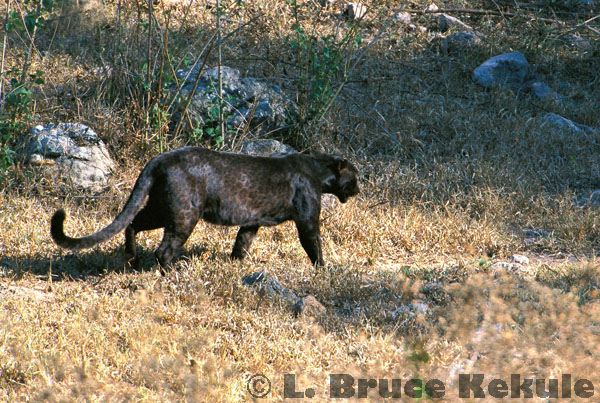
Black leopard in the late afternoon sun
The leopard Panthera pardus described by Linnaeus in 1758 is the second largest cat in Thailand. Once upon a time, leopards could be found in all the forests of the Kingdom. These felines are still surviving quite well in protected areas in the West, and some in the South. The central, eastern and northeastern regions have no reports of leopard for some time now.
A few have been reported in Phu Khieo Wildlife Sanctuary in Chaiyaphum province, but for some reason they have disappeared from most remaining forests. The reason these areas have no leopards are quite simple; prey species has been hunted out including the leopard itself for its pelt and bones, and encroachment has destroyed much of its habitat.
Sighting a leopard in Asia is extremely difficult, and even catching a rare glimpse of this very essential top predator is tough due to its solitary and stealthy behavior. However, luck can sometimes play an important part in viewing the leopard and I feel lucky to have seen and photographed them on quite a few occasions.

Leopard camera trapped in Kaeng Krachan National Park
The most thrilling or heart stopping adventure with a black leopard happened in Huai Kha Khaeng about five years ago while I was sitting up on a bluff overlooking the river. A photographic blind was erected on the rock-face about 20 meters up with a small trail that enabled me to get into the hide. It was a neat location that I had dreamed of sitting here for many years prior. The sun was bright and the weather was warm during the dry season.
About 9am, several monks down by the river passed on but did not see the camouflaged structure as they went their way. After that, I came down for lunch and set some camera traps at a mineral deposit nearby. At 2pm, I settled back in the blind and began a vigil of the river. I started to feel a bit groggy as the sun was beating down on my position. I moved my camera in to save it from the direct sunlight.
All of a sudden, I was startled by a guttural growl outside the enclosure. I stood up slightly and peering out the window came face to face with a huge round black head and yellow eyes about two meters away that penetrated my soul. My first instinct reaction; it was a big black dog. But that quickly changed as the creature stared intently at me before bounding down the trail it had come up. The big cat was gone in a split second. Of course there was not enough time to get any photographs. The incident surely is etched in my memory.
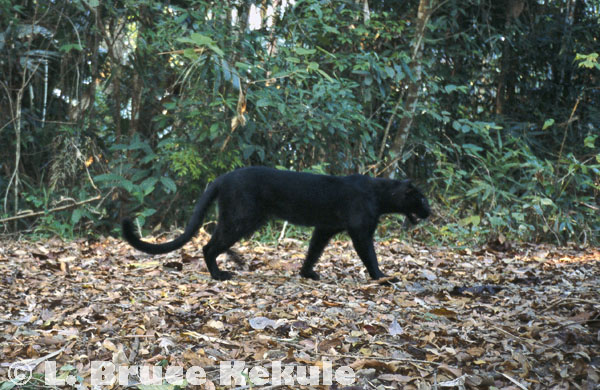
Black leopard camera trapped in Kaeng Krachan
Why had the leopard come so close without smelling me? On that particular day, I was using an old hunters technique by collecting fresh wild water buffalo droppings and putting them in front of the blind, and that probably covered my scent. Maybe the leopard thought there was a newborn calf, or an old weaken animal. Or maybe it used this natural place overlooking the river to spot prey like sambar, barking deer or wild pigs that are abundant here and came up to investigate. The vantage point is on a bend in the river and one can see for quite a distance both ways.
I will never know how close I came to being attacked by a leopard but it was a heart stopper for sure. I sat motionless for quite sometime. Only a few sticks and camouflaged material separated me from a wild creature armed with fangs and claws. On that day, the spirits of the forest looked after me, or was it the ‘Spirit of the Forest’. I like to believe that was the case. I hope one day to go back and stake out this bluff, and believe this leopard is probably a resident around here. Previously, I camera trapped tiger and a yellow phase leopard not far from here.
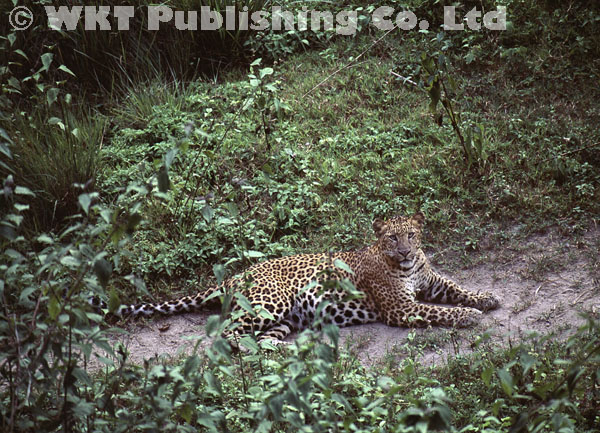
A leopard resting on a wildlife trail
Speaking of leopard attacks, my close friend and associate Dr Lon Grassman was once seriously injured in Kaeng Krachan National Park, Phetchaburi province by a leopard while working there on a survey to camera trap and collar the big cat. When Lon released one, it looked up and turned on him in a split second mauling his legs and arms. It was a close call but he survived to carry on his work researching wild carnivores. Lon established the home range and other behavior patterns of leopards in the park.
He then moved to Phu Khieo Wildlife Sanctuary, Chaiyaphum province in the Northeast and continued this work catching and releasing quite a few golden cats, clouded leopards and a marbled cat. He eventually received his doctorate for his excellent work.
In the beginning of my profession as a wildlife photographer, I was very fortunate. The Director of the Wildlife Conservation Division of the National Parks Department (DNP) at the time, my dear friend Dr Viroj Pimmanrojnagool (now retired), had confidence in me and gave permission to enter the realm of the leopard and the tiger, something not easily acquired. Entry into wildlife sanctuaries has always been very restricted but is possible with the right qualifications. Viroj and I are still very close and I visit him from time to time at his durian farm in Surat Thani down south where he is happily enjoying retirement.

Leopard in the bamboo – my very first photo of the big cat
My first encounter with the sleek cat goes back to the beginning of my career more than a decade ago. Driving into the forest late one afternoon in Huai Kha Khaeng Wildlife Sanctuary, a World Heritage Site, the sun was low but the light still quite good for photography. The protected area is situated in Uthai Thani province and is part of the Western Forest Complex.
I was about to capture my very first Asian leopard on film. This was in my early days as a wildlife photographer with a newly acquired Nikon N90s camera and 300mm lens. I was on a learning curve that would take me into some unique natural habitats and bump into some very unusual animals around Thailand.
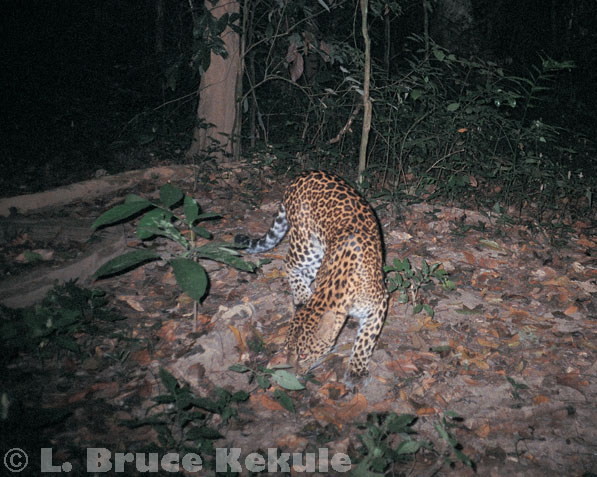
Leopard posing in Kaeng Krachan
About 4pm some 10 kilometers from the headquarters as I was driving in, a leopard jumped in front of my truck and bounded up the steep embankment on my right. I gently came to a halt and there looking down at me was these two big yellow eyes that brought my attention to 100 percent. In the meantime, I had already grabbed my camera and started snapping through the window as fast as possible but quickly slowed the pace concentrating on focus. After a few more shots, the spotted cat melted into a bamboo thicket and was gone. The encounter was measured in mere seconds.
I sat in the vehicle for a few minutes to catch my breath as my heart was thumping. A close encounter with a carnivore capable of tearing us apart is something that can get the blood flowing. I finally got going again as my destination was still a couple of hours away deep in the forest.
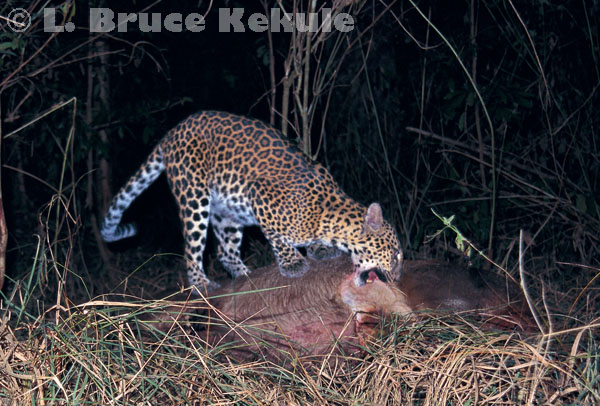
Leopard on a sambar kill – my first camera-trap photo of the feline
Arriving at the Kabook Kabieng ranger station just at dusk, the head of the station Loong Waitanyakarn, another good friend, came immediately to the truck and said, “ a sambar mother and fawn have been killed by a leopard or wild dogs not far from the station and let’s go look”.
It didn’t take me long to ponder that an opportunity had presented itself. I had a new infrared sensor for my Nikon camera and decided to set-up the unit next to the dead sambar. A new role of film was loaded and the lens focused on the mother deer. The sensor was active infrared that uses a transmitter and receiver hooked to the camera. When an animal trips the beam, the shutter is activated taking a self-portrait. At the time, this technology was rather new but I needed it to supplement my regular photography.
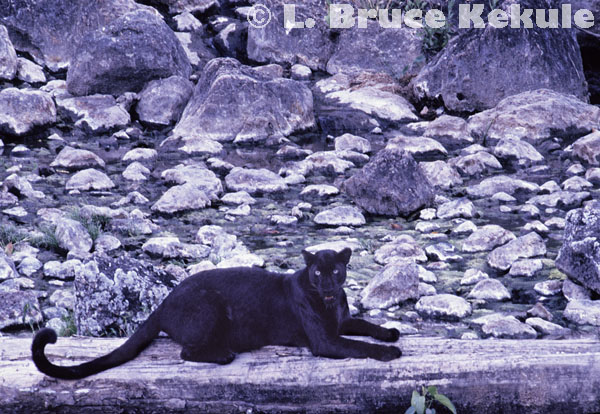
Black leopard posing for me at a hot spring
The next day at noon some 10 kilometers away, Loong took me to a tree stand over-looking a hot spring. The box-like structure was quite high up and it was a bit scary getting situated in the blind but finally, I settled down with my Nikon 500mm lens and camera scheduled for a three-day stint. The mineral deposit and hot springs attracts many large mammals including elephant, gaur, banteng, tiger, leopard, wild dogs, tapir and many other animals that come for the life-giving minerals, or for prey.

Black leopard at the hotspring
About 3pm, a troop of leaf-monkeys visited the hot springs for a quick drink but did not stay long. They had been spooked by something as they all panicked and gave flight in the trees up the hill. A short time later, a black leopard appeared from the top end and walked over to where the monkeys had just been. The sun was low in the sky and I could see the leopard’s pattern of rosettes through the lens that jumped out at me.
My heart began racing as the stealthy cat stopped at the top to take a drink. It stayed for about an hour. I calmed down but continued shooting changing several rolls of film and watching this magnificent creature. Just before the sun was gone, it moved closer to the tree I was in and then walked across the stream. The cat plopped down on a log and stretched out posing for me, all the while looking up at my position. I kept shooting and then it came even closer before veering off probably spooked by my scent. As the leopard moved through the forest, monkeys, barking deer and sambar barked at the predator.

Leopard mother and cub camera trapped at a sambar kill – A rare photo
showing both color phases
I will never forget these encounters. Three leopards in two days are pretty good going for a new wildlife photographer and it was truly the beginning of many sightings and photographs of this amazing carnivore. I have seen loads of them on film while working in Kaeng Krachan. Both black and yellow phase were camera trapped in three separate locations in the interior at almost every location.
The Tenassarim Range in southwest Thailand is an absolute haven for the leopard due to a very good prey base here. Tigers also survive and have overlapping territories with the spotted cat. Both species hunt during the day and night. My old friend Suthad Sapphu, a forest ranger in Kaeng Krachan, was extremely helpful while we were camera trapping the big cats.

Leopard track in Kaeng Krachan
Without doubt, the future of the leopard depends on one thing only – the complete protection of the remaining forests where they live. If the national parks and wildlife sanctuaries remain intact with a high number of prey species, the big cats will survive. But if over-development, poaching and encroachment are allowed to continue, the large cats will eventually disappear.
Unfortunately, too much time and money is wasted by too many organizations talking about saving wildlife and their habitats, with very little actually being done. Human population growth will eventually destroy most wild places. Only true protection by some dedicated people will slow the destruction of nature’s precious wildlife and wilderness areas. It is hoped the leopard, and the tiger, will continue to survive as they have for millions of years.
Leopard Ecology:
Pound for pound, the leopard can take on some seriously large animals several times its size. The leopard is closely related to the jaguar of South America. Both have a spotted coat pattern, incidence of ‘melanism’ or black phase, and relatively short legs.
The present distribution of the leopard is restricted to Asia Minor, India, Southeast Asia, the Himalayas, Tibet, China, Siberia, and Africa. Fossils of leopards were found in Pleistocene deposits throughout Europe, the Middle East, Java, and Africa, some 1.5 million years old, indicating the leopard arrived after the tiger. These secretive cats are mainly nocturnal but in some localities, they are active in the day too. Their populations and ranges are difficult to determine but radio tracking of collared animals has shed new light on their movements and areas they live in.

Black leopard camera trapped in Kaeng Krachan
The leopard is a member of the Felidae family and is the smallest of the four “big cats” in the genus Panthera, or roaring cats. The other three are the tiger, lion and jaguar. The leopard’s range of distribution has decreased radically because of hunting and loss of habitat. It is now chiefly found in sub-Saharan Africa; there are also fragmented populations in Pakistan, India, Sri Lanka, Indochina, Malaysia, and China. Because of its declining range and population, it is listed as a “Near Threatened” species by the IUCN (International Union for Conservation of Nature).
The species’ success in the wild is in part due to its opportunistic hunting behavior, its adaptability to habitats, human settlements and activity, its ability to run at speeds approaching 58 kilometers per hour (36 mph), its unequaled ability to climb trees even when carrying a heavy carcass, and its notorious ability for stealth. The leopard consumes virtually any animal it can hunt down and catch. Its habitat ranges from rainforest to desert terrains.
Gaur – Majestic Wild Forest Ox
WILD SPECIES REPORT
Rare mammal and the largest bovid in the world
Endangered wild cattle close to extinction
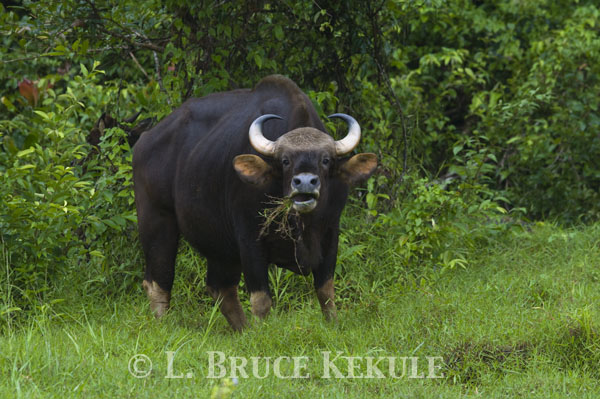
Gaur cow in Khlong Saeng Wildlife Sanctuary
About 20 million years ago, the first ungulates evolved from small, hornless deer-like ancestors. Cattle, sheep, antelopes and goats are grouped together in the family Bovidae, and the most common hoofed grazing animal seen today. Sometime during the Pleistocene Epoch 1.8 million years ago, the genus Bos evolved in Asia and spread to Europe, Africa and eventually North America. Gaur Bos gaurus is a descendent of Bos Bibos, a wild cattle that lived on the great plains of Asia. Saber-toothed cats were one of the top carnivores at the time, and evolved alongside the ancient herbivores.
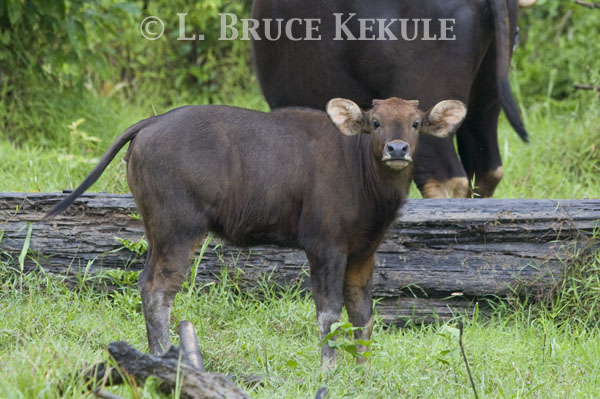
Gaur calf in Khlong Saeng Wildlife Sanctuary
Gaur, the largest bovid in the world, is threatened with extinction and deserves much greater attention. The tiger and elephant have taken most of the conservation spotlight but gaur, like all the other wild animals need just as much protection, research and concern. Unfortunately, these wild forest ox continue to vanish from the wilderness areas in the Kingdom. After years of poor protective management and neglect, poaching and trophy hunting, plus a disappearing habitat suitable for these enormous creatures once found throughout Thailand, is the main reason for the decline.
Over their entire range, they are classified as internationally threatened. But not all is lost as gaur still survive quite well in a few of Thailand’s top protected areas in fair numbers, and where there are true safe havens, the species has actually made a come back. It is now estimated that more than a 1,000 individuals remain in Thai forests. This number is up from the 500 recorded in Dr Boonsong Legakul and Jeffery McNeeley’s book Mammals of Thailand published in 1977. Dr Sompoad Srikosamatara and Varavudh Suteethorn published a paper in the Siam Society’s Natural History Bulletin in 1995 about gaur and banteng. Their estimate then was about 1000 gaur were surviving so the number is basically stable and most likely on the increase.

Gaur herd at a mineral deposit in Huai Kha Khaeng Wildlife Sanctuary
In Southeast Asia and India, gaur is found in scattered and splintered habitats. Other large wild bovine are banteng and wild water buffalo of Southeast and Southern Asia, the yak of Central Asia, the cape buffalo of Africa, and the bison of North America and Europe. In recent times, the number of these wild creatures has dwindled as humans continue to hunt them for meat and trophies, and destroy and encroach on their habitat in some places. The American bison came close to extinction but was saved in the nick of time. Thousands of wild bison now survive due to conservation efforts initiated by many people including the late U.S. President Teddy Roosevelt.
Gaur is Thailand’s second largest terrestrial animal after the elephant and tends to inhibit deep mountainous terrain far from humans. They survive in dry and moist evergreen forest plus mixed deciduous forests and therefore, have fared better than their cousin, the banteng that live in more open lowland forest. Gaur occasionally mixes with banteng that has been documented in Huai Kha Khaeng Wildlife Sanctuary, Uthai Thani province. Gaur will also shadow elephant herds using the same trails made by the larger mammals.

Gaur herd in Khlong Saeng
My favorite photographic wildlife subject is gaur. In Thailand, these majestic ungulates can still be found in the following places: the Western Forest Complex and Kaeng Krachan Forest Complex, both in the west; the Khao Ang Rue Nai Forest Complex in the east; the Dong Payayen – Khao Yai Forest Complex and the Phu Khieo – Nam Nao Forest Complex, both in the Northeast; and down south in the Khlong Saeng – Khao Sok Forest Complex. Due to the serious instability in the deep south, very few surveys have been carried out and there is no consensus on gaur but they do survive in the Hala-Bala Forest Complex situated along the border with Malaysia. It is doubtful if any gaur survive in the North but the Omkoi – Mae Tuen Forest Complex might have few left.
Gaur has a keen sense of smell and hearing, and is always alert for danger. As a result, they can be tough to spot in the dense forests of Asia. However, luck does come sometimes, and the following accounts describe the few times I have had the great fortune to observe these magnificent beasts in the wild.

Gaur bull camera-trapped at a mineral lick in Huai Kha Khaeng
My first photographic encounter with gaur in 1986 was at the beginning of my career as a wildlife photographer deep in the interior of Huai Kha Khaeng Wildlife Sanctuary. A natural deposit or mineral lick several hours walk from the road attracts many animals – gaur, banteng, elephant, sambar and muntjac come for the life-giving minerals, plus tiger, leopard and Asian wild dog hunt for prey. The balance of nature runs in harmony where “eat or be eaten” is the rule. I was extremely lucky and photographed two mature bull gaur that arrived late one afternoon as the sun was setting. The old bull on the front cover of my first book ‘Wildlife in the Kingdom of Thailand’ stayed at the waterhole for quite sometime and I shot several rolls of film. This place has always been special to me.
A year later, I began visiting Thung Yai Naresuan Wildlife Sanctuary along the western border with Burma specifically to photograph gaur. In 1985, a herd of more than 50 individuals was seen from a helicopter by park officials on the huge grassland in the center of the sanctuary. Thung Yai is a tough place to work as many mining trucks plus off-road 4X4 enthusiasts with big tires and jacked-up truck chassis have abused the road into the sanctuary for many years. Deep ruts in many areas make travel along the road difficult even for normal off-road vehicles. The rangers have a real rough time patrolling this sanctuary.

Young gaur bull in Khlong Saeng
On one of my many trips to Thung Yai, and after many grueling hours of travel, and then a couple hours’ walk to a mineral lick in the sanctuary, I set-up a photographic blind along the forest perimeter. Late in the afternoon, two bachelor bulls entered and drank from the spring at the top end. I managed to get some good photographs as they went about their business. One bull snorted at our position as I had placed fresh gaur droppings in front of the blind, and I believe he was just letting us know who he was. Both bulls then departed peacefully and I was elated to say the least. It is estimated that more than 100 individuals thrive in Thung Yai.
In October 2008, I began a camera-trap program and set several units at a mineral lick visited by gaur and elephant in Kaeng Krachan National Park in Phetchaburi province, southwest Thailand. A month later, I visited the park and collected the cameras. A herd of gaur had come to the deposit including several cows and their offspring. It seemed as if the camera had spooked them initially, but the herd came back again the next day and a long series of captures was obtained. There are about 70 of these beautiful creatures thriving and breeding in this protected area.
Over in Huai Kha Khaeng Wildlife Sanctuary in the west during December 2008, I also set some digital camera-traps at a water hole, and after one month, two gaur bulls visited the waterhole. I also sat by the river in a photo-blind across from another mineral lick and photographed a large herd of gaur that had come for the minerals and lush grass. It is estimated that 350 gaur survive in this sanctuary. Better protective measures have allowed gaur to breed profusely and this World Heritage Site lives up to its name. Predators like tiger and wild dogs capable of taking on gaur, also thrive here. In the whole of the Western Forest Complex, it is estimated that more than 500 individuals live in scattered areas covering some 15,000 square kilometers.
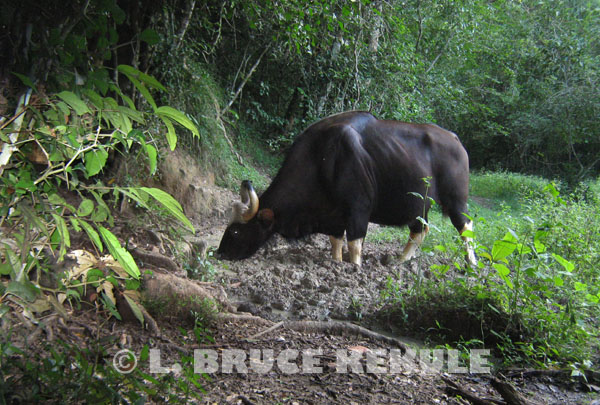
Gaur cow camera-trapped at a mineral lick in Kaeng Krachan National Park
Early this year while photographing wildlife in Khlong Saeng Wildlife Sanctuary in Surat Thani province down south, I had an amazing journey of discovery. Deep in the protected area, gaur is still thriving quite well. I set camera-traps in the sanctuary and managed to capture a very old bull gaur and several herds at many locations. A close look at the photograph shows seriously worn hooves on his hind feet. He is definitely past his prime and would not be a contender for female gaur in heat. With poor traction, he could not fight the younger bulls with stronger hooves and horns.
I also toured the flooded forests of Khlong Saeng and Khlong Ya rivers created by the Chiew Larn or Ratchaprapra Dam using a boat-blind and silent electric trolling motor. I was able to approach many herds and individuals over a four-month period. In every herd, there were young calves and yearlings indicating a healthy breeding population. Most of the mature bulls have become nocturnal due to past and present poaching pressure in the reservoir. In the Khlong Saeng – Khao Sok forest complex, it is estimated that more than 100 gaur are thriving.
In Kui Buri National Park, Prachuap Kirikan province, gaur has definitely made a come back due to increased awareness by the park staff plus financial support extended to help the rangers. It is now estimated that the population of gaur is about 70 individuals. Khun Chalerm Yoovidhya, MD of the Huai Hin Hills Vineyard and Siam Winery has taken a special interest in gaur at Kui Buri. Working with the park officials, he has funded many projects to help these creatures by sending volunteers to plant grass in selected areas to propagate grasslands, and setting up salt licks and check dams to attract the herbivores. Other projects initiated by Khun Chalerm include selling wildlife photographs and paintings at the vineyard to help the park rangers with food, clothing and equipment giving them more incentive to patrol the forest. Over time, other areas will put on the list for special help to protect Thailand’s natural heritage from the damaging effect of human poaching and intervention.

Gaur spooked by camera-trap in Kaeng Krachan
In the northwest section of Thap Lan National Park, my very close friend Gate Glomchum who worked for the Petroleum Authority of Thailand (PTT) as chief reforestation officer (retired) did some amazing things during his career as a reforester. Prior to 1996, a 10,000 rai area in Wang Nam Kheaw was completed degraded by a logging concession and squatters. Under his management and following a mandate set by His Majesty the King, this forest was replanted and the people were moved out. Today, this forest has completely grown-over, and there is elephant, gaur and tiger plus many other classic Asian species living in total harmony with nature. Other areas in Thailand also reforested under his supervision have had similar success.
Over in Khao Phang Ma just outside the eastern part of Khao Yai National Park, a national forest reserve was reforested by Wildlife Fund Thailand (WFT) and Khun Suthirat Yoovidhya (Director of CSR) of Red Bull-Thailand fame. Gaur moved back into this forest from Khao Yai after protective measures increased. There are about 50 gaur at this location and is probably the only place in Thailand where gaur live outside a protected area. Many projects like helping the rangers, setting-up salt licks and check dams have also been funded by Khun Suthirat under the ‘Red Bull Spirit’ program that is on-going. A couple of years ago, WFT shutdown all conservation operations due to internal conflicts but the Department of National Parks, Wildlife and Plant Conservation (DNP) took over responsibility of the reserve. They should be commended, and it is reassuring that some people are serious about conserving the Kingdom’s natural heritage.
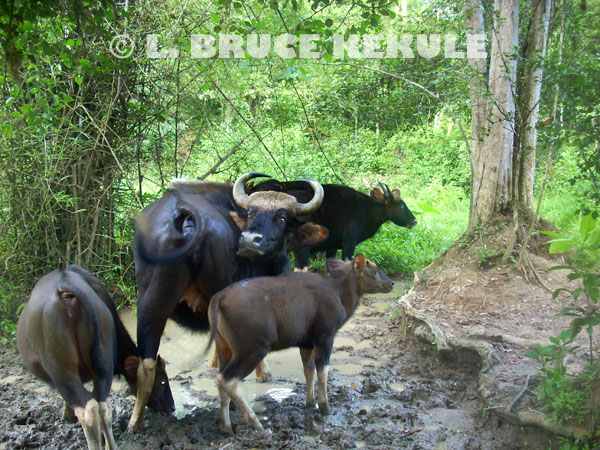
Gaur herd camera-trapped at a mineral lick in Kaeng Krachan
In the long run, the importance of protecting a prey species like gaur should be the number one priority for the government. The DNP need to increase budgets and personnel to look after these forests and animals. Thailand remains one of the best places for the survival of gaur in Southeast Asia. Protection, conservation awareness, education and monetary support are the keys to the future of these magnificent creatures of nature, and it is hoped they will continue to live in their natural habitat far from the destructive forces of man.
Ecology and Behavior
Gaur is the largest bovid in the world with a distinctive dorsal ridge and a large dewlap, forming a very powerful appearance. A fully mature bull stands about 1.6-1.9 meters at the shoulder and average weight of a big bull is 900 kilograms on up to a ton. Cows are only about 10cm shorter in height, but are more lightly built and weigh 150 kilograms less. These even-toed ungulates have stout limbs with white or yellow stockings from the knee to the hoof. The tail is long and the tip is tufted. Newborns are a light golden color, but soon darken to coffee or reddish brown. Old bulls and cows are jet black but south of the Istamas of Kra, many take on a reddish hue.
All bovine share common features, such as strong defensive horns that never shed on males and females, as well as teeth and four-chambered stomachs adapted for chewing and digesting grass. Their long legs and two-toed feet are designed for fast running and agile leaping to escape predators. They are gregarious animals, staying in herds of six to 20, or more.
Due to their formidable size and power, gaur has few natural enemies. Leopards and Asian wild dog packs occasionally attack unguarded calves or unhealthy animals, but only the tiger has been reported to kill a full-grown adult. Gaur grazes on grass but also browse edible shrubs, leaves and fallen fruit, and usually feed through the night. They also visit mineral licks to supplement their diet. During the day, they will rest-up in deep shade.
There are three separate sub-species of gaur: Bos gaurus gaurus of India and Nepal, Bos gaurus readi of Indochina and Bos gaurus hubbacki of Southern Thailand and Malaysia. However, in 1983, the zoological classification of both the Indochinese and Southern gaur was changed to Bos gaurus laosiensis. In 1993, Pleistocene fossil evidence of Bos gaurus grangeri, an ancient sub-species, was uncovered by G.B. Corbet and J.E. Hill in Sichuan province, China.