

Archive for the ‘Camera Trapping’ Category
Indochinese tigers in Thailand’s Western Forest Complex
Tigers’ reaction to camera traps and red LEDs
The following videos are a collection gathered over the last 6 months of tigers in the Western Forest Complex. Some of these wild cats showed reaction to red LEDs and the cams, but others did not seem bothered. What ever happens with some animals depends on the individual. Needless to say, there are quite a few tigers in this forest. I am trying to improve the quality of the videos with better cams that are in the process of being built…Enjoy…!!

Nikon D700 captures two civet species
My full frame DSLR trail cam still working well…!
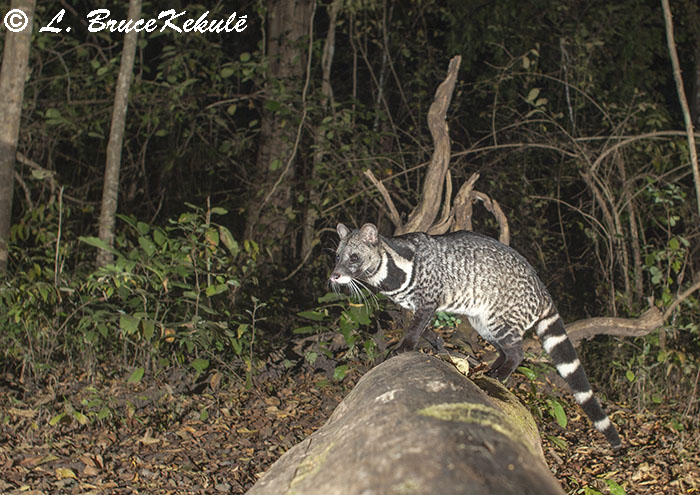
Large Indian civet up on the log…!
Just returned from the Western Forest Complex in Thailand where I checked out my Nikon D700 on the log. It continues to capture some amazing creatures that thrive in this biosphere and the ‘log’ has proven to be a goldmine for me…!

Large Indian civet up-closer…!
A large Indian civet Viverra sibetha jumped up on the log and the D700 fired off two shots. This large civet is nocturnal and common in this forest. This critter came up close but then jumped off after the flashes fired again.
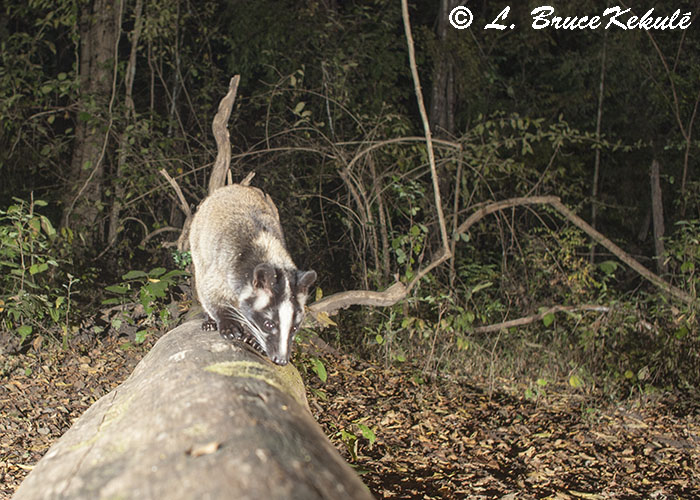
Masked palm civet a few days later….!
A few days later, a masked palm civet Paguma larvata also got up on the log and came right up to the cam. Largely arboreal, they also hunt on the ground.

Up-close…!
I did use some ‘coon bait’ by Marsyada’s Lures from Hazei Township, PA which worked real well to lure these carnivores. It was a nice catch and I’m sure they will return.

Up real close…!
Unfortunately, a tiger came up to the log but saw the red LEDs on a Bushnell setup across from the D700 and did not cross over but went around and so I missed the big cat but got him on video. Hopefully, it’ll pass over next time..Enjoy…!
Nikon D700 captures Indochinese tiger
My first good catch with a DSLR trail cam..!

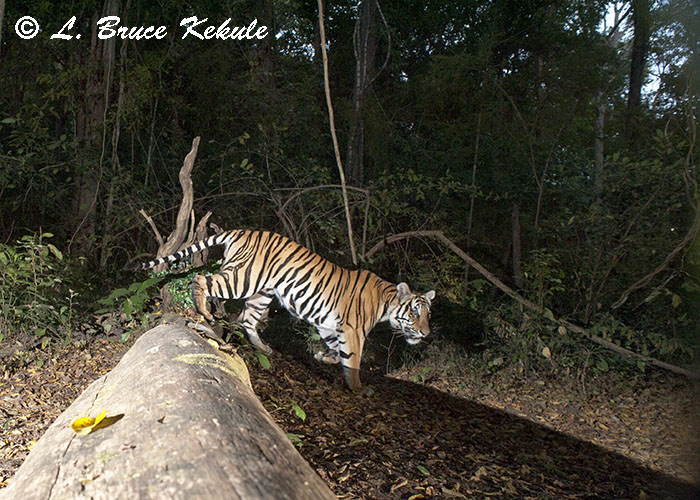
It has taken me long enough. When I first set-up my Nikon D700 and after months of frustration using wireless flash triggers (two different makes), I have come to the conclusion that the only way to capture elusive wildlife with a DSLR and get that first shot; hard-wire the flashes with a TTL sync cord is the only way to go. These two shots of an Indochinese tiger shown here was captured in January 2014 using my D700 and a Nikon 10mm fixed lens in conjunction with a Nikon ML-3 remote trigger and one SB-28 and one SB-600 Speedlight.
I have cropped these two photos. While at the cam, I replaced the 10mm with a 24mm manual lens and refocused to take in the tighter crop. The 10mm was too wide for this location. On my next visit in a week or so, I will put a 35mm lens to get an even tighter frame. Also need to add one more flash above the cam as the shadow of the log on the right is not too good. Needless to say, the hard-wired flashes are still going and burn very little power on standby. I will also hard wire my other cams one at a time to do away with the useless wireless triggers. Enjoy…!!
Wild Thailand Part One and Two
For the first time, a snarling tiger shows what their reaction is to a video cam with red LEDs when actuated at night. This male tiger is a resident at this location in the ‘Western Forest Complex’…a black leopard also passed the cam several times but did not actually look at the LEDs and so no reaction was recorded.
At the second location, the tigers did not seem too bothered by the red blob…! I now have a few cams including my Nikon D700 set-up here and hopefully will catch a tiger with my DSLR trail cam…!! Please enjoy these videos and even though they are a bit fuzzy, still show Thailand’s amazing natural heritage at its best.
Sony A500 Trail Cam
My smallest DSLR camera trap yet…!
Before my trip to the States in October 2013, I started working on a Sony DSLR trail cam using a Model A500 body with a Sony 28mm ƒ2.8 lens. I prefer prime lenses (24, 28, 35 or 50mm) over zooms for camera traps (for the most part) due to better quality images.

Sony A500/Pelican 1120/SSII/18650 externals/YongNuo CTR-301P/S.
A Pelican 1120 case has just enough room for the A500 body without a battery pack and a SSII with a #5 chip is used for control. A generic shutter release cable was cut and hooked-up to the SSII. NOTE: Make sure your SSII is up-graded to ‘no refresh’ as this can actuate the camera every couple of hours and drain the battery…!

Close-up modified YongNuo CTR-301P/S wireless flash trigger plus two 18650 externals.
Most people are not aware that Sony bought all the copyrights from Konica-Minolta (K-M) DSLR and SLR programs on the lens mount and other equipment and hence, many lenses and accessories are interchangeable between K-M and Sony. I have a few leftover Minolta lenses from my old film days for future Sony DSLR trail cams. Minolta made some of the finest lenses on the market on par with German Zeiss and Leica. However, the first K-M (Digital Dynax D7 and D5 bodies) were power hogs and a fully charged Lithium battery lasts about two-days on stand-by…!

Sony A500 in the case.
After Sony took over, power saving was improved and the A500 can last for several weeks. I decided to hack the A500 to take two 18650 – 4.2v Lithium batteries for 8.4v output as externals to increase battery life plus there was enough room in the case for them. However, the original Sony 7.2v battery must be in place for the cam to work with externals..!
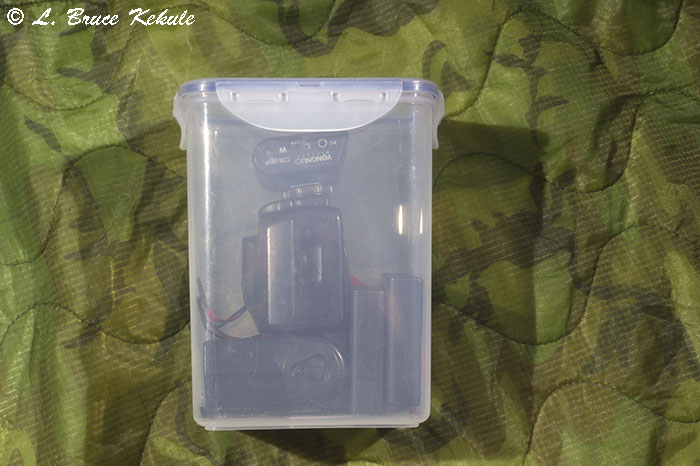
Nikon SB-28 and YongNuo CTR-301P/S flash trigger reciever in Tupperware box.
For flash, a YongNuo CTR-301P/S wireless flash trigger for Sony is used along with a Nikon SB-28. The flash trigger transmitter was modified so the body fits in the case as shown. The flash system works very well and the flash, transmitter and two extra 4-AA battery packs all fit in a Tupperware type box. The SB-28 is modified to take regular battery packs putting out 6 volts. I also made up an extra slave flash with a light sensor.

LBK elephant proof boxes for Sony A500 and Nikon SB-28/YongNuo CTR-301P/S.
The cam and flashes of course have my ‘elephant proof’ aluminum boxes to protect them from the marauding giants and possible theft. I hope to set this cam soon and any photos will be forthcoming…Also, a Sony A700 and a A55 trail cams are one the way…!

A male Indochinese tiger with a radio collar caught by my Sony A500 on a road near the main gate…!
Hope this helps anyone with a Sony or Minolta digital camera. A Minolta D7 or D5 would probably need a fairly large SLA battery. However, both make neat trail cams….!!
University of Tennessee Wildlife Presentation – November 11, 2013
This is ‘Part One’ titled ‘Chasing a Wild Dream – Predators’ of the presentation I did for the Biology Club at the University of Tennessee on Veteran’s Day, November 11, 2013. There is some old footage but some new including a black leopard in the early morning walking by my cam..one of my favorite videos…..enjoy..!
This is ‘Part Two’ titled ‘Chasing a Wild Dream – Herbivores’. Again, some old and some new….enjoy..!
A Jumping Tiger: Nikon D300s DSLR catches a big cat
The speed and reaction time of an Indochinese tiger is measured in milliseconds….!
The video is a bit raunchy and music is strong but I wanted something else for a change…! This is the most amazing behavior of a tiger I have ever seen.
I set my Nikon D300s DSLR trail cam deep in the forest at a mineral spring where all of Thailand’s large wild mammals like elephant, gaur, banteng, tapir and sambar plus others come for ‘life-giving’ minerals and a drink, and where tigers coming looking for prey.
This cam (set to manual 1/125 – ƒ8 – ISO 400) with a 35mm lens with a Snapshot Sniper SSII sensor fires-off salvos of 8 frames a second every time it records motion. The Nikon D300s was perfect for this location
I was hoping to catch a tiger and thought I might get lucky…but after going through the files, I found 13 photos of a tiger jumping away from the cam. This action footage is my best so far of the tiger in Thailand. The cat is not exceptionally sharp but movement never is and it does not have to be…..!
Amazingly, this male tiger heard the first shutter and reacted in less than three frames and started moving away in what I would like to say, blinding speed…! He looks to be mature judging from his scrotum. This place is truly the last great tiger haven in Thailand and worthy of it’s ‘World Heritage Site’ status…!
All I can say, it’s going to be tough to top this sequence….!
Enjoy…!
Canon-Nikon ‘Hybrid’ DSLR trail cam
A 600D/T3i and a Nikon manual 50mm ƒ1.4 lens combination
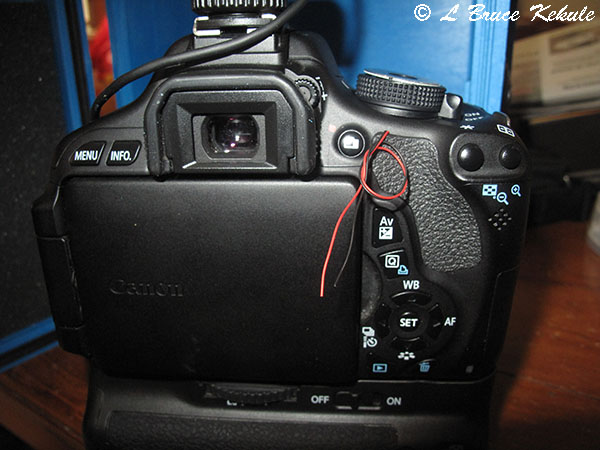
I recently acquired a Canon 600D/T3i DSLR to be used as an HD video trail cam but with its present Canon programming, it will not stay on stand-by in video mode for more than 10-15 minutes and then shuts down, and must be restarted manually. The control circuits for the still camera and the video are separate. For the moment, to control the 600D in video mode as a trail cam, a remote triggering device or a hack to the video switch on the camera is needed and connected to a motion sensor.
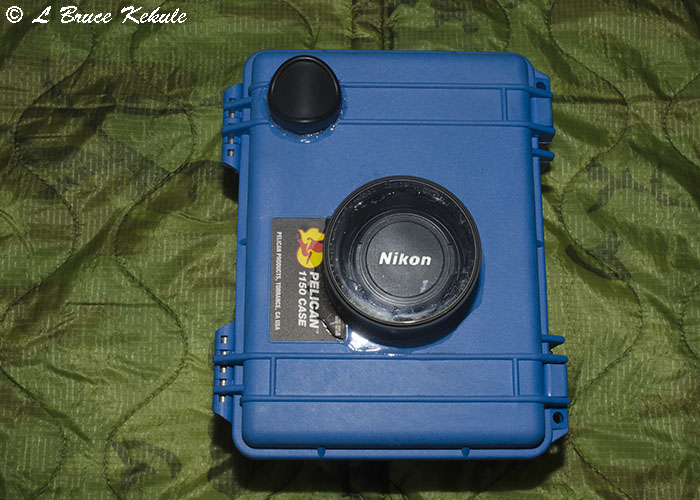 Canon-Nikon Hybrid trail cam.
Also, a sensor board with the right programming to turn the cam on, go into recording mode and take a video clip for 60 seconds and then shut the cam down for a delay (as short as possible). If there is still motion, start-up and a repeat of the video cycle will activate the cam again. I can hack an IR remote or the video switch on the Canon to accomplish this task for now. More battery power for the cam will probably be needed and will be doing some serious testing real soon. On the video remote option, and since it is IR controlled, it would have to be in front (line of sight) or next to the sensor inside the case.
 Canon-Nikon ‘Hybrid’ SSII Pelican 1150.
However, there is a ‘Magic Lantern’ firmware program for the Canon to control it with a shutter release cable but I’m not sure at the moment. That seems to be in the field of programming, something I don’t do. I’ll leave that to the pros but will be looking into the ‘Magic Lantern’ program at a later date. For now, I will be setting this cam to shoot stills and hopefully test it in video soon.
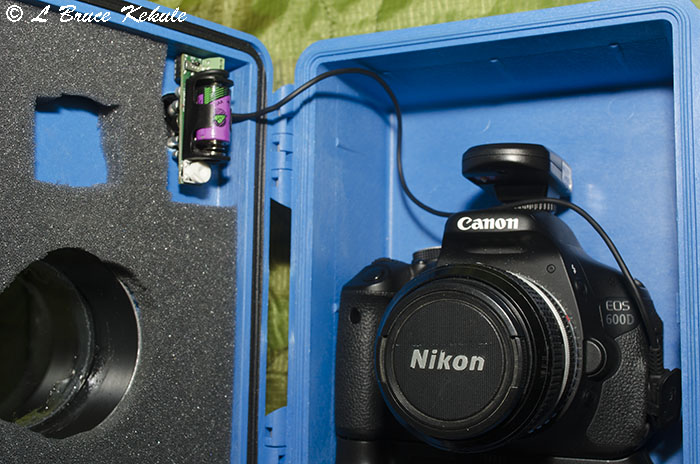 Hybrid close-up.
The Nikon lens is a very old manual 50 ƒ1.4 I’ve had for ages back in the days when only glass and metal were used for lens materials, and clarity and sharpness is superb plus it’s very robust. A converter was bought to allow the Nikon to fit on the Canon. I’m now using manual Nikon lenses except for a Canon 400D and Nikon D90 with their newer 50mm glass/plastic lenses. I love the old prime manual lenses from Nikon.
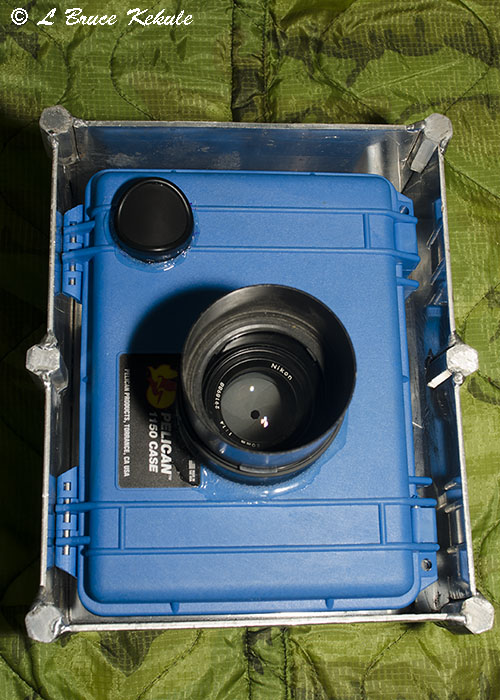 Hybrid in aluminum ‘elephant proof’ box.
The 600D fits easily in a Pelican 1150 using a 77mm diameter aluminum tube snorkel and a 77mm UV filter for the lens, and a Snapshot Sniper SSII #5 board/HPWA connected by a Canon shutter release cable (shortened) with a 90-degree plug. The cam is set to ‘continuous mode’ and fires off 6 or more shots on each trigger. It is very fast…!
 Nikon SB-600 with PT-04NE FM radio transmitter.
A PT-04NE FM radio transmitter is used on the Canon and two receivers trip Nikon SB-600 and a SB-800 housed in ‘tupperware’ type plastic boxes with 4-locks on the lid and will be airtight. I will also have another spare flash (a generic ‘Speedlight’ 850/Canon flash mount) with a PT-04 receiver in a slightly larger plastic box. I got this idea from Cutter on the ‘Outdoor Talk’ forum that used them for externals and many thanks to him for a great idea. I will certainly be using these boxes for all my future slave flashes and some external battery builds.
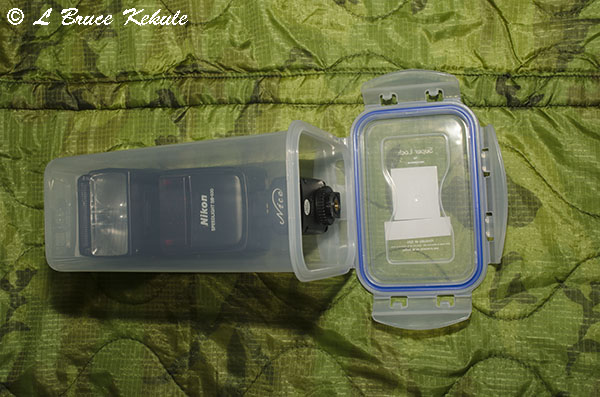 Nikon SB-600 with PT-04NE FM radio transmitter in a ‘tupperware’ box.
Another sensor to be used with this cam will be an old ‘TrailMaster’ TM1500 ‘active infrared’ unit housed in two separate aluminum boxes to be securely attached to trees between a trail or over a log for precise tripping. The only drawback is the loose wire between the receiver and cam…! However, I will be using special aluminum braided telephone cable to connect the two as rodents and other small creatures could chew/gnaw on the wire. It will also have to be secured to the tree using clips and lag screws, and then buried in the dirt.
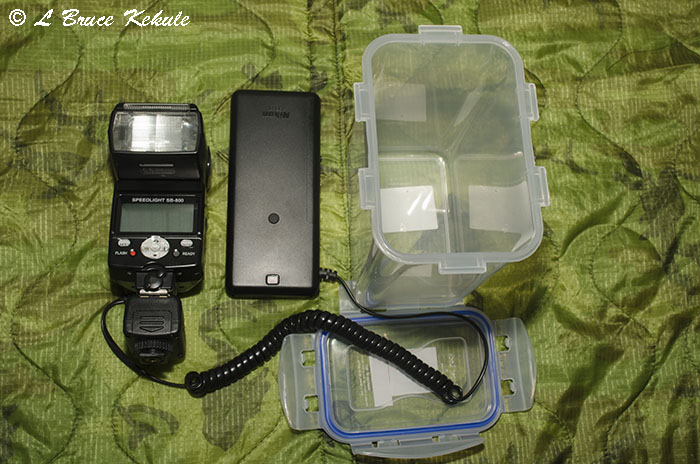 Nikon SB-800 with Nikon SD-8 battery pack and PT-04NE FM radio transmitter.
As usual, the cam and three-four flashes are housed in my aluminum ‘elephant proof’ boxes that are bolted to trees in conjunction with ‘Python’ lock cables. Due to time restraints and a cracked molar, I did not get the boxes done in time for this post but they will be finished soon. Anyway, that’s the way these very strong boxes look from the welder. The ‘TrailMaster’ units are also shown in unfinished boxes. When they are all done, I will post some photos later.
 A TrailMaster TM-1500 ‘active infrared’ unit in unfinished boxes.
The cam will be set to manual focus and exposure: ƒ8 – 1/125 @ ISO 400 to test the Canon/Nikon combo and depending on how the photos come out, can increase ISO. Look forward to setting this cam not far from the ‘Big Cat Trailhead’ with images and videos to follow…!
As there is loads of space in the 1150, I’ll be able to add various items needed for video including another sensor with a sister board to get white light for the video at night. I’m certain a large battery with loads of power will be needed close by…I’ll be addressing these issues as I go forward with this project.

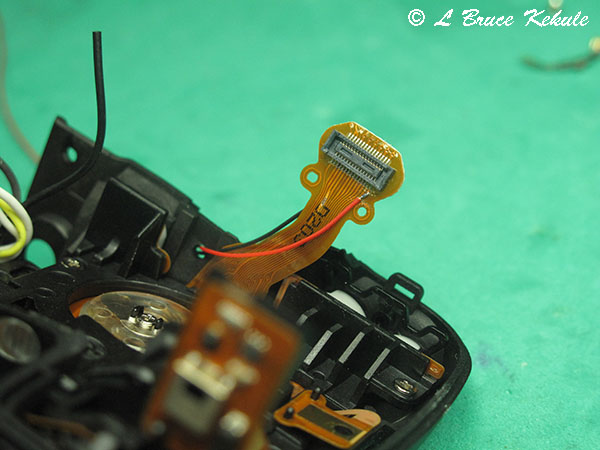
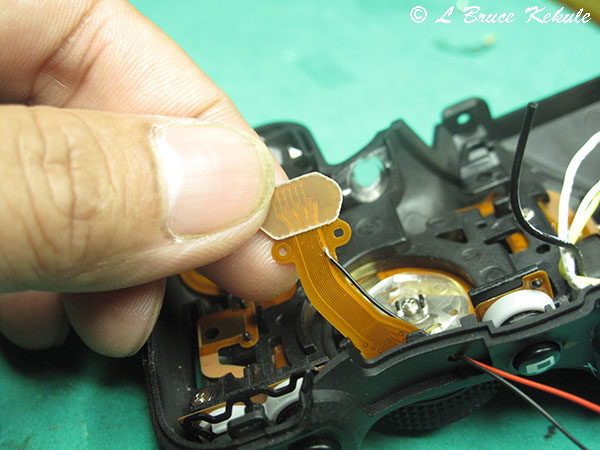
The hack to the camera to operate video only is as follows. It is a difficult modification but is doable. Only two wires – positive and negative is needed. I’m waiting for a chip for my board with the right programming.
Nikon D90 DSLR trail cam catches a ‘Large Indian Civet’
The ‘Big Cat Trailhead’ has proven to be a real wildlife haven with loads of cats plus other carnivores walking past on almost a daily/nightly basis. Because of so much interaction, I decided to set-up my Nikon D90/SB400/Yeti/Plano 1460 case facing the other way opposite my Canon 400D.
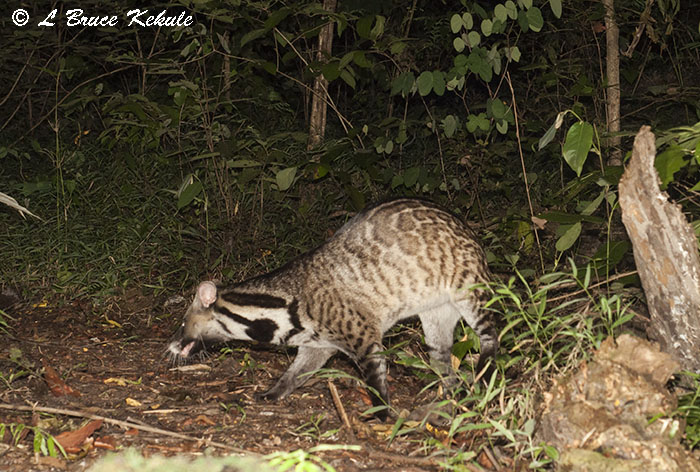
The Yeti board was very old and not working too well. I tried to adjust distance and sensitivity but it still would only trip the cam from about a meter away. However, the cam did get one shot of a ‘Large Indian Civet’ shown here. The markings on this medium sized carnivore are unique and these creatures are very common in this forest.
I have since brought the cam home and replaced the board with a Snapshotsniper SSII #5 board and it is now ‘rocking and rolling’. Look forward to checking both cams in a couple of weeks and I’m confident there will be some interesting creatures walking past…! Enjoy.
Canon 400D DSLR catches a ‘black leopard’
Once again, the ‘Big Cat Trailhead’ situated deep in the Western Forest Complex continues to be a real hotspot for the big cats. Both black and yellow phase leopards were captured on digital stills and video at this location.

In July at the beginning of the rainy season, I set my Canon 400D down low (about two feet off the ground) on a tree at the trailhead wanting a real low-down set-up. When I returned, the lens was completely covered by sand and mud from extremely heavy rain and splatter…and no photos were on the card: a disappointment…! I then moved the cam way up about five foot and angled down about 45 degrees.
After some three weeks, I was back and a black leopard had passed the cam at night. Only one flash went off (a Nikon SB-28) and just one good shot was acquired. A bunch more were captured of the cat but it was standing half-out of the frame. The Canon flashes (270EX) have proven to not be very reliable and I will probably just drop them out eventually. The Nikon flashes (especially the SB-28s) are better and last longer on stand-by.
Even though the composition is not the greatest, it’s still a good record shot…I have since moved the cam back down to about three feet hopefully to catch a full-frame head-on shot of this melinestic creature. I have now caught this cat 5-6 times including a beautiful daytime video as the black cat passes by and another IR video showing its spots…I will be posting these vids soon.. Enjoy..!