

Archive for the ‘Camera Trapping’ Category
A new DSLR camera trap
A Canon 400D trail camera with three Canon 270EX speedlights
This DSLR camera trap has been in the making for over a year but with many great opportunities now for tiger, leopard and other interesting wildlife photographs, I decided to finish it off.

DSLR Canon trail camera components
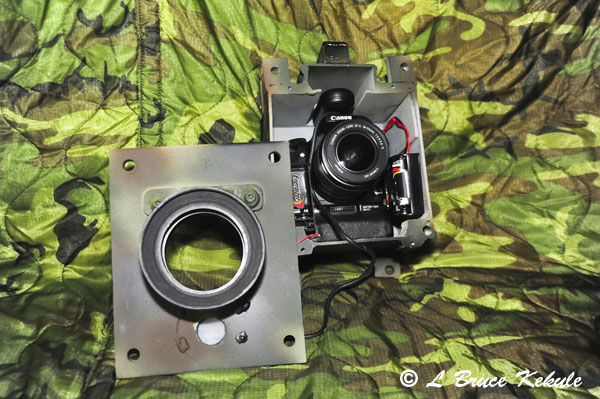
Canon 400D and ‘elephant proof’ aluminum box

Canon flash components

Close-up of wireless flash units
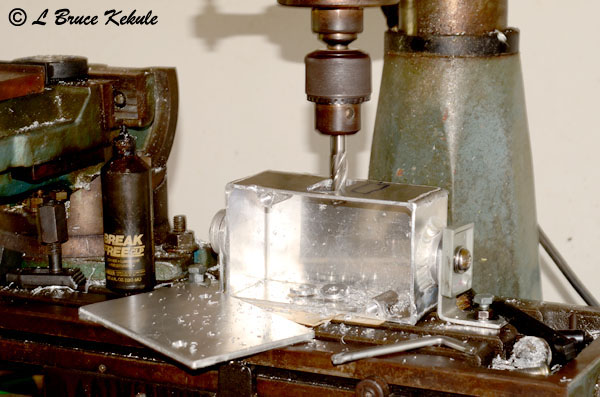
Machining flash boxes at my machine shop in Chiang Mai
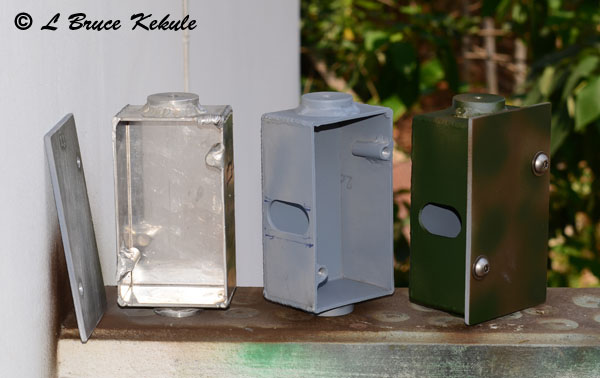
Flash boxes in the raw, with a primer coat and camouflage paint job

Wireless flash trigger external modification
This Canon camera and flash units were assembled into an infrared camera trap using aluminum housings made in my shop at home in Chiang Mai. The main object of this project is to use multiple flashes and get some really great wildlife shots from this DSLR. The system works very well and it will be interesting to see what comes out.
Next week, I’m on my way to my favorite wildlife sanctuary in Thailand: Huai Kha Khaeng. I will be setting this rig where I have captured several tigers and leopard plus sun bear, gaur, banteng, elephant and a host of other animals that visit this mineral deposit and water hole. It should be interesting and I will post set-up and photos as soon as I get some (hopefully a tiger).

Small camera traps catch top carnivores
Camera trapping in Huai Kha Khaeng Wildlife Sanctuary Jan. to Feb. 2012
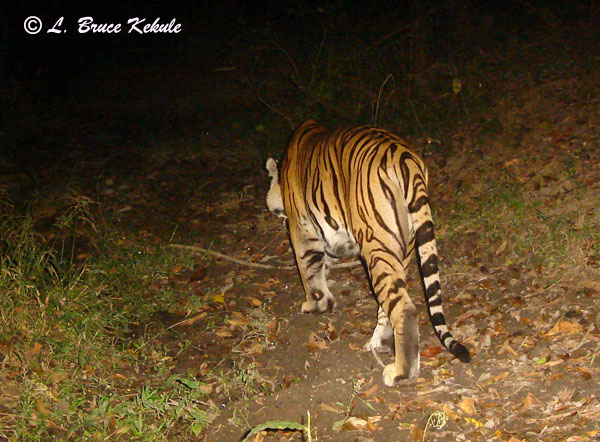
An Indochinese tiger with a radio collar on the same trail as the leopard below. This one is out of 8-10 tigers that are part of scientific survey by the research people at Khao Nang Ram Wildlife Research Station of the big cats here.
In January of 2012, I began a new journey into Thailand’s top wildlife sanctuary and protected area. The unmatched biodiversity of this place is second to none. At the top of the food chain, the Indochinese tiger thrives here in good numbers along with the Asian leopard which is quite common in the interior. Leopard found in both color phases: yellow/black.

Leopard caught by LBK #3 a few nights after the tiger above.
I made up a series of three camera traps based on the Sony S600, Pelican 1010 cases and SnapshotsniperSSI and SSII boards. The following are the builds and employing them in the forest of Huai Kha Khaeng, a World Heritage Site. Afrer two months, LBK trail camera #3 caught two big cats within several nights of each other. This set of three cameras are presently working in this forest and when I go back in March, photos will be downloaded and posted on this site.

LBK #1 Sony S600/Pelican 1010/SSI in the hand to show size

LBK #2 S600/1010/SSI in
‘Elephant Proof’ aluminum box & 10mm Python locking cable

LBK #3 S600/1010/SSII with 3D camo on box

LBK #3 in an elephant proof box out in the field –
‘Elephant Proof’ aluminum box, 10mm Python locking cable & padlock
LBK ‘Clear View’ camera trap project
Building a modern digital camera trap

LBK ‘clear-view’ camera traps parts assembled
Recently, I wanted to up-grade my camera trap fleet using ‘Pelican’ cases available here in Thailand consisting of the 1010, 1015, 1020, 1030 and 1040 ‘Micro’ series. All of them were clear and I thought I would just coat them with camouflage paint when finished. After studying and collecting cameras, boards and externals, I began building this series of trail cameras around these clear boxes.

Camera trap #1 in the ‘clear view’ series
A Sony S600/Pelican 1015/SSII/2 AAs
Then it hit me. The practical aspect of this build is no need to drill an extra hole for the flash and just let the camera’s flash shoot straight through the box. A lens snorkel is used in every build and so there is no flash-bleed with the clear boxes.
I sourced all the components including Sony cameras depending on which Pelican case was used including a S600, W55 and several W5/7s. The infrared board is the SS1 & SSII plus one Yeticam board. Snorkels were machined from aluminum and a rubber gasket was made from Permatex black silicon sealant. SnapShotSniper ‘HPWAs’(High Performance Wide Angle fresnel lens) are used with one exception (the W5/1040/Yeticam using a standard wide angle lens).

Completed Sony S600/Pelican 1015/SSII/2 AAs
At most of my camera trap sites in Thailand’s protected areas, an aluminum box fitted around the Pelican case to protect it is an absolute must primarily from wild elephants, but also from theft. I use several 3” stainless lag bolts inside the box screwed into the tree (preferably dead) in conjunction with a ‘Python locking cable’ in 5/16” or 3/8” diameters. A 3mm aluminum alloy faceplate drilled for the lens, flash and sensor holes is bolted on to the front using stainless steel ‘power torque’ 10mm machine screws.

Power torque 10mm machine screws and wrench
This system has defeated many inquisitive jumbos who can destroy traps with extreme strength. These aluminum boxes are so firmly attached to the tree they just leave them alone after awhile. A friend of mine recently had three camera trap units with Python locking cables completely ripped off the tree and smashed by wild elephants in Thap Lan National Park in eastern Thailand because he used no lag bolts.
Fortunately for me, there is a custom motorcycle welding shop close to my house that offers ‘Tig’ welding of aluminum and I can have custom dimensions made up to fit any one of the Pelican cases I use. I do all the machining required in my shop at home. Aluminum is much better than steel being more lightweight and rust proof. Also, it is much easier to machine then tough old steel.

Completed camera trap and ‘elephant box’
I cut off the belt loops on the Pelican to make the boxes slightly smaller. I then do a 3D camouflage job on the outside box with black silicone sealant and paint with flat brown, tan and/or green to suit different tree bark colors and patterns. Pre-scouting of camera trap areas and photographing the trees to match-up the bark pattern can be accomplished.
Another aspect of using clear Pelican boxes is I can then use them in wildlife photography and camera trap workshops I occasionally do for Kasetsart University and the private sector in Bangkok. Camera trapping in Thailand with all its exotic animals is amazing and this series of clear boxes are my 4th generation camera traps (1st – generation were film cameras in aluminum boxes, 2nd – digital cameras in aluminum boxes and 3rd – Standard Pelican cases in aluminum boxes).
I hope this might help some people with bear problems in North America and elephant trouble elsewhere with access to ‘tig-welding’ equipment and a machine shop. I have completed the first trap shown here and will post the others to follow. This one is my favorite: A Sony S600/SS2/1015 with a single AA external. This small camera trap is just right for my day pack.
I will be setting this one next month in Huai Kha Khaeng Wildlife Sanctuary, a World Heritage Site situated in western Thailand. I now have ten digital camera traps and three video traps working in this forest and will post photos and videos as soon as I get back out from the field. I am extremely lucky to be able to work here.
Camera trap videos in Huai Kha Khaeng Wildlife Sanctuary
Early in 2011, I set several camera traps and video units including a Bushnell Trophy Cam around a mineral deposit and water hole visited by wild animals including wild pig, banteng, sambar, tiger, gaur, peafowl and crab-eating mongoose plus more. This is a collection of video clips from the Bushnell captured over the course of one month from January to February.
Goral in Mae Lao-Mae Sae Wildlife Sanctaury – Northern Thailand
From June to August 2011, I set a Bushnell Trophy Cam on video mode at the top of ‘Mon Liem’ mountain in the sanctuary. After collecting the camera, many clips of goral were taken, both during the day and at night. This is just a few of those clips.
Asian tuskless bull elephant in Huai Kha Khaeng
A huge tuskless bull elephant at a mineral lick in Huai Kha Khaeng Wildlife Sanctuary
This bull has been involved in a few close encounters with rangers, and actually killed one man while he was riding his motorcycle along the road in the sanctuary. These old elephants are to be avoided at all cost. I certainly stay out of their way when I’m working in this World Heritage Site which means slow and deliberate movement is essential and ears and eyes on high alert when walking through this forest.
Poacher camera trapped in Mae Lao-Mae Sae Wildlife Sanctuary
Silent video is not noticed by a low-land village man scouting for game or forest products
This hunter/gatherer was caught by a very sensitive Bushnell Trophy Cam set on video mode during May-June 2011 up the mountain in this protected area. He was probably Hmong or Karen hill-tribe but had no gun. But this does not mean he did not have rope or wire sling, and poison in his backpack, or had already set some snares near wildlife concentrations like mineral licks. These are the main tools for poachers now-days. More camera trapping of this sanctuary is needed to get face recognition of people who illegally entering this place. Look for future posts of this nature.
Pig-tailed Macaque in Mae Lao-Mae Sae Wildlife Sanctuary
A mature pig-tailed macaque up on a ridge-line in the sanctuary
This monkey showed-up in front of a Bushnell Trophy Cam set to video, and then made an amazing leap to a tree overlooking the lower valley. As a loner or solitary primate, he must have been pushed out of the group by a larger male. But the big question: What was he doing all the way at the top of this mountain?
Asian Wild Dogs in Mae Lao-Mae Sae Wildlife Sanctuary: Part Two & Three
Wild dogs pass a Bushnell Trophy Cam a few days later:
These videos once again demonstrate Thailand’s beautiful and amazing natural heritage, and the fact these carnivores are still thriving in the North formally thought to be extinct.
Wildlife Candid Camera-Update: Photographing rare creatures with modern digital wizardry
Trail cameras catch Thailand’s cryptic wildlife

Indochinese tiger camera trap abstract
Camera trapping has been around for over a century when George Shiras III making history used the first flashlight camera triggered by trips wires in 1906. In the late twenties, two other men, F.M. Chapman and F.W. Champion, used pressure plates to activate their cameras. National Geographic and other magazines published many photographs from these early pioneers’ work.
In the 1970s, the first commercial camera trap was produced by TrailMaster.com using ‘active infrared’ to control the cameras followed by CamTrakker.com that used ‘passive infrared’ controlled traps to set off their cameras. Both companies incorporated simple point-and-shoot film cameras from Olympus and Yashica to capture photographs of wildlife.

Asiatic sun bear in Kaeng Krachan
Active infrared uses a beam between two separate units (transmitter and receiver hooked to a camera) and when the beam is broken, the camera is tripped. One the other hand, passive infrared detects motion within a given area covered by the sensor and will trip the camera when movement is detected (much like the sensors above automated doors in shopping malls and convenience stores). Both systems have merit and used in the right situation work equally well.
These first early-production units were designed and used by hunters in America to scout areas for deer, turkey and bear prior to hunting season. This in turn helped them to indentify trophy animals and movements of game in a given forest.

Gaur bull at a waterhole in Huai Kha Khaeng
It was not long before wildlife researchers found camera traps could also benefit their work with a photograph, plus the time and date, allowing them to create an extensive database of the animals living is a certain area. Behavior, presence/absence and other aspects of mammals, birds and reptiles are recorded.
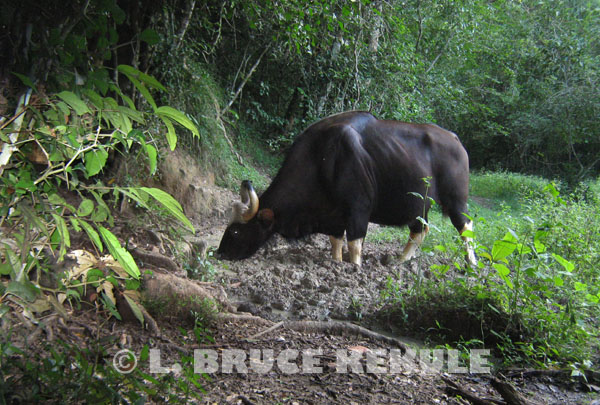
Gaur cow at a mineral deposit in Kaeng Krachan
Wildlife photographers have also used camera traps to capture images of rare, endangered or cryptic creatures. Some have used simple camera-traps but others have incorporated high-end SLR or DSLR cameras with several flashes.
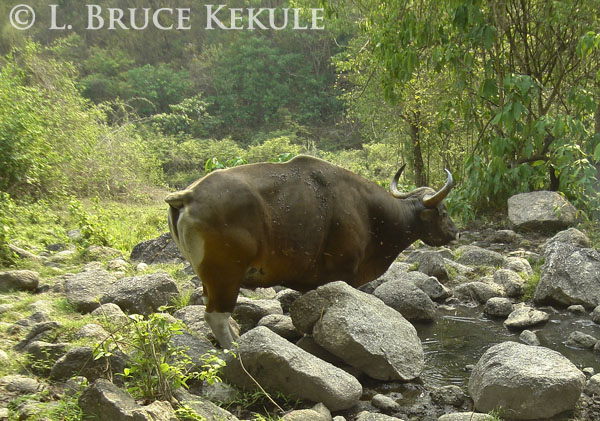
Banteng bull and forest flies in Huai Kha Khaeng
Steve Winter with National Geographic Magazine got an amazing photo of a snow leopard using a Canon DSLR and three Nikon flashes that won the Wildlife Photographer of the Year contest in 2008. The following year, a camera trap photograph of a wolf jumping over a fence won first prize but was later disqualified as the carnivore was domesticated and trained to jump. The organizers of this prestigious event should put camera trapping into its own category.

Banteng cows at a waterhole in Huai Kha Khaeng
The homebrew ‘Game Cam’ or ‘Trail Cam’ as it is now known by its users in the U.S.A. is a unique device with some units very high tech in its features, yet simple to operate and enjoy for just about anyone that has an interest in capturing photographs of wildlife.
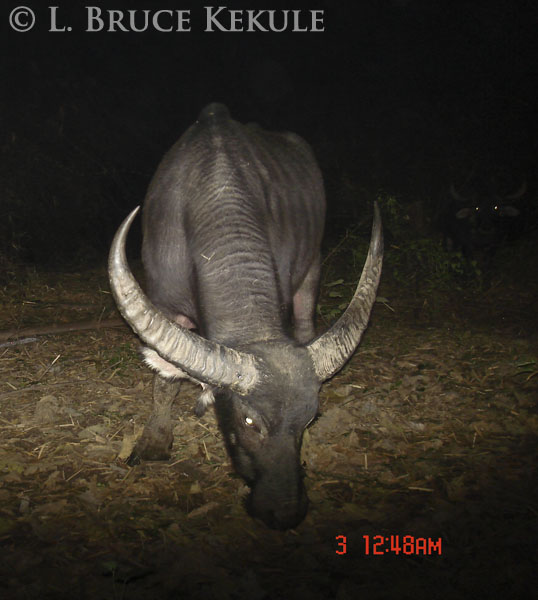
Wild water buffalo caught by the Huai Kha Khaeng
The popularity of these cameras has grown at a fast pace over the last few years and opened up a number of usage possibilities to the users. There is also a huge ‘home-brew’ market for the do-it-yourself enthusiast plus the ready-made models that are available for those with a larger budget and no time to build one.
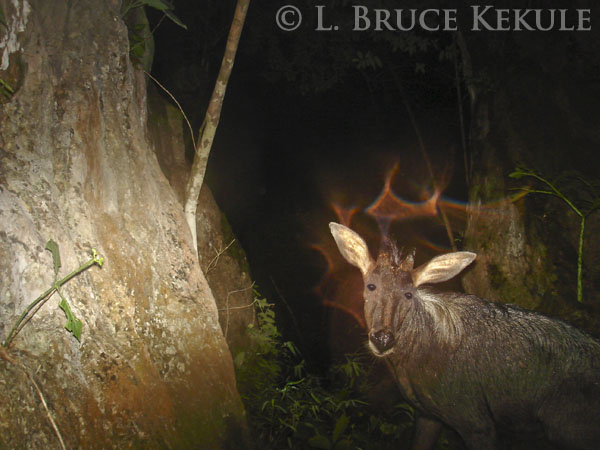
Serow in Sai Yok reserved forest
Camera traps have become very sophisticated and most now use some form of digital camera incorporated into the housing. There are now many companies producing them for less than one hundred U.S. dollars up to $900 or more. Some are fair and some quite good but many are not suitable for the tough conditions found in Thailand’s forests, especially the lower cost models.

Sambar stag in Khlong Saeng
As a wildlife photographer and due to the high cost of buying and importing commercial models into Thailand, I decided to produce my own camera traps. In the beginning, I used passive infrared circuit boards obtained from ‘Radio Shack’ in the U.S and had my close friend Yutdhana Anantavara from Chiang Mai, an electrician working offshore in the Gulf of Thailand, to hook-up the delicate electronics and modify some simple ‘point and shoot’ film cameras (Olympus and Canon).
To stand-up to the rigorous conditions in a Thai forest where moisture, invading insects and elephants can destroy plastic bodied camera traps, I designed and built the housings from aluminum at my machine shop in Chiang Mai.
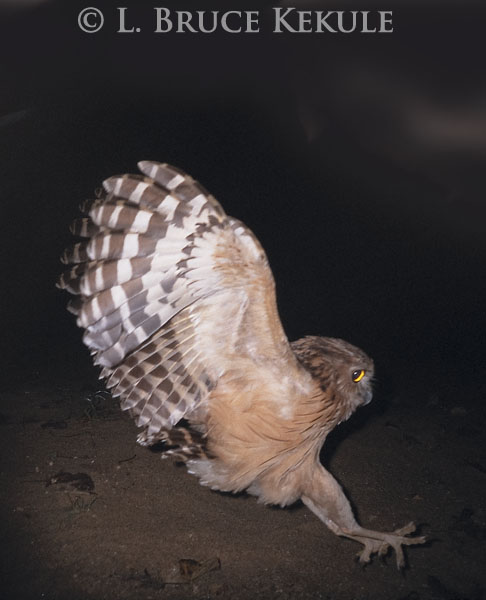
Buffy fish-owl landing by the Phetchaburi River
A local welder TIG welded-up the box and I machined it flat. By using silicon sealant available at most hardware stores between the box and the flat faceplate, and by using large 10mm machine screws to get a tight seal, sealing is 100 percent. These have defeated many inquisitive elephants.
A small bag of silica gel (desiccant) is inserted in the box to protect the delicate circuit boards, cameras and film from moisture. I tested them on feral cats that walked on a wall at the back of my shop with some good results. These early models worked very well and I then decided to deploy them in the forest.

Feral cat camera-trapped behind my shop in Chiang Mai
In mid-2003, I set six camera traps in Sai Yok National Park in western Thailand by wildlife trails and waterholes. Every month, I would visit the traps and change film, batteries and desiccant. After four months, I finally got my first tiger, and then a second cat a few days later up on a 600-meter ridgeline. All the hard work and expense finally paid off.
It was the beginning of a program to catch the tiger on film. Other animals caught in Sai Yok were elephant, sambar, barking deer, wild dog, wild pig, serow and stumped-tailed macaque. I even managed to catch a water monitor on one camera.

Indochinese tiger by the Phetchaburi River
Even some poachers and hunting dogs were captured on film. One of those original film cameras is still working in the field and I named it ‘Tiger Cam’ as it caught my second tiger.
I then moved down to Kaeng Krachan National Park in the Southwest where I spent three years camera trapping wildlife to establish a presence/absence program in conjunction with Worldwide Fund for Nature (WWF-Thailand provided funding), and the Department of National Parks granted permission.
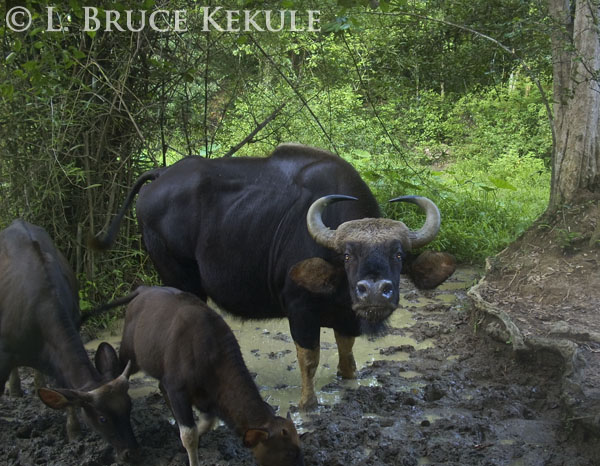
Gaur cow and calves in a mineral deposit in Kaeng Krachan
At that time, many tigers and leopards plus loads of prey species were thriving by the Phetchaburi River and a few of its tributaries, and many photographs were obtained over the course of the survey indicating a healthy ecosystem. Both prey and predator were living in natural harmony. I shut down the program after poachers stole three units near the headwaters of the river that was both costly and disappointing.
Sometime in 2007, my good friend Chris Wemmer, the Camera Trap Codger, who is now retired from the Smithsonian Institute, was the first person to tell me about a new company in the US producing infrared circuit boards and other accessories for the home-brew digital camera trap market. The company is Pixcontroller.com. Unfortunately, they no longer offer parts but now sell complete units with digital camera and video.
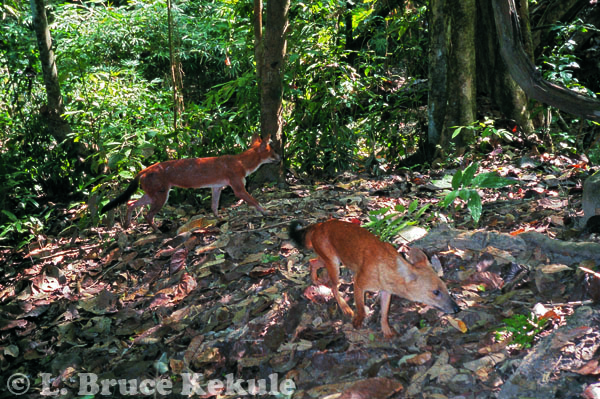
Asian wild dogs by the Phetchaburi River
A quick look on the Internet, and several companies offering boards and components to build ‘homebrew’ trail cameras are on-line. The best and the most reliable are boards from Snapshotsniper.com and Yeticam.com. The list for complete units is long and is best searched on the web.
I finally purchased some of the new high-tech boards and made-up some new traps using Sony ‘point-and-shoot’ digital cameras. These were modified by EDI, a company based in Bangkok to work with the electronic boards. The aluminum cases remained the same as the early production units as the best option for durability, and against moisture and elephants.

Tusker camera trapped at a waterhole in Huai Kha Khaeng
The first units were set-up at several mineral deposits deep in the forest of Kaeng Krachan National Park over a three-month period from October to December 2008. Animals digitally captured were tiger, elephant, gaur, sambar and muntjac. One camera had over 300 captures in one month at a mineral lick of elephant and gaur.
I then moved down to Khlong Saeng Wildlife Sanctuary in Surat Thani, southern Thailand and in the first part of 2009, began a new program setting both film and digital camera traps deep in the interior. Elephants, gaur, tapir, wild pig, sambar, muntjac, golden cat and Argus pheasant were captured.

Giraffe caught in Samburu Game Reserve in Kenya, Africa
This year in September, I made a trip to Kenya, Africa and took two camera traps with me. Due to the strict regulations about exiting the safari vehicle, it was difficult to set them up. But at one location, I was able to install one by a game trail. In four hours, a giraffe and elephant passed the camera. It showed how well these cameras can record passing wildlife, and the giraffe photograph shown in the story is the best one.
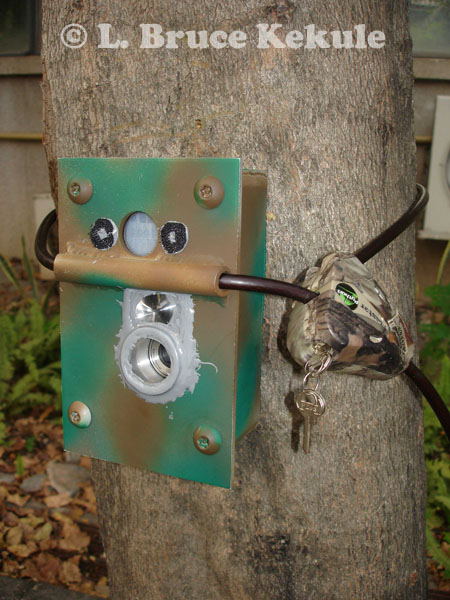

LBK camera trap using Sony W7 with a ‘Yeticam.com’ infrared board
in aluminum case with ‘Python’ locking cable
I now have more than a dozen digital camera traps using primarily ‘Sony S600 and W7’ cameras. They have been the best and most durable due to the manual features like ISO and f-stop adjustments, and compatibility with the infrared boards. Picture quality with the ‘Carl Zeiss’ lens is very good in the daytime and quite good at night.
The latest craze for camera trappers is ‘infrared capture’. The photos however are a greenish black and white, but are quite good for identification and scientific work. This system is unseen by animals and reported not to disturb them as a conventional flash.

Poachers and dog camera trapped in Sai Yok National Park
Video is another option. I now have two ‘Sony Handy Cams’ set-up with ‘Lanc’ video infrared boards that work very well. One is for daytime only and the other set to ‘night-shot’ with an infrared filter over the video light. Both work together at the same location over the course of a month between battery changes and downloads. It is just another option for those needing wildlife images, whether stills or movie.
The modern digital camera trap has allowed me to capture/recapture many rare and cryptic creatures on their own time, and in their own habitat. As wild animals continue to disappear, more protection, research and understanding are needed to save the natural world.
It is my main priority in life to educate all levels of society on what the Thai nation still has in regards to wildlife and the protected areas, and the need for proactive response to all the dangers facing Mother Nature. We must act fast to illuminate these threats to the Kingdom’s natural world so present and future generations can see, enjoy and cherish this wonderful heritage.