

Archive for the ‘The West’ Category
Wild Water Buffalo – Part One
WILD SPECIES REPORT: The last wild herd in Thailand
Massive beasts with a mean temperament
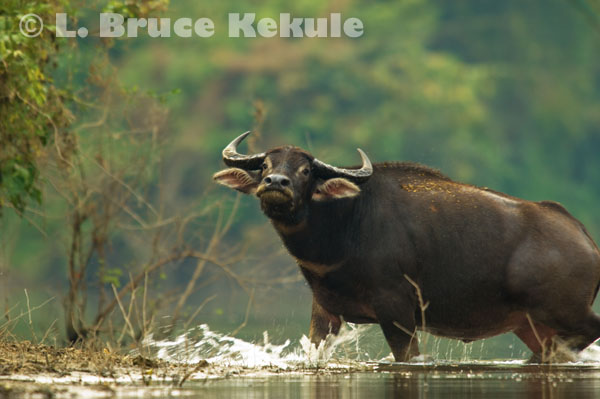
Young buffalo bull locked onto my boat-blind
Coincidence, according to the dictionary, is the occurrence of two events at the same time. I guess the following story would be seen by most as just that. However, I personally believe that good things come our way after we have made merit.
Such was the case when I showed up with a bag of rice at Huai Mae Dee, a ranger station in Huai Kha Khaeng Wildlife Sanctuary in March of 2007. My longtime friend and chief of the station at the time, Khun Fern, accepted the rice, saying we would cook it in the morning and make an offering to some monks. I agreed and retired for the evening in my comfortable hammock. The weather was cool and I slept well after the long drive from Bangkok.
Up at six, the food was prepared and we both eagerly waited. After a short while, the holy man arrived with some of his followers. We filled their alms bowls with rice and curry. I gave a Thai version of my second book Thailand’s Natural Heritage to the abbot of the temple, hoping it would help the local people around to understand more about Mother Nature. Feeling good at having made merit, I packed up and headed south to where the wild water buffalo live.

Old buffalo bull by the river
After more then three hours of grueling off-road driving, a forest ranger and I set-up camp by the lower Huai Kha Khaeng about mid-day. We had lunch and put my boat-blind together. I then motored upriver for several hours. On the way, I observed some smooth-coated otters hunting along the shoreline but these carnivores quickly disappeared after seeing the boat.
About 4pm as I rounded a bend, a small group of wild water buffalo cooling off in the river actually surprised me and I hesitated for a few seconds locked-on to the herd. About the same moment, I heard a national parks helicopter in the distance out on patrol and it was headed my way so I quickly gunned the electric trolling motor to get closer to the herbivores not thinking there was any danger.
When I was about 50 meters away, I started shooting my camera knowing the helicopter would certainly spook the buffalo. Nonetheless, I noticed a young bull in the herd staring directly at me. He moved up the shoreline followed by a larger cow and the rest of the herd galloping towards the boat-blind. I just kept firing away until my heart shuddered – as I finally realized I was being charged. I suddenly made a gut-wrenching effort to motor the boat out of harm’s way, just as the noisy helicopter hovered overhead. After a few seconds, I looked back and the buffalo were gone.

Buffalo cow charging my boat-blind
Had I been saved by the arrival of the mechanical flying bird – or was it the spirits of the forest that caused such a coincidence and protected me? I will never know how close I came to an attack by the aggressive buffalo, but these photographs are some of the most exciting I have taken as a wildlife photographer. A month later, I photographed a herd of wild elephants in the river not far from the same site. There were a few tense moments with baby elephants in the family unit. My camouflaged boat-blind has definitely paid for itself.
The most gratifying thing was seeing these rare beasts and catching them on digital. There are only 50 individuals surviving in the sanctuary and they can be tough to see and photograph. But it was not the first or the last time I would bump into wild water buffalo. During the late 1990s’ while I was still shooting film and working in Huai Kha Khaeng at the southern area, I managed to get some good shots of a herd wallowing in the river.

Buffalo bull, a purple heron and several pond herons

The Indochinese Tiger: Lord of the Jungle
Wild Species Report
Thailand’s mystical cat – A rare striped carnivore and awesome natural predator
Falling leaves signals the dry season has arrived and the forest floor is carpeted with a mosaic of green, yellow, brown, red and orange. A large predator walks the trails seeking its next meal. A barking deer sensing danger barks a warning. The whole community of wild animals is on alert as squirrels and monkeys cry out from the trees above. A striped carnivore stalks a herd of wild pigs. The nervous omnivores squeal and panic, running through the underbrush to escape. But the big cat is quick as lightning – it catches a young pig with sharp claws. The struggle is over in seconds as fangs penetrate to the spine.
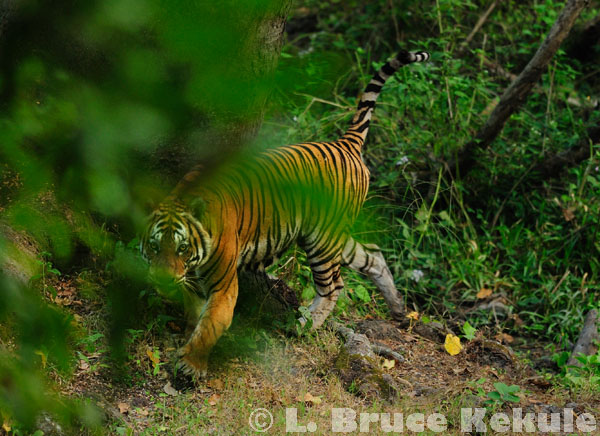
Indochinese tiger Panthera tigris corbetti in Huai Kha Khaeng
A tiger has just made a kill. It lifts the lifeless pig into deep cover and devours the carcass. After feeding, the big cat will seek water for a thirst quenching drink. It will lie down and rest until the desire to eat or drink begins again. Tigers sometimes move great distances in search of food. But where there is an abundance of prey, tigers continue to live in balance with nature. The average kill ratio is about twenty unsuccessful attempts to one kill. At a certain time of year, the male tiger will seek out a female in estrus to carry on his legacy.
Some two million years ago, the tiger evolved in Northern China and Siberia, and spread to many parts of Asia all the way to the Caspian Sea and eastern Turkey in the west. The Himalayas stood as a serious barrier to their migrating into India. Some reached Korea and Manchuria, and also advanced south through China then into Indochina, and down to the islands of Sumatra, Java and Bali. Tigers are good swimmers and made it across narrow sea channels. About 10,000 years ago, the big cat moved west through Burma and Bangladesh on to India. At one time, there were probably more than a hundred thousand of them throughout the tiger’s world range.
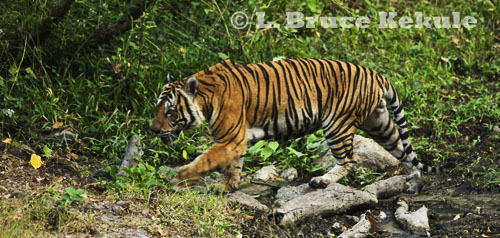
Tiger on the prowl in late afternoon
A century ago, Thailand was an absolute haven for this carnivore. They could be found in every forest within the Kingdom. But as humanity expanded, the species quickly declined because of human predation, and loss of habitat and prey animals. The pelt is sought after by hunters and its bones wanted by Asian medicine practitioners. Many considered this predator a pest and as modern weapons became available, and humans expanded into the forest, these magnificent beasts really began to vanish. Realistically, it is estimated there might be about 200 to 300 tigers left in Thai forests, which unfortunately, is barely sustainable over the long run in some areas. However, a very few protected areas if properly taken care of, could sustain a population of tigers. Thailand still retains some of the best-protected tiger habitat left in Southeast Asia. Wildlife corridors between protected areas are one of the most important keys to sustainability.


Feral cats caught by camera traps on a wall behind my home
When I began wildlife photography, the burning desire to photograph a tiger in the wild was one of my great wishes. These cats are extremely difficult to see let along photograph. My real first encounter with a tiger was in Sai Yok National Park in western Thailand back in 1996. I was sitting in a tree-blind when one jumped across the stream behind me and I caught a very brief glimpse of the sleek cat as it moved downstream hunting for prey. From that day on I photographed many other wild creatures including the leopard, but never a tiger. I was beginning to doubt whether I would ever photograph one.

My first camera trapped tiger in Sai Yok National Park
Several years later coming back to Sai Yok, I began a camera trap program not far from the headquarters. This was in mid-October 2003. Six traps were set-up in the forest at waterholes and game-trails. As we were breaking camp, the cook asked me for a lucky number. I just lifted my camp chair that left two impressions in the dirt like the numeral 11, and so I called out 11.
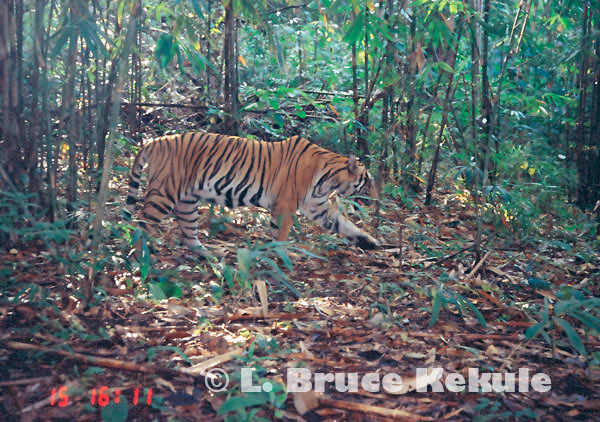
My second camera trapped tiger in Sai Yok
A month later, the film and batteries were collected and after processing, I saw two tigers on film. The first was an old male caught at a waterhole on the 11th day of the 11th month that was recorded on the frame. Three days later, a younger male tiger passed another camera up on a 600 meter ridgeline on the 15th at 16.11 pm also imprinted in the frame. Some may say it was just a coincidence to have the number 11 in both photos, but I like to think the ‘spirits of the forest’ had finally answered my prayers.
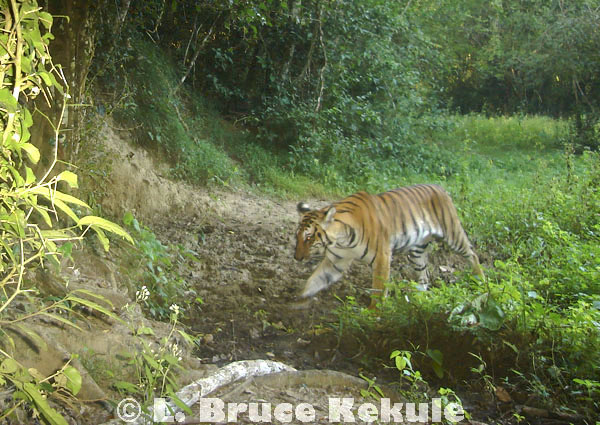
Tiger camera trapped in Kaeng Krachan National Park
Further south along the Tenasserim Range in Kaeng Krachan National Park at the beginning in January 2001, I began another camera trap program in conjunction with World Wildlife Fund for Nature (WWF) and the Department of National Parks (DNP) at two locations in the park. The first was along an old logging road not too far from the main gate at Sam Yot. During a four-month period, many animals were captured on film including an amazing six photographs of one mature male tiger. He actually came right up to the camera trap for a facial portrait, and then walked away. That was the beginning of a very successful ‘presence/absence’ program carried out (2001-2004) to determine if tigers and other large mammals were still surviving here.

Tiger male hunting on an old logging road in Kaeng Krachan
The second area was along the Phetchaburi River that flows crystal clear through this magnificent forest. Many tigers walk the elephant trails hunting for prey. My very close friend Sutat Sapphu (a forest ranger with incredible knowledge of this ecosystem) and I began a monthly program setting up more than 20 cameras along the river. One particular individual tiger named ‘four-spots’ due to a marking on its left flank was caught down near a crocodile pond where he actually tried too bite a camera trap and we got a shot of his mouth and whiskers. Over the next few months, ‘4-spots’ was captured up and down the river, and then way up Phanern Thung Mountain at 900 meters by the road into the park at kilometer 28.
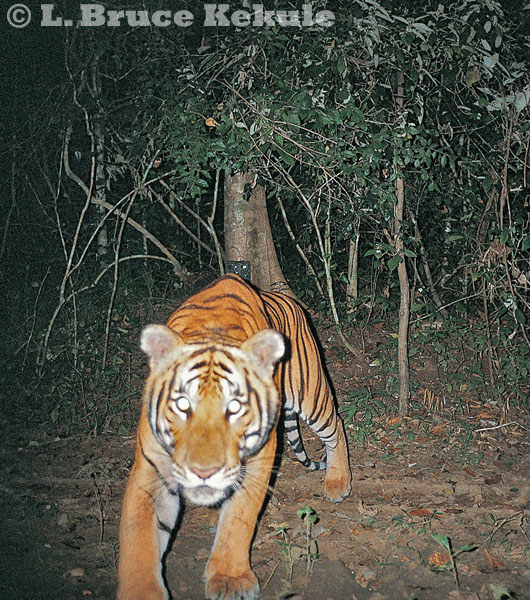
Tiger camera trapped on old logging road in Kaeng Krachan
When the road was closed in Kaeng Krachan due to heavy storms and landslides in October 2003, four-spots was consistently camera trapped at kilometers 33, 34 and 35, and down at the infamous ‘KU’ camp by the river. The distance was calculated to be about 22 kilometers apart. Several other male and female tigers were recorded over the three-year program and are a testament to the remarkable biodiversity of Kaeng Krachan. Many other creatures were also caught including tapir, leopard, wild dog, fishing cat, sun bear, the rare Fea’s muntjac, elephant, gaur and serow among others. Returning in November 2008, and now using a digital camera trap, I got a tiger in November at a mineral lick just 12 kilometers from the front gate.
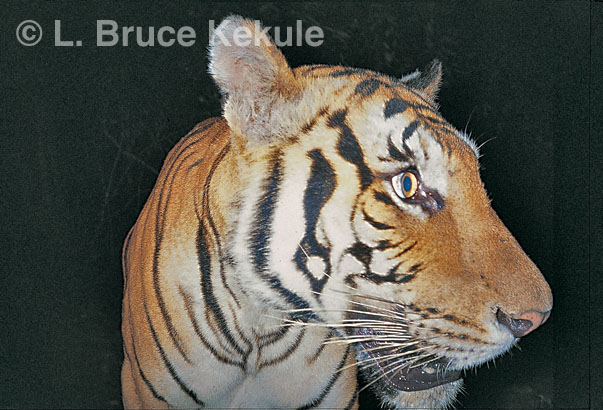
Tiger up-close in Kaeng Krachan
Good things sometimes come our way and I was about to get a reward to coincide with ‘2010-The Year of the Tiger’. The absolute chronology of being at the right place, the right time with the right equipment and the right technique was played out before my eyes. On the 11th of December 2009 (my lucky number again), the tiger in the lead photo and I crossed paths. I was lucky to have been sitting down with my hands on my lap right in front of my camera. If I had been standing, or made just the slightest noise, I would have never seen this old male.

Indochinese tiger on the prowl at night
The trail through dry dipterocarp forest takes about a 40 minute walk to a photographic blind set above a mineral deposit deep in the interior of Huai Kha Khaeng Wildlife Sanctuary, Thailand’s top protected area and World Heritage Site situated in western Thailand. The flimsy structure made of bamboo sits about two meters off the ground and is attached to a tree. Black mesh closes off the cubicle on all four sides that was erected by the park rangers. An opening large enough for a big lens allows a clear view of the waterhole some 50 meters downhill to a saucer shaped depression.

Tiger at night by the Phetchaburi River
This waterhole attracts many creatures such as elephant, gaur, banteng and other ungulates like sambar and wild pig. Tiger, leopard and Asian wild dog also come looking for prey. It is truly a magical place and a tribute to Thailand’s natural biodiversity. Arriving about 12pm, I immediately set-up my cameras and then waited. Feeling dozy, I strung my hammock for a bit of a snooze after the long haul from Bangkok. The afternoon passed-by slowly and about five got up and began a vigil of the mineral lick. A few minutes later decided to actually sit behind my 400mm lens and camera, and do some adjustments to compensate for the fading light. Took a few test shots to make sure the exposure was correct and then waited. Two minutes later, the dream of a lifetime unfolded before me.

Same tiger a month later during the day at the above location
A striped carnivore magically and silently appeared from the forest on my right. The tiger walked straight down to a little stream for a quick drink. The mature male did not linger and continued on his way. However, he did pause briefly to stare up at my position three different times before disappearing into the forest on my left. Total time spent by the cat at the waterhole was less than a minute. I was extremely fortunate to snap 20 frames as the magnificent creature carried on its way. I banged my head against my camera in disbelief to make sure I was not dreaming. After 15 years of wildlife photography, my aspiration to photograph a tiger through the lens has finally come true.
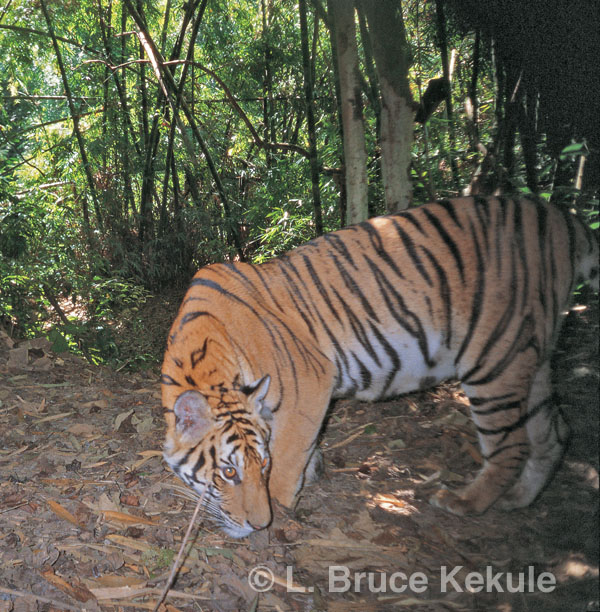
A female tiger in early morning at the same location
The present status of the tiger in Thailand is balancing on the beam of nature. As a World Heritage Site, Huai Kha Khaeng and Thung Yai Naresuan wildlife sanctuaries is the core area and absolutely the last great tiger haven in the Kingdom, and Southeast Asia for that matter due to its size (6,427 square kilometers), and its biodiversity. In Huai Kha Khaeng, the Department of National Parks has really improved the situation with better patrolling, increased help for the rangers, a demarcation fence along the eastern buffer zone in Uthai Thani, constant vigilance by many people and NGOs’ plus improved management, wildlife research and better awareness education. With these measures in place, prey species have come back and are now abundant. Tigers are thriving. There are about a hundred in the Huai Kha Khaeng-Thung Yai block.

Male tiger posing for my camera
Research on the tiger has been carried out by the Wildlife Research Division under the direction of Dr Saksit Simcharoen and his staff in conjunction with several other people and organizations including Dr Ullas Karanth (from India) and Dr Dave Smith from the University of Minnesota.

A waterhole with mineral deposits in Huai Kha Khaeng
Dr Saksit and others has published a paper in the science journal Oryx (How many tigers Panthera tigris in Huai Kha Khaeng: An estimate using photographic capture-recapture samplings) to establish a number. According to Dr Saksit, the home range of the Indochinese subspecies is about 240 square kilometers. Dr Peter Cutter with WWF-Thailand, and also a student with the University of Minnesota, has done his doctorate thesis on ‘tiger’s occupancy monitoring’ using transect and trail sign data gathered in Huai Kha Khaeng.
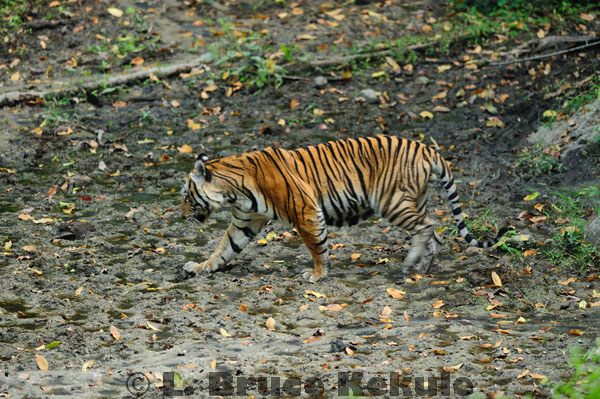
Tiger entering waterhole
Camera trapping is still by far the best and safest way to establish a home range of a tiger due to its individuality. No two tiger’s striped pattern is alike. It is imperative to use opposing camera traps to get a picture of both sides to identify individuals. Footprint and scat analysis are also very good techniques.

Tiger drinking from shallow stream
In my opinion, collaring a tiger is extremely dangerous as the capture process could possibly injure or impair the animal. As rare as they are, it does not justify losing even one of these magnificent creatures to a possible botched captures and release. Some researchers may not agree but eight tigers in Huai Kha Khaeng have already been collared and ranges determined. You can only get so much data. Loads of tiger home range information has also come from India and elsewhere. I’m all for good passive scientific research (wild animals are not handled at all) carried out to save the tiger.

Tiger looking back at my position
The Western Forest Complex includes 17 protected areas encompassing more than 18,000 square kilometers and has the potential to accommodate 700 tigers. Even though this estimate is high, with good protection and patrolling in all the protected areas in the complex to keep poachers out and encroachment to zero, and to protect the prey species or food chain for the tiger, it is feasible in the future this number could be a reality. However, due to serious fragmentation with roads, dams and reservoirs plus humanity and agriculture, it will be a difficult road ahead unless the present boundaries of the large protected areas stay intact and unharmed, and more corridors set-up through national forests. The World Heritage Site of Huai Kha Khaeng and Thung Yai must be the number one priority of the DNP as a conservation area.

Tiger on the move
For the long run, forest protection and wildlife awareness education to all levels of society is the key to saving the Kingdom’s natural heritage. The government should always strive to use all its resources to keep the forest and wildlife free from the damaging effects of human intervention. The private sector and the government need to be aware of all the problems regarding the forest rangers and try to improve their lives. The forest can be a deadly place to work and these men need incentive, as they put their lives on the line.

Tiger’s final look before disappearing into the forest
Projects to provide food and clothing to help these men are being carried out in a few protected areas by a few individuals, companies and organizations. Without dedicated ranger patrolling, tigers will surely slip away. It is up to the present generation to take proactive measures to make sure Thailand’s wild flora and fauna stays intact for future generations to see, enjoy and cherish.
Ecology and behavior of the Tiger:
To understand how the tiger evolved, we must go back to the beginning of these wild creatures. Nimravidae were the first cats to evolve in the Early Oligocene epoch, about 35 million years ago. They lasted till the Late Miocene, some eight million years ago, when huge grasslands had developed around the world. The large saber-toothed cats were the first of the family Felidae. These long-fanged felines evolved alongside huge herds of grazing mammals like antelope and cattle. There were several different species of saber-tooth, but they all became extinct about two or three million years ago.
Modern cats belong to the family Felidae which includes: tiger, lion, leopard, cheetah, and domestic cats. Ultimate carnivores, they feed almost exclusively on vertebrate prey and sit at the top of the food chain. Wild cats have few predators apart from man. The tiger belongs to the genus Panthera or roaring cats that also includes the lion, leopard and jaguar.
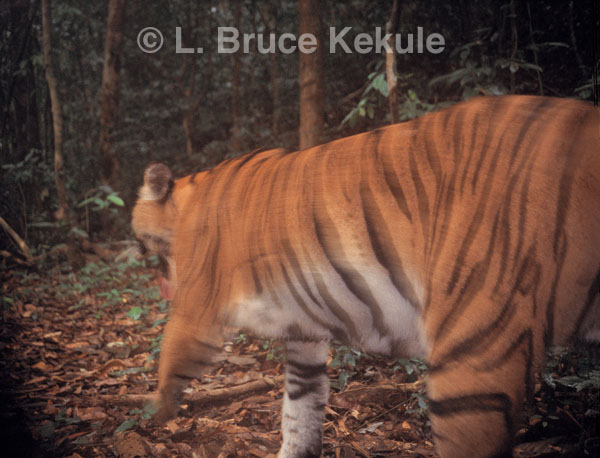
Tiger camera trapped abstract
The Indochinese tiger Panthera tigris corbetti was named after Jim Corbett, the famous conservationist and hunter of man-eating tigers and leopards in India during the 1930s’. This subspecies is found in Thailand, Vietnam, Laos, Cambodia, eastern Burma and southeastern China. According to Chatchawan Pisdamkham, Director of the Wildlife Conservation Division of the DNP, there are approximately 250-300 tigers left in the wild of Thailand.
The following protected areas still harbor these magnificent felids: Huai Kha Khaeng, Thung Yai Naresuan, Umphang and Salak Phra wildlife sanctuaries plus Mae Wong, Sai Yok, Sir Nakarin, Erawan, Kaeng Krachan and Kui Buri national parks in the west; Khao Yai, Thap Lan and Pang Sida national parks, and Phu Khieo wildlife sanctuary in the Northeast, and Hala Bala Wildlife Sanctuary in the deep south.
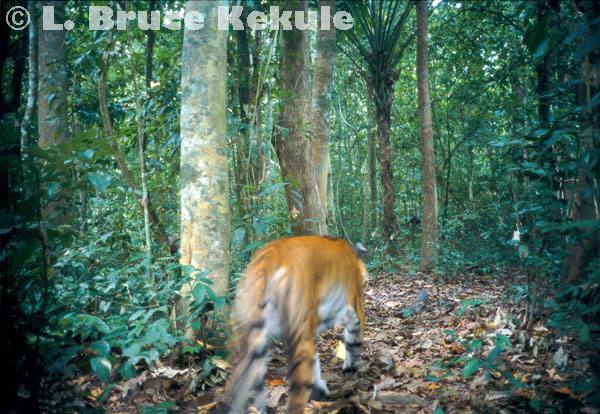
Tiger camera trap abstract
It is doubtful if any tigers survive in the protected areas of the north or Khlong Saeng-Khao Sok forest complex in the south as no reports have come from these areas for many years. Eastern Thailand has no tigers on record. A couple of years back, the newspapers reported on tiger tracks found not far from the road around several national parks in Chiang Mai and Lampang but were fake put down by a prankster to stir-up media frenzy. This was supposedly to help villagers who had lost cattle to a predator, more likely feral dogs.
Tigers are essentially solitary but come together when a female is in estrus. The resident male will copulate with a female many times over several days. Gestation ranges from 93-114 days. Litters can be from one to seven but usually only two to three cubs survive. Tigresses rarely accompany more than three cubs in the wild and abundant prey is required for a growing family with a small home range about 60 square kilometers.

Indochinese tiger tracks in Kaeng Krachan
It has highly developed vision about six-times more powerful than man and an extreme sense of hearing. These attributes are essential in locating prey. The feed almost exclusively on herbivores and are at the top of the food chain.

Indochinese tiger habitat in Kaeng Krachan
The tiger’s ultimate advantage in stalking prey is its striped pattern that is natural camouflage and this cat is a very efficient killer. It has awesome strength and unmatched armament of retractable claws, long fangs and dagger-like canines. It can sometime dispatch animals as large as gaur, wild water buffalo and small elephants. Tigers have no predators other than humans.
Asian Elephants: Thailand’s Mega Fauna
Wild Species Report
A flagship species and cultural symbol
Thailand’s largest terrestrial animal on the brink of extinction

Wild elephant family unit in Huai Kha Khaeng Wildlife Santuary
In 1927, a film was made depicting wild Thailand, and shown to audiences around the world. Entitled ‘Chang – A Drama of the Wilderness’, this epic documentary was produced by two American filmmakers Merian C. Cooper and Ernest B. Schoedsack, and released by Famous Players-Lasky, a division of Paramount Pictures.
‘Chang’ (Thai for elephant) is a melodrama and silent film about a man, the jungle, and wild animals as its cast. The main character is Kru, a poor farmer depicted in the film that battles tigers, leopards, bears and even rampaging elephants, all of which pose a constant threat to his livelihood. The saga was depicted in the northern province of Nan where thousands of wild elephants survived in vast herds at the time. The footage of elephants in the hundreds is remarkable.
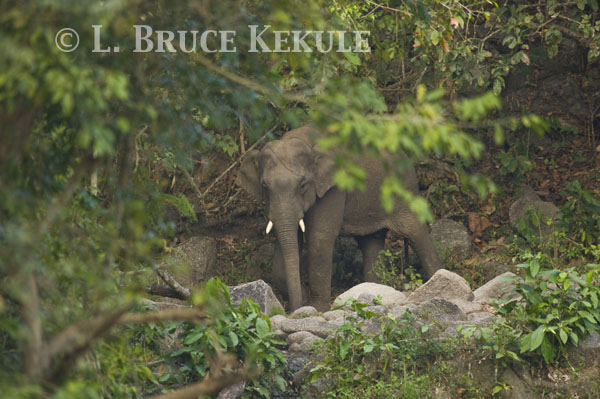
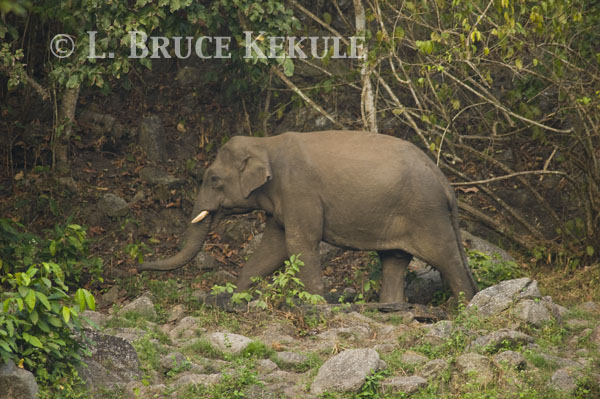
Young tusker at a mineral lick in Huai Kha Khaeng
The film also shows tigers and leopards caught in pit-falls and dispatched with a muzzleloader from the top. It was an amazing piece of celluloid production where logistics must have been really tough. Chang was nominated for an Oscar for Unique and Artistic Production at the first Academy Awards in 1929. Cooper and Schoedsack went on to make the classic blockbuster movie King Kong.
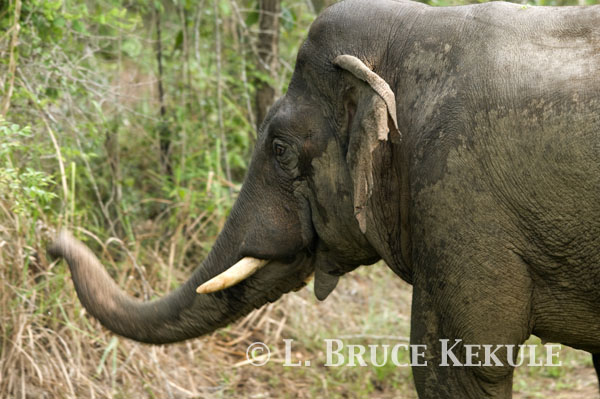
Tusker in Khao Ang Rue Nai Wildlife Sanctuary
The Asian and African elephants are the only two surviving species of a once diverse and widespread group called proboscids (order Proboscidea), or animals with a trunk. They are characterized particularly by developments of their teeth and adaptation of their limbs for supporting their increasing mass. All total there is fossil evidence of some 350 species of ancestral proboscideans, mastodons, mammoths and modern elephants.
The first ancestor of elephants lived approximately 50 million years ago during the Late Eocene and Early Oligocene Epochs. It was named Moeritherium after the place where it was discovered, the Moeris Lake in Egypt. Though its form and appearance were completely different from the elephant, scientists base Moeritherium’s ancestry of the elephant on its skull and teeth. The skull had air holes, just like the elephant, and four small incisors grew from the upper and lower jaw that the growth of tusks had begun. At least three divergent groups of proboscideans evolved there from Moeritherium or close relatives.
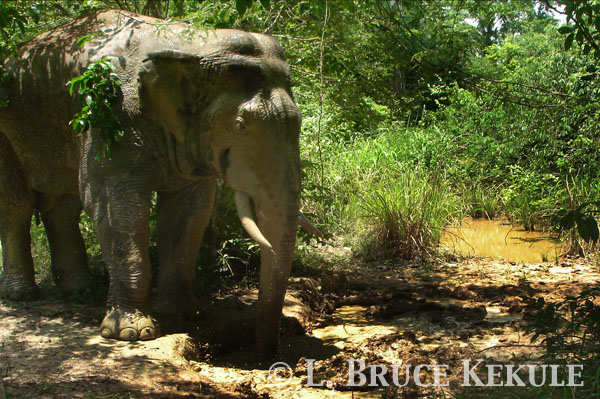
Mature tusker camera trapped at a waterhole in Khao Ang Rue Nai
The next beast of elephantine build and bulk was the Deinotherium that was still not a true elephant. They became common in Africa, Asia and Eastern Europe during the Miocene Epoch. They were very large at 4 meters high with down curving tusks from the lower jaw. Surviving for 20 million years well into the Pleistocene Epoch, Deinotherium was clearly a very successful animal. About the same time Paleomastodon and Phiomia began to evolve and show the closet beginnings of a trunk allowing the species to feed higher off the ground.
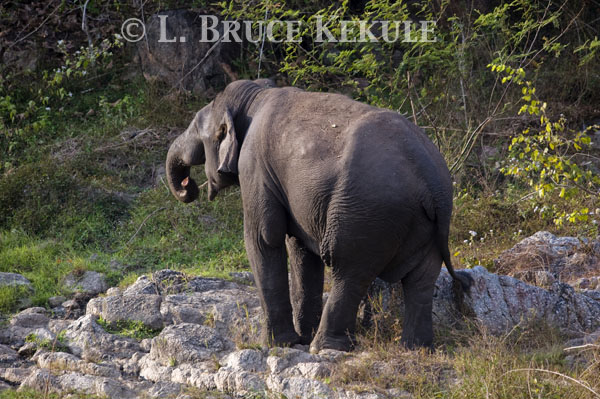
Very old tuskless bull in Huai Kha Khaeng
At the beginning of the Miocene epoch about 24 million years ago, the ancestral Gomphotheres was the real commencement of Proboscidean diversity. There were literally hundreds of species at one point including mastodons and mammoths. Elephantidae is the family to which the modern elephant belongs and the first species was Elephas antiquus from the middle to late Pleistocene Epoch. However, by the beginning of the Holocene Epoch around 10,000 years ago, only two species remained: African elephants Loxodonta africana and Asian elephants Elephas maximus.
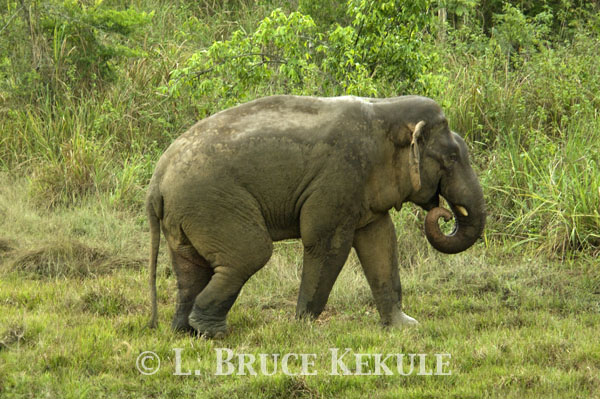
Tusker in Khao Ang Rue Nai
The main differences between the two species are anatomical. The African elephant are larger and has a more elongated skull, a trunk with deep rings, larger ears, a flat forehead and, in general, holds its head at a 45 – degree angel to the ground. Asian elephants are smaller and have a double – bulged forehead, a trunk with fewer rings, smaller ears and a skull with a 90 – degree orientation.
There are three Asian sub-species: the Sri Lankan elephant Elephas maximus maximus, the mainland elephant Elephas maximus indicus, and the Sumatran elephant Elephas maximus sumatranus, and two African sub-species: the bush elephant Loxodonta africana africana, and the forest elephant Loxodonta africana cyclotis.

Young tusker camera trapped at a waterhole in Huai Kah Khaeng
Prehistoric fossil evidence of proboscideans has been discovered in the north, the northeast, the central plains, and the south of Thailand. The first find in 1948 was fossil bones of Stegodon insignis (mastodon) during the construction of the bridge across the river just south of Nakorn Sawan provincial city. Following this, discoveries were made in lignite deposits in Lamphun, Lampang and Phayao provinces. Fossil teeth of a Deinotherium at Ban Sop Khan in Phayao have been uncovered. Another find new to science is the earliest known species Stegolophodon praelatidens fossils from the Early Miocene discovered in Lamphun and Lampang by Pascal Tassy (from France) and others.
Many extraordinary ancient proboscidean fossils have been unearthed in Nakhon Ratchasima (Korat) province at the Tha Chang and Chang Thong sand pits along the Mun River in Chaloem Prakiat district going back to the middle Miocene about 16 million years ago. Eight different genera of proboscideans have been discovered here and is a testimony to the Kingdom’s fossil record.

Family unit in Huai Kha Khaeng
About 150 years ago, wild elephants were surviving around Bangkok along the Chao Phraya River, and in the districts of Rangsit, Bang Sue, Bang Kapi and Bang Na. The ‘City of Angles’ was a real jungle back then. It seems difficult to believe but in those days, Thailand was almost completely covered by forest cover – more than 90 percent. Today, only 30 percent remains. Due to the immense destruction, elephants have been at the forefront of a disappearing habitat.
The best current estimates say there are no more than 2,500-3,000 elephants surviving in the wild of Thailand today. There are 60 protected areas that have less than a hundred elephants, and another eight protected areas that have over one hundred individuals as follows: Huai Kha Khaeng Wildlife Sanctuary – 280-300; Khao Yai National Park – 200; Khao Ang Rue Nai Wildlife Sanctuary – 230; Salak Phra Wildlife Sanctuary – 175-200; Phu Luang Wildlife Sanctuary – 100; Phu Khieo Wildlife Sanctuary – 135; Kui Buri National Park – 150 and Kaeng Krachan National Park – 115. Surely, an up-to-date consensus of the wild elephant population should be undertaken by the Department of National Parks, Wildlife and Plant Conservation (DNP) in all the forests throughout the Kingdom, and a report published as soon as possible. As it stands, many of these quotes are mere guesstimates.

Young tusker on the road in Khao Yai National Park
Elephants have been persecuted for a long time. The following scenario has been chosen for this column and has been carried out for decades in Thailand’s forests, and unfortunately is the dark side of nature that carries on to this day. Gunshots reverberate explosively through the forest panicking and scattering a herd of wild elephants. The huge beasts instinctively flee as fast as they can through heavy foliage away from the cacophony. In minutes, the forest returns to normal but the sad fact is humans have just disrupted the herd permanently. A baby elephant mills aimlessly around its mother lying dead on the ground. The confused calf has no sense of danger as poachers move in and capture it to be sold on the illegal black market. The calf will likely be forced to wander city streets or work in tourist camps.
Such atrocities are still practiced by some unscrupulous people intent on killing the mother solely to capture the baby. Many other animals are also hunted down in much the same way like gibbons and monkeys. Middleman and end-use buyers perpetuate this market and seem to evade the law. Wildlife black-market trading is fueled by a few shady individuals and is on-going. Great strides have been achieved by a few wildlife enforcement agencies and many arrests have been made in recent years exposing these law-breaking individuals. However, the so-called ‘big fish’ continue to do business as usual. It is a never-ending battle!

Mature tusker on the road in Khao Yai
In another scenario, a mature bull elephant with a large set of tusks tramples and gores a man deep in a protected forest many days walk from the nearest village. News travels fast but is subdued by the authorities due to the sensitive nature of the incident. The man was with a group of poachers hunting the tusker and he was armed with a crude muzzleloader. He was separated from the group and came upon the huge herbivore firing a shot, which only enticed the old bull to charge. It was all over in seconds and when the man was found critically injured the group rushed him to the nearest medical facility but it was too late. The villagers cried fowl and hunted the old bull down eventually taking his tusks and selling them to a middleman for pennies compared to what they would fetch from a rich end-user or agent. This has been going on for ages to feed the illegal ivory trade.
Human settlement, agriculture and roads have taken over much of the elephant’s habitat. Villages spring up in old elephant terrain, and the trespassers expect the giants to simply fade away into the forest. But elephants can develop a taste for crops grown by farmers, and they often take what they want. Countless conflicts have arisen between villagers and the real owners of the land, whose ancestors have lived there for many thousands of years. Thailand is not alone to crop-raiding elephants. Other countries in Asia and Africa have experienced the same outcome when humans have taken over elephant land.

Very young tusker about five years old in Khlong Saeng Wildlife Sanctuary
Most of the conservation areas where wild elephants live are just small isolated pieces, and agricultural areas or towns surround these forests, a major obstruction to natural breeding. Elephants in each forest are caught on islands and cannot walk back and forth between these areas. Thus, inbreeding among close relatives is inevitable, which leads to an inferior population and causes genetic diseases, and ultimately, to extinction. Belinda Stewart-Cox with Elephant Conservation Network has campaigned relentlessly for the establishment of a corridor between Salakpra and Srinakarin protected areas in order to prevent the total isolation of Salakpra’s elephants. Other corridors in other parts of Thailand are on the drawing boards.

The young tusker a month earlier
Elephants have been maimed and killed by poisoning, pungee stakes and pit-falls, gunshots, and electrocution. They have been chased out of rice paddies, mango orchards, and pineapple and tapioca fields. The use of fireworks, bright lights and gunshots scare them away temporarily, but the elephants are intelligent enough to lose their fear of such ruses. Elephants grow bolder and go on the rampage, sometimes killing people, tearing up villages and damaging DNP facilities usually during the dry season when water is scarce.

Nick-named ‘Nong Saeng’ after the sanctuary
This year, a herd of wild elephants in a western national park raided a village and broke into a shack with fertilizer. A young calf gorged itself and died shortly thereafter. On the other side of the spectrum, an old tuskless bull killed a ranger in western Thailand, and a tusker gored a villager in the East. Wild elephants have also died or been injured accidently by vehicles speeding on roads in some protected areas. Most of the accidents occur at night when the elephants are difficult to see. Some conservation organizations have erected new signs in some areas warning drivers the danger of elephants on the road at night.

Mature tuskless bull in Kaeng Krachan National Park
These noble beasts have featured prominently in almost every important historical event in the Kingdom. They are national, royal, and religious icons of Thailand. The ‘white elephant’ was on the flag of Siam. They are a national symbol of pride and joy. The Thai elephant’s survival lies in the hands of those responsible for these vanishing Asian giants. Proactive conservation awareness is a top priority for the government and existing outdated laws (some a hundred years old) need to be reviewed and changed for the elephant’s future. Strict penalties and fines for poaching and encroachment need to be enforced to insure the survival of nature’s largest terrestrial mammal in Thailand before it is too late.
Ecology and behavior of elephants:
“Tractors of the forest” is what the late Mark Graham called wild elephants in his excellent book entitled ‘Thailand’s Vanishing Flora and Fauna’ co-authored by Philip Round, the eminent bird ornithologist. Graham went on to say “in all parts of Khao Yai National Park there are trails which have been used by herds of elephants for, in all probability, thousands of years”. This trait is evident throughout continental Thailand where these creatures roamed.

Tusker about 25 years old in Kaeng Krachan
Asian elephants consume 75-150 kilograms of food and about 80-160 liters of water per day. A variety of grass species including bamboo is consumed, as well as tender twigs, barks, leaves and fruit. Natural mineral deposits are also very important to these herbivores supplementing their diet. An adult mainland Asian elephant may reach a height of 3.5 meters and weigh 5,000 kilograms. Elephants form family units but lone bulls are common. Male elephants have tusks but tuskless bulls are now quite common and can be very bad tempered, especially if the bull is in a state known as ‘musth’ where fluid leaks from the temporal gland.

Mature tusker at a waterhole in Khao Ang Rue Nai
Reproduction of the Asian elephant is the same as the other sub-species. The young are born after a gestation period of 18-22 months. Elephants usually give birth to a single offspring, rarely twins, and more rarely triplets. A female elephant can give birth every 4-6 years, and has the potential of giving birth to seven offspring in her life. Life expectancy for elephants is 60-70 years.
Elephants in domestication:
Elephants are extremely intelligent creatures. For centuries, humans have taken elephants from the wild and turned them into many different uses such as war elephants, working elephants at logging sites, as pets, tourist attractions and street beggers.

Elephant on the highway in Ayuttaya province
My very close friend Richard Lair who works for the Forest Industry Organization at the Conservation Center in Lampang has worked with elephants for many years. He was the first to get elephants to paint in Thailand, and the first in the world to establish a musical band made up entirely of elephants. He has produced several CD’s of this accomplishment.

Begging elephant near the 700 year stadium in Chiang Mai
Probably the most appalling fate for a domesticated elephant is to become a ‘street walker’. These magnificent creatures are forced to saunter hot, dusty and polluted streets of Thai cities ‘begging’ for food and money. Stories about elephants hit by cars and falling into drainage ditches, plus other accidents have been documented. At one time, a trip at night around Bangkok and other cities in the Kingdom one was greeted by a huge gray beast with a red light and a flashing CD attached to its tail. Continuous calls for change went unnoticed by mahouts and the owners of these elephants who sneaked them into cities and tourist sites. Legislation concerning domesticated elephants remains old and out-dated, and law enforcement has also been very poor.

Domesticated elephants being trucked into Chiang Mai
In late-2010, I saw an elephant on the streets of Chiang Mai at night. I took a few photographs but just watched as the mahout and elephant went about their business of begging for money. However, the situation has improved and there are several new sanctuaries dedicated to helping both mahout and elephant. It seems that most of the elephants have left Bangkok but they are still found in the out-lying areas. Hopefully, one day, the street-walker will be a thing of the past and these magnificent creatures will be treated with the respect, love and admiration they deserve.

Elephant with handlers on the streets of Chiang Mai – An abstract
Gaur – Majestic Wild Forest Ox
WILD SPECIES REPORT
Rare mammal and the largest bovid in the world
Endangered wild cattle close to extinction
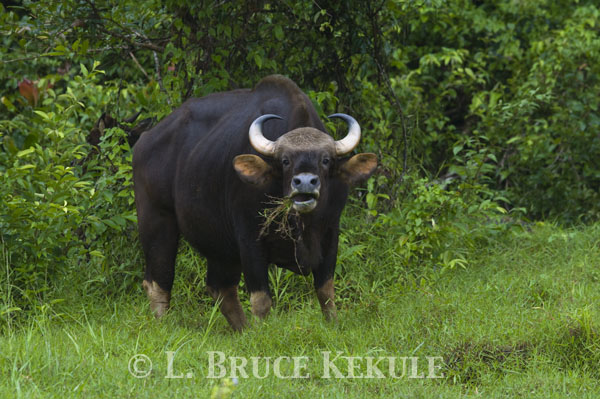
Gaur cow in Khlong Saeng Wildlife Sanctuary
About 20 million years ago, the first ungulates evolved from small, hornless deer-like ancestors. Cattle, sheep, antelopes and goats are grouped together in the family Bovidae, and the most common hoofed grazing animal seen today. Sometime during the Pleistocene Epoch 1.8 million years ago, the genus Bos evolved in Asia and spread to Europe, Africa and eventually North America. Gaur Bos gaurus is a descendent of Bos Bibos, a wild cattle that lived on the great plains of Asia. Saber-toothed cats were one of the top carnivores at the time, and evolved alongside the ancient herbivores.
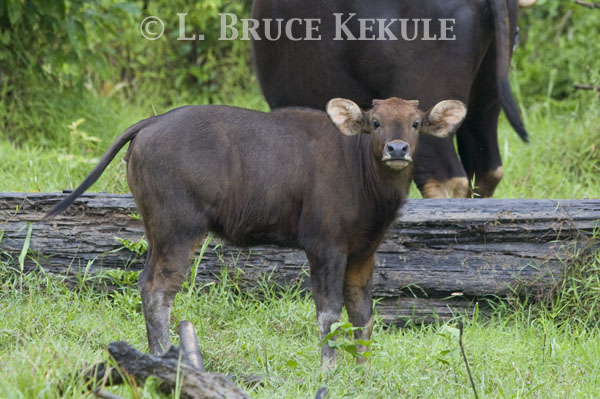
Gaur calf in Khlong Saeng Wildlife Sanctuary
Gaur, the largest bovid in the world, is threatened with extinction and deserves much greater attention. The tiger and elephant have taken most of the conservation spotlight but gaur, like all the other wild animals need just as much protection, research and concern. Unfortunately, these wild forest ox continue to vanish from the wilderness areas in the Kingdom. After years of poor protective management and neglect, poaching and trophy hunting, plus a disappearing habitat suitable for these enormous creatures once found throughout Thailand, is the main reason for the decline.
Over their entire range, they are classified as internationally threatened. But not all is lost as gaur still survive quite well in a few of Thailand’s top protected areas in fair numbers, and where there are true safe havens, the species has actually made a come back. It is now estimated that more than a 1,000 individuals remain in Thai forests. This number is up from the 500 recorded in Dr Boonsong Legakul and Jeffery McNeeley’s book Mammals of Thailand published in 1977. Dr Sompoad Srikosamatara and Varavudh Suteethorn published a paper in the Siam Society’s Natural History Bulletin in 1995 about gaur and banteng. Their estimate then was about 1000 gaur were surviving so the number is basically stable and most likely on the increase.

Gaur herd at a mineral deposit in Huai Kha Khaeng Wildlife Sanctuary
In Southeast Asia and India, gaur is found in scattered and splintered habitats. Other large wild bovine are banteng and wild water buffalo of Southeast and Southern Asia, the yak of Central Asia, the cape buffalo of Africa, and the bison of North America and Europe. In recent times, the number of these wild creatures has dwindled as humans continue to hunt them for meat and trophies, and destroy and encroach on their habitat in some places. The American bison came close to extinction but was saved in the nick of time. Thousands of wild bison now survive due to conservation efforts initiated by many people including the late U.S. President Teddy Roosevelt.
Gaur is Thailand’s second largest terrestrial animal after the elephant and tends to inhibit deep mountainous terrain far from humans. They survive in dry and moist evergreen forest plus mixed deciduous forests and therefore, have fared better than their cousin, the banteng that live in more open lowland forest. Gaur occasionally mixes with banteng that has been documented in Huai Kha Khaeng Wildlife Sanctuary, Uthai Thani province. Gaur will also shadow elephant herds using the same trails made by the larger mammals.

Gaur herd in Khlong Saeng
My favorite photographic wildlife subject is gaur. In Thailand, these majestic ungulates can still be found in the following places: the Western Forest Complex and Kaeng Krachan Forest Complex, both in the west; the Khao Ang Rue Nai Forest Complex in the east; the Dong Payayen – Khao Yai Forest Complex and the Phu Khieo – Nam Nao Forest Complex, both in the Northeast; and down south in the Khlong Saeng – Khao Sok Forest Complex. Due to the serious instability in the deep south, very few surveys have been carried out and there is no consensus on gaur but they do survive in the Hala-Bala Forest Complex situated along the border with Malaysia. It is doubtful if any gaur survive in the North but the Omkoi – Mae Tuen Forest Complex might have few left.
Gaur has a keen sense of smell and hearing, and is always alert for danger. As a result, they can be tough to spot in the dense forests of Asia. However, luck does come sometimes, and the following accounts describe the few times I have had the great fortune to observe these magnificent beasts in the wild.

Gaur bull camera-trapped at a mineral lick in Huai Kha Khaeng
My first photographic encounter with gaur in 1986 was at the beginning of my career as a wildlife photographer deep in the interior of Huai Kha Khaeng Wildlife Sanctuary. A natural deposit or mineral lick several hours walk from the road attracts many animals – gaur, banteng, elephant, sambar and muntjac come for the life-giving minerals, plus tiger, leopard and Asian wild dog hunt for prey. The balance of nature runs in harmony where “eat or be eaten” is the rule. I was extremely lucky and photographed two mature bull gaur that arrived late one afternoon as the sun was setting. The old bull on the front cover of my first book ‘Wildlife in the Kingdom of Thailand’ stayed at the waterhole for quite sometime and I shot several rolls of film. This place has always been special to me.
A year later, I began visiting Thung Yai Naresuan Wildlife Sanctuary along the western border with Burma specifically to photograph gaur. In 1985, a herd of more than 50 individuals was seen from a helicopter by park officials on the huge grassland in the center of the sanctuary. Thung Yai is a tough place to work as many mining trucks plus off-road 4X4 enthusiasts with big tires and jacked-up truck chassis have abused the road into the sanctuary for many years. Deep ruts in many areas make travel along the road difficult even for normal off-road vehicles. The rangers have a real rough time patrolling this sanctuary.

Young gaur bull in Khlong Saeng
On one of my many trips to Thung Yai, and after many grueling hours of travel, and then a couple hours’ walk to a mineral lick in the sanctuary, I set-up a photographic blind along the forest perimeter. Late in the afternoon, two bachelor bulls entered and drank from the spring at the top end. I managed to get some good photographs as they went about their business. One bull snorted at our position as I had placed fresh gaur droppings in front of the blind, and I believe he was just letting us know who he was. Both bulls then departed peacefully and I was elated to say the least. It is estimated that more than 100 individuals thrive in Thung Yai.
In October 2008, I began a camera-trap program and set several units at a mineral lick visited by gaur and elephant in Kaeng Krachan National Park in Phetchaburi province, southwest Thailand. A month later, I visited the park and collected the cameras. A herd of gaur had come to the deposit including several cows and their offspring. It seemed as if the camera had spooked them initially, but the herd came back again the next day and a long series of captures was obtained. There are about 70 of these beautiful creatures thriving and breeding in this protected area.
Over in Huai Kha Khaeng Wildlife Sanctuary in the west during December 2008, I also set some digital camera-traps at a water hole, and after one month, two gaur bulls visited the waterhole. I also sat by the river in a photo-blind across from another mineral lick and photographed a large herd of gaur that had come for the minerals and lush grass. It is estimated that 350 gaur survive in this sanctuary. Better protective measures have allowed gaur to breed profusely and this World Heritage Site lives up to its name. Predators like tiger and wild dogs capable of taking on gaur, also thrive here. In the whole of the Western Forest Complex, it is estimated that more than 500 individuals live in scattered areas covering some 15,000 square kilometers.
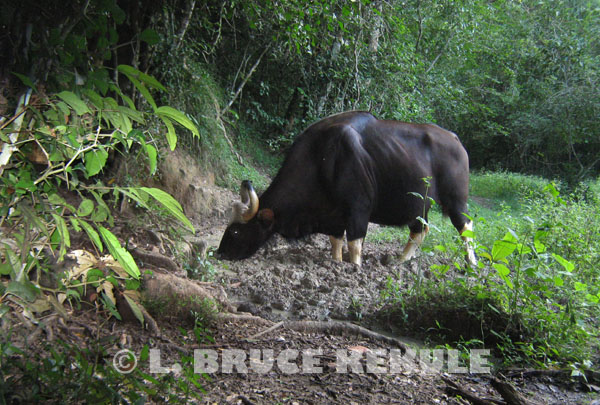
Gaur cow camera-trapped at a mineral lick in Kaeng Krachan National Park
Early this year while photographing wildlife in Khlong Saeng Wildlife Sanctuary in Surat Thani province down south, I had an amazing journey of discovery. Deep in the protected area, gaur is still thriving quite well. I set camera-traps in the sanctuary and managed to capture a very old bull gaur and several herds at many locations. A close look at the photograph shows seriously worn hooves on his hind feet. He is definitely past his prime and would not be a contender for female gaur in heat. With poor traction, he could not fight the younger bulls with stronger hooves and horns.
I also toured the flooded forests of Khlong Saeng and Khlong Ya rivers created by the Chiew Larn or Ratchaprapra Dam using a boat-blind and silent electric trolling motor. I was able to approach many herds and individuals over a four-month period. In every herd, there were young calves and yearlings indicating a healthy breeding population. Most of the mature bulls have become nocturnal due to past and present poaching pressure in the reservoir. In the Khlong Saeng – Khao Sok forest complex, it is estimated that more than 100 gaur are thriving.
In Kui Buri National Park, Prachuap Kirikan province, gaur has definitely made a come back due to increased awareness by the park staff plus financial support extended to help the rangers. It is now estimated that the population of gaur is about 70 individuals. Khun Chalerm Yoovidhya, MD of the Huai Hin Hills Vineyard and Siam Winery has taken a special interest in gaur at Kui Buri. Working with the park officials, he has funded many projects to help these creatures by sending volunteers to plant grass in selected areas to propagate grasslands, and setting up salt licks and check dams to attract the herbivores. Other projects initiated by Khun Chalerm include selling wildlife photographs and paintings at the vineyard to help the park rangers with food, clothing and equipment giving them more incentive to patrol the forest. Over time, other areas will put on the list for special help to protect Thailand’s natural heritage from the damaging effect of human poaching and intervention.

Gaur spooked by camera-trap in Kaeng Krachan
In the northwest section of Thap Lan National Park, my very close friend Gate Glomchum who worked for the Petroleum Authority of Thailand (PTT) as chief reforestation officer (retired) did some amazing things during his career as a reforester. Prior to 1996, a 10,000 rai area in Wang Nam Kheaw was completed degraded by a logging concession and squatters. Under his management and following a mandate set by His Majesty the King, this forest was replanted and the people were moved out. Today, this forest has completely grown-over, and there is elephant, gaur and tiger plus many other classic Asian species living in total harmony with nature. Other areas in Thailand also reforested under his supervision have had similar success.
Over in Khao Phang Ma just outside the eastern part of Khao Yai National Park, a national forest reserve was reforested by Wildlife Fund Thailand (WFT) and Khun Suthirat Yoovidhya (Director of CSR) of Red Bull-Thailand fame. Gaur moved back into this forest from Khao Yai after protective measures increased. There are about 50 gaur at this location and is probably the only place in Thailand where gaur live outside a protected area. Many projects like helping the rangers, setting-up salt licks and check dams have also been funded by Khun Suthirat under the ‘Red Bull Spirit’ program that is on-going. A couple of years ago, WFT shutdown all conservation operations due to internal conflicts but the Department of National Parks, Wildlife and Plant Conservation (DNP) took over responsibility of the reserve. They should be commended, and it is reassuring that some people are serious about conserving the Kingdom’s natural heritage.
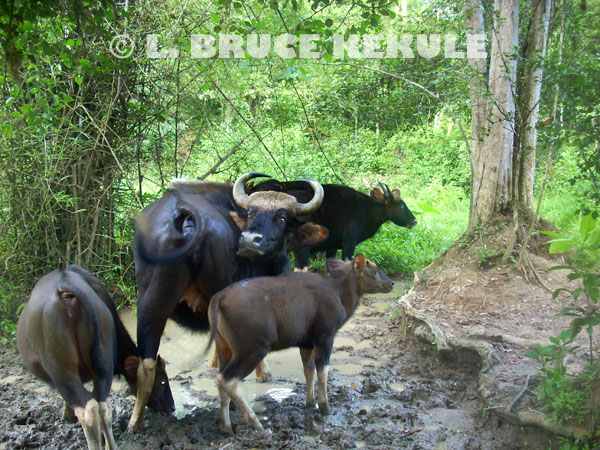
Gaur herd camera-trapped at a mineral lick in Kaeng Krachan
In the long run, the importance of protecting a prey species like gaur should be the number one priority for the government. The DNP need to increase budgets and personnel to look after these forests and animals. Thailand remains one of the best places for the survival of gaur in Southeast Asia. Protection, conservation awareness, education and monetary support are the keys to the future of these magnificent creatures of nature, and it is hoped they will continue to live in their natural habitat far from the destructive forces of man.
Ecology and Behavior
Gaur is the largest bovid in the world with a distinctive dorsal ridge and a large dewlap, forming a very powerful appearance. A fully mature bull stands about 1.6-1.9 meters at the shoulder and average weight of a big bull is 900 kilograms on up to a ton. Cows are only about 10cm shorter in height, but are more lightly built and weigh 150 kilograms less. These even-toed ungulates have stout limbs with white or yellow stockings from the knee to the hoof. The tail is long and the tip is tufted. Newborns are a light golden color, but soon darken to coffee or reddish brown. Old bulls and cows are jet black but south of the Istamas of Kra, many take on a reddish hue.
All bovine share common features, such as strong defensive horns that never shed on males and females, as well as teeth and four-chambered stomachs adapted for chewing and digesting grass. Their long legs and two-toed feet are designed for fast running and agile leaping to escape predators. They are gregarious animals, staying in herds of six to 20, or more.
Due to their formidable size and power, gaur has few natural enemies. Leopards and Asian wild dog packs occasionally attack unguarded calves or unhealthy animals, but only the tiger has been reported to kill a full-grown adult. Gaur grazes on grass but also browse edible shrubs, leaves and fallen fruit, and usually feed through the night. They also visit mineral licks to supplement their diet. During the day, they will rest-up in deep shade.
There are three separate sub-species of gaur: Bos gaurus gaurus of India and Nepal, Bos gaurus readi of Indochina and Bos gaurus hubbacki of Southern Thailand and Malaysia. However, in 1983, the zoological classification of both the Indochinese and Southern gaur was changed to Bos gaurus laosiensis. In 1993, Pleistocene fossil evidence of Bos gaurus grangeri, an ancient sub-species, was uncovered by G.B. Corbet and J.E. Hill in Sichuan province, China.
Banteng: Endangered Herbivores
WILD SPECIES REPORT
Banteng: Endangered herbivores
Magnificent wild cattle of Southeast Asia
Bovids threatened with extinction
It was a hot steamy morning deep in the wilderness of Huai Kha Khaeng Wildlife Sanctuary, a World Heritage Site located in the central province of Uthai Thani. Not much was stirring other than a few birds and insects as the sun rose high in the sky. A hot breeze whiffed through, and heat shimmered from the center of a natural mineral deposit several hours walk from the nearest road. As the day got hotter, thirst kicked in among the many species of herbivore that live in the forest nearby.

Banteng bull in Huai Kha Khaeng
Muntjac (barking deer), sambar, banteng and gaur use this important source of minerals. Many smaller mammals, birds, and reptiles also come to the lick as part of their everyday life. Tiger, leopard, and wild dog frequent the area in search of prey. Occasionally, wild elephant stop for a drink. A male barking deer stepped cautiously down to the water hole. Moving slowly and constantly watching out for predators, the young buck took a long-awaited sip of the life giving minerals. Shortly after, it disappeared back into the forest it had come from. Silence again took precedence as the morning wore on.
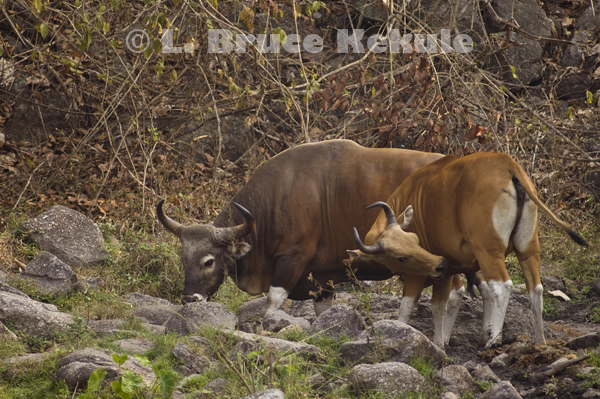
Banteng bull and cow in Huai Kha Khaeng
About an hour later at the top-end of the clearing, a herd of twelve banteng magically appeared and went straight down to the waterhole, as their kind have done for aeons. The herd included one old bull, a couple of young bulls and cows, plus three calves, and, like the deer, were extremely alert for carnivores. All of a sudden, a cow snorted an alarm, and the herd bolted for the safety of the bush. Curious by nature, the herd bull stopped short near the forest edge for one last look. The herd surrounded the bull and the young calves trailed behind before disappearing into the trees. For a moment, they were vulnerable to attack by predator. Banteng are very sensitive to any disturbance and flee immediately on the first hint of danger.

Banteng on the run in Huai Kha Khaeng
Another hour went by and suddenly, a solitary banteng bull appeared from the forest and moved down to the waterhole but stayed only momentarily. These loners usually pursue the herd during the mating season and have an irresistible urge to mate with the females. However, the herd bull will keep the young bulls in check.
The spirits of the forest had just provided a vision; some beautiful moments in the lives of banteng, Southeast Asia’s wild cattle. My friend Robert Semon and I were sitting in a photographic blind set up just inside the forest edge, but with an open view to the water hole. Banteng had been the main photographic objective on this trip, and it was magnificent seeing and photographing these wild bovids. My camera was very busy during that short period. As it was the first time I had photographed them, the encounter will be forever etched in memory.
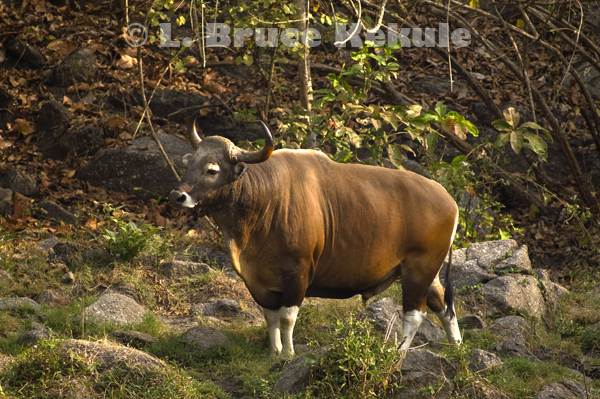
Mature banteng bull in Huai Kha Khaeng
Coming back to Huai Kha Khaeng a couple of years later, my team erected a photo-blind while I went looking for tracks. A large granite rock sits in the middle of this oasis in the forest, so I paid my respects to the spirits of the forest thanking them for my previous good fortune here. It was about an hour’s walk back to the truck, and another hour to camp, but I was feeling lucky. After dinner, and a few drinks with the team, I retired to my hammock for an early wake-up.
The next morning I was in the blind at 6am and, after a three-hour wait, a lone banteng bull lumbered down to the waterhole for a drink. My wish had come true. After getting very close to the blind, he sensed danger and bolted. I shot several rolls of film. Alone, the bull was open to attack by tiger or wild dogs. It was very exciting photographing this beautiful creature.
A couple of years later, on one of my many forays into Huai Kha Khaeng, I decided to stay overnight in a permanent photographic blind set-up along the banks of Huai Mae Dee, a tributary of the Huai Kha Khaeng. That night as I lay in my hammock, I wished once again to see banteng. The next morning, the mist was thick as soup, coating the forest with dew. My focus was on a mineral lick across the river. Many rare species of large mammal visit this natural deposit for a drink, and a nibble on the lush grass growing on the rocky slope. A female muntjac nervously appeared, took a drink but quickly departed.
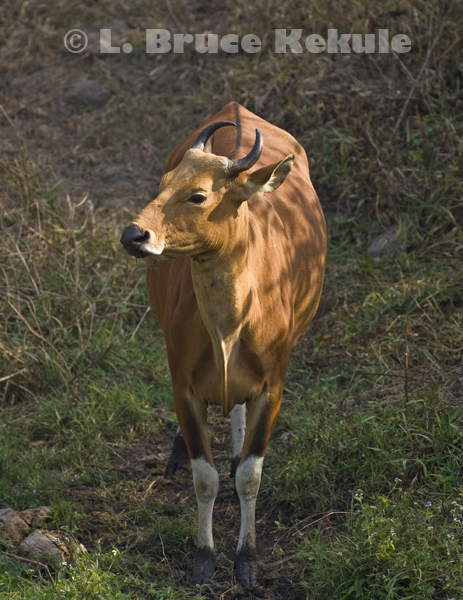
Banteng cow on the Huai Mae Dee
At about 8am, as the sun was just peaking over the treetops, a large herd of banteng stepped out into the mineral lick. There were five bulls and numerous cows and calves in this herd totaling 18 banteng, and it was an exciting ten-minute session. It was during the mating season, the reason so many bulls had come together. I was shooting a digital camera by now and did not stop photographing them until the last one had gone. As always, I gave thanks to the spirits of the forest for my good fortune.
The accompanying photographs show the beauty and gracefulness of these magnificent ungulates. Over the years, I have seen these wild cattle many times, not only in Huai Kha Khaeng (present herd estimated at over 250 individuals), but also over in Khao Ang Rue Nai Wildlife Sanctuary, eastern Thailand (about 80 banteng). These two santuaries are the last bations of a sizable banteng herd left in the Kingdom.

Banteng cows at a waterhole
Huai Kha Khaeng still retains the best prey/predator relationship with many tigers and a sizable herd of banteng plus many other ungulates like gaur, sambar and wild pig. Khao Ang Rue Nai has very few carnivores but Asian wild dogs do take banteng from time to time. Humans unfortunately, are the most devestating predator and are directly responsible for the disappearence of these wonderful creatures. Trophy hunting and bush meat are the two main reasons for this demise.
The other remaining sites that have recorded banteng but are probably now close to extirpation of the species with very few remaining are: Om Koi Wildlife Sanctuary in the North; Nam Nao and Tap Praya national parks in the Northeast; Salak Phra Wildlife Sanctuary and, Sai Yok, Sri Nakharin and Kaeng Krachan national parks in the west; Khlong Saeng and Khlong Yan wildlife sanctuaries in the south; and Sri Satchanarai National Park in the foot-hills of Central Thailand. Their present numbers are estimated to be no more than a very low 300-500 nationwide.
Fossils of an antelope-like ox named Leptobos was discovered in Early Pleistocene deposits 1.8 million years old in Eurasia. Another ancient cattle found in Europe called Bos primigenius or better known as aurochs were domesticated some 6,000 years ago but died out about 500 years ago. Banteng are common ansestors to Bos bibos, a cattle that inhibitated the vast plains of Asia during prehistoric times. Fossil finds of banteng from the Pleistocene epoch in Bali and Java are common.

Banteng herd on a sandbar in Huai Kha Khaeng
Wild banteng Bos javanicus have a scattered distribution throughout Southeast Asia, and three subspecies are recognized. The Java banteng Bos javanicus javanicus of Java and Bali, the Borneo banteng Bos javanicus lowi, and the Burma banteng Bos javanicus birmanicus, also of Thailand and Indochina. Only a few thousand wild banteng are reported to survive throughout their entire range, since human encroachment and poaching in all the above countries have exacted a heavy toll on them. Their future hangs in the balance. Thailand is no exception and the banteng population has declined drastically since World War II.
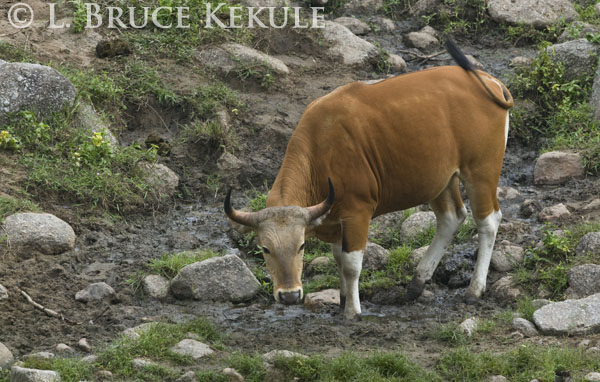
Banteng bull at a mineral lick in Huai Kha Khaeng
The Kingdom’s protected areas include national parks and wildlife sanctuaries, and are all controlled and managed by the Department of National Parks, Wildlife and Plant Conservation (DNP). It is extremely difficult defending these forests from human intervention, and the DNP has a heavy burden to bear. Let us hope that they will succeed in this very important but really tough task!
One alternative to disappearing banteng is a reintroduction program to save the species. There are a few breeding centers around the country with banteng. Unfortunately, most of the stock is Indonesian banteng. Years ago, Kukrit Pramote, Thailand’s Prime Minister using government to government relations, imported Indonesian banteng that were released at Lum Phow Non-hunting Area in Kalasin province. There are about 60 surviving on a 900 rai plot. Only one breeding center at Khao Nam Phu, Kanchanaburi province is reported to have Thai banteng. Several young banteng were taken from Salak Phra Wildlife Sanctuary next door and produced off-spring. Presently, there are about 10 individuals at Khao Nam Phu.
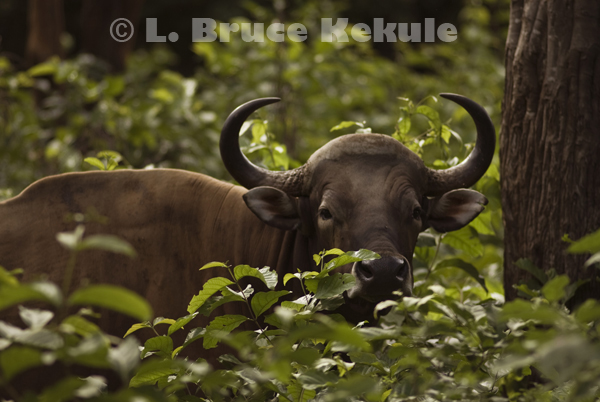
Banteng bull at a breeding station in Salak Phra Wildlife Sanctuary
Another pilot program started in 1991 was initiated at Khao Kheow Open Zoo and 13 banteng (unknown origin) were released to adjacent Khao Kheow-Khao Chumpu Wildlife Sanctuary (144 sq.kilometers) in Chonburi province. There are now an estimated 49 banteng surviving in this herd with a few mature bulls living in a very splintered habitat. Poachers however, are a serious threat here using pipe guns and rope snares left in the forest, and inflict casualties on these reintroduced denzins. DNP needs to make sure they are protected to the fullest.

Rare white-spotted banteng cow – endemic to Huai Kha Khaeng
Banteng have been called the most beautiful of all the wild relatives of cattle. The colouring of young bulls and cows is generally a vibrant reddish brown, though some are fawn. The old bulls in Thailand are mostly blackish-brown, but Indonesian banteng bulls are very dark brown to black in some. Regardless of sex, all Thai banteng have a white band around the muzzle, small white patches over the eyes, white stockings on all four legs, and a large white patch on the rump. Another distinct feature is a black stripe along the spine. The dorsal ridge is pronounced in the large adult bulls. Some Thai banteng have white spots along the flank, but this is not found among the other subspecies.
The skull and horns of banteng are less massive then their cousins the gaur Bos gaurus, but are nevertheless formidable weapons. They use their horns for protection, but the males also use them to decide who will get the females during the breeding season in May and June. Gestation is nine and a half to ten months, and one or two calves may be born. The calves are suckled until they are fourteen to sixteen months old.
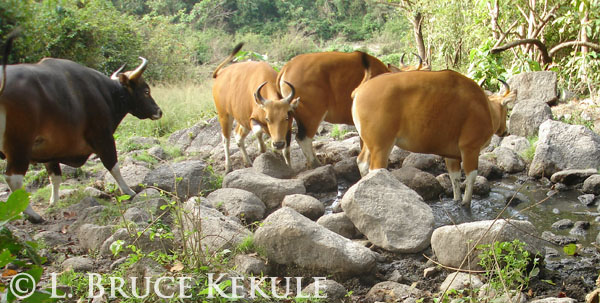
Banteng bull and cows at a waterhole in Huai Kha Khaeng – note very dark colored bull
Banteng look very much like some domestic cattle and are probably ancestral to them. In Indonesia and Borneo, banteng have been successfully domesticated and are widely used there. For some reason, this practice has not caught on in mainland Southeast Asia. However, many villagers living close to banteng habitats have had wild bulls mingling with their domesticated cattle, and hybrids have been born. Hybrids have also been reported from some forests in the west where banteng and gaur overlap.
The habitat where banteng are normally found is open deciduous forests and hence banteng are more seriously endangered than gaur. They are grazers and prefer open grasslands. However, they have become more nocturnal due to hunting pressure and are rarely seen during the day, preferring to come out in the open at night. Herds of two up to twenty-five or more have been recorded and usually there is only one mature bull.
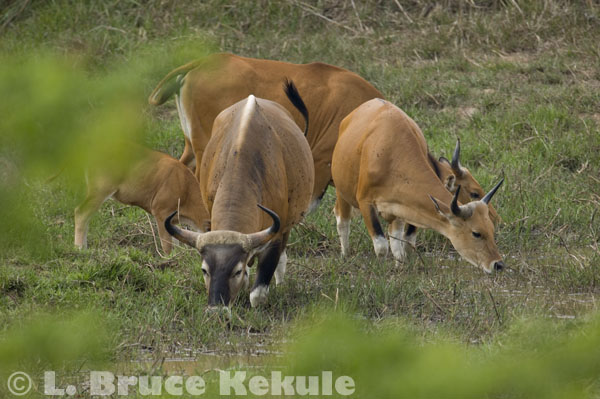
Banteng bull and cows at a waterhole in Khao Ang Rue Nai
Solitary bulls, or loners, are quite common, as the herd bull has kicked them out. They will typically shadow the herd, especially during the breeding season when they are hoping for the chance to mate with the cows that come into heat. The herd bull will remain supreme only for as long as he remains fit and has not broken a horn.
The future chances of these magestic creatures is slim. Pressure from humans and increased population growth over the long run can only have an adverse effect on the flora and fauna of the nation. The question is, how long will these magnificent bovid survive and in what places? Can we say that in 50 years banteng will continue to live in their protected areas, safe from human poachers and encroachment. Nature’s clock is ticking relentlessly, and only time will tell.
Wildlife Candid Camera – Infrared cameras ‘trap’ Thailand’s elusive wildlife
Wildlife Candid Camera – Infrared cameras ‘trap’ Thailand’s elusive wildlife
Indochinese tiger camera trapped in Sai Yok National Park
One evening as the shadows were melting into darkness in the jungle of Sai Yok National Park, an Indochinese tiger Panthera tigris corbetti was meandering up to a forest pool for his evening drink. At the planned position, a camera-trap mounted on a dead tree tripped a photograph of the cat, causing it to bound into a bamboo thicket. The tiger could not of course have understood exactly what had just taken place. Instinct triggered its reaction to the flash and the camera’s mechanical click. Taking a photograph of a tiger in the wild is a very daunting task but the wizardry of modern electronics has made the job much easier.
Gaur herd caught at a mineral deposit in Kaeng Krachan National Park
A few days later and just two kilometers away, another tiger pads slowly through the forest topping a 600-meter-high ridge in late afternoon. Its senses are on high alert for any movement or sound that could lead to its next meal. A passive infrared camera-trap set on a wildlife trail catches the tiger as it passes through an invisible motion-detection field. The time and date is recorded and the wildlife photographer has just triumphantly photographed one of Thailand’s rarest mammals in the wild – without even being there at the time; a rare candid wildlife photograph set off by the subject itself.

Mother and cub in Huai Kha Khaeng Wildlife Sanctuary
Far away in Huai Kha Khaeng Wildlife Sanctuary in Western Thailand, a mother leopard guides her young cub to a sambar kill. The carcass is ripe after a few days but still good for a full meal. In early-morning darkness the leopards trigger an active infrared SLR camera and strobe strategically positioned close to the dead deer. When the film was processed, I saw two feeding leopards – a mother and its cub. The female is yellow but the young one is black. Photographs of the notoriously elusive leopard would be far rarer if not for modern technology.
The history of camera traps goes back more than a hundred years. In 1906, pioneer wildlife photographer George Shiras III used a flashlight camera with trip wires to photograph wild animals. His equipment was very heavy and very complicated to use, with the lens aperture being very difficult to anticipate. Two other men experimented with camera traps activated by pressure-plates: F.M. Chapman in 1927 and F.W. Champion in 1928. Their primitive traps produced many superb black-and-white photographs that thrilled magazine and book readers at the time.

Banteng herd at a waterhole in Huai Kha Khaeng
For the last four decades or so, researchers and biologists to collect data on wildlife and also to investigate the secretive and nocturnal lives of such rare and endangered species as the tiger and leopard use camera traps. Beyond glamorous predators, species such as wild cattle, deer and pig are also, without discrimination, recorded to reveal such useful information as relative abundance and activity patterns. Camera trapping can lead to important scientific databases.
The units are most often attached to a tree, usually half a meter above the ground and three to four meters away from water holes, mineral licks, wildlife trails, forest roads or stream beds. The time and date is imprinted on each frame for scientific research.
An American hunter whose goal was to survey designed one of the first camera traps utilizing infrared technology and scout possible locations for big game like deer and bear. These active infrared sensors manufactured by TrailMaster.com in Kansas used a separate transmitter and receiver connected to a small ‘point-and-shoot’ camera which is triggered when the beam between the two units is interrupted by any moving object. A major drawback of active systems is that even an insect momentarily blocking the sensor will stimulate a photograph of seemingly empty forest. Active infrared camera traps are best suited to conditions that are dry with minimal insect activity. Further, three separate units are quite complicated to set up and maintain.
Problems with active infrared systems caused a researcher in Texas to ask a friend to develop a passive infrared camera trap, leading to the establishment of CamTrakker.com in Georgia. Passive camera-traps are a self-contained unit with the camera, batteries and sensing electronics sealed in a box. The sensor detects motion. The chief advantage of the passive system is the ease of a single unit installation with no alignment or external wires.

Asian leopard feeding on a sambar carcass in Huai Kha Khaeng
Passive infrared camera traps, which can work for one month or more between battery changes, have proven the most utilitarian for both researchers and wildlife photographers. The relatively high cost of commercial units is the major drawback, particularly to budget-strapped researchers in developing countries.
Both TrailMaster and CamTrakker have steadily improved their equipment over the years. Other companies have now joined the competition, bringing prices for entry level units down to about US$250 (Top-of-the-line models are about US$500 and CamTrakker offers a digital model that costs US$1,200).
Throughout my early years of wildlife photography, the thought of camera trapping had frequently crossed my mind. Finally, with many years of mechanical experience, I decided to build my own camera-traps. Using existing units as a model, I built a passive infrared camera-trap housed in a 6” x 6” tig-welded aluminum alloy box with a removable front cover. The camera-trap as an enclosed unit that is fixed to a tree using two stainless steel lag bolts contained within the box. A small bag of dessicant (silica gel) is set inside to protect the delicate electronics and camera from moisture, and the front cover is hermetically sealed using silicon sealant and stainless steel screws. The unit is elephant-proof that is very important in the forests I work in. Elephants destroy plastic camera-traps.
Tuskless bull elephant in Kaeng Krachan
Out of my home workshop, I was able to make these custom-built cameras for way less than half the price of imported commercial units. My very close friend Yutdhana Anantavara from Chiang Mai modified the cameras and installed the infrared electronic systems. This early work really helped me onto the road to successful home-made camera traps.

Feral cat camera trapped at my home in Chiang Mai
The first batch of prototype units employed several brands of ‘point-and-shoot’ cameras and different experimental housings. To evaluate each camera’s quality and reliability, I intensively tested each on the domestic cats that regularly walked on top of a wall behind my machine shop. Various films were tested but slide film at 400 ISO proved to produce the highest quality image.
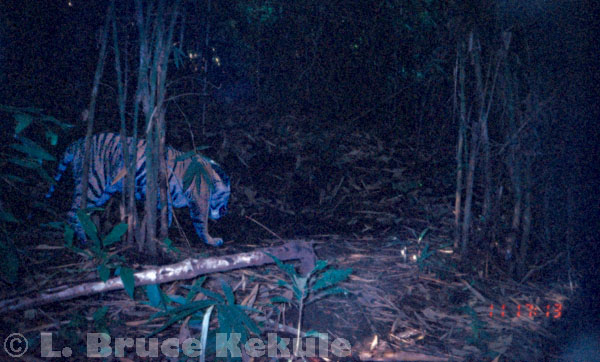
My 1st camera trapped tiger in Sai Yok
To field test the new gear I took a trip to Sai Yok National Park in western Thailand. All of the cameras were placed along wildlife trails, waterholes and mineral licks. Over several months, the film was collected and developed. I was ecstatic when I saw two different tigers, an elephant, serow, muntjac, stumped-tailed macaque, bear, porcupine, water monitor, jungle fowl and wild pigs. The omnivores were the most frequently photographed and probably the tiger’s main prey species. A totally unexpected bonus was photographs of a few poachers.

Serow male camera trapped in Kaeng Krachan NP
Numerous camera trap surveys have been conducted in many of Thailand’s forests. A 2001 survey produced a photograph of a Siamese crocodile in Kaeng Krachan National Park. The croc was caught in broad daylight on a sandbar along the river. Park staff set cameras for a month along the Phetchaburi River. The amazing discovery of this very rare reptile has prompted more investigation into this endangered species. In 2003, I camera trapped a crocodile in Khao Ang Rue Nai Wildlife Sanctuary.

Wild Siamese crocodile camera trapped in Khao Ang Rue Nai Wildlife Sanctuary
To analyze wildlife in a given area, researchers use two main techniques: a trail-based survey (where cameras are randomly placed along wildlife trails and roads covering 100 to 300 square kilometers) and a more intensive plot-based method. A smaller plot is chosen (usually 40-50 sq. kilometers) and a camera is placed in each one-kilometer grid. An area can eventually be exhaustively surveyed – the duration depending on the number of cameras used – to prove the presence or absence of tigers and other animals. The data then can be used for conservation management of the protected area.
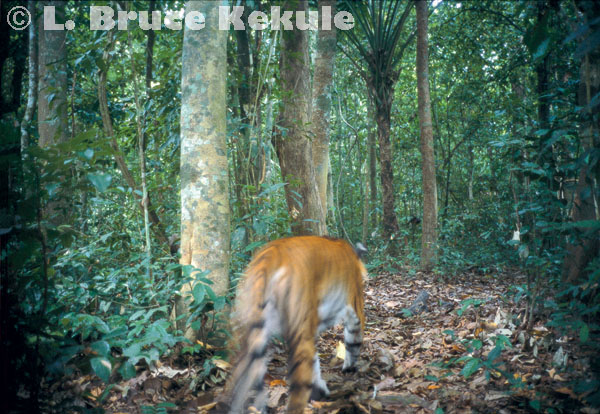
Indochinese tiger abstract in Kaeng Krachan
Camera traps can reveal very disturbing information. Extensive surveys around Khao Yai National Park indicate that only two tigers survive. The patterns of tigers are as unique as human fingerprints so it is essential to get photos of both sides of each animal so that individuals can be identified. Researchers often set cameras on either side of a trail to capture both sides simultaneously. Khao Yai might have more tigers but the fact that only two individuals are confirmed is depressing. As of 2005, no tigers have been seen in intensive surveys carried out by Kate Jenks from the Smithonian Institute.

Indochinese tiger camera trapped abstract
Poachers have also been camera trapped here. Usually they walk obliviously past the camera but they sometimes damage or steal cameras. Elephants also destroy cameras, tearing the plastic commercial housings off the tree and smashing them or lobbing them into the bush. A Royal Forest Department researcher at Hala-Bala Wildlife Sanctuary in the deep south of Thailand found a unit damaged by elephants, but the camera was still working and developed the film. The last frame shows a very close view of an elephant’s trunk! Some researchers have built stronger steel boxes to protect the plastic units.
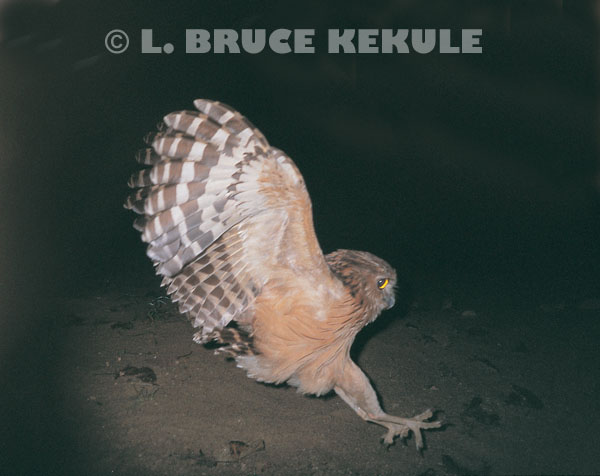
Buffy fish-owl landing by the Phetchaburi River in Kaeng Krachan NP
My aluminum-cased camera-traps firmly bolted to a tree have survived many inquisitive elephants. However, they can be stolen or vandalized by determined people who do not want their photo taken. In May of 2005, I lost three cameras near the headwaters of the Phetchaburi River in Kaeng Krachan National Park. Forest fires in the dry season destroy cameras. Insects will invade the interior of imperfectly sealed units, playing havoc with their operation. High humidity in the rainforest also damages electrical circuitry, cameras, film and batteries not protected by a well sealed unit and a small bag of moisture absorbing silica gel.
Infrared camera trapping has undoubtedly become a uniquely useful tool for conservation biologists. This ‘candid camera’ is also a blessing for wildlife photographers wanting images of rare and endangered animals. Who knows? In the future, a camera-trap could photograph a species new to science. I’m always excited when I get camera-trap film back from the lab. But the digital age had arrived. Film is being slowly phased out and digital cameras have now overtaken the market dominating it.
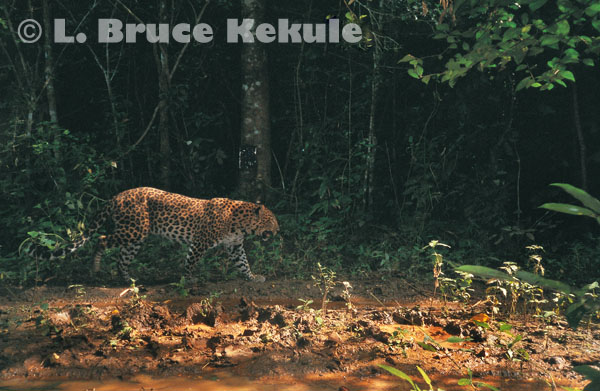
Asian Leopard hunting on old logging road in Kaeng Krachan NP
***************************************************************************************************
Wildlife Candid Camera: The Digital Age has arrived

LBK camera trap attached to a tree using Python locking cable

LBK camera trap with Yeticam board and Sony W7 in custom aluminum case
Digital camera traps have now become the new sensation, especially the home-brew (self-made) market. It is now a huge business with a few companies vying for market share. The most predominant are Snapshotsniper.com and Yeticam.com, and they offer parts (sensor boards, lens, battery packs, cases, etc.) to the home builder.

Very old bull gaur at a waterhole in Huai Kha Khaeng WS
My friend Chris Wemmer, the ‘Cameratrap Codger’, was the first person to tell me about a new company in the US producing infrared circuit boards and other accessories for the home-brew camera trap market. The company is Pixcontroller.com. Unfortunately, they no longer offer parts but now sell completed units with digital camera and video.

Mature bull gaur at water hole
As a wildlife photographer, I decided to produce my own digital camera traps using passive infrared circuit boards acquired from the U.S., and digital cameras modified locally with housings and constructed from tig-welded aluminum alloy at my machine shop at home in Chiang Mai. The first cameras used Nikon L11 and L14 cameras and Snapshotsniper boards that were set-up in the forest of Kaeng Krachan National Park in Phetchaburi province in Southwest Thailand over a three-month period in October to December 2008.

Asian tapir – mother and calf in Khlong Saeng WS, Southern Thailand
Animals captured were elephants, gaur, tiger, sambar and muntjac. One camera had over 300 captures in one month at a mineral deposit in the park.

Asian tapir calf in Khlong Saeng
Down in Khlong Saeng Wildlife Sanctuary in the first part of 2009, I set both film and digital camera traps deep in the forest. Elephants, gaur, tapir, sambar, muntjac, golden cat and Argus pheasant were captured.
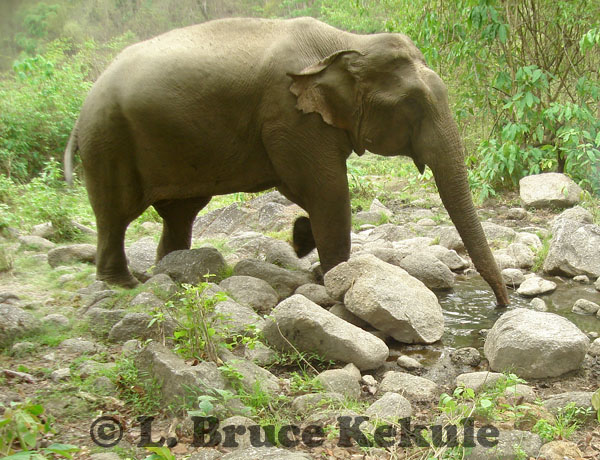
Tuskless bull elephant camera trapped at waterhole in Huai Kha Khaeng
I now have more than a dozen digital camera traps using primarily ‘Sony S600’ and W5-7 cameras, Snapshotsniper.com and Yeticam.com circuit boards.

Tusker elephant in Khao Ang Rue Nai Wildlife Sanctuary
The Sony cameras have been the best and most durable due to the manual features like ISO and f.stop adjustments. Picture quality with the ‘Carl Zeiss’ lens is usually good.

A herd of wild pigs including a runt in Khlong Saeng
Camera trapping has allowed me the sheer pleasure of seeing Thailand’s amazing wildlife on both film and digital. As of this writing, I have expanded my camera trap fleet to more than 20 units and continue to run a trap-line in Sai Yok National Park. On my first setting in July 2011, I got a mature Gaur bull up a hill in the interior. Still waiting on a tiger.
Big Cats in Kaeng Krachan: The tiger and leopard
A look at tiger and leopard evolution in Asia
At the beginning of the dry season in January, the jungle canopy is still mostly green but falling leaves begin to carpet the forest floor as the first cold snap arrives. Some species of trees start their transformation, producing a mosaic of yellows, oranges, reds, browns and greens. For the first few hours each morning, heavy fog blocks out the sun as moisture dissipates from the forest. The Phetchaburi River is crystal clear as it flows through this magnificent forest.
Indochinese tiger camera trapped by the Phetchaburi River
A large predator walks the trails seeking its next meal. Sensing danger, a muntjac barks a warning. The whole community of wild animals is on alert as macaques and langurs cry out from the trees above. A striped carnivore stalks a herd of wild pigs. The nervous omnivores squeal and panic, running through the underbrush to escape. But the big cat is lightning quick – it catches a young pig with sharp claws. The struggle is over in seconds as fangs penetrate to the spine.

Leopard camera-trapped on an old logging road
The tiger has just made a kill. It lifts the lifeless prey into deep cover and devours the carcass. After feeding, the big cat seeks water for a thirst quenching drink. It will then lie down and rest until the desire to eat or drink begins again. Tigers will sometimes move great distances in search of food. But where there is an abundance of prey species, these magnificent cats continue to live in balance with nature. The average kill ratio for a tiger is about twenty unsuccessful attempts for one actual kill. At a certain time of year, the male tiger will seek out a female to carry on his legacy.
Another tiger by the Phetchaburi River
Kaeng Krachan National Park is a great wilderness that sits in the Tenassarim Range in southwest Thailand. It is one of the most beautiful protected areas left in the country. Elephants, gaur, tiger, leopard, tapir, gibbons, hornbills and literally thousands of other plants and animals still survive in a rich ecosystem that is world class.

A tiger camera trapped at a mineral lick in Kaeng Krachan
To understand how the tiger and leopard evolved, we must go back to the beginning of these wild creatures. After the carnivorous dinosaurs died out about 65 million years ago, mammals with sharp teeth, strong jaws and claws replaced them as the top land predators. The first successful mammalian carnivores were the Creodonts that evolved during the Eocene epoch 57-35 million years ago. Creodonts ranged in size from smaller than a weasel to as big as a bear. A bear-dog also evolved during this period. These carnivores all had voracious appetites that were satisfied by large concentrations of prey species, mainly the odd-toed and even-toed ungulates that browsed and grazed the lush forests and plains of the time. The early Creodonts evolved into the modern carnivores that we know today: the bears, cats, dogs and other predators.
Tiger camera trap abstract
The order Carnivora is separated into three superfamilies: The Arctoidea includes marten, weasel, badger, otter, bear and the panda; the Cynoidea are made up of the dog, fox and the wolf; and the Herpestoidea includes the mongoose, civet, hyena and the cat. Most carnivores are dedicated meat-eaters, but some groups such as civet, panda and bear are omnivorous, eating meat and plants.
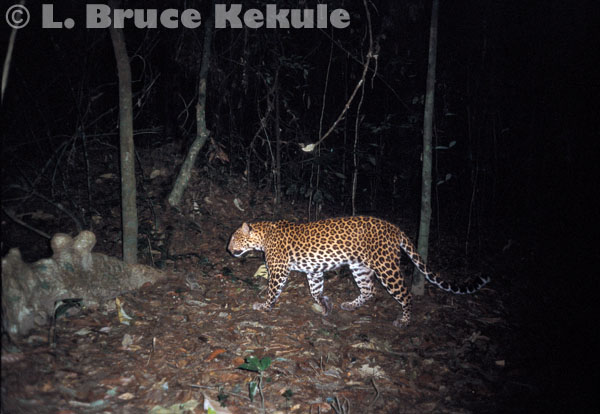
Leopard camera trapped on a nature trail in the park
Nimravidae were the first cats to evolve in the Early Oligocene epoch, about 35 million years ago. They lasted till the Late Miocene, some eight million years ago, when huge grasslands had developed around the world. The large saber-toothed cats were the first of the family Felidae. These long-fanged felines evolved alongside huge herds of grazing mammals like antelope and cattle. There were several different species of saber-tooth, but they all became extinct about two to three million years ago.

Black leopard camera trapped on the main road in the park
Modern cats belong to the family Felidae and include: tiger, lion, leopard, jaguar, cougar and cheetah, and all the smaller cats such as lynx, bobcat, jungle cat, fishing cat to name just a few plus domestic cats. Wild carnivores feed almost exclusively on vertebrate prey and sit at the top of the food chain. Tiger and lion have few predators apart from man but a pack of wild dogs however are a constant threat to the large cats and their offspring. The tiger and leopard belong to the genus Panthera, or roaring cats, that include the lion and the jaguar.

Leopard camera trapped in the interior
Thousands of years ago when primitive humans lived off the land as hunters and gatherers, they survived by pure instinct. They killed animals for meat and skins, and also gathered many different tools and plants from the forests. As humans became more sophisticated, they used weapons to take down larger animals. Clubs, spears, knives, bow and arrows were all that separated them from almost certain death at the claws and jaws of a predator many times their size.

Black leopard camera trapped on an old logging road
The possibility of being eaten by a carnivore like a tiger or leopard must have been on everyone’s mind that lived in or near the wilderness. Entering the forest where every step could be the last was like walking a tightrope. Attack normally lasted only seconds as a huge predator pounced from behind, biting the neck and causing almost instant death. Very few people survive such an incident. It must have been a scary environment to live in.
The will to survive, however, was strong and men eventually conquered his fear of the wild cats with more modern weaponry. The tables had finally turned and the predators became the hunted. As human populations and settlements grew, the forests were quickly transformed into agricultural land.
An Indochinese tiger on the prowl at night by the Phetchaburi River
After firearms were invented, European royalty, native kings, landlords, planters, foresters, government officials and many adventurers journeyed to the forests of Asia in search of the tiger. Mostly, they came to prove their dominance over the big cat. A trophy of tiger on the wall or floor at home proved beyond doubt that the owner was the supreme species. One could boast of their prowess as a hunter.
But the fact is most hunters shot tigers and leopards from the safety of a tree-blind, vehicle or elephant back. The cats would be attracted to within gun range by cattle, buffalo or a goat used as bait. For special hunts, hundreds of local villagers were recruited as beaters, trackers and mahouts. To join a shikar (Indian word for the hunt) was the ultimate experience for the adventurous.
The same tiger as above a few moments later
More tigers have been killed for sport in India then anywhere else in the world. In the days of the Raj, it was common to see five, ten or twenty cats lying dead on the ground in front of a hunting party. The Maharajah of Surguja killed some 1,157 tigers during his reign. Some Englishmen claimed to have shot more than 100 tigers. Fortunately in 1972, the Indian government finally banned hunting because the tiger and many other species were threatened with extinction.
The most famous hunter ever to overcome his fear of the big Asian cats was Jim Corbett of India. From 1907 to 1939, he single-handedly dispatched scores of man-eating tigers and leopards. His book ‘Man-eaters of Kumaon’ is a classic. Some cats mentioned in the book had killed hundreds of people. Corbett National Park was established in his honor, and the Indo-Chinese subspecies of tiger Panthera tigris corbetti is named after him.
In Thailand, the tiger and the leopard were also hunted for sport but on a much smaller scale than in India. In the past, rural Thai people living near wilderness areas built houses high off the ground that protected them during the night. But daytime was another thing. If they worked in fields bordering thick jungle or they went into the forest, they risked their lives.
At the turn of the 20th Century as modern firearms, agriculture and transportation took hold in the Kingdom, the forests and wildlife began to disappear. Man-eaters also declined. However, during World War II along the death railway in the Sai Yok district of Kanchanaburi province there were still accounts of man-eating cats. In recent times, there has been no such record. From time to time, domestic cattle are still killed by a tiger or leopard but this is now very rare. Low wildlife densities in the forest and easy prey are the main reason for this occurrence.
Thailand is fortunate in that tiger and leopard plus another seven species of cat still survive in some of the larger national parks and wildlife sanctuaries. Kaeng Krachan National Park is one of those protected areas that still harbor the big cats. Tigers can and do kill the leopard. Although their paths do cross, normally the spotted cat will avoid the striped predator. Documentary accounts and photographs do exist of tigers eating leopards.
In 2002-2003 while carrying out camera trap work in Kaeng Krachan in cooperation with the National Parks, Wildlife and Plant Conservation Department, I was surprised and elated to see both species tripping the same cameras in several areas only days apart. In one month, four different leopards, one of them black, were caught on film. In the following month, a leopard was caught during the day, and a huge male tiger stopped and posed for the camera. Both species were using the same trail for their hunting forays. A few other protected areas like Huai Kha Khaeng and Thung Yai Naresuan wildlife sanctuaries have records of overlapping.
In Kaeng Krachan, an important discovery is that tiger and leopard hunt at all times during the day. It is usually thought they are only active in the late afternoon and throughout the night preferring to rest during the day. More research is required if we are to determine the pattern of daytime hunting by the big cats here. It is probably due to the pristine state of this forest and the lack of human activity.
Without doubt, the future of the big cats depends on one thing only – the complete protection of the remaining forests where they live. If the national parks and wildlife sanctuaries remain intact with a high number of prey species, the big cats will survive. But if overdevelopment and encroachment is allowed to continue, these magnificent animals will eventually disappear.
Unfortunately, too much time and money is wasted by too many organizations talking about saving the tiger and other wildlife, with very little actually being done. Human population growth will eventually destroy most wild places. Only true protection by a few dedicated people will slow the destruction of nature’s precious wildlife and wilderness areas. It is only hoped that the tiger and leopard will continue to survive as they have for millions of years.
Leopard – Panthera pardus
The leopard is closely related to the jaguar of South America. Both have a spotted coat pattern, incidence of melanism (black phase), and relatively short legs. The present distribution of the leopard is restricted to Asia Minor, India, Southeast Asia, the Himalayas, Tibet, China, Siberia, and Africa. Fossils of leopards were found in Pleistocene deposits throughout Europe, the Middle East, Java, and Africa, some 1.5 million years old. These secretive cats are mainly nocturnal. Their populations and ranges are difficult to determine but radio tracking of collared animals has shed new light on their movements and area they live in. ‘Spots’ is more tolerable to humans and their settlements.
Tiger – Panthera tigris
According to fossil evidence Panthera cats branched from the other Felidae about five million years ago in Asia. The first tigers originated in eastern China. Fossils of the earliest tigers date back to the Pleistocene epoch, about 1.6 to two million years ago, have been found in Henan, southeast China, and on the island of Java in Indonesia. The historic range of the tiger covered much of Asia and some of its islands.
However, humans have had an enormous impact on the geographic range of the species. The big cat only survives in 13 countries: Russia, China, India, Nepal, Bhutan, Bangladesh, Burma, Laos, Cambodia, Vietnam, Indonesia, Malaysia and Thailand. The present range is less than five percent of the tiger’s former range. There are less than 5,000 tigers left in the wild.
Elephants : Killing for Cash
THE SAGA OF ‘PANG DURIAN’: An orphaned baby elephant from Phraektakor Reserved Forest in Phetchaburi province close to Kaeng Krachan National Park

‘Pang Durian’ in Kaeng Krachan National Park
Elephants are being slaughtered in supposedly protected forests so that their young can be used to beg for money on the streets of Bangkok and other cities around the Kingdom. ‘Pang Durian’ is one of those orphaned baby elephants. But unlike other victims of this cruel trade, she has found a new family in the wild. This story is true and based on fact!
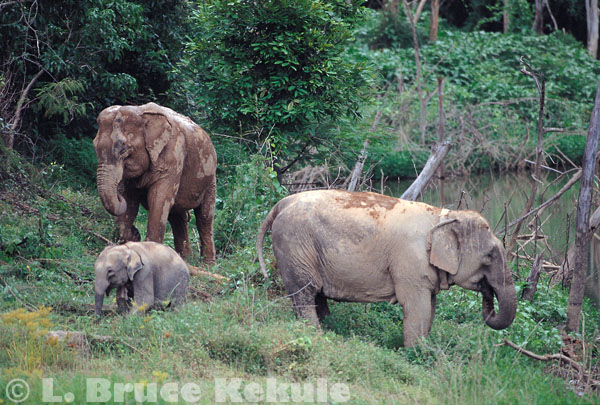
‘Pang Durian’ and two step-mothers in Kaeng krachan
A baby elephant wanders aimlessly around her mother lying dead on the ground. The confused young creature has no idea what the future holds as poachers move in to capture her. Her freedom is about to be taken away. Later her spirit will be broken and she will probably end up begging for food and money in some big town or tourist destination
The above scenario is all too common. The killing of mother elephants is perpetrated by some very unscrupulous people who then grab their young and sell them for cash. Other indigenous species like gibbon and langur are hunted down in a similar manner. The middleman and eventual buyers who create the demand for animals snatched from the wild seem to be insulated from the law. When will the killing and kidnapping stop?

Mother and baby tusker camera trapped at a mineral deposit in Kaeng Krachan
The cruelty of this illicit trade is epitomised by the remarkable but traumatic experience of ‘Pang Durian’, a female baby elephant abducted from Phraektakor Reserved Forest, just south of Kaeng Krachan National Park in Phetchaburi province. Her mother was killed by poachers in 1998 and the six-month-old was being kept at Ban Durian, a village just outside the park’s southern boundary. It was there, as she awaited sale on the black market, that she was given her name.
The young orphan was in very poor health. Luckily, however, Royal Forest Department (RFD) rangers in Kaeng Krachan heard about her and investigated. By the time they got to her, she was suffering from a deficiency of protein, calcium and other minerals that would normally come from mother’s milk. Her left leg had become bow shaped and deformed. The villagers hadn’t provided a nutritious, well-balanced diet, and malnutrition had set in.

Elephant family unit in Kaeng Krachan
After negotiations, ‘Pang Durian’ was traded for raw rice, other foodstuffs and construction materials. Shutat Sapphu, head of Ban Krang station in the park, took responsibility and looked after her for several months. Non-governmental organisations including the Wildlife Fund Thailand and Wild Animal Rescue Foundation took an interest in Pang Durian’s plight. After her health began to improve, the World Wide Fund for Nature (WWF-Thailand) moved her to the well-established Elephant Hospital at Mae Yao Reserve Forest in Lampang. For the next six months, she was in good hands. And her life was about to change for the better. Reintroduction into the wild was the plan.
In 1996, during a state visit to Thailand by Britain’s Queen Elizabeth and Prince Philip (then president of the WWF-International), Her Majesty the Queen announced her intention to initiate a reintroduction project for elephants in the Kingdom . The idea was to offer an alternative future to domesticated and traumatised elephants, to let them live out the remainder of their lives as nature had intended.
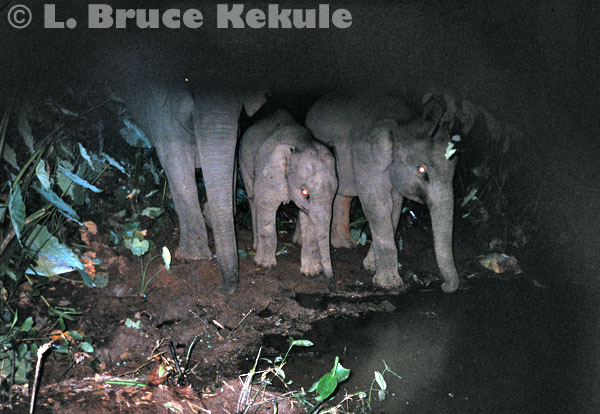
Family unit camera trapped in Khao Ang Rue Nai Wildlife Santuary
In January of 1997, the process officially began when Her Majesty released the first three female elephants ‘Pang Bualoi’, ‘Pang Boonmee’ and ‘Pang Malai’ into Doi Pha Muang Wildlife Sanctuary in Lampang. In February 1998, ‘Pang Sangwan’ and ‘Pang Khamnoi’ were let loose in the same sanctuary as, exactly a year later, were Pang Kammoon and her one-year-old male calf, Plai Song. (“Pang” and “Plai” are Thai prefixes denoting female and male elephants, respectively.)
Some 50 elephants are currently being kept in Lampang for future release and other wilderness areas are now being looked at for inclusion in the project, for which the government recently allocated a budget of 100 million baht. Support for the scheme has come from agencies including the Bureau of the Royal Household, the Thai Elephants Conservation Centre, the Forest Industry Organisation, RFD and WWF.
It was decided to release ‘Pang Durian’ along with four adult elephants (two male, two female) into Kaeng Krachan, the Kingdom’s largest national park. According to the park chief, there are about 200 wild elephants, in seven or eight different herds, living in the interior. The question is, after having become used to humans can elephants be introduced into an area where wild ones roam?
By now ‘Durian’ was more than two years old but she would still be very vulnerable to attack by tigers and leopards and susceptible to possibly recapture by humans. So two stepmothers, ‘Pang Buangern’ (Silver Lotus) and ‘Pang Buathong’ (Golden Lotus), were assigned to look after and protect her. The two males in the group bore the names ‘Plai Eak’ and ‘Plai Mangkorn’ — the latter a bull aged about 60.

Tuskless bull camera trapped on an old logging road in Kaeng Krachan
In late May 2000, the five elephants made the 900-kilometre trip from Lampang south to Phetchaburi; it took about 24 hours to cover the distance. A veterinarian named Dr Somkiat Trongwongsa along with a team of mahouts and RFD rangers working with WWF-Thailand were assigned to look after and monitor the group. One of the females had been fitted with a radio collar for satellite tracking. The group were released near the main entrance at Sam Yot (Three Peaks) Gate into Kaeng Krachan on June 1 of that year.
Sadly, ‘Plai Mangkorn’ was found dead of old age six months later, but the rest of the group continued to move in and out of the park. After the intense rains in late 2000, contact was lost for several months, but in mid-2001 the three surviving adults in the group were spotted near Sam Yot Gate. But Durian had disappeared and everyone feared the worst. Had she been taken by a tiger or lost in the thick jungle?

A tusker camera trapped by the Phetchaburi River in Kaeng Krachan
The three adults hung around the gate, refusing to go back into the park. It transpired that they had been chased away from several villages in the vicinity and were becoming a serious problem for the RFD. Eventually, almost a year after their release, it was decided that they should be sent back to Lampang.
In September 2002, while working with the RFD in Kaeng Krachan in conjunction with WWF-Thailand, I made a trip into the park to set up some infra-red camera-traps at mineral licks about 12 kilometres from Sam Yot Gate. The cameras were attached to trees on trails leading to the salt licks and left for one month.
‘Pang Durian’ camera trapped in Kaeng Krachan showing her bowed left front leg
Positive proof that she was surviving with a wild herd in the park
When the films were processed in October, low and behold, ‘Pang Durian’ was spotted passing one of the cameras at about 4 o’clock one morning, her deformed left leg clearly visible. It almost seemed as if she was saying, “Here I am!” Other elephants captured on the same roll of film around the same time meant that this remarkable little elephant was now obviously in good hands. She had come full circle and had been adopted by a herd. A magnificent testimony to the tenacity of Thai elephants and a wonderful Walt Disney ending to the whole scenario.
Actually, RFD rangers had told me earlier that they’d spotted ‘Durian’ one night near Ban Krang station. But this camera trap photo confirmed her continued existence in the park and the partial success of a difficult yet ultimately rewarding reintroduction program. According to Dr Somkiat, the Durian success story indicates that it will only be feasible to reintroduce young elephants, about five years old, into wild populations. A year later, I believe I caught her again on a camera trap but it was more difficult to identify her so I’m not sure if it was her or not. Someday I will find this photograph and re-evaluate it.
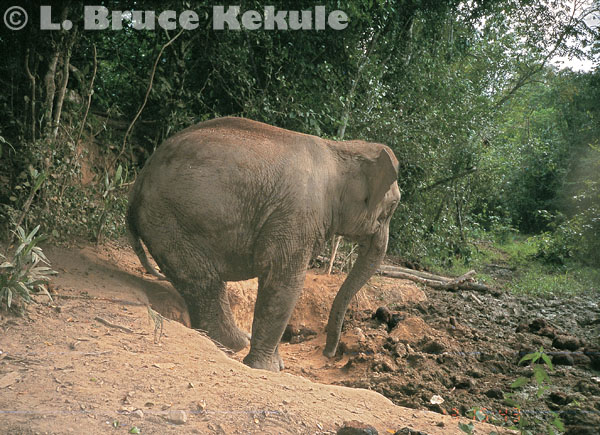
Tuskless bull in a mineral deposit in Kaeng Krachan
Countless conflicts have arisen between villagers and the real owners of the land; the creatures whose ancestors have lived there for thousands of years. Many elephants have been persecuted and killed by poisoning, gunshot wounds and electrocution (electric fences carrying an alternating current of 220 volts are used). Fireworks are set off to chase them out of mango orchards and pineapple plantations. But this tactic only frightens them temporarily; the elephants get bolder. Some have gone on the rampage tearing up villagers’ houses, RFD buildings and other facilities.
Wild elephants have also been killed or maimed by vehicles traveling along paved roads in protected areas where there are no speed limits in force. Accidents usually happen at night when the animals are difficult to spot until it is too late.
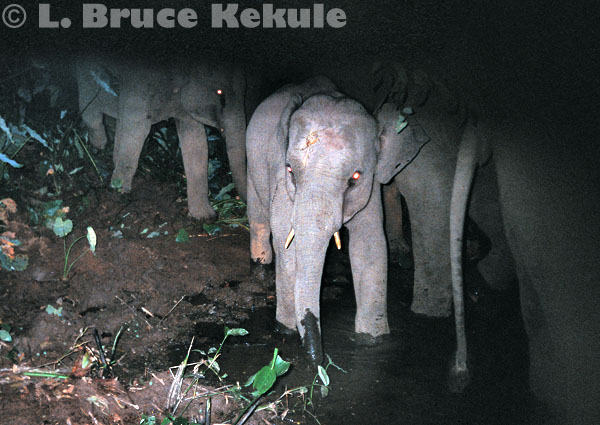
Young tusker elephant in Khao Ang Rue Nai just before
it was killed by a reckless driver on the road through the sanctuary
Above is a young tusker I camera trapped in Khao Ang Rue Nai Wildlife Sanctuary in Eastern Thailand. Two weeks after, he was hit and killed more than twenty kilometers away by a truck traveling at high speed on the road through the sanctuary. The driver was also killed but his wife next to him survived. The powers-to be have now closed the road from 9pm to 5am to allow animals freedom to use the road during the night. Road kill has dropped more than 50 percent and is considered a success in wildlife conservation and the authorities should be commended for taking action. This young tusker did not die in vain
Probably the most appalling treatment meted out to pachyderms is the beatings baby elephants snatched from the wild have to endure as their captors try to make them toe the line. Most are fed totally unsuitable food that lacks the necessary protein, minerals and vitamins. Later, these youngsters will be forced to ply the hot, dusty polluted streets of Thai towns begging for food and money.
Given the lax legislation concerning domesticated elephants, and poor enforcement, the future for these unfortunate animals is bleak. Continuous calls for change are ignored. Mahouts are still bringing elephants into urban areas and tourist traps. At one time, driving around Bangkok at night and you were almost certain to spot a huge gray beast plodding along with a red light or a CD attached to its tail. Even though this has been stopped by the BMA city officials, it still goes on in other parts of Thailand where there are late-night eateries and tourists.
One can only hope that the ‘Pang Durian’ success story will wake people up to the plight of these noble beasts which has played such an important role in Thai traditions, belief systems, culture, society and politics, and which has been involved in almost every important event in the Kingdom’s history.
Once featured on the Thai flag, the elephant is still a national symbol in which we should take pride. It needs our love and compassion, plus our help and respect. Without that, the magnificent Asian elephant is doomed.
Heavy storms and floods have closed the visitors’ road, and wildlife has thrived because rangers kept it closed
First published in October 2003
Just a three-hour drive southwest of Bangkok, along Phetchaburi province’s border with Burma, lies Kaeng Krachan – Thailand’s largest national park, encompassing 2,915 square kilometers of mostly tropical broad-leafed evergreen and mixed deciduous forests. In the interior live tigers, leopards, elephants, gaur, tapir and many other amazing species. Even the rare Siamese crocodile still lurks in one of the park’s watercourses. Kaeng Krachan is one of the country’s least touched forests.

Black Leopard phase
Prior to the government ban in 1989, logging was carried out in the lowland areas of Kaeng Krachan. Timber cutters cut an 18km road into the interior from Sam Yot Mountain to transport logs from the concession areas. When logging ceased, the Royal Forest Department extended the road another 18km to Phanern Thung Mountain to facilitate visitors to Thor Thip Waterfall.
Kaeng Krachan became a popular destination, with thousands of visitors each year. But too many visitors ruined some areas in the park. Wild creatures, especially mammals, faded into the more inaccessible areas and were not often seen along the road.
In October of 2002, two back-to-back violent tropical rainstorms hit Kaeng Krachan, overflowing the park’s streams and rivers, and inundating much of Phetchaburi province. Five local villagers, along with homes, vehicles, and livestock, were swept away in the worst flooding in more than 40 years. Blame for the flash floods was placed on excessive logging of the past.

Road washed out
There was extensive devastation inside the park as well. Floods washed away many sections of the main road, and more than 50 landslides uprooted trees and blocked access by tourists. The National Parks, Wildlife and Plant Conservation Department (DNP) has to wait for funds to repair the road, and this takes time. That ended the flow of people in their noisy vehicles, and the wild creatures began to use the road in their search for food and water.

Yellow phase leopard in the interior
For the last few years I have worked with the RFD and later the DNP, to carry out infrared camera-trap surveys in Kaeng Krachan to monitor large and small mammals. Some exciting photographs have resulted. Tigers and leopards, both in black and yellow phases, have come into almost every camera trap. The big cats are also surviving in overlapping territories in quite a few areas, especially along the Phetchaburi River, and along the road close to the ranger station on Phanern Thung Mountain.

Indochinese Tiger camera-trapped
Last January, more than three months after the storms closed the road, was a great opportunity to camera-trap. Four camera-trap units were placed at Kilometres 31, 32, 33 and 35, and the units started photographing almost immediately.
Tigers and leopards were now using the road to hunt day and night, and creatures like the very rare Fea’s muntjac were also caught on film. Other animals such as Asian wild dogs, black bears, large Indian civets, leopard cats, common muntjac and porcupines were also camera-trapped.

Fea's muntjac camera-trapped
One of Kaeng Krachan’s biggest advantages (from the animals’ viewpoint) is that the rainy season makes its interior inaccessible. It is almost impossible to move in and out of the main Phetchaburi watershed area when the river is swollen by heavy rains, meaning from June to October. At present, the river is a raging torrent and only professional rope handlers could possibly hope to cross. And this doesn’t mention the leeches, which are everywhere.
Without human interference, the wildlife of Kaeng Krachan lives in total peace. The ecosystem rejuvenates itself.
An example: The staff at the national park headquarters decided to close an old logging road about 12km from the main gate at Sam Yot, securing it with a steel pipe barrier. No vehicles were allowed to enter this 9km road, which leads to important Huai Mae Sariang watershed. After about a month, I set 10 cameras along the road and nearby mineral licks. Tigers, leopards, elephants, gaur, sambar, serow, common muntjac, civet cats and porcupines made an appearance.
At one camera, four different leopards, three in yellow phase and one in the black phase, were camera-trapped. The next month, a mature leopard was caught at midday, and after that, a huge male tiger (shown in the main photograph) was captured on film. The road is now used mainly by wild creatures and forest rangers on patrol and in many places, the forest on either side has grown together.
The DNP should be commended for cleaning up the park while the road was closed. At Ban Krang ranger station alone, they collected hundreds of rubbish bags full of trash thrown into the bush by visitors.
The department has also set new regulations for visitors. Other than the headquarters area down the mountains, camping is allowed only at Ban Krang. Only day trips to Phanern Thung and Thor Thip waterfalls are allowed, and a forest ranger must accompany the visitors.
Without doubt, these measures will help Kaeng Krachan’s natural ecosystem. Due to the recent heavy rains, the park is closed once again until the beginning of the dry season next month.
These camera-trap programs have barely scratched the surface of the park’s full potential. There are still many species that surely survive in the interior. Further research and surveys should be carried out by the department to determine the diversity of this great forest.
Photo captions: The tiger, the leopard and the Fea’s muntjac are just a few examples of predators and prey that venture out on the park’s road while it is closed to tourists. Since last year, violent storms have torn up many sections of Kaeng Krachan’s main road, cutting human access to the forest’s interior.
Kaeng Krachan: Jewel in the Tenasserim Range
One of the Kingdom’s Last Great Tiger Reserves: Thailand’s Largest National Park and Biodiversity Hotspot
Just a short forty years ago, a local Karen hunter sitting alone in a tree-stand made of bamboo waits by the headwaters of the Phetchaburi River. He has trekked south from his humble abode for about a week. This young man is a traditional hunter and knows how to subsist by himself in this forbidding forest. His father before him also hunted this place and taught him all the tricks-of-the-trade: hunting for a living and surviving in the wild.
Rainbow over the Phetchaburi River
Darkness envelopes the man as the sun sets behind him. The moon and stars are brilliant and night visibility is good. The location is a mineral deposit (salt lick) deep in the interior close to the river. This site attracts gaur, banteng, elephant, and the extremely rare Sumatran rhino, plus sambar, muntjac and wild pigs. Tigers and leopards also came looking for prey. It was a magnificent animal kingdom.

Serow camera trapped on old logging road
His primary target was the rhino but would take anything that came to the natural seep for the life-giving minerals. The hunter sets in for the night knowing the large mammals sometimes prefer to visit in darkness. He is armed with a crude self-made muzzle-loading rifle. It is the dry season, and he is not too worried about a misfire. The caliber is as large as his thumb, and the round heavy lead ball and black powder charge is enough to take down an elephant.
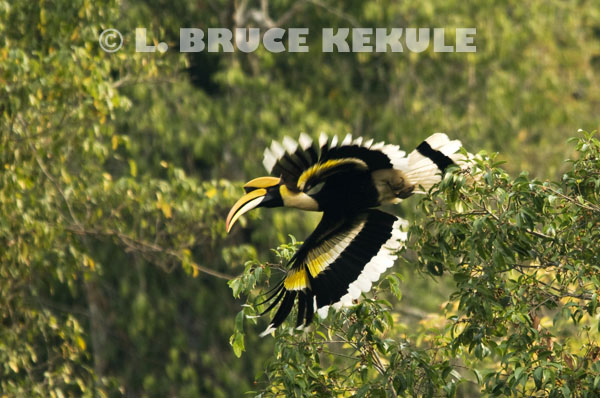
A great hornbill lifting off a fruit tree
At last, a dark shape emerges from the forest and slowly ambles straight to the seep. Head down, the odd-toed ungulate drinks to quench its thirst. The hunter switches on his flashlight and temporarily blinds the two-horned rhinoceros. He takes aim and fires his weapon with a resounding boom and tremendous muzzle flash that breaks the still night. The creature is hit in the shoulder and runs for a short distance before collapsing. It is a long wait but dawn eventually comes and the hunter climbs down from the platform to investigate his trophy. Sadly, he just killed one of the last few Sumatran rhinos left in this forest.
Indochinese tiger caught by camera trap by the Phetchaburi River
Shortly hereafter, he dispatched another rhino and then never saw the species again. He sold the horns, which were small, for about 100 U.S. dollars to a waiting middleman: a pathetic return compared to what the horns probably fetched on the black market which was most likely in the thousands of dollars. This voracious wildlife trade has absolutely wiped out many species from the forests throughout the Kingdom. It has been devastating and unfortunately, still carries on to this day.

Indochinese tiger camera trapped at a mineral lick
When Kaeng Krachan was declared a national park in 1981, the hunter, his family and several other families in the little village were relocated more than twenty kilometers outside the boundaries of the protected area. A plot of land was given to them but it was not to much, probably just sustainable. He was told that he could not hunt anymore and had to eke out a living by farming. It was a difficult road ahead for them after living in the forests since they were born. Relocation was tough but they adapted and survived. The hunter and his family now plant pineapples and other crops. He stopped hunting, and his two sons actually care about conserving the forest and wildlife.
Bull elephant camera trapped at a mineral deposit
The Phetchaburi is one of Thailand’s most famous waterways. King Rama V visited this waterway and His Majesty had water sent to his palace in Bangkok for drinking purposes. The King was also presented with rare white elephants found here. During his reign, both Sumatran and Javan rhinos existed in the interior in good numbers.
Tiger camera trapped by the Phetchaburi River
In 1914-1915, an Englishman named K.G. Gairdner made many forays into the Phetchaburi watershed recording the wildlife. He published several papers in the Natural History Society of Siam about his exploits and encounters in this wilderness. Large herds of elephants and gaur were present and many tigers thrived due to the prolific amount of prey species.
Tiger camera trapped by the Phetchaburi River
The Phetchaburi River flows from the Tenasserim Range through Kaeng Krachan, the Kingdom’s largest national park encompassing 2,915 square kilometers (1,125 square miles). It is still pristine within some areas of the park. Montane forest is found on the highest peaks with predominantly dry evergreen forest interspersed with mixed deciduous vegetation. Even though both species of rhino have disappeared, the park continues to showcase a great diversity of wildlife.
Gaur camera trapped at a mineral lick
Rare and endangered animals still survive such as the Siamese crocodile and stumped-tailed macaque as well as elephant, gaur, tiger, leopard, Asian wild dog, tapir, sun bear and Asiatic black bear. Other mammals such as sambar, and the rare Fea’s muntjac plus common muntjac and wild pig keep the balance of nature intact by providing ample prey for the carnivores. Banteng were common in the mixed deciduous lowlands but humans encroaching on the forest soon eliminated most of these wild cattle and there are very few remaining if any at all.
Gaur herd spooked by camera trap
However, the Phetchaburi is still an important watershed and is the main source of water for people on the lowlands. Hornbills and gibbons are plentiful. I once listened to four separate gibbon groups calling at the same time from Phanern Thung Mountain. The surrounding forest contains fertile food in abundance and safe habitats for all the wild animals. Both Sundaic and Indo-Chinese species survive here.
Gaur cow camera trapped at a mineral deposit
The Phetchaburi is one of the Kingdom’s least disturbed waterways and although the lower section is dammed, the upper reaches of the river are still fairly intact. More than 400 bird species have been recorded in Kaeng Krachan and thousands of unusual plant and insect species can be found. There are more than 70 species of fish in the waterway. Many reptiles including the king cobra and reticulated python, and amphibians like the giant tree frog are here. There are probably some species new to science still to be discovered, specially insects and plants.
Additional animals found in Kaeng Krachan National Park:
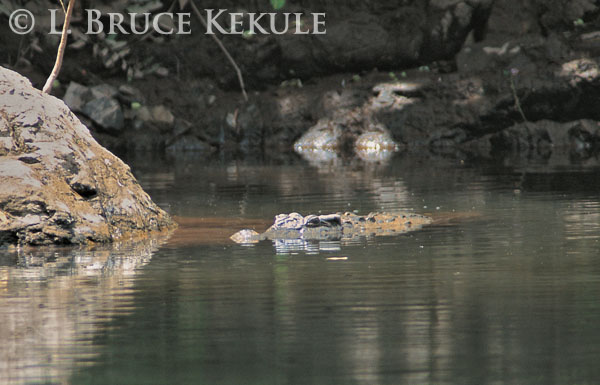
Siamese crocodile in the Phetchaburi River

Lone Siamese croc in the river
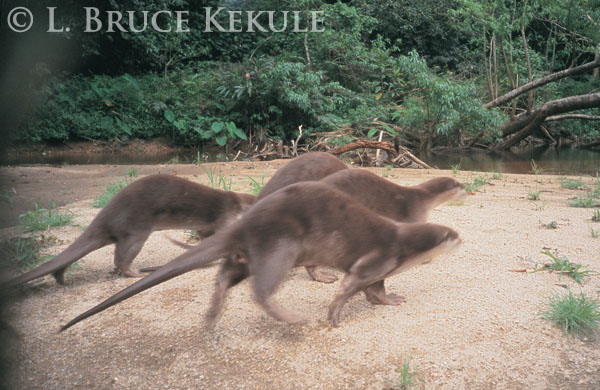
Smooth-coated otters camera-trapped by the Phetcahburi River
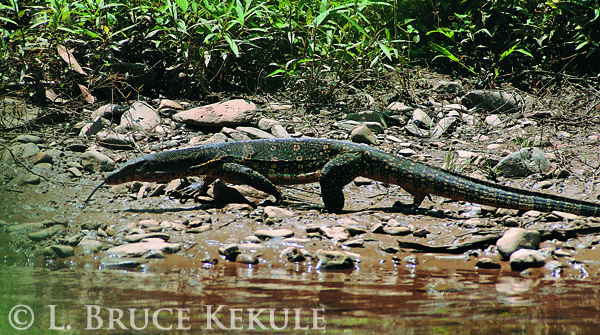
Water monitor hunting for prey by the Phetchaburi River

Smooth-coated otter hunting by the Phetchaburi River

Smooth-coated otter jumping into the Phetchaburi River
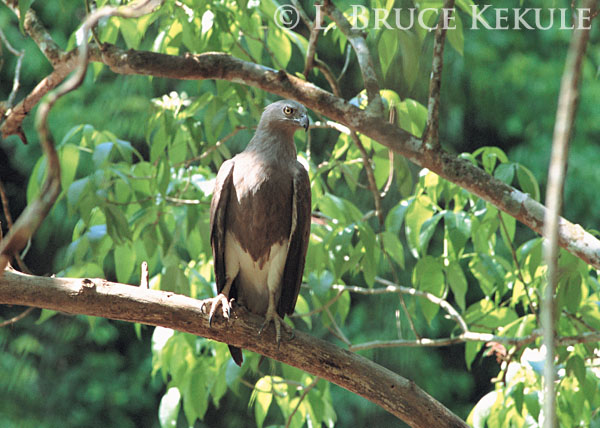
Lesser fish-eagle by the Phetchaburi River
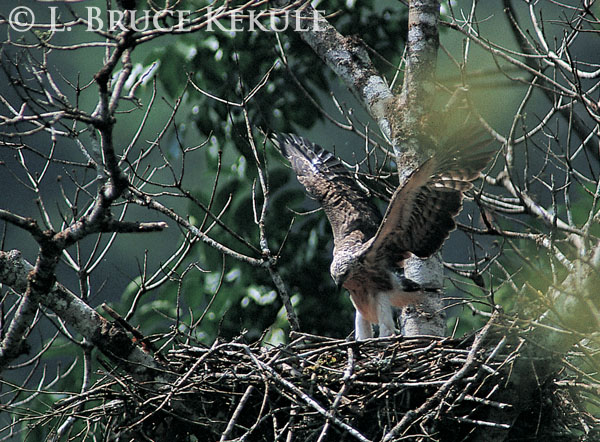
Lesser fish-eagle chick in a nest above the Phetcahburi River
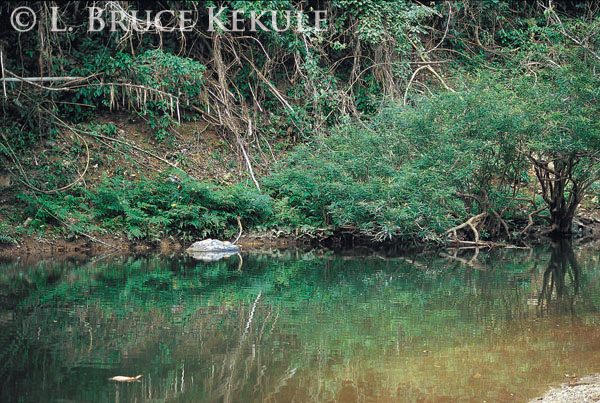
Crocodile pond in the Phetchaburi River